
Quick Summary
SEBI’s final order dated October 15, 2026 is against Capital Stroke Investment Services Pvt. Ltd. It found 10 violations, including assured returns promised to clients, false website claims, forged documents and repeat fees. SEBI cancelled the certificate and barred the company from the securities market for 5 years, with the period already served set off. The order carries no monetary penalty. It takes effect immediately.
Promised daily profits on a sales call?
SEBI’s October 15, 2026 order shows what it found when it looked at one adviser’s claims.
The Capital Stroke Investment Services SEBI order lists 10 violations, from assured returns and false testimonials to forged documents.
It ends in a cancelled certificate and a five-year market bar.
Here is every finding, figure, and date, and what investors can do.
SEBI Order Against Capital Stroke Investment Services
This table puts the order’s key details in one place. Use it before reading the findings.
Every entry comes straight from the final order.
| Detail | What The Order Says |
|---|---|
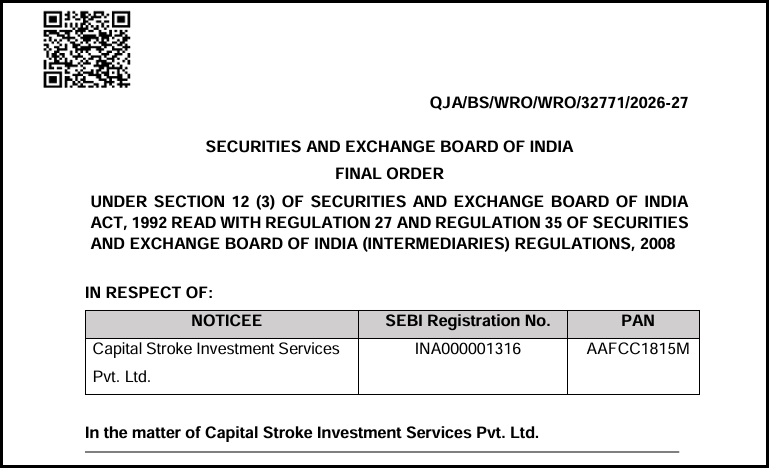
| Company | Capital Stroke Investment Services Pvt. Ltd. |
| Order date | October 15, 2026, Mumbai |
| Passed by | Biju S., Quasi Judicial Authority, SEBI |
| Order reference | QJA/BS/WRO/WRO/32771/2026-27 |
| Passed under | Section 12(3) of the SEBI Act, 1992 read with Regulations 27 and 35 of the Intermediaries Regulations, 2008 |
| Violations established | 10 |
| Charges not established | 4 |
| Directions | Certificate cancelled; 5-year market bar with set-off |
| Monetary penalty | None in the final directions |
| Effective | Immediately |
How The Capital Stroke Investment Services Case Unfolded: From Inspection To Final Order
The case ran for almost six years. It began with an inspection in November 2020 and ended with the final order in October 2026.
Here are the milestones in order, so the dates are easy to follow.
1. November 3 To 6, 2020: SEBI Inspects The Company
SEBI inspected the company at its registered office. The inspection covered April 1, 2019 to September 22, 2020.
Investor complaints received after September 22, 2020 and still pending were also examined.
2. August 27, 2021 And June 8, 2022: Interim And Confirmatory Orders
SEBI passed an interim ex-parte order on August 27, 2021. After the company’s reply dated October 15, 2021, a confirmatory order followed on June 8, 2022.
They alleged two main violations: promising assured profits and charging unfair and unreasonable fees.
3. April 16, 2024 To August 29, 2025: Pre-Enquiry Notice And Enquiry Report
The Designated Authority issued a pre-enquiry show cause notice on April 16, 2024. The company replied on May 17, 2024.
The Enquiry Report dated August 29, 2025 recommended cancelling the certificate.
4. January 5, 2026 To May 1, 2026: Show Cause Notice, Reply And Hearing
A post-enquiry show cause notice was issued on January 5, 2026. The company replied on February 23, 2026.
A personal hearing was held on April 24, 2026, and post-hearing submissions followed on April 24 and May 1, 2026.
5. October 15, 2026: Final Order
SEBI passed the final order after considering the notice, the Enquiry Report, the replies, and the record.
The proceedings were broader than the two allegations in the earlier orders.
The Capital Stroke Case: 10 Proven Violations vs. 4 Dismissed Charges
SEBI did not accept every allegation.
It found 10 violations established and held four charges not proved.
The two lists below show both sides:
1. Violations SEBI Found Established
- Assured returns promised and false website claims about the research team and performance.
- Failure to act in a fiduciary capacity towards clients.
- Employees and representatives not qualified and certified.
- Forged documents submitted to SEBI during the inspection.
- Repeat and arbitrary fees, including fees above those on its website.
- No proof of communication of advisory details to clients.
- Free trials offered to prospective clients.
- Involvement in the unregistered advisory activity of Green Wealth.
- Risk profile not disclosed to a client.
- Investor complaints not redressed on time.
2. Charges SEBI Held Not Established
- Vague or misleading risk-profiling questionnaire and weightage.
- Failure to obtain supporting documents and call recordings in risk profiling.
- Manipulation of a client’s risk category.
- Failure to maintain records of risk profiling, suitability and sales of advisory services.
Capital Stroke Investment Services Assured Returns: Recorded Calls, SCORES Complaints And A ₹36,000 Refund
SEBI found that the company promised assured returns to clients despite knowing that all investments in the securities market are subject to market risk.
The proof came from client complaints, call recordings and SCORES complaints, not from the website.
1. What Clients Complained About
The inspection report covered the company’s dealings with 14 clients. Four complaints were quoted in the order.
One client said a weekly profit of ₹60,000 to ₹70,000 was offered. Another said 100% profit was offered.
Another said ₹35,000 in a week was offered, and another said profit of 3 times and more was offered.
2. What The Recorded Call Said
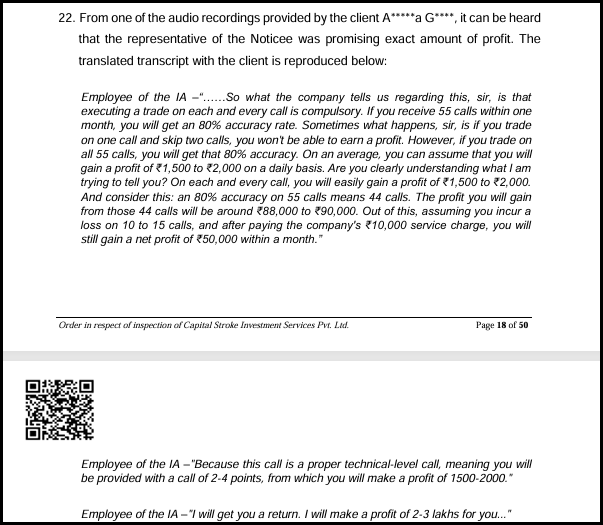
In a recording quoted in the order, an employee spoke of 80% accuracy across 55 calls. He said a client could assume a profit of ₹1,500 to ₹2,000 daily.
He said 44 successful calls would bring around ₹88,000 to ₹90,000, and a net profit of ₹50,000 a month after a ₹10,000 service charge. He added, “I will make a profit of 2-3 lakhs for you.”
3. Why The Recording Alone Was Not The Test
The Designated Authority gave the company the benefit of the doubt on one recording, after the company argued it was a male voice.
The company did not seek cross-examination of any complainant before SEBI.
SEBI said the allegation was also proved by other complaints on SEBI’s own SCORES platform.
4. The ₹36,000 Settlement On SCORES
One of those complaints was closed only after the company settled with the client by paying a refund of ₹36,000.
SEBI said that refund was inconsistent with the company’s denial. If you are weighing a similar promise, read how to report assured return claims by a stock advisor.
5. Where SEBI Gave The Company The Benefit Of Doubt
SEBI said the website lines such as “Investor can get huge profit by holding the stocks” denote possibility, not assurance.
The company’s invoices and welcome mail also carried a market risk disclaimer.
SEBI added that this reasoning does not extend to the specific promises made directly to clients, which it found violated Regulations 3(a), (b), (c) and (d), 4(1) and 4(2)(k), (o) and (s) of the PFUTP Regulations.
Capital Stroke Investment Services Website Claims: Research Team And Testimonials SEBI Found False
The company’s homepage described its research team as MBAs (Finance), CFA charter holders, and Engineers. SEBI tested that claim against the company’s own staff records.
It also tested the client testimonials. Both claims failed.
1. The Research Team Claim
The website said the team comprised MBAs (Finance), CFA, and Engineers. The company’s records showed 4 research employees.
Their qualifications were B.Com, BBA, MBA (Finance), and one not provided. None were CFA, and the only MBA was a director.
2. The Testimonials
Three client testimonials from different cities were displayed on the website. The directors admitted, in a joint submission dated November 10, 2020, that no records existed for those clients and that the testimonials were false.
SEBI held that this amounted to knowingly misrepresenting the truth.
3. The 2012 Explanation
The company later said the testimonials were from clients served in 2012. SEBI called that an impossibility.
The company was incorporated only on March 14, 2013.
4. What SEBI Concluded
SEBI held that the conduct amounted to fraudulent inducement and mis-selling, and found the company in violation of the PFUTP Regulations read with Section 12A of the SEBI Act.
SEBI also said the company leveraged its status as a market participant to inflate its own income.
The Advisory Workforce Gap: 314 Staff Members, But Only 7 NISM Certifications
SEBI examined who was actually giving advice to clients. The numbers show a large gap.
The company’s defence rested on how many staff counted as advisers.
1. The Headcount
Out of 314 employees, only 7 held NISM certification. Three were in research, and four were sales executives.
The company served some 9,000 clients.
2. The Admission
The directors admitted in the November 10, 2020 joint submission that around 35 employees were providing advisory-related services.
That is roughly 11% of the workforce. SEBI called it far more plausible for a company of that size than a claim of only three advisers.
3. The Company’s Counter
The company said the requirement applied only to people who gave advice, that only three were engaged in advising, and that the admission was obtained under coercion.
SEBI called the coercion plea wholly uncorroborated and the retraction an afterthought.
4. SEBI’s Conclusion
Even on the company’s narrower view, 32 employees were engaged in advisory-related services without the required qualification and certification.
SEBI called this a gross disregard of the requirement and held that the rule applied to representatives even before the 2020 amendment.
Forged Documents Submitted To SEBI By Capital Stroke Investment Services: The Invoice Mismatch
SEBI held that the company submitted forged documents during the inspection. The key proof was a comparison of invoices.
Invoices from complainants did not match the invoices the company gave SEBI.
1. The Company’s Explanation
The company said the common creation date came from compressing bulky files for email, and that invoice numbers differed because its CRM platform generates internal references.
It also said no forensic audit of its servers had been done.
2. The Invoice Comparison
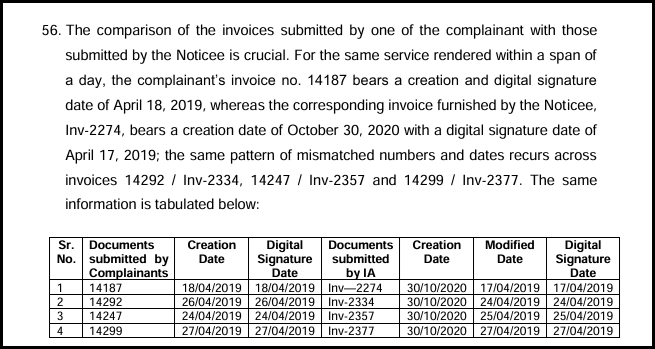
For the same services, the complainant’s invoice and the company’s invoice carried different numbers and dates.
The company’s copies all showed a creation date of October 30, 2020.
| Complainant Invoice | Creation And Signature Date | Company Invoice | Creation Date | Signature Date |
|---|---|---|---|---|
| 14187 | April 18, 2019 | Inv-2274 | October 30, 2020 | April 17, 2019 |
| 14292 | April 26, 2019 | Inv-2334 | October 30, 2020 | April 24, 2019 |
| 14247 | April 24, 2019 | Inv-2357 | October 30, 2020 | April 25, 2019 |
| 14299 | April 27, 2019 | Inv-2377 | October 30, 2020 | April 27, 2019 |
3. What SEBI Held
SEBI said the mismatch cannot be explained by file compression or CRM numbers. It also noted the directors’ admission in the November 10, 2020 joint submission.
SEBI held that the only inference was that the documents were fabricated before they were compressed and sent.
It said they were submitted to conceal deficiencies, including repeat fee charging.
Repeat And Overlapping Advisory Fees At Capital Stroke Investment Services: Three Client Examples
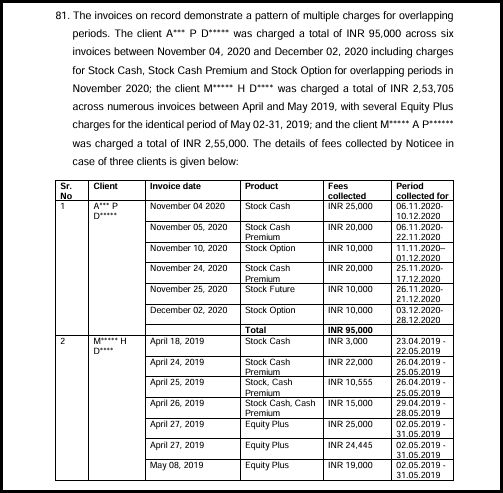
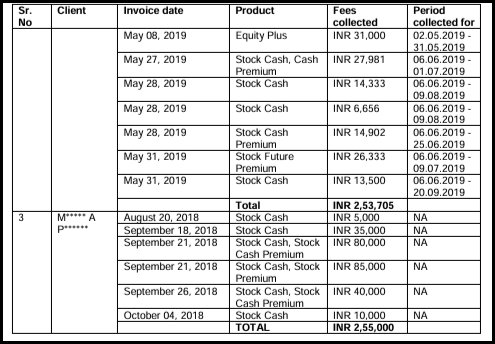
SEBI found that the company charged clients more than once for the same advisory services. It examined invoices for three clients.
The finding rests on repeat charging, not on how large each fee was.
1. The Three Client Examples
The order uses masked client names. This blog uses initials only.
| Client | Total Charged | Invoices And Period |
|---|---|---|
| A.P.D. | ₹95,000 | Six invoices between November 4 and December 2, 2020, with overlapping Stock Cash, Stock Cash Premium and Stock Option charges |
| M.H.D. | ₹2,53,705 | Numerous invoices between April and May 2019, with several Equity Plus charges for the same May 2 to 31, 2019 period |
| M.A.P. | ₹2,55,000 | Six invoices between August 20 and October 4, 2018 |
2. The “Instalments” Defence
The company said the payments were instalments and clients voluntarily renewed and upgraded.
SEBI said the invoices show distinct services billed for overlapping periods, not scheduled instalments.
3. The Monthly Fee Comparison
The Designated Authority found the company collected more than ₹2 lakh in a month. On an annualised basis that is about ₹24 lakh, which it compared with the Star World Research matter.
SEBI said the quantum is not the issue, because the finding rests on charging more than once for services already paid for.
4. The Refund Point
SEBI said that processing refunds against complaints of unreasonable fees itself points to excess collection.
It also said that having no fee ceiling does not allow arbitrary and overlapping fees.
Is Capital Stroke Investment Services SEBI Registered Or Not?
The order answers this directly, and the answer has changed.
The company held a SEBI registration. SEBI cancelled it in this order.
1. The Registration Details
The company was registered with SEBI as an Investment Adviser under registration number INA000001316.
It was incorporated on March 14, 2013, and registered as an investment adviser on March 21, 2014.
2. The Current Position
Through this order, SEBI cancelled the certificate of registration under Section 12(3) of the SEBI Act, Regulation 27 of the Intermediaries Regulations and Regulation 28 of the IA Regulations read with Section 19 of the SEBI Act.
The order came into force with immediate effect on October 15, 2026.
3. Who Was Told
A copy of the order was directed to the company, BSE Limited (the Investment Advisers Administration and Supervisory Body), the recognised stock exchanges and the registered depositories.
4. How To Check An Adviser
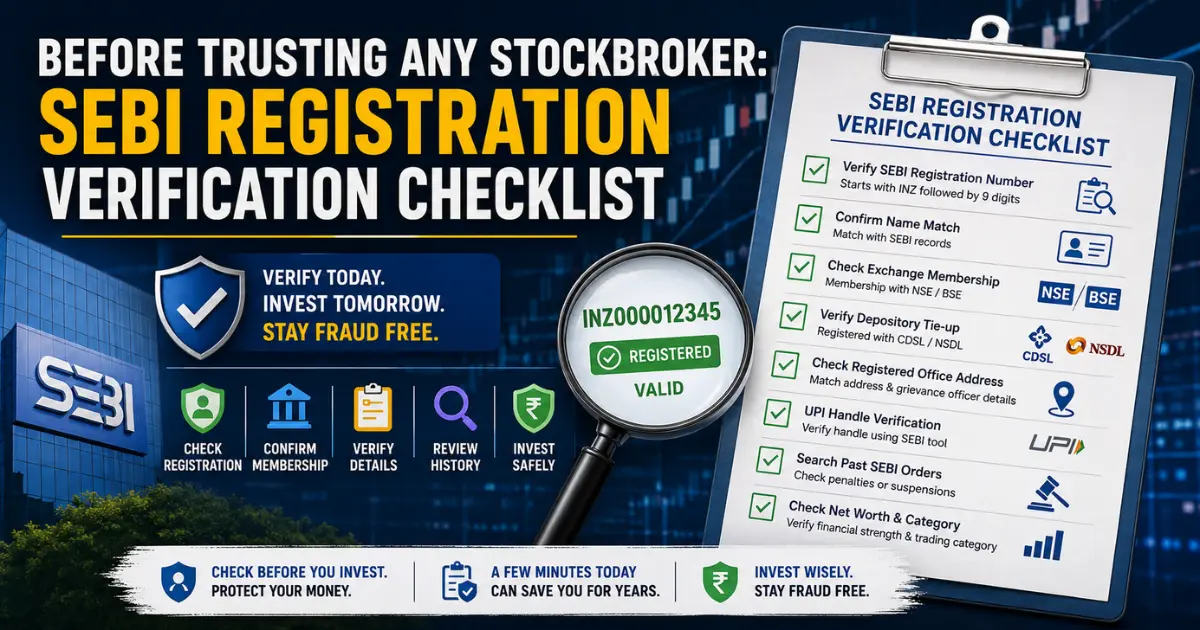
Check an adviser’s registration on SEBI’s website before paying any fee. Also check whether the adviser’s number matches the name on the website.
Capital Stroke and Green Wealth: SEBI Uncovers Unregistered Advisory Operations
SEBI called the company’s involvement in Green Wealth the most egregious violation it found.
Green Wealth was an unregistered advisory firm run by an employee. SEBI found the company complicit.
1. What SEBI Said About Green Wealth
An earlier SEBI order dated October 28, 2022 issued directions against the Green Wealth proprietor for unregistered advisory activity.
That order recorded that Green Wealth used the company’s registration number to appear registered.
SEBI’s Adjudication Order dated August 28, 2025 also concluded the company was complicit.
2. The Company’s Defence
The company said the person was a former employee who had left, that it received no money from Green Wealth, and that it had filed a complaint with the SEBI Local Office.
It also said a bank account belonged to one director, and the company and other directors could not be held liable for his private acts.
3. What The Designated Authority Found
It found no proof of any complaint to SEBI and no police complaint.
The proprietor’s spouse was employed by the company, and the proprietor continued to receive salary after the claimed departure.
It also found that Green Wealth used the company’s registration number.
4. The Money Trail
Two of the three directors received funds from Green Wealth.
One director received advisory fees of about ₹18 lakh in three bank accounts held in the name of his proprietorship concern, at ICICI Bank, HDFC Bank and Axis Bank.
Another director received advisory fees in his sister’s bank account.
5. Why The Company Was Held Responsible
SEBI said a company acts only through natural persons and the acts of its directing minds are treated as its own.
Two of the three directors receiving funds did not support a claim that the company was a stranger.
Green Wealth used the company’s registration number to look like a registered adviser.
A registration number on a website does not prove who is actually giving the advice, as this case of a research analyst who allegedly leased his registration number shows.
6. Why No Refund Was Directed Here
SEBI said the funds went to the directors’ accounts and a relative’s account. There is no material on record, in the DA or inspection report, that the money was transferred to the company.
So no direction for refund against the company arose in these proceedings.
Other Violations Established Against Capital Stroke Investment Services: Free Trials, Disclosures, Risk Profile And Complaints
Four more violations were established. Each is smaller in scale but shows weak compliance.
Here is what SEBI found on each:
1. Free Trials To Prospective Clients
A SEBI circular dated December 27, 2019 says advisers shall not provide free trials. The company said the free trial tab was removed in January 2020.
Website archives showed the FAQs in August 2020 still stated a free trial, and a free-trial form was live.
2. No Proof Of Disclosures To Clients
The company had to disclose material facts and key features, particularly the performance track record. Apart from a general welcome email, it produced no communication.
It claimed SMS disclosures but produced not a single SMS.
3. Risk Profile Not Communicated To A Client
Regulation 16(e) requires the risk profile to be communicated to the client after assessment. The only email on record was the client sharing his own form.
SEBI said the offer to provide the document on request does not satisfy the obligation.
4. Investor Complaints Not Redressed On Time
The company has to redress grievances within 21 calendar days. The notice identified 14 unique complaints not redressed in time.
The company said it served around 9,000 clients with 73 unique SCORES complaints and 3 pending. The Designated Authority absolved it, but SEBI disagreed and held the violation established.
SEBI said there is no proportionality test, and a complaint is resolved only on closure in SCORES.
What SEBI Did Not Find Against Capital Stroke Investment Services: Four Charges That Failed
A fair reading of the order needs the charges that did not succeed.
SEBI gave the company the benefit of the doubt on four.
Here is why each one failed:
1. Risk Questionnaire And Weightage
The questionnaire had 21 questions.
Maximum weightage of 2 went to two questions and 1.5 to four, with the rest at 1 and 0.5.
SEBI said this does not show disproportionate weight, and the questionnaire was not vague or misleading.
2. Supporting Documents And Call Recordings
SEBI said the regulation requires the risk profile record, not external supporting documents or call recordings on risk profiling.
No clear violation was established.
3. Manipulation Of A Client’s Risk Category
The record showed a client’s risk appetite, profile, and proposed investment changed.
But the client’s SCORES complaint was closed for want of response, and he had emailed the risk profile himself.
SEBI said the foundation for attributing the change to manipulation was wanting.
4. Record Maintenance
The charge rested only on a business process document.
SEBI said it describes the flow and cannot assess record-keeping, and the records appear to have been produced.
Capital Stroke Investment Services Defences: What The Company Argued And How SEBI Responded?
The company made 16 submissions. Several were procedural, and several went to the evidence.
Here are the main ones, with SEBI’s response.
1. Estoppel And Double Jeopardy
The company said the notice contained allegations not made in the earlier orders, and that closed SCORES complaints barred further action.
SEBI said the charges arise from the inspection findings and must be decided on the material in these proceedings.
2. Evidence Said To Be Forged Or Unauthenticated
The company said screenshots, emails and recordings lacked a Section 65B certificate.
SEBI said the Evidence Act’s rigours do not apply to quasi-judicial proceedings before it, citing Tata Consultancy Services Limited v. Cyrus Investments Pvt. Ltd.
3. The ₹10 Lakh Penalty
The company said it paid a penalty of ₹10 lakh as commercial prudence, not as an admission. The order records this submission and does not detail the earlier proceeding.
4. A Lesser Penalty Like Censure
The company relied on the Winway Research order, where a censure was imposed. SEBI said directions depend on the facts of each case.
The gravity and multiplicity of violations made no lesser measure adequate.
5. Hardship Already Faced
The company said it had remained out of business for about four and a half years and had paid a registration fee of ₹5,00,000 by demand draft, encashed on February 2, 2019.
SEBI took the period already served into account through the set-off.
Capital Stroke Investment Services SEBI Order Directions: Certificate Cancelled And A 5-Year Market Bar
SEBI agreed with the Designated Authority’s recommendation on cancellation.
It also added a market bar under Regulation 35(b).
The directions are two.
1. Certificate Of Registration Cancelled
SEBI cancelled the certificate of registration of the company, registration number INA000001316.
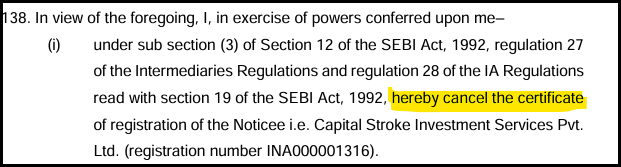
It said the gravity and multiplicity of the violations made the company unfit to hold a certificate.
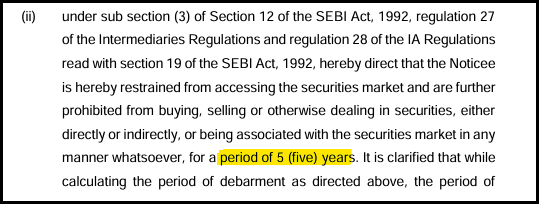
2. Five-Year Restraint From The Securities Market
The company is restrained from accessing the securities market for 5 years. It cannot buy, sell, or deal in securities, directly or indirectly, or be associated with the securities market in any manner.
3. Set-Off For Time Already Served
The period of restraint already undergone under the interim order of August 27, 2021, confirmed on June 8, 2022, is set off from the five years.
SEBI noted this was done in the interest of proportionality.
4. No Fine And No Refund Direction
The final directions do not impose a monetary penalty. They also do not include a refund direction.
If you were a client, read how to complain against a stock advisory.
Paid An Adviser Who Promised Profits? What Investors Can Do After The Capital Stroke Order
This section is general guidance for investors. The order does not set out these steps.
They apply to any adviser who promises profits or charges repeat fees.
1. Check Whether The Adviser Is Registered
Check the adviser’s name and number on SEBI’s website before paying.
Advice from firms without registration raises its own risks, as explained in unregistered advisory firms in India.
2. Keep Your Records
Keep invoices, emails, call recordings, SMS, and payment proof. The Capital Stroke order shows how invoices and recordings were used as evidence.
3. Mail Your Complaint To SEBI
Send SEBI an email with your invoices, call recordings, chats, and payment proof. State what the company promised, what you paid, and the dates.
Not sure how to word it?
Read how to file a complaint in SEBI before you send yours.
If you paid because of false promises, also consider a police complaint.
4. Challenge Repeat Billing Early
Compare each invoice’s service and period.
Overlapping periods are a flag.
Conclusion
SEBI found 10 violations by Capital Stroke Investment Services, from assured returns on calls to forged documents and repeat fees.
It cancelled the certificate and barred the company for five years, with the earlier restraint set off.
SEBI also rejected four charges, which shows how closely it weighed the evidence.
The order carries no fine and no refund direction.
Report. Recover. Stay Fraud Free.
SEBI cancelled the certificate of registration and restrained the company from the securities market for 5 years, with the period already served set off. The final order is dated October 15, 2026 and came into force immediately. SEBI found 10 violations established and held 4 charges not established. No. The final directions are the cancellation and the five-year restraint. The order does not impose a monetary penalty. The directions do not include a refund. SEBI said no refund direction arose on the Green Wealth funds because no material showed they reached the company. An unregistered advisory firm run by an employee. SEBI found the company complicit in its activity. SEBI found that specific representations made directly to clients, supported by recordings and SCORES complaints, constituted assurance of profit. No. SEBI cancelled the certificate with immediate effect on October 15, 2026. Five years, with the period already undergone since the interim order of August 27, 2021 set off. Email SEBI with your invoices, recordings and payment proof, and consider a police complaint if you paid on false promises.Frequently Asked Questions

 Add us as a preferred source on Google »