
Quick Summary
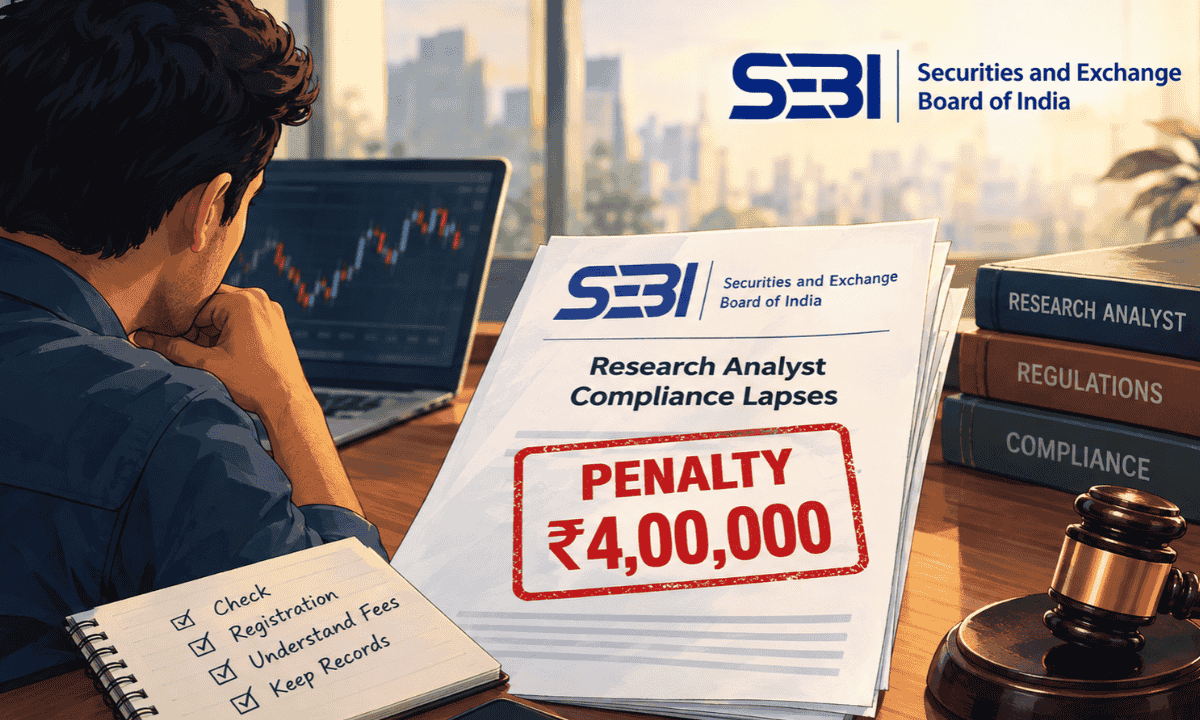
SEBI has imposed a total penalty of ₹4 lakh on research analyst Vineet Ashwinikumar Chawla for eight compliance lapses identified during an inspection covering April 1, 2024, to November 30, 2025. The violations included missing client PAN details, cash deposits of fees, and a Coal India trade during a restricted period. In an order dated October 9, 2026, Adjudicating Officer Medha Sonparote upheld all eight lapses. The penalty must be paid within 45 days.
If you have ever paid a stock tips provider for calls, this case is worth five minutes of your time. It shows what can go wrong behind the scenes even when nobody is accused of cheating.
SEBI inspected Vineet Ashwinikumar Chawla’s research business on January 29, 2026. The review looked back over 20 months of activity, from April 2024 to November 2025.
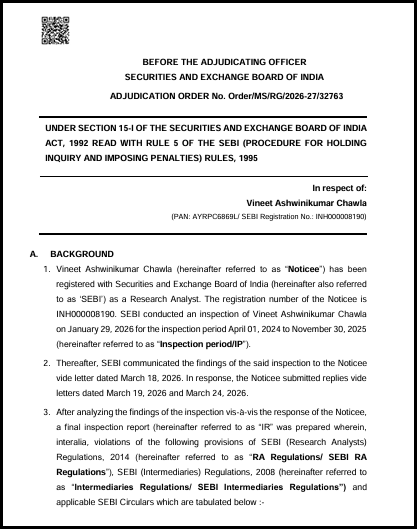
The findings went out to Chawla on March 18, 2026. A show cause notice followed on August 10, 2026, listing eight separate lapses.
Chawla replied in writing, appeared for an in-person hearing on September 8, 2026, and filed final submissions two days later. The order came on October 9, 2026.
What Were the 8 SEBI Compliance Lapses?
Here are all the charges SEBI raised, the rule behind it, and what the adjudicating officer decided.
All eight lapses were upheld.
|
# |
Lapse | Rule cited | Finding |
| 1 | Incomplete fee records and cash fee deposits | Clause 1.9 and Annexure B Clause 12(iv), RA Master Circular, with Regulation 15A |
Upheld |
|
2 |
Trading in a stock followed inside the restricted window | Regulation 16, RA Regulations | Upheld |
| 3 | Missing disclosures in research reports | Regulation 19, RA Regulations |
Upheld |
|
4 |
Unsigned rationales and missing client PANs | Regulation 25, RA Regulations | Upheld |
| 5 | No grievance register | Clause 1.13, RA Master Circular, Regulation 25(1), and Regulation 13(2), Intermediaries Regulations |
Upheld |
|
6 |
No KRA/CKYC registration and no MITC | Clauses 1.13 and 1.12(c), RA Master Circular, with Regulations 25(1) and 24(6) | Upheld |
| 7 | No FIU enrolment or Principal Officer | Clause 14.6, RA Master Circular, with Regulation 24(2) and Code of Conduct Clause 7 |
Upheld |
|
8 |
Ads without BSE approval, no ad records | Regulations 24(2) and 25(2), with Clause 11, RA Master Circular |
Upheld |
The RA Master Circular referred to here is SEBI’s circular dated June 27, 2025, which consolidates the rules for research analysts.
Why Did SEBI Flag 6,782 Missing Client PANs?
The biggest problem was paperwork. Out of 7,909 client entries shared with inspectors, PAN details were missing for 6,782 entries. Some PANs were wrong, and some client names were blank.
Without PANs, SEBI could not check whether any client had been charged more than the fee ceiling. That ceiling is ₹1,51,000 a year per family for individual and HUF clients.
Chawla argued the 7,909 figure counted payments, not unique clients, since some people paid more than once.
The order noted that 7,891 of those entries belonged to FY 2024-25, and only 18 were dated after March 31, 2025.
19 Clients Paid More Than ₹1.5 Lakh in Annual Fees
Where PANs were available, the order found 19 clients who paid over ₹1,50,000 each in FY 2024-25, excluding GST.
The single highest total was ₹8,27,119.
The order lists all 19 by PAN. We are not reproducing those to protect the clients, but the five largest annual totals tell the story on their own.
| Client (anonymised) | Total paid in FY 2024-25, excluding GST | Times the ₹1.51 lakh cap |
|---|---|---|
| Client A | ₹8,27,119 | About 5.5x |
| Client B | ₹6,29,359 | About 4.2x |
| Client C | ₹5,88,387 | About 3.9x |
| Client D | ₹5,05,332 | About 3.3x |
| Client E | ₹4,84,721 | About 3.2x |
One caution here. The cap applies per family, and the order did not record a separate finding of excess fees for each of these clients.
What it did find is that, without PANs for most entries, SEBI simply could not verify whether the cap was respected.
That failure itself was held to break Clause 1.9.
Why Were Cash Fee Deposits a Compliance Violation?
SEBI also found fees received in cash. Chawla said there were eight cash deposits from three clients, made directly into his bank account by clients without online banking.
The officer accepted that this may differ from collecting cash by hand.
Still, SEBI’s rules say cash payment of research fees is not allowed, so the mode of payment itself was the violation.
Why Did a 100 Share Coal India Trade at a Loss Still Count?
Research analysts cannot trade a stock they recommend or follow from 30 days before to 5 days after publishing a report. Inspectors found Chawla traded inside that window.
His defence was simple. It was one trade of 100 Coal India shares, bought at ₹537.65 and sold at ₹491.50, so he actually lost money.
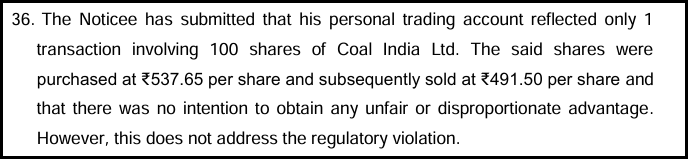
The officer was not moved. The rule is about timing and the stock involved, not the size of the trade, the profit or loss, or any intent to move the market.
Why should you care?
This rule exists so the person giving you a call is not quietly positioned on the same stock. A small trade still breaks the trust the rule protects.
Why Did SEBI Flag Missing Research Report Disclosures?
Research reports must tell you about the analyst’s disciplinary history, associates, ownership in the stock, and any conflicts of interest.
The order found none of these mandated disclosures in Chawla’s reports.
Chawla called it an inadvertent oversight and said he held no interest in the companies covered.
The officer held that the duty exists so investors can judge the analyst before acting, and upheld the violation.
Why Were Unsigned Trade Rationales a Problem?
The rationales behind his recommendations were prepared but not signed.
Chawla pointed out the rule does not expressly demand a signature on rationales.
The officer agreed the text is silent, yet said a proper record must show who arrived at a rationale and when.
Combined with the missing PAN records, this was held a breach of Regulation 25.
Why Did SEBI Flag the Missing Client Grievance Register?
There was also no register of client grievances. Chawla said complaints came by email and phone, and SCORES or ODR cases sat on those portals.
The officer noted that shutting down a website or email ID does not excuse losing complaint records that must be kept for five years.
What Were the KYC, MITC, FIU and Advertising Lapses?
Four more lapses related to how clients were signed up and how the business was promoted.
- No KRA or CKYC registration. Analysts must upload and check client KYC with a KYC Registration Agency. Chawla had not registered with a KRA or the Central KYC Registry.
- No MITC shared. The Most Important Terms and Conditions were not added to agreements or sent to clients onboarded before February 17, 2025, though existing clients had to get them by June 30, 2025.
- No FIU enrolment. Chawla had not registered with the Financial Intelligence Unit or a Principal Officer. He started the process only after inspectors raised it.
- Ads without approval. Advertisements went out without prior BSE approval, and copies were not kept for the required five years.
Chawla argued his direct client business shut in March 2025, before some of these rules bit.
The officer pointed to the 18 fee entries dated after March 31, 2025, and said winding down did not by itself prove an exemption.
Why Did the Google Drive Explanation Not Work?
Chawla’s main explanation ran through most of his replies. He said he moved from direct clients to aggregator platforms, naming Stockgro, Stockants and Opigo, around March 2025.
According to him, FY 2024-25 client records sat on a Google Drive linked to his old website and email. Once that website was shut down, the data could not be retrieved.
He also cited a 2024 SCORES complaint where he had uploaded a client’s KYC and PAN as proof that such details were being collected at the time.
The officer’s answer was consistent across every head. Records must be kept for five years, and losing access after a business change does not remove the duty to preserve and produce them.
Chawla also stressed there was no finding of manipulation and no quantified investor loss.
The order agreed on the second point and treated his post-inspection fixes as mitigating factors.
How Does the ₹4 Lakh SEBI Penalty Break Down?
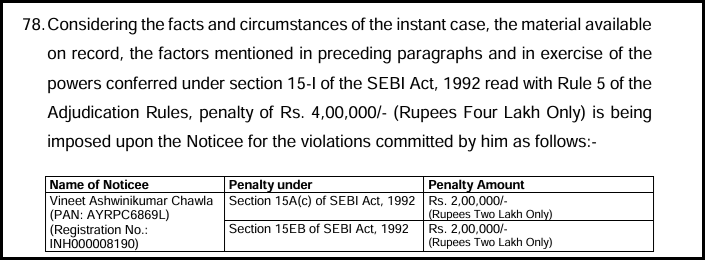
Both sections used here carry a minimum of ₹1 lakh and a ceiling of ₹1 crore.
The officer landed at ₹2 lakh under each.
| Provision | What it covers | Penalty |
|---|---|---|
| Section 15A(c), SEBI Act | Failure to maintain books and records | ₹2,00,000 |
| Section 15EB, SEBI Act | Research analyst failing to follow SEBI rules | ₹2,00,000 |
| Total | ₹4,00,000 |
The order found no quantified gain, no quantified investor loss, and no sign of repeat defaults.
Fixes made after the inspection were also counted in Chawla’s favour.
The amount must be paid through SEBI’s website within 45 days.
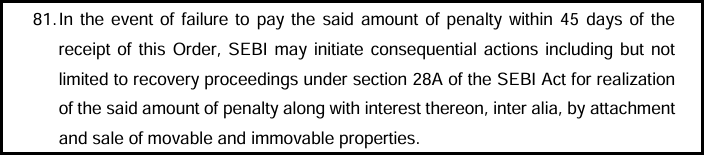
If not, SEBI may start recovery, including attachment and sale of property, with interest.
Paid an Advisory and Something Feels Off?
Our team helps retail traders document the issue and take it to the right forum.
Register with us and tell us what happened.
What Did SEBI’s Order Not Say About Chawla?
It helps to be precise about the limits of this case. The order is about compliance failures, not about cheating investors.
The officer recorded that the material on record did not show any disproportionate gain made by Chawla.
It also did not show a loss caused to any investor or group of investors.
The order did not describe the violations as repetitive. Chawla also pointed out that the show cause notice did not name any specific unresolved investor complaint.
That is why the penalty stayed at ₹4 lakh against a possible ceiling of ₹1 crore under each section.
What Happens After SEBI Imposes a Penalty?
Chawla has 45 days from receiving the order to pay. SEBI’s website has a direct payment route under Enforcement, then Orders, then Orders of AO.
If the penalty is not paid, SEBI may move under Section 28A of the SEBI Act. That allows recovery with interest, including attachment and sale of movable and immovable property.
As with any SEBI adjudication order, the noticee also has the statutory option of appealing to the Securities Appellate Tribunal. The order itself does not discuss an appeal.
For clients, the order does not direct any refunds.
If you paid this or any provider above the cap or in a way that felt wrong, your remedy lies in a separate complaint.
Is Vineet Ashwinikumar Chawla SEBI Registered?
Yes. As per the order, Vineet Ashwinikumar Chawla is registered with SEBI as a Research Analyst under registration number INH000008190.
That is exactly why this case matters.
Registration is the starting point, not a guarantee that every rule is followed day to day.
You can confirm any analyst’s status on SEBI’s intermediary list before paying a rupee.
Do it every time, even for names you have seen on a trusted app.
5 Checks to Make Before Hiring a Stock Market Research Analyst
Every lapse in this order maps to something you can check yourself.
- Never pay fees in cash. SEBI rules allow cheque, bank transfer, UPI or BSE’s CeFCoM route. Cash is not allowed, even as a direct bank deposit.
- Watch the fee cap. For individuals and HUFs the limit is ₹1,51,000 a year per family, plus statutory charges. Anything higher is a red flag.
- Ask for the MITC. You should receive the Most Important Terms and Conditions in writing before you start.
- Read the disclosure section of every report. Missing details on conflicts, holdings or disciplinary history should make you pause.
- Keep your own trail. Save invoices, chats and payment proofs. If records go missing on the provider’s side, yours may be all you have.
How to File a Complaint Against Vineet Ashwinikumar Chawla?
Finding a problem with a research analyst does not always mean you know where to complain.
You may have payment proof, chats, or a service agreement, but the next step depends on the type of issue and whether it has already been raised with the analyst.
Investors have different channels for reporting grievances and resolving disputes. Here are three options to understand before deciding what to do next.
- SCORES SEBI Complaint: Use the SEBI SCORES portal to submit and track eligible grievances against registered intermediaries.
- Smart ODR Portal: Visit the SMART ODR Portal to explore online dispute resolution through conciliation or arbitration, where applicable.
- Share Market Arbitration: Consider arbitration through the applicable securities market mechanism if your dispute qualifies.
Keep payment receipts, bank statements, chats, agreements, and complaint records ready before filing.
Want to understand the complete process?
Read our guide on complaint against SEBI registered RA to learn about the available options and the steps involved.
Conclusion
SEBI’s order against Vineet Ashwinikumar Chawla highlights why proper records, clear fee terms, and required disclosures matter when dealing with a research analyst.
However, a compliance violation does not automatically mean an investor is entitled to a refund.
Before paying for stock market advice, check the analyst’s registration, understand the fees, and keep payment proofs and written communication.
If a dispute arises, explore the appropriate complaint or resolution channel. Knowing your options early can help you take the right next step if something goes wrong.
Report. Recover. Stay Fraud Free.
Frequently Asked Questions
A SEBI inspection found eight compliance lapses between April 2024 and November 2025. They included incomplete client records, cash fee deposits, a restricted-window trade, missing report disclosures and ads without BSE approval.
The total is ₹4 lakh. It is split as ₹2 lakh under Section 15A(c) and ₹2 lakh under Section 15EB of the SEBI Act.
No. The order states that the material on record did not show any quantified investor loss or any disproportionate gain made by Chawla.
No. Under SEBI's rules, fees must be paid by cheque, bank transfer, UPI or similar modes, or through BSE's CeFCoM. The order held that even a client's own cash deposit into the analyst's bank account breaks this rule.
For individual and HUF clients who are not accredited investors, the cap is ₹1,51,000 per year per family. Statutory charges such as GST sit outside this limit.
Under Regulation 16(2), an analyst cannot trade a stock they recommend or follow from 30 days before to 5 days after publishing a research report. Trade size and profit or loss do not matter.
Not according to this order. Records must be preserved for five years, and the officer held that losing access after closing a website does not remove that duty.

 Add us as a preferred source on Google »