
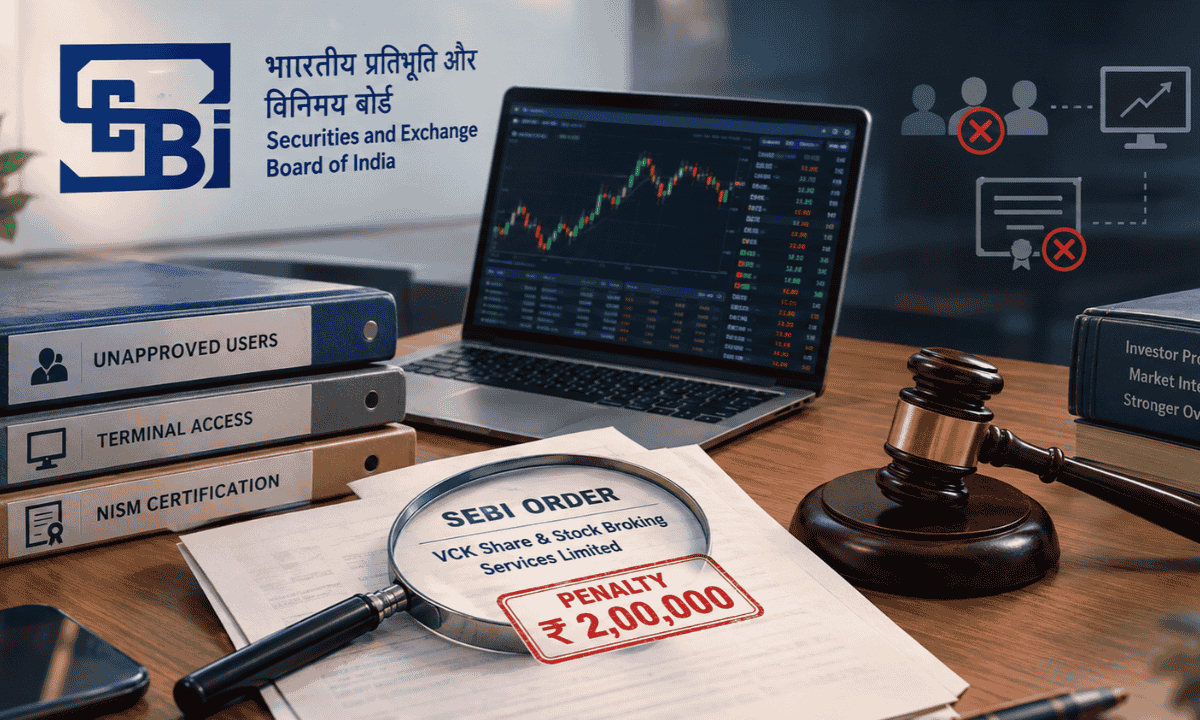
Quick Summary
SEBI’s Adjudicating Officer has imposed a ₹2,00,000 penalty on VCK Share & Stock Broking Services Limited under Section 15HB. The order dated October 8, 2026 says terminals of its Authorised Persons were run by people the exchange had not approved. It also says its APs lacked mandatory NISM Series VII certification. The broker admitted the terminal violations at the hearing.
Ever wondered who’s really executing your trades behind the scenes?
A recent SEBI order against VCK Share & Stock Broking revealed that unapproved individuals, including family members, were operating official trading terminals.
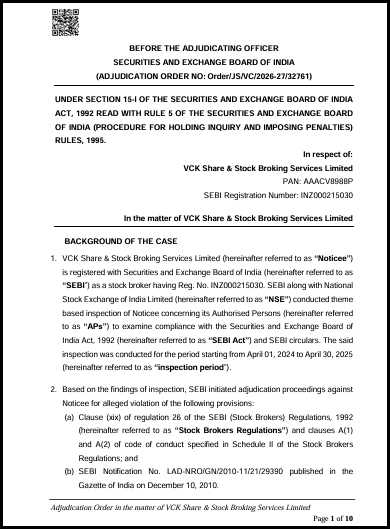
On top of that, key Authorised Persons were caught trading without mandatory NISM Series VII certifications.
Here is a breakdown of why SEBI slapped a ₹2 lakh penalty on the broker and what it means for investor safety.
VCK Share & Stock Broking Authorised Persons: Four CTCL Terminals Run By Unapproved Users
SEBI and NSE inspected the broker’s Authorised Persons (APs).
The focus was on Computer to Computer Link (CTCL) terminals, the systems used to place orders.
The table below sums up what inspectors found, using initials for the individuals.
| AP | Location | Approved User On Exchange Records | Who Was Operating The Terminal |
|---|---|---|---|
| M.K. | Kolkata | The AP | The AP’s spouse, a director of the broker |
| M.K.P. | Jamshedpur | The AP | The AP’s husband |
| P.K.M. | Kolkata | The AP’s spouse (M.M.) | The AP, by his own phone confirmation |
| A.K.S. | Kolkata | The AP | D.G., who was not an approved user |
SEBI Inspection Findings On VCK Share & Stock Broking’s Authorised Person Terminals
Each case had its own details. The order records them one by one.
Read them in sequence, because the details differ from case to case.
1. AP M.K., Kolkata: Terminal Run By A Director Of The Broker
The AP had one active CTCL terminal, allocated on January 5, 2024, enabled in the CM segment.
Inspectors saw it operated by the AP’s spouse, a director of the broker.
All AP activities were handled by him, though he was not an approved user.
2. AP M.K.P., Jamshedpur: Husband At The Keyboard On May 30, 2025
The terminal was enabled only in the CM segment at the AP’s registered address.
On the May 30, 2025 inspection visit, her husband was operating it. He was not an approved user.
3. AP P.K.M., Kolkata: Terminal Locked, Approved User Unaware Of Login
The approved user in the CM segment was the AP’s spouse. The AP was not at the address during the inspection.
He confirmed by phone that he operates the terminal himself.
The terminal was locked, and the approved user did not know the login credentials.
4. AP A.K.S., Kolkata: Another Person Operating, Approved User Absent
The terminal was enabled only in the CM segment. It was operated by D.G., who was not an approved user.
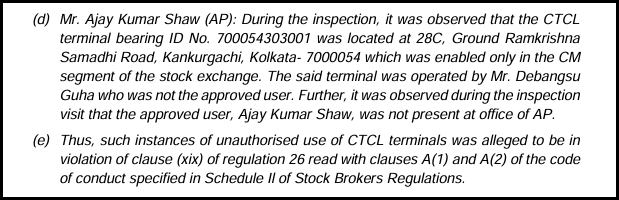
The approved user, the AP himself, was not present at the AP’s office during the visit.
VCK Share & Stock Broking Authorised Persons Without NISM Series VII Certification
The inspection also checked qualifications.
Five of the broker’s APs were found operating without the required certificate.
This was a separate charge, built on a SEBI notification from 2010.
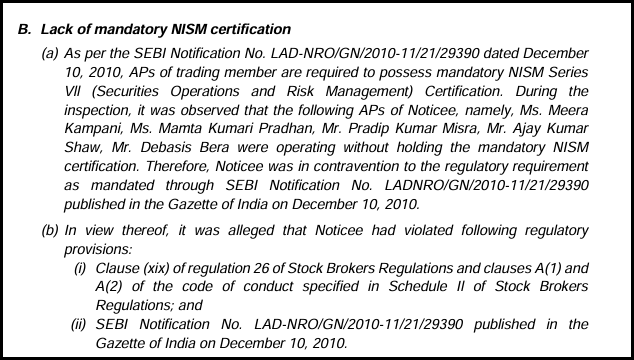
1. The Rule: Valid NISM Series VII Certification Within One Year
A SEBI notification dated December 10, 2010 covers persons associated with a stock broker.
They must hold NISM Series VII (Securities Operations and Risk Management) certification.
Brokers who employ such persons must ensure they obtain valid certification within one year of employment.
2. The Five APs Named In The Order
The order names five APs as lacking the certificate: M.K., M.K.P., P.K.M., A.K.S. and D.B.
Four of them are the same APs whose terminals were found to be operated by others.
Rules SEBI Says VCK Share & Stock Broking Violated
The show cause notice invoked three provisions. The order quotes each one.
They are short, so here they are in plain words.
1. Regulation 26(xix) Of The Stock Brokers Regulations, 1992
This makes a broker liable to a penalty for extending use of a trading terminal to any unauthorised person or place.
2. Schedule II Code Of Conduct, Clauses A(1) And A(2)
Clause A(1) requires high standards of integrity, promptitude and fairness.
Clause A(2) requires due skill, care and diligence in all business.
3. SEBI Notification of December 10, 2010
This is the NISM Series VII requirement discussed above. It applies to persons associated with a stock broker.
SEBI Adjudication Against VCK Share & Stock Broking: Timeline From Inspection To Order
The case ran from a theme-based inspection to a final order in a little under two years of regulatory activity.
The key steps are listed in order:
1. Theme-Based Inspection By SEBI And NSE
SEBI and NSE inspected the broker’s Authorised Persons for compliance with the SEBI Act and circulars.
The period covered was April 1, 2024 to April 30, 2025.
2. Show Cause Notice on February 17, 2026
SEBI issued the notice under reference SEBI/HO/EAD3/SM/KS/DIS/5994-5995/2026.
It asked why an inquiry should not be held and why a penalty should not be imposed under Section 15HB.
3. New Adjudicating Officer on July 7, 2026
The matter was re-allocated. The present Adjudicating Officer was appointed by order dated July 7, 2026.
4. Hearing Notice and Personal Hearing on September 2, 2026
A hearing notice dated August 12, 2026 gave the broker a hearing on September 2, 2026. The broker had filed no written reply to the notice.
5. Final Order on October 8, 2026
The order was passed at Mumbai on October 8, 2026, after the broker’s repeated chances to reply.
VCK Share & Stock Broking’s Reply To SEBI
The broker never filed a written reply. Its position comes from the hearing and one email.
The order records what was said and what was not delivered.
1. At the Hearing on September 2, 2026
The broker’s authorised representative, its director Mr. Hemal Kampani, appeared by video conferencing.
He admitted the violations in the operation of trading terminals by unapproved users.
2. On NISM Certificates
He said the APs had since obtained certification, except one. He promised a written reply within a week and was asked to submit copies of the certificates.
3. The Follow-Up on September 11, 2026
No reply came, so SEBI emailed on September 11, 2026, asking for a response by September 14, 2026.
The broker replied the same day that it was still obtaining certificates and asked for more time. No written reply to the notice was received.
Why SEBI Held The Broker Responsible: Findings On Both Charges
The Adjudicating Officer examined two issues. On both, the broker was held to have violated the rules.
The reasoning is worth reading closely, since it shows what SEBI expects of brokers.
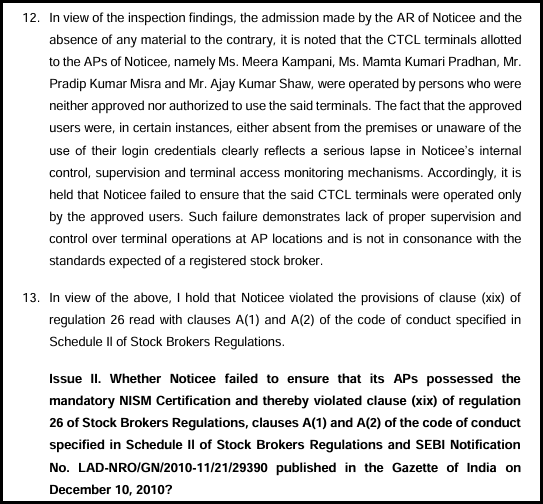
1. Terminal Use: A Serious Lapse In Supervision
The order cites the inspection findings, the admission, and no contrary material.
It says the terminals were operated by people neither approved nor authorised.
Approved users were absent or unaware of the logins.
The order calls this a serious lapse in internal control, supervision and terminal access monitoring.
2. NISM Certificates: Later Compliance Does Not Cure The Default
The broker’s claim that certificates were later obtained was not accepted, since it submitted no supporting documents.
The order adds that obtaining them later does not cure or absolve the non-compliance during the inspection period.
3. The Broker’s Obligation
The broker was under a clear duty to ensure its APs met the qualification requirements before engaging in market activity.
SEBI called the failure a lack of due diligence and regulatory oversight.
How SEBI Calculated the ₹2 Lakh Penalty on VCK Share & Stock Broking?
Section 15HB sets a penalty from ₹1 lakh up to ₹1 crore where no separate penalty exists.
The order then weighs three Section 15J factors.
Here is how each factor played out:
1. No Intent Needed
The order relies on the Supreme Court’s decision in SEBI v. Shriram Mutual Fund.
Penalty applies once the contravention is established, regardless of the intention.
2. No Quantifiable Gain And No Loss Shown
The record does not show any quantifiable gain or unfair advantage to the broker.
It also does not show the extent of any investor loss.
3. Repetitive Nature Of The Default
The order lists two earlier cases against the broker, covered in the next section.
4. Why SEBI Still Penalised
The order says the lapses can affect the integrity of the trading access framework.
They also dilute supervisory oversight and fall short of the goal of minimum professional competence.]
Previous SEBI Orders Against VCK Share & Stock Broking: 2011 Warning And 2019 Penalty
The order includes a table of previous defaults. It was used to assess whether the lapses were repetitive.
Two earlier orders are listed:
| Order Date | Provisions Violated | Outcome |
|---|---|---|
| July 18, 2011 | SEBI Circulars | Regulatory warning |
| October 25, 2019 | SEBI Circulars and the Securities Contracts (Regulation) Act, 1956 | ₹2,00,000 |
Our list of SEBI action against brokers shows how common such orders are.
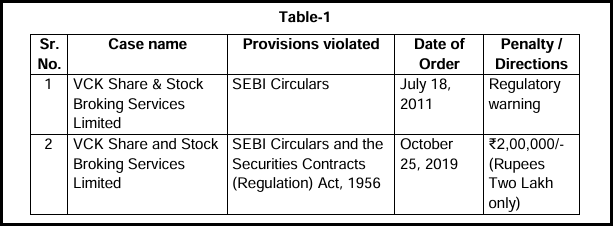
The current penalty is also ₹2,00,000.
The Final Directions: Pay Within 45 Days Or Face Recovery
The order gives the broker a fixed period to pay and states what follows if it does not.
The directions are clear and time-bound.
1. The Penalty Amount
SEBI imposed a monetary penalty of ₹2,00,000 (Rupees Two Lakh only) under Section 15HB of the SEBI Act.
The Adjudicating Officer called it commensurate with the violation.
2. How To Pay And By When
The broker must pay within 45 days of receiving the order.
Payment is online on SEBI’s website, through ENFORCEMENT, then ORDERS, then ORDERS OF AO, then PAY NOW.
3. If The Broker Does Not Pay
Recovery proceedings may begin under Section 28A of the SEBI Act.
They can include interest and attachment and sale of movable and immovable property.
Is VCK Share & Stock Broking Services Limited SEBI Registered Or Not?
Yes. The order says the company is registered with SEBI as a stock broker under Reg. No. INZ000215030.
The penalty therefore applies to a registered intermediary. It does not mean the registration was cancelled or suspended, and the order makes no such direction.
You can confirm any broker’s status in SEBI’s intermediary records before trading.
A list of SEBI registered brokers is a good place to begin.
What Investors Trading Through Authorised Persons Should Learn From The VCK Share & Stock Broking Penalty
Many investors place orders through an Authorised Person of a broker. This order shows why the person behind the terminal matters.
These points are general guidance.
The order does not set them out.
1. Know Who Is Placing Your Orders
If you trade through an AP, ask who operates the terminal. Orders should come only from approved users.
2. Check Contract Notes And Statements
Match every trade against your contract notes.
Raise any trade you did not place on SEBI SCORES portal, which covers registered intermediaries such as this broker.
The order finds no unauthorised trading by the broker, and it does not say any investor was harmed.
3. Where To Complain If Something Goes Wrong
Start with the broker’s own grievance channel.
If it is not resolved, the next step is SMART ODR and then arbitration.
If you want to know the full process in detail, check our guide: how to file complaint against a stock broker.
Conclusion
SEBI fined VCK Share & Stock Broking Services Limited ₹2,00,000.
The reasons were unapproved people operating AP terminals and APs working without NISM Series VII certification.
The broker admitted the terminal violations, filed no written reply, and did not prove the certificates.
The order finds no quantifiable gain or investor loss.
Report. Recover. Stay Fraud Free.
SEBI imposed a penalty of ₹2,00,000 under Section 15HB of the SEBI Act. The Adjudicating Officer passed the order at Mumbai on October 8, 2026. Trading terminals of its APs were operated by people not approved by the exchange. Its APs also lacked mandatory NISM Series VII certification. Its authorised representative admitted the terminal violations at the September 2, 2026 hearing. It filed no written reply. No. The order says the record does not show the extent of any investor loss. Yes. The order records it as a registered stock broker under Reg. No. INZ000215030. Recovery proceedings can begin under Section 28A, including attachment and sale of property.Frequently Asked Questions


 Add us as a preferred source on Google »