
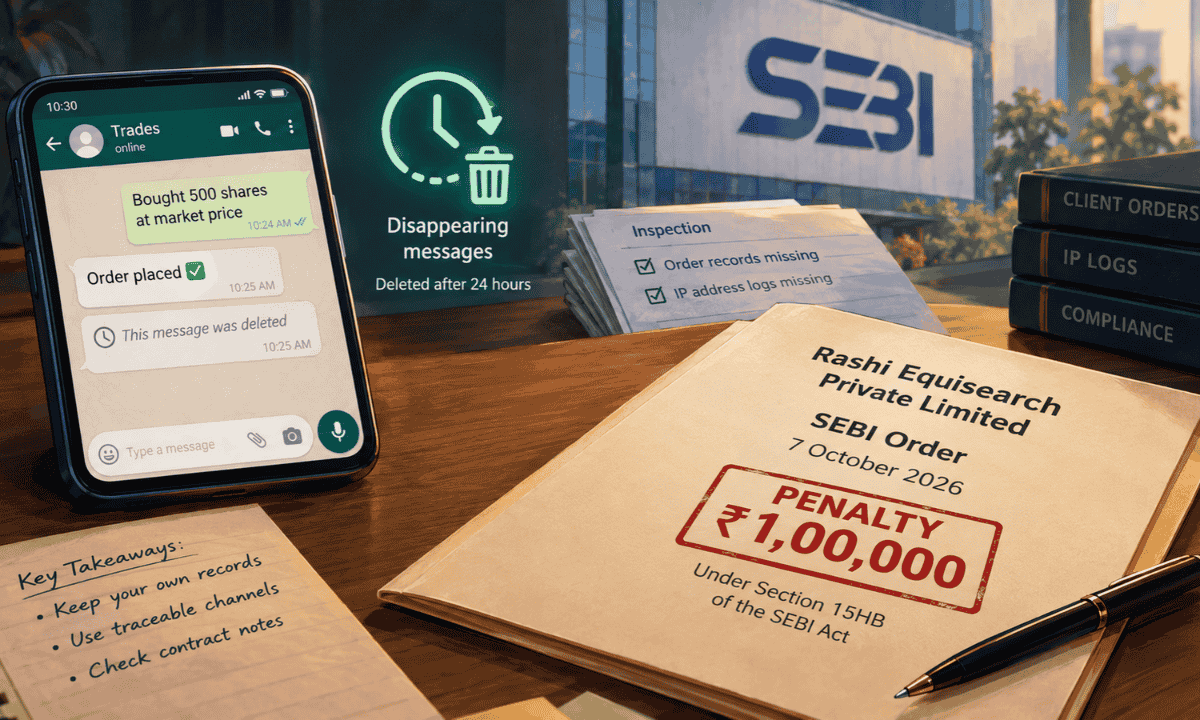
Quick Summary
SEBI has fined stock broker Rashi Equisearch Private Limited ₹1 lakh under Section 15HB in an order dated October 7, 2026. For 38 of 50 sampled clients, the broker had no evidence that the clients placed their orders. It also did not capture IP addresses for internet-based orders. SEBI found no quantified investor loss or gain. The broker has 45 days to pay.
Imagine placing a trade over WhatsApp, and the chat deleting itself within 24 hours.
For 36 clients of a registered stock broker, that is exactly what happened to the order records.
SEBI and NSE spotted it during an inspection.
The Rashi Equisearch SEBI order of October 7, 2026 shows what the regulator did next.
Here is every important detail, including what the order does not say.
SEBI Order on Rashi Equisearch
SEBI’s Adjudicating Officer Jai Sebastian imposed a ₹1,00,000 penalty under Section 15HB of the SEBI Act.
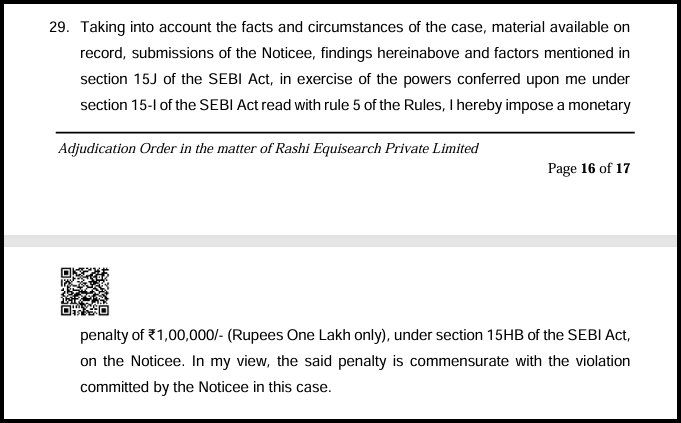
The order is Order/JS/VC/2026-27/32760, dated October 7, 2026. It runs to 17 pages.
It found two violations: missing evidence of client order placement and missing IP address logs for internet-based trading.
Rashi Equisearch has 45 days from receiving the order to pay.
Rashi Equisearch Private Limited
Rashi Equisearch Private Limited is a stock broker registered with SEBI under number INZ000276636.
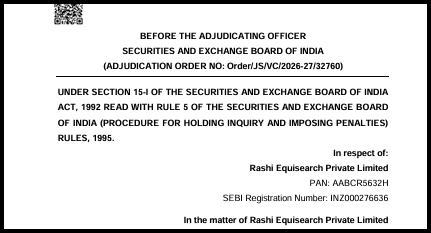
The order lists its PAN as AABCR5632H.
The broker told SEBI it has 258 non-institutional clients.
How Did the Case Move From Inspection To Penalty?
The case ran for under a year.
These are the dates that matter:
1. The Inspection (November 2025)
SEBI and NSE carried out a thematic inspection on November 27, 2025. It covered April 1, 2024 to November 27, 2025.
2. The Show Cause Notice (August 2026)
A new Adjudicating Officer took over on July 23, 2026. The show cause notice followed on August 7, 2026.
The broker replied on August 20, 2026.
3. The Hearing (September 2026)
A hearing was fixed for September 10, 2026. At the broker’s request, it was moved to September 16, 2026.
The broker’s representative attended by video conference. The broker also filed an additional reply that day.
4. The Order (October 2026)
The order followed on October 7, 2026.
SEBI Finding: Broker Failed to Provide Order Proof for 38 Out of 50 Clients
This is the main finding in the order.
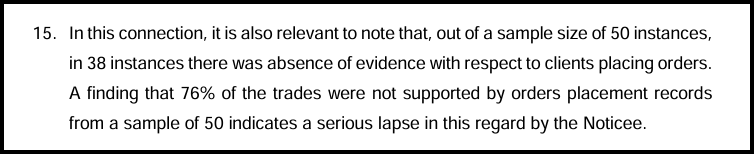
SEBI sampled 50 clients. For 38 of them, the broker could not show any evidence that the client placed the order.
SEBI noted that this means 76% of the sampled trades had no order records.
The 36 Clients Whose WhatsApp Records Disappeared
The broker said its dealer took orders over WhatsApp calls and messages.
The dealer had switched on disappearing messages, set to delete after 24 hours.
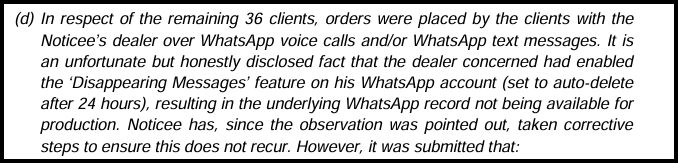
So the records were not available.
The 2 Clients Who Said They Gave Orders In Person
The broker said two clients (one a HUF account) placed orders face-to-face at its dealing room.
SEBI said there was no record of those orders either. A verbal claim does not meet the rule.
The 4 Clients With Call Recordings
For four clients, the broker produced voice call recordings. The broker said SEBI and NSE accepted these in the final inspection report.
What The Rule Asks For
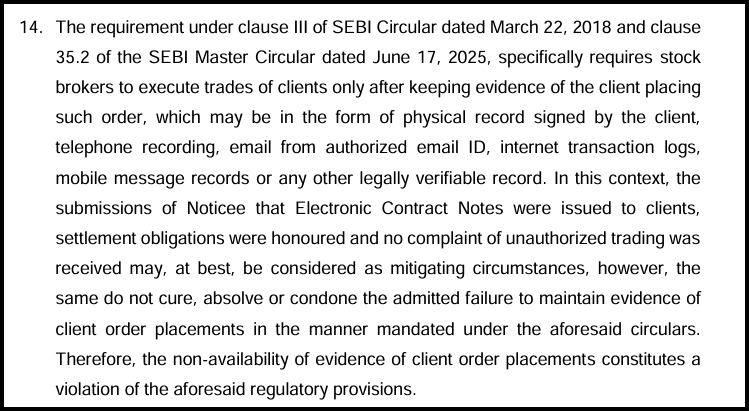
The order says a broker must keep evidence before it executes a client’s order.
The accepted forms include a signed physical record, a telephone recording, an email from an authorised address, internet transaction logs, mobile message records or any other legally verifiable record.
The rule comes from a SEBI circular of March 22, 2018, and clause 35.2 of the SEBI Master Circular of June 17, 2025.
Missing IP Addresses On Internet Trades: The Second Violation
The second finding is about internet-based trading, called IBT, and trading using wireless technology, called STWT.
SEBI picked three clients on the internet trading platform. The broker could not provide system logs with the IP addresses of their orders.

The broker admitted this in a reply dated March 17, 2026.
The Broker’s Explanation
The broker used the BOLTPlusOnWeb terminal provided by BSE. It said the terminal gave it no way to download IP logs.
It said BSE’s helpdesk confirmed this in January 2026.
It also said BSE held the data at the server level, and that it later obtained the details for the dates in question.
Why SEBI Did Not Accept This?
SEBI said the broker cannot shift its compliance burden to the stock exchange.
As a registered broker offering internet trading, it had a mandatory duty to capture and keep these IP addresses.
SEBI also said later fixes, including a daily logging system by April 2026, do not erase the violation.
Also Read: VCK Share and Stock Broking SEBI order, the ₹2,00,000 penalty and what SEBI found at its Authorised Persons.
Rashi Equisearch Arguments vs SEBI Response: Defense and Legal Findings
The broker asked SEBI to drop the case, or to give a warning, or at most a minimal penalty.
SEBI weighed each point:
1. “These Were Technical Lapses”
The broker called them record-keeping lapses, not unauthorised trading.
SEBI said they relate to core requirements. They keep an audit trail and protect investors.
2. “No Client Complained”
The broker said none of its 258 non-institutional clients raised a complaint of unauthorised trading, including on SCORES.
It also said contract notes went to every client’s registered email, and clients paid their dues without objection.
SEBI called these mitigating circumstances. It said they do not cure the failure to keep evidence.
3. “We Fixed It”
The broker said it stopped taking orders over channels with no audit trail.
It told NSE in a Compliance Status Report dated April 27, 2026 that both issues were complied with. That was ahead of the May 7, 2026 deadline set after SEBI’s letter of April 1, 2026.
SEBI said remedial steps taken after the inspection do not remove the earlier violation.
4. “The Tribunal Once Replaced A Penalty With A Warning”
The broker cited a Securities Appellate Tribunal decision in the NHAI case (Appeal No. 232 of 2020, order dated August 27, 2020).
SEBI said that case was different. The Tribunal had said it should not be treated as a precedent, and NHAI is a statutory authority with layers of decision-making.
5. “Penalty Does Not Need Bad Intent”
SEBI also relied on Supreme Court rulings. These included a Kotak Mahindra Asset Management order dated July 13, 2026 and the 2006 Shriram Mutual Fund ruling.
The point: a regulatory breach attracts a penalty whether or not there was loss or intent.
Why SEBI Imposed a ₹1 Lakh Minimum Penalty on Rashi Equisearch?
Section 15HB sets a penalty range of ₹1 lakh to ₹1 crore. SEBI chose the minimum.
Under Section 15J, SEBI looks at three factors: gain made, loss caused to investors, and whether the default was repeated.
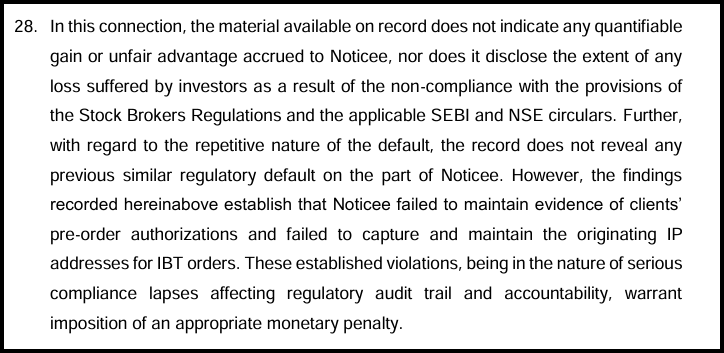
The order found no quantifiable gain and no quantified investor loss. It also found no earlier similar default.
Even so, SEBI called these serious lapses that affect the regulatory audit trail and accountability.
If the penalty is not paid in 45 days, SEBI can start recovery under Section 28A, including attaching and selling property.
What This Order Does Not Say?
A careful reading matters here.
The order does not find any case of unauthorised trading.
It does not mention any investor complaint, and it records no quantified investor loss.
The order does not allege any misuse of client money. The violations concern record-keeping and IP logging.
Is Rashi Equisearch SEBI Registered Or Not?
Yes. The order lists Rashi Equisearch Private Limited as a stock broker with registration number INZ000276636.
It was a registered broker during the inspection period.
A registration number shows a broker cleared SEBI’s entry rules. It does not show how well the broker follows the rules every day.
So checking SEBI registered brokers is only the first step. Watching your own account matters just as much.
How Investors Can Maintain Trade Records for Phone and WhatsApp Orders?
Order evidence protects the client too. If a dispute ever comes up, it decides who can prove what.
These are general safety habits.
The order does not list them:
1. Keep Your Own Record
Save your contract notes and your trade confirmations.
2. Prefer Channels That Leave A Trail
If you give orders by chat or phone, keep your own copy of the message or call details.
3. Check Every Contract Note
Match each trade against what you asked for. Raise any mismatch the same day.
Regulators have acted on broker lapses before, and real examples are collected under SEBI action against brokers.
How to File a SEBI Complaint Against a Stock Broker?
You can complain if a registered broker traded without your order or handled your account wrongly.
Keep contract notes, ledger statements, chats, and call details.
1. Start With The Broker And File On SCORES
Raise it with your broker first. If it is not resolved, you can file a SEBI SCORES complaint with your documents.
2. Escalate To SMART ODR
If SCORES does not settle the matter, the next step is the SMART ODR complaint portal. It offers online conciliation, then arbitration.
Anyone who wants to file a complaint against stock broker can follow one route, from the grievance desk to arbitration.
Conclusion
SEBI fined Rashi Equisearch ₹1 lakh for keeping no proof of client orders and no IP logs for internet trades.
The penalty is the statutory minimum, and the order finds no unauthorised trading and records no quantified loss.
The lesson for investors is simple.
Keep your own records, and know your broker’s duties.
Report. Recover. Stay Fraud Free.
SEBI imposed ₹1,00,000 under Section 15HB of the SEBI Act. This is the minimum under that section. It failed to keep evidence of client pre-order confirmations for 38 of 50 sampled clients. It also failed to capture IP addresses for internet-based orders. The broker said its dealer had turned on disappearing messages, set to delete after 24 hours. The order does not find any. It does not mention an investor complaint and records no quantified investor loss. Yes. It is a stock broker with registration number INZ000276636. Within 45 days of receiving the order. Otherwise SEBI can start recovery under Section 28A. Start with the broker, then file on SCORES, then use SMART ODR if the matter is still not resolved.Frequently Asked Questions




 Add us as a preferred source on Google »