

Quick Summary
StockDunia is run by Arijit Mazumdar, an individual SEBI Investment Adviser, registration INA300011609, based in Chandannagar, West Bengal. Four plans covering intraday, short-term delivery, long-term delivery and stock futures all cost ₹500 a week, ₹1,500 a month, ₹4,500 for three months and ₹9,000 for six months, whatever the risk level. The refund policy leaves every decision to the adviser, the terms contradict themselves on whether calls are recommendations, and monthly complaint data stops at March 2025. The fees are low, no returns are guaranteed, and risk profiling and grievance links are provided.
StockDunia charges ₹1,500 a month for four very different services, and the same price for each.
Intraday calls, short-term delivery, long-term delivery, and stock futures all cost exactly the same. The refund policy is shorter than any of them: the adviser decides every time.
The registration is real, and the fees are small. The rest needs a closer look.
The Adviser Behind StockDunia
StockDunia is a one-person operation, so the person matters more than the brand. Here is who he is and what he says the service does.
StockDunia is run by Arijit Mazumdar, a SEBI Investment Adviser with an M.Com and an MBA in accounting and finance.
The site adds a B.Com (Hons) from St. Xavier’s, Kolkata, and says he has experience in stock market investing and is still learning the advisory field.
The approach rests on technical and fundamental analysis of market trends, sectors, and individual stocks.
Services target traders and investors: intraday equity, equity cash-market calls, stock futures, Nifty futures, delivery calls, short-term and swing trading, and long-term investing.
Timeframes run from intraday and BTST/STBT calls to holding periods of one to three weeks and long-term horizons of one to five years.
Calls carry specific levels: buying and selling levels, targets or price-review ranges, stop-losses, and follow-ups.
A daily Nifty view with support and resistance is also provided.
The site says services are differentiated by risk profiling, using capital, objectives, risk-taking ability, experience, and time available.
Delivery is through a single login and SMS, including during live market hours.
The site mentions stock tips in a ₹50 to ₹1,000 range and says analysis is presented through graphs, data, and simple language.
Arijit Mazumdar is listed as the Investment Adviser, Compliance Officer, and Grievance Officer at once.
The registered office is in Haridradanga, Goalapara, Chandannagar, Hooghly, West Bengal.
StockDunia also says it operates no social media pages, naming YouTube, Facebook, Instagram and X.
A Broader Service Offering
One independent detail is worth knowing.
The firm’s other domain, stockdunia, describes a broader service: personal financial planning, mutual fund advice, advice on stocks, asset allocation, portfolio construction and rebalancing based on risk profile and goals.
That is a different offer from the weekly trading calls on the pricing page, and it is worth asking which one you are actually buying.
That page also carries a candid line: making money from the stock market is very hard without data, knowledge, experience, and discipline. Few sales pages say so.
Arijit Mazumdar’s Registration and Contact Details
The registration checks out against several sources. One contact detail does not.
Arijit Mazumdar holds SEBI Investment Adviser registration INA300011609 as an individual, valid from September 4, 2018, with perpetual validity. His BASL membership ID is 1139.
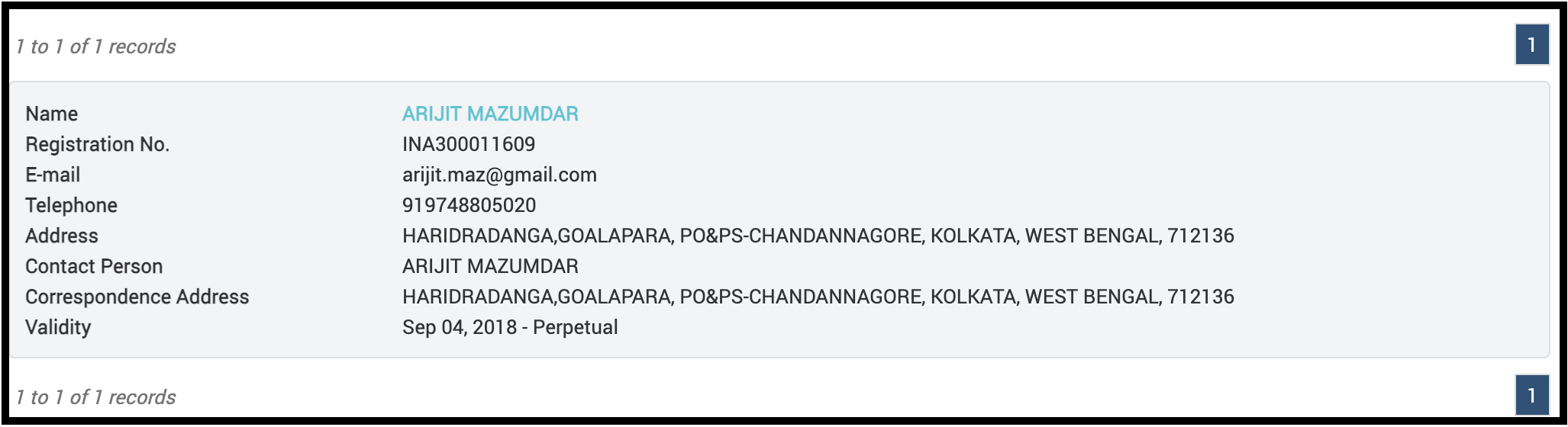
SEBI’s record lists the address as Haridradanga, Goalapara, PO and PS Chandannagore, Kolkata, West Bengal, 712136.
The firm’s own compliance page lists a different number and email compared to SEBI’s records.
Different numbers and emails for the same registration are easy to mistake for a typo. Use the registered details when you file anything formal.
StockDunia Pricing: One Price List for Four Services
Four plans share one price list. Their structure, risk level, and call volume differ, so here they are one at a time.
-
Intraday Equity Plan
Medium and high risk. 20 calls a month, up to two open at a time, intraday holding.
It includes Nifty support and resistance, entry, exit, and follow-up calls, SMS alerts, and live technical support. Minimum capital: ₹40,000.
-
Short Term Delivery Plan
Medium and high risk. 5 to 6 calls a month, up to three open at a time, minimum holding of 10 working days.
It includes entry, exit, and follow-up calls and SMS alerts. Minimum capital: ₹50,000.
-
Long Term Delivery Plan
Medium and high risk. 5 calls a quarter, held for one to three years or until the target or stop-loss triggers.
It includes SIP-based investment instructions. Minimum capital: ₹50,000.
-
Stock Future Plan
High risk. 6 calls a month, one open at a time, with entry, exit, and follow-up calls, SMS alerts, and live technical support.
The holding period isn’t specified, and the capital needed depends on stock valuation and the broker’s limits.
Every plan costs ₹500 for one week, ₹1,500 for one month, ₹4,500 for three months, and ₹9,000 for six months.
The site says the number of calls may vary with market conditions, calls may not come every day, and accuracy depends on market conditions.
The arithmetic is simple. Three months at ₹4,500 and six months at ₹9,000 are exactly three and six times the monthly price, so longer plans carry no discount.
The weekly rate is the expensive one: four weeks cost ₹2,000 against ₹1,500 for a month.
Even a full year at the monthly rate comes to ₹18,000, far below SEBI’s ₹1.51 lakh ceiling for individual clients. That deserves credit.
Six things still need answers.
-
The Same Fee for Different Risk and Structure
Intraday, delivery, and futures plans carry different risk, call volumes, and holding periods, yet cost the same.
The site doesn’t explain the basis for uniform pricing.
-
Six Months Paid in Advance
SEBI allows advance fees for up to two quarters, so six months is the maximum permitted, not a breach.
It does mean a client’s money is committed for the longest allowed stretch, which makes the refund terms matter.
-
No Statement on Taxes
The pricing page doesn’t say whether the quoted fees include GST, so the final amount payable isn’t clear before purchase.
-
Refund Terms Not Shown Beside the Plans
Four durations are offered, but cancellation and refund terms don’t sit next to any of them. A client can’t tell whether an unused period can be refunded.
-
A Futures Plan With No Holding Period
The Stock Future Plan is a paid package but states no holding period. Clients can’t tell how long the covered positions are meant to last.
-
No Plan for a Low-Risk Profile
All four plans are labelled medium and high risk, or high risk. The site says packages are chosen by risk profiling score, yet nothing is listed for an investor whose profile comes out low.
The page doesn’t say what such a client is offered.
Arijit Mazumdar Complaint Data That Stops in March 2025
SEBI requires advisers to publish complaint data monthly. StockDunia’s tables reconcile, but the record they show ends long ago.
| Month | Carried Forward | Received | Resolved | Pending |
|---|---|---|---|---|
| April 2024 | 0 | 1 | 1 | 0 |
| May 2024 | 0 | 0 | 0 | 0 |
| June 2024 | 0 | 2 | 2 | 0 |
| July 2024 | 0 | 0 | 0 | 0 |
| August 2024 | 0 | 0 | 0 | 0 |
| September 2024 | 0 | 0 | 0 | 0 |
| October 2024 | 0 | 0 | 0 | 0 |
| November 2024 | 0 | 0 | 0 | 0 |
| December 2024 | 0 | 0 | 0 | 0 |
| January 2025 | 0 | 0 | 0 | 0 |
| February 2025 | 0 | 0 | 0 | 0 |
| March 2025 | 0 | 0 | 0 | 0 |
| Monthly Grand Total | 0 | 3 | 3 | 0 |
The yearly table shows zero received, resolved, and pending in every year from 2018-19 to 2023-24, and in 2024-25: Received 3, Resolved 3, Pending 0.
Its grand total is 3 received and 3 resolved, matching the monthly figures.
-
Three Complaints After Six Years of Zero
Six straight years of zero were followed by three complaints in 2024-25.
All were resolved, but the change after such a long quiet stretch is worth noting.
-
About Eighteen Months Out of Date
The latest monthly disclosure is for the month ending March 2025.
SEBI requires advisers to publish this data monthly, so investors have no current view of the grievance record.
-
A Zero That Only Covers March 2025
The latest table shows zero pending, but that applies only to March 2025.
It can’t tell you whether anything was received or left pending afterwards.
-
The Complaints Aren’t Described
The tables don’t give the nature or category of the three complaints, so a prospective client can’t tell whether they concern refunds, call quality, or something else.
StockDunia’s Terms and Disclosures That Contradict Each Other
A paid advisory service should describe itself the same way everywhere. StockDunia’s own documents don’t.
-
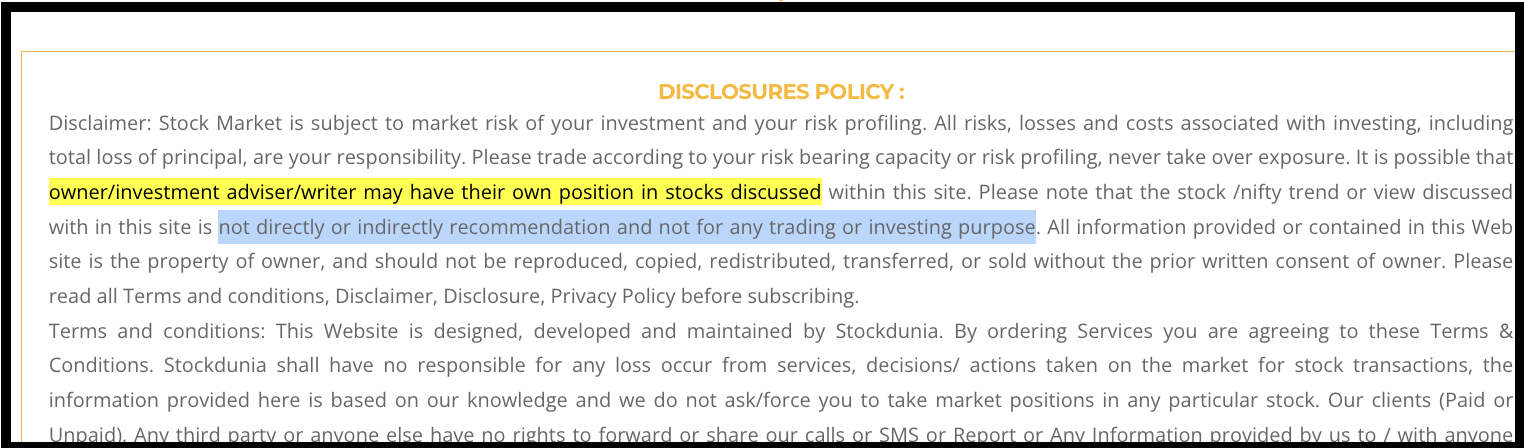
Recommendation or Not?
One disclosure says the “stock / nifty trend or view” is “not directly or indirectly a recommendation and not for any trading or investing purpose.”
The pricing page sells entry, exit, target, and stop-loss calls on equities and futures.
A reader can’t tell what the paid service is meant to be used for.
-
The Adviser’s Own Holdings
One section says the owner or adviser “may have their own position in stocks discussed.”
A later one says there is “not holding or position” by the adviser or employees.
Investors can’t assess conflicts of interest from two answers that disagree.
-
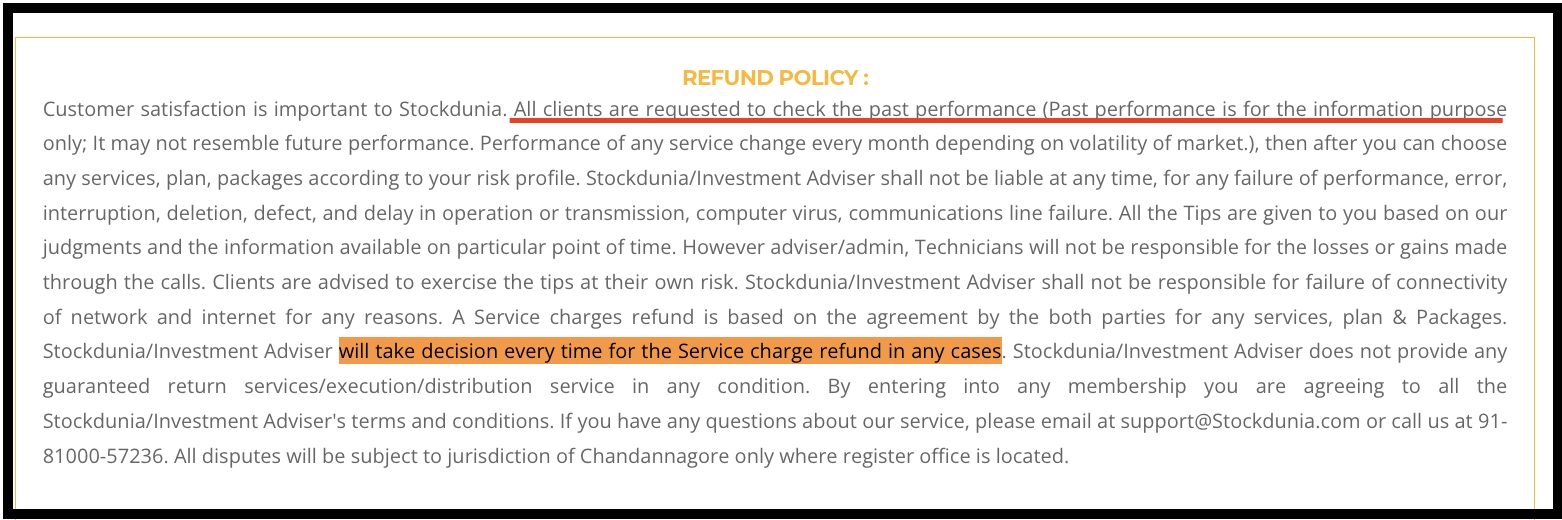
Refunds at the Adviser’s Discretion
The Refund Policy says the adviser “will take decision every time for the Service charge refund in any cases.”
It doesn’t say when a client is eligible or how the amount is worked out.
SEBI’s framework allows an adviser to retain at most one quarter’s fees as a breakage charge on termination.
A policy that leaves each refund to discretion doesn’t map onto that limit.
-
Past Performance as a Selling Point
The Disclosure and Refund Policy directs investors to check “past performance” or the “performance track record” before subscribing.
History is a weak guide to future results, and the site itself says it doesn’t assure performance.
Paid StockDunia and still waiting on a refund?
We check the refund policy you accepted against SEBI’s rules on what an adviser can retain, and help you take it further. Register with us for a free consultation.
StockDunia’s Marketing Language Worth a Second Look
Most of the site is plain. Three phrases lean toward promises.
-
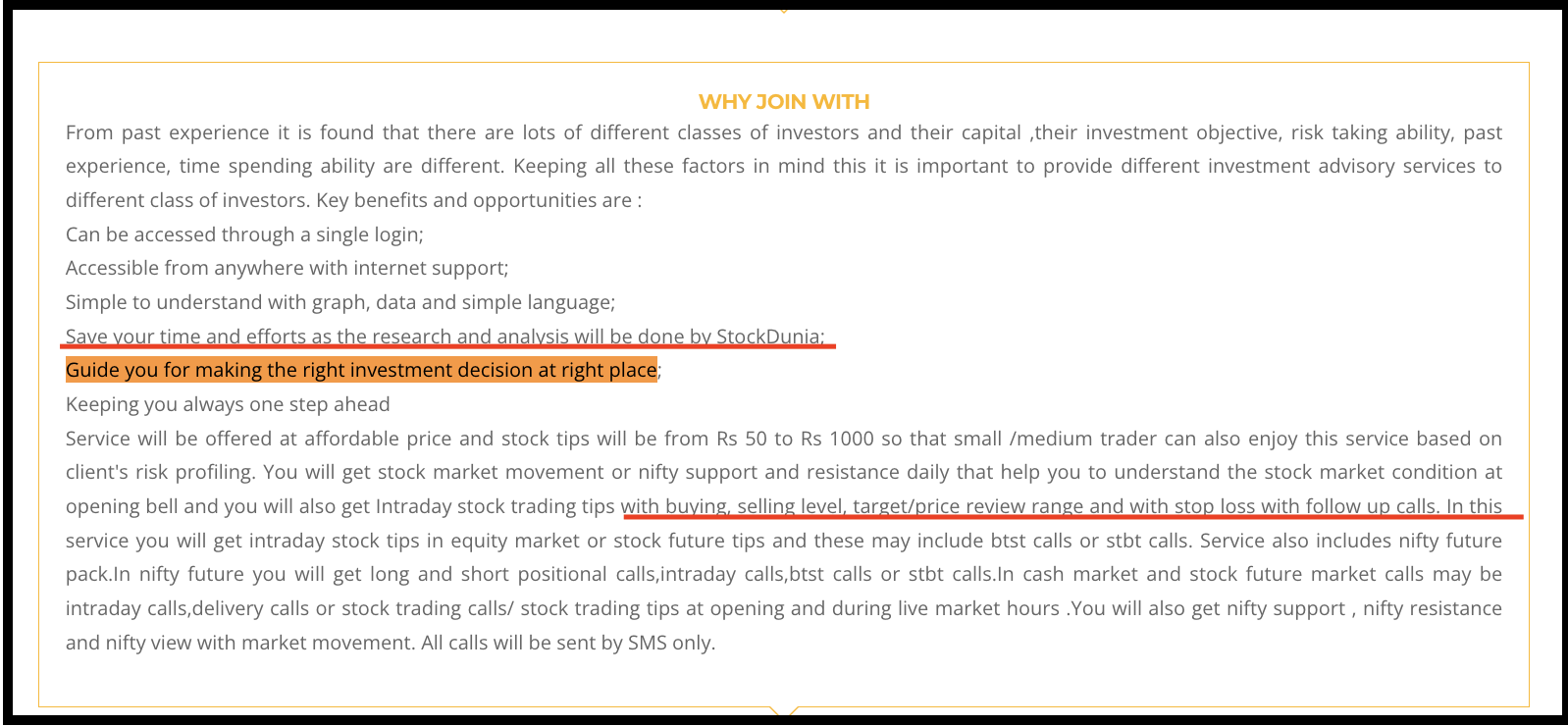
“The Right Investment Decision at the Right Place”
“Guide you for making the right investment decision at the right place” and “keeping you always one step ahead” can suggest consistently successful guidance, despite market uncertainty.
-
Tips With Levels Attached
The site promotes “stock tips” with “buying, selling level, target/price review range and stop loss.”
That presents the service as a direct trading solution rather than advice an investor weighs independently.
-
“Save Your Time and Efforts”
“Save your time and efforts as the research and analysis will be done by StockDunia” can encourage heavy reliance on the adviser, and less checking of risk and suitability.
To its credit, the site says markets are uncertain, accuracy varies, and nothing is guaranteed.
It also provides risk profiling, KYC and agreement forms, and links to SCORES and SMART ODR.
Where to Take a Grievance Against StockDunia?
One person is the adviser, the compliance officer, and the grievance officer.
A first complaint therefore goes to the same person who gave the advice, which makes written records and regulatory channels matter more.
Start with Arijit Mazumdar at his email or phone number.
His compliance page asks for your name, mobile number, email, and the package you subscribed to.
Write clearly, name the plan and the amount, and keep every reply.
When that stalls, file a SCORES SEBI complaint quoting INA300011609, using the telephone number and email on SEBI’s record.
StockDunia’s own site links to SCORES, so the firm expects this route.
Refund and fee disputes can move on to the SMART ODR portal for conciliation.
Keep your SCORES reference number and the refund policy as it read when you paid.
A binding decision sits with arbitration in share market, the final step.
Arbitration awards bind both parties, so the refund policy you kept becomes key evidence.
Our guide on SEBI complaint against investment advisor covers each stage in more depth.
Conclusion
StockDunia’s registration is genuine, its fees are low, it makes no promises of returns, and it gives clients risk profiling and grievance links. Those are real strengths.
The weak spots are the refund policy that leaves every decision to the adviser, terms that contradict one another, a single price list covering four different services, a phone number that differs from SEBI’s record, and complaint data that stops in March 2025.
None of that proves wrongdoing. All of it is worth settling in writing before you pay.
Report. Recover. Stay Fraud Free.
Legal Disclaimer
This blog is based on StockDunia’s own published materials and independently checked SEBI records. No SEBI order against Arijit Mazumdar was identified in the sources reviewed as of the date of writing, and we make no claims about his conduct beyond what these sources confirm.
Frequently Asked Questions
Every plan costs ₹500 for a week, ₹1,500 for a month, ₹4,500 for three months or ₹9,000 for six months. The site doesn't say whether GST is included.
The Refund Policy says the adviser decides every time. SEBI's framework limits what an adviser may keep on termination to one quarter's fees, so get refund terms in writing before paying.
Yes. Arijit Mazumdar holds individual Investment Adviser registration INA300011609, perpetual from September 4, 2018, with BASL membership ID 1139.
The site doesn't explain it. No later monthly disclosure appears, so ask the adviser directly, and check SCORES for any complaints filed since.
No. The site says accuracy varies with market conditions and that it doesn't assure or guarantee performance.





 Add us as a preferred source on Google »

