

If you’ve come across Stockifi on Instagram, YouTube, or Telegram, you’ve probably seen the promise of multibagger stock ideas, some pitched as Diwali picks with 300 to 450 percent returns, all wrapped in the “Investors Ka Dost,” or investor’s friend, tagline built around Abhijit Chokshi’s YouTube and Twitter presence.
Bold claims like these are common across India’s advisory space, so bold claims alone don’t tell you much.
What actually matters is whether the firm is properly registered, what it delivers once you’ve paid, and what real subscribers report afterward.
Stockifi does hold a genuine SEBI Research Analyst registration, INH000008376, active since July 2020, with zero formal complaints recorded on SCORES through 2025.
But a clean registration record is not the same as clean marketing.
Three specific elements visible on the firm’s own website raise real questions about whether that marketing stays within what an SEBI RA registration actually permits.
This page covers all of it: who runs Stockifi, its registration status, subscription costs, what the app offers, what real users report, and exactly what to do if something has already gone wrong
Stockifi India
Stockifi is the trading name of the equity research service operated by Abhijit Chokshi as a sole proprietorship.
The firm is officially registered at YESH KRUPA, Shimpoli, Chikuwadi, Borivali West, Mumbai 400092.
Instead of positioning itself as a rigid corporate entity, Stockifi is built around Chokshi’s highly conversational, community-driven online persona.
Through an active presence on YouTube, Twitter, and Telegram, he has built a level of retail credibility that smaller Research Analyst (RA) firms rarely achieve.
The core service:
- The Product: A curated list of 10 to 12 long-term “multibagger” stock ideas per year, intended for multi-year holding periods.
- Delivery Channels: Broadcasted to paid subscribers via their website, WhatsApp, a dedicated Telegram channel, and a mobile app launched in May 2026.
Is Stockifi Worth Paying For?
The answer depends entirely on what you expect when you subscribe.
Stockifi is a legitimate advisory firm with a verifiable SEBI Research Analyst registration.
Run by Abhijit Chokshi, the service has operated for five years and maintains a clean record with zero formal complaints on SEBI’s SCORES platform through 2025.
For retail investors looking for a structured, long-term stock advisory service, these are solid foundational facts.
However, a closer look at the firm’s public marketing reveals elements that push the boundaries of SEBI’s compliance rules.
While the registration is genuine, the website features aggressive return claims and a referral commission structure that run contrary to standard SEBI Research Analyst regulations.
Understanding these compliance gaps will help you evaluate whether the service justifies its premium subscription fee.
The SEBI Registration: What It Confirms and What It Does Not
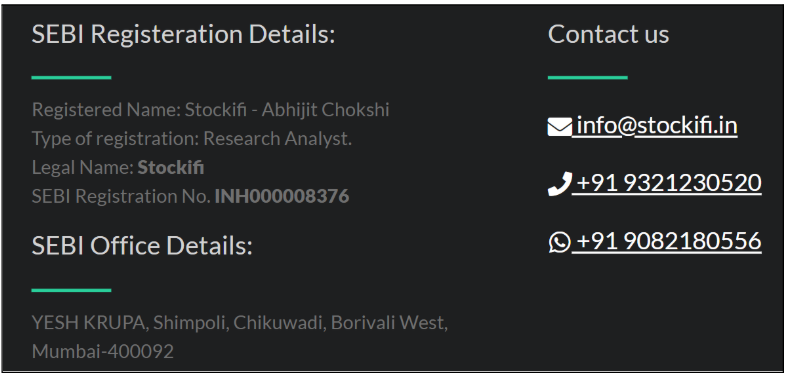
Stockifi holds SEBI Research Analyst registration INH000008376, granted on July 2, 2020, with perpetual validity.
The registration is in the name of Abhijit Chokshi as the sole proprietor, with Kinnar Shah listed as the Compliance Officer.
A SEBI Research Analyst registration authorises the firm to publish research reports with buy, sell, or hold recommendations supported by documented analysis.
It permits educational content about markets and trading strategies. It allows charging a fixed, pre-disclosed subscription fee.
What it does not permit is guaranteed return promises, marketing of specific return percentages from past recommendations, profit-sharing or referral commission structures, and live execution guidance beyond the scope of a formal research report.
What those boundaries mean in practice, and how you can independently verify Stockifi’s registration details on SEBI’s portal using registration number INH000008376, are explained step by step in our guide. Is Stockifi SEBI registered?
Three Red Flags Visible on Stockifi’s Own Website
These are not allegations.
These are observations from publicly visible content on Stockifi’s own website, which is citable as Source Type 2 under the legal framework we apply to all content on this site.
Red Flag 1: “70% of stocks gave 2x to 18x returns”
Stockifi’s website displays a marketing claim stating that 70 percent of their stock recommendations have delivered returns between 2x and 18x.
A screenshot of this claim is included in this blog for reference.

[Citation: Screenshot of Stockifi website marketing claim, stockifi.in, date as per screenshot, verify before publishing]
SEBI Research Analyst Regulation 16(b) explicitly prohibits a registered RA from making any statement that promises profits or assures specific returns.
Displaying a specific return range in marketing material, even as a historical claim, is a form of performance advertising that SEBI’s RA advertising guidelines restrict.
The guideline intends to prevent investors from making subscription decisions based on return percentage claims that do not represent a full and balanced performance picture.
Red Flag 2: Past performance displayed as current marketing content
Related to the above, Stockifi’s website features current profit figures presented visually to encourage visitors to subscribe or upgrade.
Selecting only profitable outcomes for public display, without disclosing the complete record, including recommendations that did not achieve their targets, creates a selective picture of the firm’s actual track record.
SEBI’s advertising norms for research analysts require disclosure to be complete and not misleading.
Red Flag 3: Active referral scheme paying commission per new subscriber
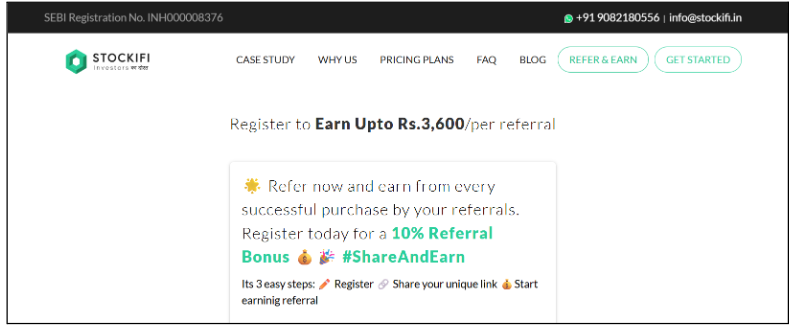
Stockifi operates a referral programme through its website, offering a 10 percent commission to subscribers who bring in new paying customers.
A screenshot of this referral scheme is included in this blog.
[Citation: Screenshot of Stockifi referral scheme, stockifi.in/refer, date as per screenshot, verify before publishing]
A SEBI-registered Research Analyst cannot legally operate a referral or affiliate commission scheme. RA fees must be fixed and pre-disclosed between the firm and the subscriber.
A structure where existing subscribers earn money by recruiting new paying subscribers is not a permitted fee or compensation arrangement under SEBI’s Research Analyst Regulations.
Investors who want to understand Stockifi’s subscription plans, pricing structure, and the role played by the referral programme can find a detailed breakdown in our guide on Stockifi subscription charges.
The Complaint Record: What the Data Shows
Stockifi’s SEBI-mandated complaint disclosure shows nil complaints across all financial years from 2018–19 through 2024–25.
This is the officially recorded figure in the firm’s disclosures and in SEBI’s records.
Zero formal complaints over five years is certainly notable.
At the same time, an absence of complaints on SEBI SCORES does not necessarily mean that every subscriber had a positive experience.
Many investors never pursue the formal complaint process, either because they are unaware of it or because they do not believe the amount involved justifies the effort.
Inside the Subscriber Experience: What Real Users Report
Three Google Reviews from paying subscribers describe experiences that point to a consistent pattern: recommendations that arrive before the market opens but do not account for gap risk, capital concentrated in declining positions without exit guidance, and a marketing approach that highlights winning picks while not communicating losing ones.
These accounts are from individual subscribers on a public platform.
We are reporting what they described and not independently verifying each one. The detailed descriptions of each review, including the stocks mentioned and the specific concerns raised, are covered on the trust assessment page.
To understand the complete context behind these reviews and the concerns expressed by subscribers, refer to our analysis: Can you trust Stockifi?
What does Stockifi offer as a Service?
The Stockifi subscription is structured as an annual research service delivering 10 to 12 stock ideas per year.
These are positioned as long-term multibagger candidates, meaning stocks that the firm believes have the potential for significant price appreciation over a multi-year period.
Each recommendation is accompanied by an entry price range, a target, and a stop-loss level.
The firm communicates with subscribers through a Telegram channel, WhatsApp, the Stockifi website, and the Stockifi app, which launched in May 2026 and is available on Google Play under the publisher name Stockifi Investment Consultancy Private Limited.
Investors who want to understand how the app works, how it differs from Stockifi’s other communication channels, and what its recent launch means in practice can refer to our detailed review of the Stockifi app.
Filing a Complaint: What to Do If You Have an Issue?
If you subscribed to Stockifi and your experience involved guaranteed return promises, recommendations that consistently missed their stated targets without adequate stop-loss guidance, or fees collected without a written service agreement, you have grounds to explore the formal complaint process.
Because Stockifi holds a SEBI Research Analyst registration, complaints can be filed through SEBI SCORES by selecting the Research Analyst category and using the registration number INH000008376.
If you want to understand the process in detail, including when a complaint may be appropriate, which documents and screenshots to preserve, and how disputes can be escalated from SCORES to SMART ODR and Stock Market arbitration, our guide, complaint against Stockifi, walks through each step.
Not sure how to move your complaint forward?
Our team can help you prepare the required documents and navigate the process.
Conclusion
Stockifi is a SEBI-registered Research Analyst with a clean formal complaint record and five years of operation.
It is also a firm whose own website contains marketing content that raises specific questions about compliance with SEBI’s RA advertising and fee structure regulations.
The three red flags identified here, the return percentage claim, the selective performance display, and the referral commission scheme, are all visible on publicly accessible pages of the firm’s own website.
None of these observations constitutes a SEBI order against the firm.
They are documented concerns that an informed investor should weigh alongside the registration record before subscribing.
Frequently Asked Questions
1. What is Stockifi?
Stockifi is a SEBI-registered Research Analyst firm run by Abhijit Chokshi under registration number INH000008376, active since July 2020.
It offers long-term stock research to retail investors, delivering 10 to 12 multibagger stock ideas per year through Telegram, WhatsApp, its website, and a dedicated app launched in May 2026.
2. Is Stockifi SEBI registered or not?
Yes. Stockifi holds Research Analyst registration INH000008376 under proprietor Abhijit Chokshi, granted on July 2, 2020 with perpetual validity.
Kinnar Shah is the designated Compliance Officer. The registration is verifiable on SEBI’s intermediary portal at sebi.gov.in.
3. What are the main concerns about Stockifi?
Three specific concerns are visible on the firm’s own website. The first is a marketing claim stating 70 percent of stocks gave 2x to 18x returns, which raises questions under SEBI’s RA advertising guidelines.
The second is the selective display of profitable picks in marketing without a complete performance record.
The third is an active referral commission scheme, which is not a permitted structure for SEBI-registered research analysts.
4. Has SEBI taken any action against Stockifi?
No SEBI adjudication order, penalty notice, or formal regulatory action has been publicly recorded against Stockifi or Abhijit Chokshi as of July 2026.
The firm’s official complaint data shows no complaints from 2018 through 2025.
5. How much does a Stockifi subscription cost?
Stockifi currently offers subscriptions at an offer price of approximately Rs. 19,999 against a stated regular price of Rs. 27,000 for a 12-month plan covering 10 to 12 stock ideas.
Pricing should always be confirmed directly with the firm before paying, as offer terms change.
6. How do I complain against Stockifi?
File on SEBI SCORES at scores.gov.in, selecting Research Analyst as the intermediary type and entering INH000008376 as the registration number.
Before filing, gather your payment receipt, any written service agreement, all recommendations received, your trading records showing actions taken, and any communication where return promises were made.





 Add us as a preferred source on Google »

