
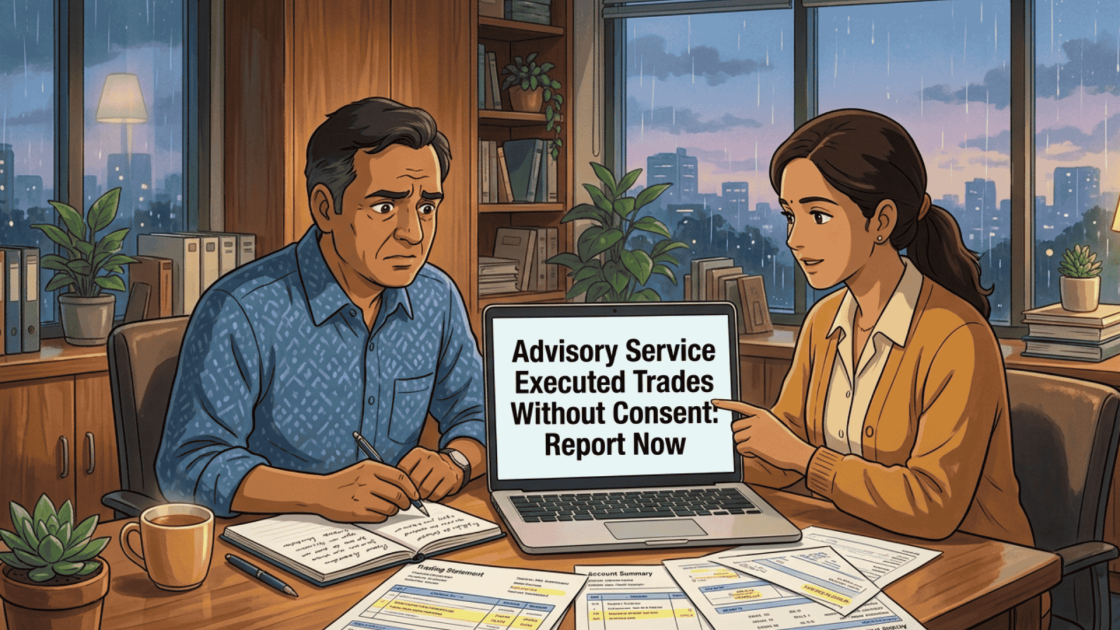
You trusted them with your money. They took that trust a step further, straight into your trading account, placing orders you never approved, in instruments you never discussed.
What they call a “convenience service,” SEBI calls a regulatory violation.
This is one of the most alarming situations an Indian investor can face. The question isn’t just “what happened?”, it is “what do you do next?”
This blog walks you through exactly that: what the rules say, what to do if advisory services execute trades without permission, and what steps you must take to protect yourself.
Can an Advisory Service Execute Trades Without Permission?
No. SEBI makes this unambiguous.
Under the SEBI (Investment Advisers) Regulations, 2013, a registered Investment Adviser (IA) provides advice, not execution.
According to SEBI registered investment advisor guidelines, the advisory agreement between an IA and client must explicitly state that the IA cannot execute any trades on behalf of the client without their explicit consent for each trade.
Many clients facing these violations wonder, can we trust a SEBI registered investment advisor?
The answer is yes, because the regulatory framework is built to safeguard you, but you must still verify that your advisor is sticking strictly to their permitted scope.
Similarly, Research Analysts (RAs) registered with SEBI under the SEBI (Research Analysts) Regulations, 2014 are permitted to publish research and recommendations.
What a SEBI registered research analyst can do is strictly limited to analysis and advice; they hold no authority whatsoever to access, operate, or place orders in a client’s trading account.
If your advisory service is placing trades without your permission, your contract notes and ledger statements will reveal the truth.
Any trade execution by an advisor, with or without your consent, is a clear violation of their regulatory mandate. Consent does not make it legal. Only PMS registration does.
SEBI Rules Against Unauthorized Trade Execution
SEBI lays down clear boundaries through multiple regulations:
- Regulation 19(1)(d), IA Regulations: Requires a written advisory agreement stating that trades cannot be executed without per trade client consent.
- Regulation 22A, IA Regulations: Permits optional execution services only without client fees or commissions, and clients are not obligated to use them.
- SEBI FAQ on IA Regulations: Clarifies that individual Investment Advisers cannot provide distribution or execution services after registration.
- RA Regulations: Prohibit Research Analysts from operating client trading accounts.
- SEBI Circular, January 12, 2024: Introduced voluntary trading account freeze options to prevent unauthorized access and trades.
- SEBI Circular, August 29, 2024: Barred regulated intermediaries from sharing client data with or directing clients to unauthorized advisors.
The rules are clear. Most investors never ask what to do if advisory services execute trades without permission until it happens to them.
The line between “giving advice” and “executing trades” is not blurry; it is a bright regulatory line.
So what happens when registered entities cross it? SEBI has answered that question through enforcement.
SEBI Order Against Unauthorized Trading by Advisory Services
When a registered intermediary steps outside its permitted scope and operates client accounts, SEBI’s adjudication process moves into action.
The following case is a documented example of exactly that.
In its Adjudication Order dated August 13, 2025, SEBI penalised Eqwires Research Analyst (Reg. No. INH000007465), a SEBI-registered Research Analyst based in Ahmedabad.
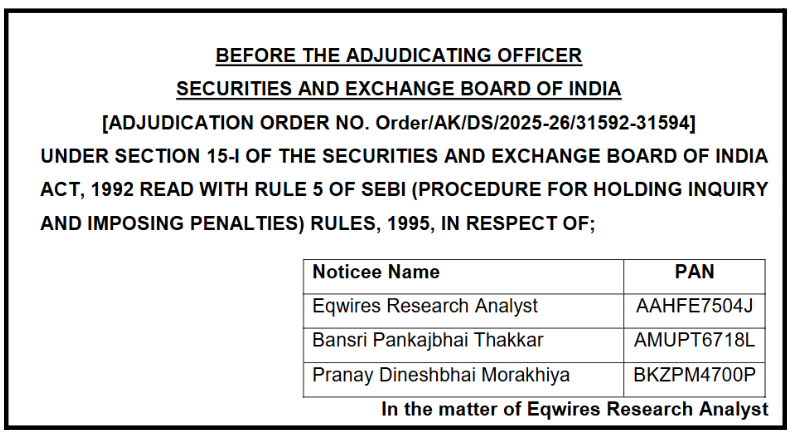
The order was passed for operating a client’s trading account, an activity expressly outside the scope of what an RA can do.
The inspection covered the period from April 1, 2020, to November 25, 2021.
Violations Found
SEBI established the following violations directly related to unauthorized trade execution and account handling during the adjudication proceedings.
1. Operating Client Accounts via Login Credentials
A client complaint (SCORES complaint dated March 16, 2023) revealed that Eqwires obtained the client’s trading account login credentials and operated her account for approximately nine months.
The authorisation letter that enabled this access was prepared by Eqwires itself, not by the client.
Eqwires presented this as an “add-on service” when the client said she had no time to trade.
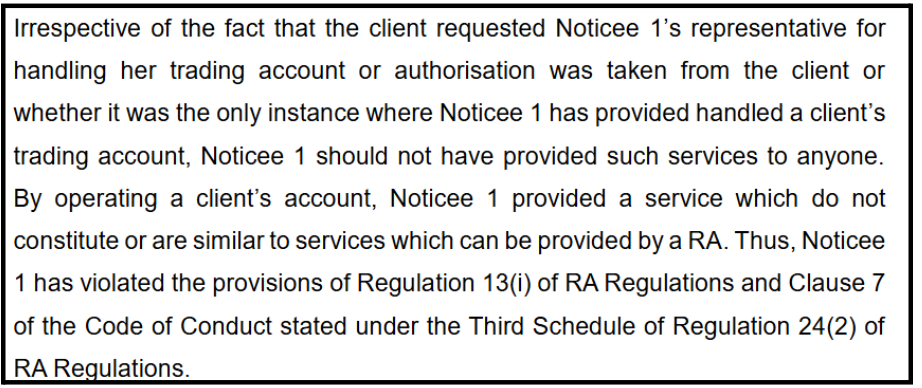
SEBI held that irrespective of whether the client consented or not, Eqwires should not have provided such services.
Research Analysts hold no regulatory authority to operate client trading accounts under any arrangement.
2. Misrepresenting Registration Status to Access Client Accounts
Eqwires held only an RA registration but consistently promoted itself as a “SEBI registered advisory company,” “Best investment advisor in India,” and “Most successful stock advisors in India” across its website and Telegram channel.
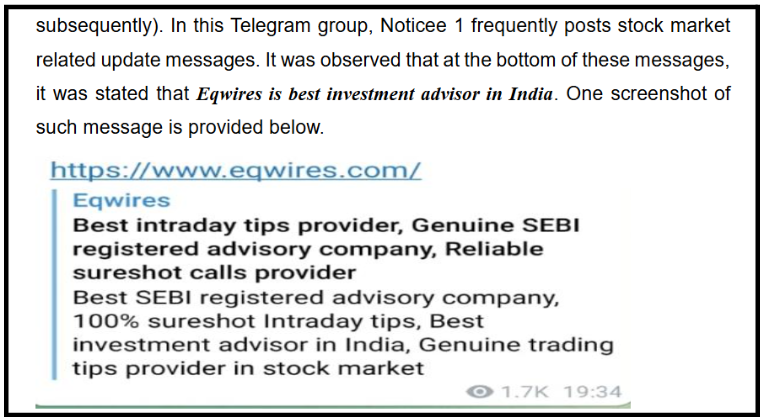
It issued client-specific recommendations, a service requiring IA registration, without holding one.
This misrepresentation directly enabled client relationships that led to account access.
3. Executing Trades on Behalf of a Client Without PMS Registration
Even if the investor voluntarily shared her login credentials, executing trades on her behalf remains a clear violation.
Advisors love to hide behind the “convenience” defense. They will point at the login you shared and claim, “The client gave us the password; she wanted us to trade.”
Under SEBI regulations, an Investment Adviser (IA) or Research Analyst (RA) has one job: to provide advice.
They do not have the regulatory authority to act as your Portfolio Manager (PMS).
Only SEBI-registered Portfolio Management Services (PMS) providers can legally execute trades and manage funds in a client’s account on their behalf.
If your portfolio manager or advisory firm operates without authorization, learning how to file a complaint against portfolio managers is the first critical step toward recovery.
This was precisely the issue in the case of Eqwires, which held no PMS registration. Yet it operated a client’s trading account, placing orders and managing positions without the regulatory authorization that such activity requires.
Penalty
SEBI’s Adjudicating Officer Amit Kapoor imposed a joint and several monetary penalty of ₹6,00,000 on Eqwires Research Analyst and its partners.
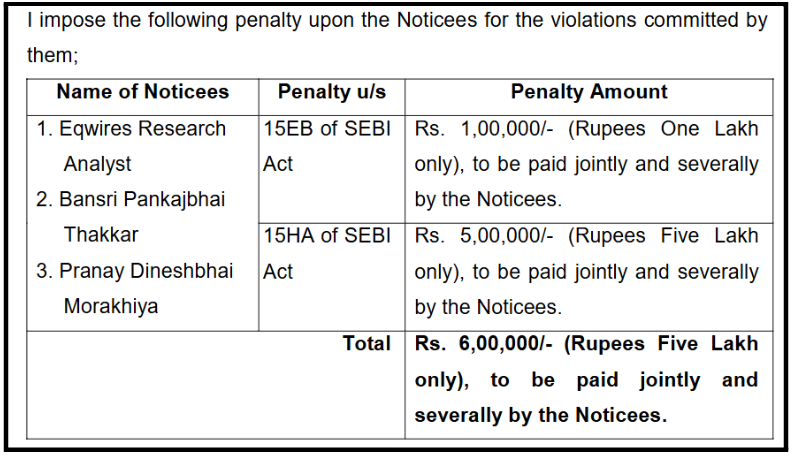
The penalty comprised ₹1,00,000 under Section 15EB of the SEBI Act for violations of RA Regulations, and ₹5,00,000 under Section 15HA for fraudulent and unfair trade practices under PFUTP Regulations.
Payment was directed within 45 days of the order.
Understanding how these violations happen is equally important because recognizing the pattern early is what protects you.
Lessons for Investors
The Eqwires case makes one thing clear: investors who know what to do if advisory services execute trades without permission are far better positioned to act fast.
SEBI acts. It inspects. It imposes bans. But investors also carry responsibility to act early.
- Check every trade alert in your account the same day it arrives; anomalies surface fast when you look.
- Monitor your daily paper trail. Never ignore your Contract Notes and Ledger Statements. If you discover that a research analyst trades in my account without permission or notice an unexplained debit in your ledger, treat it as an immediate red flag.
- If you have already shared login credentials or signed an authorisation letter, revoke access immediately, change your password, and preserve every communication that led to that point; it becomes evidence
- Verify your advisor’s registration status and exact registration category on the SEBI website before onboarding.
- Preserve all communications, WhatsApp messages, emails, call recordings, and payment receipts; they are admissible evidence in SEBI complaints.
Prevention and documentation together are your strongest protection.
Is Recovery from Unauthorized Trading Possible?
Yes, and this is where understanding what to do if advisory services execute trades without permission truly matters. The key condition is that the entity must be SEBI-registered.
Investors dealing with SEBI-registered IAs and RAs have access to formal redressal mechanisms that carry refund directions.
Recovery channels available to investors include:
- SEBI adjudication orders that direct monetary penalties against the entity, as in the Eqwires case.
- SMART ODR arbitration, where an arbitrator’s decision is binding on both parties and enforceable.
- SCORES complaints, which SEBI actively monitors and escalates when intermediaries do not resolve them.
- Securities Appellate Tribunal (SAT), available if SEBI’s order itself requires challenge or if investors need higher-level enforcement.
Recovery is possible, but time matters. Document everything. Act quickly. SEBI’s complaint mechanisms work better when the investor approaches them with a complete, organized record of what happened.
Prevention, however, is always less costly than recovery. The moment you spot an unauthorized trade, treat it as a serious matter because SEBI regulations classify it as exactly that.
What To Do In Such Cases?
If an advisory firm executed trades in your account without PMS registration, the situation qualifies for a formal complaint against a SEBI registered investment advisor or research analyst depending on which category the entity holds.
The complaint process for both categories, including the correct SCORES intermediary type to select, the evidence to prepare first, and how to escalate through SMART ODR and arbitration if needed, is covered in full on our dedicated complaint guide: complaint to SEBI against investment advisor.
Need Help?
If an advisory service has been operating your account without PMS registration, you have a documented regulatory violation on your hands, and a clear path to pursue it.
We assess the violation, map your evidence, draft your SCORES complaint, and represent you through SMART ODR and arbitration if it comes to that. Every step, handled.
Tell us what happened. We will tell you exactly what your case is worth and what recovery looks like from here.
You do not need to fight this alone. The regulations exist to protect you. Our job is to help you use them. Register with us now.
Conclusion
If an advisory service, whether a SEBI-registered Investment Adviser or Research Analyst, executes trades in your account without your per-trade explicit consent, that is a violation of SEBI regulations.
“Every investor in this situation deserves clarity on their rights, and now you have it.
The Eqwires Research Analyst case demonstrates that the regulator does enforce these rules against registered entities. Your first move is documentation. Your second move is SCORES.
From there, utilizing the SMART ODR complaint portal and arbitration gives you enforceable remedies.
Act early, preserve evidence, and use the system SEBI has built for exactly this situation.
Frequently Asked Questions
1. My advisor is asking for my trading account login credentials as an “add-on service”, is it safe?
No, it is a high-risk security breach and a violation of SEBI’s mandate for an advisor to handle your credentials.
2. I gave my advisor my login details, and they executed unauthorized trades; who is legally responsible?
The advisor is legally responsible, as no amount of client consent can grant them the legal right to manage funds without a PMS license.
3. I wasn’t aware that sharing my account was illegal, and now I’m at a significant loss; what should I do?
You should immediately change your passwords, revoke all access, and file a formal complaint through the SEBI SCORES portal or your stock exchange’s grievance cell.
4. Does signing an agreement or a Power of Attorney (POA) with my advisor authorize them to trade for me?
No, a POA or any private contract cannot override the statutory requirement that only a registered Portfolio Manager (PMS) can exercise discretionary trading authority.
5. How can I prove the trades were unauthorized if the logs show my own credentials were used?
You prove it through two things. First, the entity lacks PMS registration, zero legal authority to manage your capital, regardless of who typed the password.
Second, cross-reference your Contract Notes and Ledger Statements against your chats and emails; trades never discussed or approved in writing are unauthorized, full stop.





 Add us as a preferred source on Google »

