Tradebulls Securities Reviews: Arbitration Case & User Complaints
October 3, 2026
Trading often begins with personal savings and a curiosity about how markets move.
For many, it’s a hands-on way to understand price behaviour and see how individual decisions shape outcomes over time.
Successful trading involves more than just buying and selling.
TradeBulls Securities may not be the biggest name in the Indian broking industry, but when it comes to investor complaints, size does not always tell the full story.
A closer look at their complaint data over the last four years reveals some patterns that are hard to ignore.
If you are an investor with TradeBulls or are considering opening an account, this is worth reading before you decide.
TradeBulls Securities Complaint Overview
TradeBulls Securities Private Limited is a Vadodara-based stockbroking firm offering trading services across equities, derivatives, and other financial instruments.
While it may not have the national footprint of larger brokers, it serves a dedicated client base for whom reliable and transparent service is just as important.
Exchange Complaints Data
The following analysis examines TradeBulls’ Exchange Complaint Data across four financial years, from 2022-23 to 2025-26, to understand how complaint volumes have moved over time and what that tells us about the platform’s service quality.
Financial Year
Total clients
No. of complaints
% of complaints w.r.t. Total clients
Resolved complaints
% of resolved w.r.t. complaints
Arbitrations
2022-23
76435
43
0.05
43
100
0
2023-24
76435
38
0.04
37
97.36
0
2024-25
83494
138
0.16
138
100
0
2025-26
77534
64
0.08
54
84.37
0
The numbers here look relatively small compared to larger brokers, but the trend is still worth paying attention to.
Complaints jumped sharply from 38 in 2023-24 to 138 in 2024-25, more than tripling in a single year, which is a significant spike for a platform of this size.
The resolution rates have been strong for the most part, with two years showing 100% resolution, but 2025-26 tells a different story.
Only 54 out of 64 complaints were resolved, bringing the resolution rate down to 84.37%, which is the weakest performance across all four years.
The fact that zero arbitrations have been filed throughout suggests either that disputes are being settled before escalation or that clients are simply not aware of their options.
Given the drop in resolution rates, that second possibility is something worth thinking about seriously.
Types of Complaints Against TradeBulls Securities
Tradebulls Securities Limited has had multiple complaints on various fronts over the years.
The analysis given below digs into exactly that as we decide whether Tradebulls is a reliable option for you.
Complaint type
Description
2022-23
2023-24
2024-25
2025-26
Type I
Delay in payment
2
1
3
1
Type II
Non- receipt/ delay in securities
–
–
1
2
Type III
Non-receipt of documents
2
–
2
1
Type IV
Unauthorised trading
8
12
47
34
Type V
Service related
8
20
67
21
Type VI
Square off related
–
–
1
1
Type VIII
IPO related
–
–
3
1
Type IX
Others
7
5
14
12
Delay in Payment and Non-Receipt or Delay in Securities
These numbers are small but persistent, and the appearance of securities-related complaints from 2024-25 onwards suggests new operational gaps are opening up.
Even one or two cases of clients not receiving their money or securities on time is a problem that should not be brushed aside.
Non-Receipt of Documents
The numbers are low but inconsistent, fluctuating across years with no clear downward trend.
Clients not receiving their documents reliably points to a gap in basic back-office processes that needs fixing.
Unauthorised Trading, Service Related and IPO Related
This is where the real concern lies.
Unauthorised tradingcomplaints jumped from 12 to 47 in a single year, and service complaints surged from 20 to 67 in the same period.
Together, these three categories account for the bulk of complaints and paint a picture of a platform struggling to keep up with basic service standards and client trust.
Square Off Related
Square off complaints are small in number but appeared for the first time in 2024-25 and have continued since.
Clients disputing how their positions were closed is a serious concern, given the direct financial impact it carries.
Others
The “Others” category usually represents sections of complaints that are too small to have their own separate categories.
This category has grown steadily from 5 to 14 and settled at 12, suggesting a quiet but consistent stream of issues that do not fit neatly into existing categories.
A growing catch-all is always worth watching closely.
Also Read: Anand Rathi reviews, a forced app upgrade that broke features overnight.
Tradebull Securities Arbitration Cases
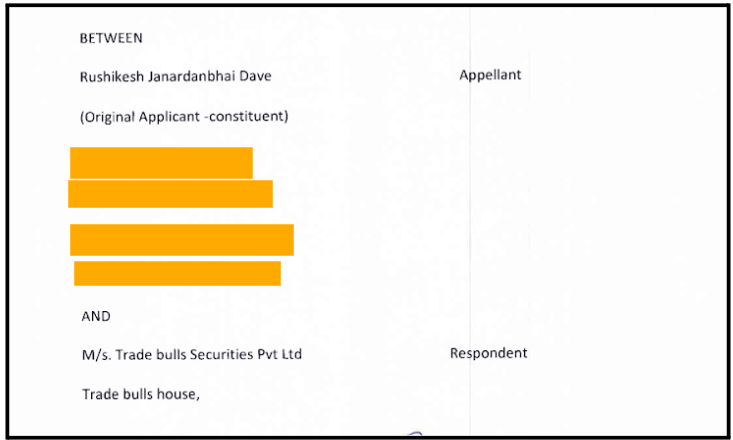
This case was between Rushikesh Janardanbhai Dave, a senior citizen investor, and TradeBulls Securities Private Limited, a stockbroker.
The dispute centred around unauthorised trading in the Futures and Options segment.
The investor alleged that the broker’s representatives induced him to trade in F&O without fully understanding the risks, resulting in significant financial losses.
What Was The Case?
The investor claimed that he had clearly communicated his lack of knowledge about F&O trading to the broker’s representatives, who nonetheless encouraged him to trade in the segment by promising returns of Rs. 40,000 to 50,000 per month.
He alleged that trades were placed by the broker’s employees without his explicit consent.
The broker, however, argued that all trades were authorised, pointing to the investor’s regular account activity, online logins, and the fact that he never raised any written objection during the disputed period.
What Was The Award?
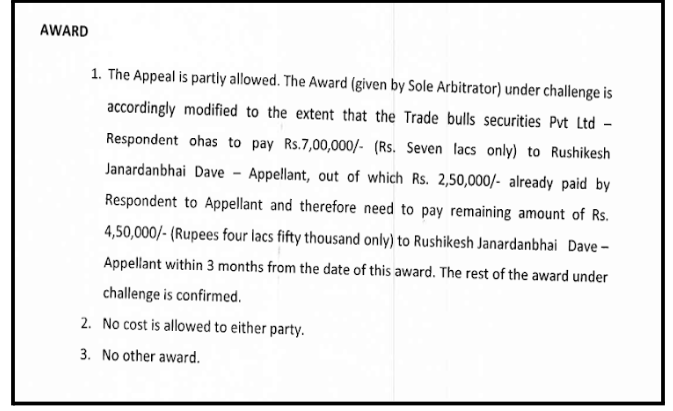
The tribunal found both parties partially at fault.
Trade Bulls was directed to pay a total of Rs. 7,00,000.
Out of this, Rs. 2,50,000 had already been paid under an earlier award, leaving a remaining payment of Rs. 4,50,000 to be paid within three months.
No legal costs were awarded to either party.
Key Takeaways
Brokers are strictly prohibited from inducing or pressuring clients to trade in high-risk segments like F&O, and failing to produce call recordings of order placement can be used as evidence against them.
Staying silent about unauthorised trades, continuing to transact, depositing more funds, and never raising a written objection can be interpreted as passive consent, which significantly weakens your legal position.
Even if a broker is found to be at fault, the tribunal may assign shared responsibility to the investor if their own conduct suggests awareness and participation in the trades.
As an investor, raising your objection in writing at the very first instance of a suspicious trade is critical. Verbal complaints alone, without documented evidence, are very difficult to prove in arbitration
Also Read: Nirmal Bang reviews, three real user reviews, each describing a genuinely distinct failure.
Tradebulls Securities App User Reviews
Tradebulls securities provides Tradebull Touch 2.0 as their latest trading platform for brokers to invest their money and stay on top of market changes.
They call themselves a ‘next generation investment and trading platform for a unique user experience’.
However, with an overall rating of 4.3 and over 11000 reviews, there still seem to be quite a few unsatisfied users.
Let us take a look at some of them:
1. Complaints Related to Brokerage Churning
Excess charges or churning in the stock market is when the broker encourages you to trade frequently to generate brokerage fees for themselves, rather than focusing on your personal profit.
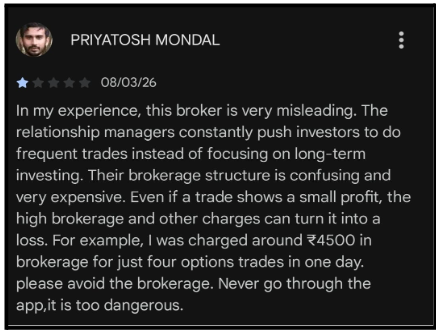
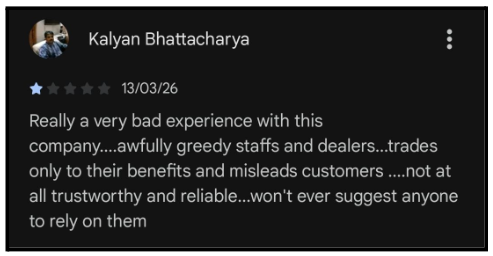
This user claims to have faced this issue while trading on this app, describing it as a clear case of Tradebulls Securities excess charges where brokerage deductions ate into every position before profits could materialise.
He calls the broker “misleading”, stating that they are churning brokerage for him.
The charges imposed are also so high that small profits inevitably turn into losses- you pay more than you earn.
Again, more users come forward with similar complaints of the broker being ‘misleading’ and the dealers only focusing on their own earning potential rather than presenting the client with actual decent help.
This user even goes as far as to say that the company is greedy, and he would not suggest this app.
2. Complaints Related to User Interface
User interface-related issues usually arise out of inconsistency, complex navigation, poor responsiveness or insufficient feedback, which can lead to a lot of frustration built up on the investor’s part.
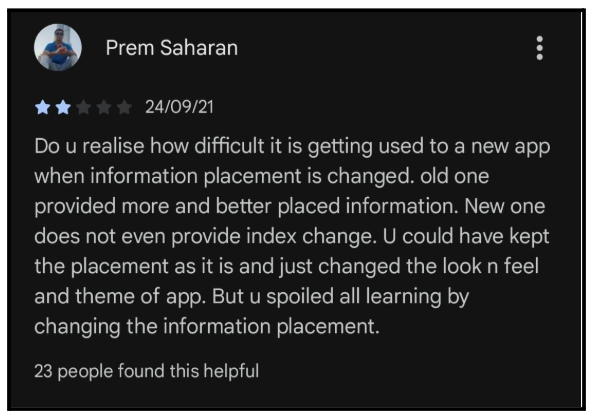
This user believes that the new app is not on par with the older version and even lacks some important features, such as the index change.
He claims that the new layout and overall changes have entirely ruined the experience for him.
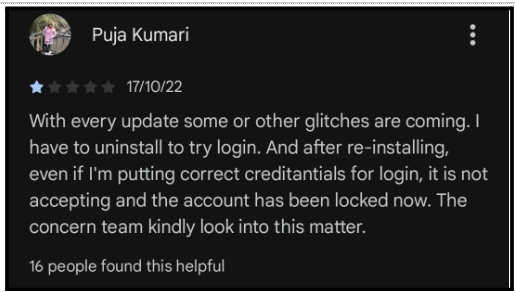
This user also faced some serious issues with the app.
After facing multiple glitches on the app, she thought it best to delete and reinstall it, hoping to curb the issue.
However, it only ended up becoming a bigger issue for her as she cannot even access her account anymore.
3. Complaints Related to Customer Service
Customer service is an essential part of any organisation as it allows users to seek the help they need when they need it.
However, it seems that based on the complaints, the representatives of this platform have not been able to complete their duty of helping the investors.
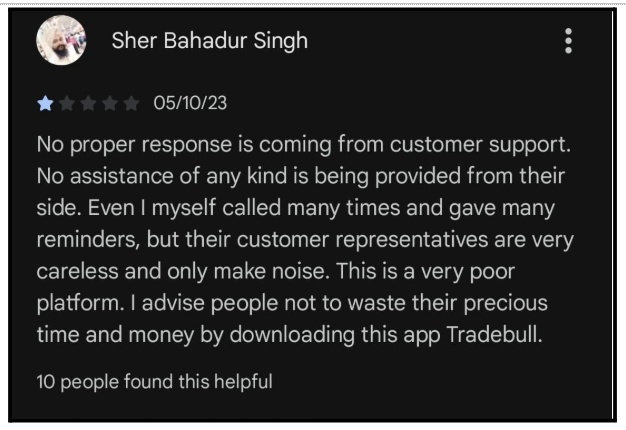
This user contacted the customer support team multiple times and every time was disappointed.
The representative failed to offer solutions to his problem despite numerous reminders from his end.
Once again, a user came forward with multiple issues with this platform.
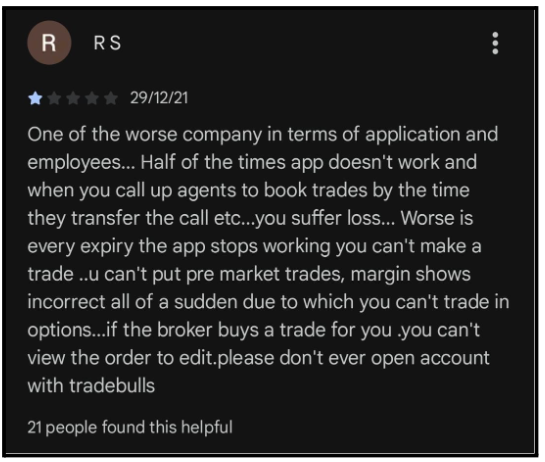
The app did not operate up to his expectations; the customer service did not respond in a timely manner which led him to bear losses.
He goes on to explain how he faced multiple issues with the user interface as well and advises not to create a trading account with this app.
When to Take Action Against Brokers?
Take a close look at your account activity and match it against every trade confirmation, SMS, or email your broker has sent you.
If you come across anything that does not line up with what you actually did, do not dismiss it.
Investigate it immediately and flag it to your broker’s grievances team within the first week.
The earlier you raise the issue, the harder it becomes for anyone to argue that you were aware and comfortable with what was happening.
There are certain situations where escalating becomes not just an option but a necessity:
When your broker is unable or unwilling to share documented proof of order placement
When a formal arbitration process establishes that trades happened without your knowledge
When a regulatory inspection finds that the broker failed to maintain proper order records as required by law
If you decide to take the matter to SEBI, keep in mind that you have a window of three years to file a formal complaint, and your broker is obligated to hold on to your transaction records for that same duration.
That said, acting quickly is always in your best interest.
The longer a dispute sits unaddressed, the more it can start to look like you were not bothered by it, which is the last impression you want to give when your case is being reviewed.
Trading issues or problems with services can happen when investors feel that the communication, execution, or support they received wasn’t up to their expectations.
In these cases, Indian regulators and stock exchanges have set up clear ways for investors to formally and properly report their concerns.
Following the right steps ensures that the issues are looked into fairly and according to the rules.
1. Collect Proof
Start by gathering every piece of evidence you can find such as screenshots, contract notes, call recordings, emails, anything tied to that specific trade.
Organise everything chronologically so the issue is easy to follow and verify.
The more complete and structured your documentation, the stronger your case becomes.
2. Contact the Broker
Next, reach out directly to your broker’s official support or grievances team, clearly explaining what happened and backing it up with everything you have collected.
If the broker does not respond satisfactorily, you can file a complaint in SEBI on its SCORES portal.
Filing here puts the broker under regulatory scrutiny and gives them a defined timeline to respond, with SEBI keeping a close eye on the process throughout.
4. Report to the stock exchange’s complaint team
You can also file a complaint with NSE or BSE, where the trades were made. Exchanges look into how brokers handled trades, margins, and settlement procedures.
If things still remain unresolved after that, escalate by filing for arbitration through SEBI’s Online Dispute Resolution platform.
An independent panel will review the case based on evidence submitted by both sides and deliver a binding decision, one that both parties are obligated to follow.
Need Help?
Between understanding what went wrong, gathering the right evidence, and knowing how to present it all effectively, the complaint process can feel like a full-time job on top of an already stressful situation.
Here is where we step in:
Digging into your transaction records to identify what does not belong
Spotting patterns of unauthorised or suspicious account activity
Crafting a complaint that is structured, specific, and difficult to dismiss
Assembling and organising your supporting evidence in the right format
Building submissions that are ready for regulatory or arbitration review
Getting this right the first time matters and you do not have to figure it out on your own.
Tradebull Securities is a brokerage company that is registered with SEBI. It helps people trade and invest in different financial products like stocks, derivatives, commodities, and wealth management options.
The company offers both online and offline ways to trade, along with research tools and services tied to individual accounts to help people take part in the market.
Feedback from investors shows that their experiences with the company can vary.
This shows how important it is to understand the features of the products, the costs involved, and how the trading process works before starting to trade, especially to avoid issues like Tradebulls unauthorised trading, excess charges occurring without your knowledge.
Keeping yourself safe in the market depends on being aware, keeping records, and regularly checking your account.
You should pay close attention to terms related to borrowing money, interest rates, and alerts about transactions.
If you have any questions, it’s best to get a written explanation.
If you are facing something similar, know that you have a clear path forward, and the sooner you act, the stronger your position will be.



 Add us as a preferred source on Google »

