

The Indian equity markets add hundreds of new participants every month, and not just investors. New SEBI-registered Research Analysts are entering the ecosystem regularly, setting up independent practices to serve a retail investor base that is hungry for credible, regulated guidance.
But the question an investor must always ask is: how much do I actually know about this analyst before I trust them with my financial decisions?
Abhinav Singla is a SEBI-registered Research Analyst based in New Delhi, operating under the proprietary firm Abhinav Singla & Associates.
In this blog, we examine his regulatory profile in detail, the SEBI guidelines for research analyst in India that dictate what SEBI authorises and prohibits for registered analysts, and what every investor must weigh carefully when engaging with a newly registered, independently operating RA.
Abhinav Singla Review
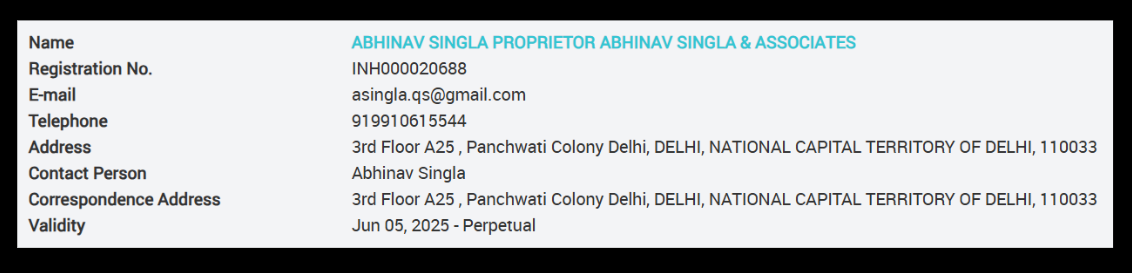
Abhinav Singla holds a SEBI Research Analyst registration (Reg. No. INH000020688), valid for perpetual use from June 5, 2025.
He operates as an individual proprietor under the name Abhinav Singla & Associates, registered at 3rd Floor, A-25, Panchwati Colony, Delhi, National Capital Territory of Delhi, 110033.
On LinkedIn, Abhinav Singla presents himself under the handle “asingla-youngminds”, with his professional designation listed as SEBI Registered Research Analyst.
The “youngminds” branding in the profile handle suggests a positioning aimed at engaging younger, first-time, or growth-oriented investors, a segment of the market that is particularly active but also particularly vulnerable to advisory services that overstate certainty or underdeliver on substance.
It is also worth noting a separate entity, Abhinav Singla & Associates, that appears on IndiaMart as a retailer of printers and IT hardware products, based in New Delhi (110033), with the same address pincode.
This is a distinct commercial activity unrelated to equity research.
The two should not be conflated, but their coexistence under the same name is a detail investors should be aware of when conducting background research.
The absence of a dedicated stock market advisory website compounds the transparency challenge.
Standard investor due diligence, reading service terms, risk disclosures, fee schedules, and past research samples is simply not possible through a public digital channel in this case.
Everything must be explicitly requested in writing from the analyst directly, and documentation must be received and retained before any payment is made.
What SEBI Allows a Registered Research Analyst to Do?
Under SEBI (Research Analysts) Regulations, 2014, Abhinav Singla is authorised to provide a defined set of research and analytical services.
Understanding this scope helps investors assess whether the services being offered are appropriate and compliant.
- Publish Research Reports on Securities: Registered RAs can issue documented analysis on listed stocks, sectors, and market trends. All research must be unbiased, analytically grounded, and accompanied by proper risk disclosures. The quality and depth of research from a newly registered RA will typically improve over time as the practice matures.
- Issue Research-Backed Recommendations: Buy, sell, or hold views may be shared, provided they are supported by documented research rationale. These must be presented as analysis, not as guaranteed outcomes or certainties about future market behaviour.
- Use Permitted Channels for Research Delivery: Research may be delivered through email, WhatsApp, telephone, or SMS, even without a website, as long as delivery is consistent with SEBI’s communication and conduct guidelines.
- Charge Transparent, Fixed Fees: Subscription-based fees are permitted provided the fee amount, payment terms, and service scope are disclosed in writing in a signed service agreement before any service begins. Fees must not be linked to client trading outcomes in any form.
What SEBI-Registered Research Analysts Cannot Do?
Equally important is understanding the hard boundaries that govern what even a legitimately registered RA cannot do.
These limits protect investors from the kinds of practices that flourish in unregulated corners of the advisory industry.
- No Guaranteed Return Promises: An RA cannot assure investors of specific profits, fixed income from trades, or loss-free outcomes. Any such claim violates SEBI’s regulations and should be treated as a serious red flag regardless of the analyst’s registration status.
- No Discretionary Portfolio Management: Acting on behalf of clients, executing trades for them, managing their capital, or making investment decisions on their behalf requires a separate SEBI registration. A Research Analyst licence covers only research and analysis outputs.
- No Profit-Sharing Fee Structures: Fees cannot be contingent on or calculated as a proportion of client gains. Any arrangement that ties the analyst’s income to the client’s investment outcomes is an impermissible conflict of interest under SEBI’s framework.
- No Misleading Track Record Claims: Especially important for a recently registered analyst, claims of historical performance must be accurate, balanced, and verifiable. Presenting a curated selection of winning calls without disclosing losses or the full research context is prohibited.
- Mandatory Onboarding Documents Before Any Service: Before any paid engagement, the analyst must provide a signed service agreement, a SEBI risk disclosure document, and all regulatory disclosures. Investors should never pay before receiving and reviewing all of these documents in full.
What Should You Do If Problems Arise With Your RA?
If your experience with Abhinav Singla, or any SEBI-registered Research Analyst, raises concerns about misleading claims, undisclosed fees, missing documentation, or service quality, acting through the right channels in the right sequence is what determines how effectively your grievance is addressed.
- Compile your full documentation: Gather payment receipts, bank transfer records, all written communications (WhatsApp, email, call logs), any documents provided during onboarding, and records of all research received. Chronological organisation is essential.
- Write a concise factual account: Document the service period, amount paid, what was promised, what was delivered, and exactly where the experience fell short. Use dates, specific amounts, and verifiable facts throughout.
- Contact Abhinav Singla directly first: Email [email protected] or call +91 9910615544. Record the response, or any non-response, as part of your evidence file before escalating further.
- Lodge a complaint in SCORES: Register at the SEBI SCORES portal, ensuring your details match your KYC records. Select Research Analyst, enter registration number, upload your documented evidence, and describe each grievance point clearly and separately.
- Monitor your submission consistently: Check SCORES regularly for responses from the analyst and any SEBI communications. Respond promptly to any requests for additional documents to avoid delays in processing.
- Escalate if the resolution is inadequate: If the response fails to address your concern, use the escalation mechanism within SCORES. Provide documented reasons and attach all prior correspondence as context.
- File a Complaint in SMART ODR: The SEBI Online Dispute Resolution platform offers a structured, faster pathway for qualifying disputes, a valuable alternative to conventional arbitration proceedings.
- Arbitration in the Stock Market (if required): If the issue remains unresolved, you can initiate arbitration through the relevant stock exchange (such as the National Stock Exchange of India or BSE Limited). Arbitration is a formal dispute resolution mechanism where an independent arbitrator reviews your case, evidence, and submissions from both parties before issuing a binding decision.
- Retain all records throughout: Keep copies of every submission, acknowledgment number, and formal response received at every stage of the process, from the first direct contact to any final resolution.
Need Help?
Navigating a complaint against a newly registered, independently operating analyst, especially one without a public website, can feel uncertain.
Knowing exactly what you are entitled to and how to pursue it makes all the difference.
When you register with us, we help you with:
- How to independently verify SEBI RA registrations and check for any adverse regulatory history
- What mandatory documentation are you entitled to receive before any advisory service begins
- How to draft structured, evidence-backed complaints to SEBI SCORES and cybercrime portals
- How to use SMART ODR and arbitration pathways if standard resolution attempts fall short
Conclusion
Abhinav Singla holds a valid SEBI Research Analyst registration under his proprietary firm Abhinav Singla & Associates, with perpetual validity since June 2025.
He operates from Panchwati Colony, New Delhi, and identifies as a SEBI-registered analyst on LinkedIn under the “youngminds” branding.
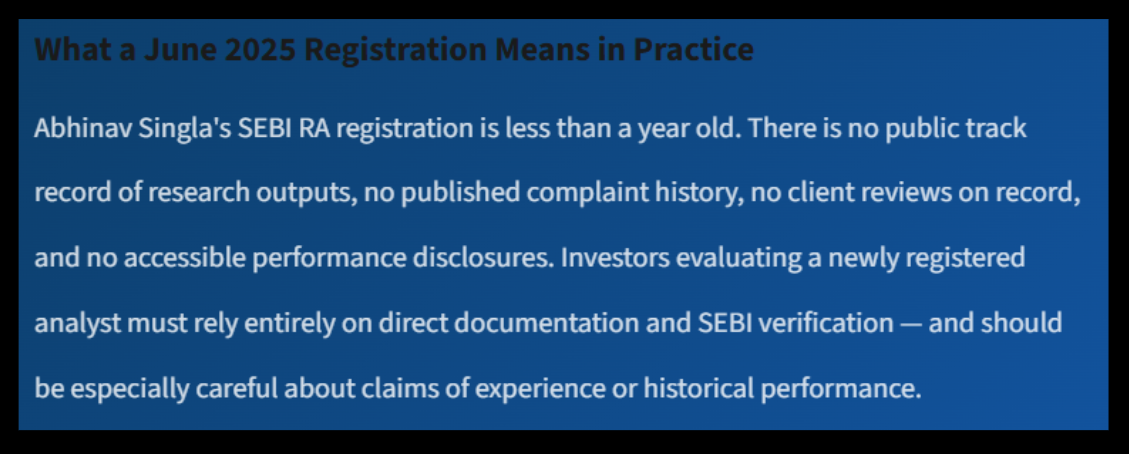
Two aspects of this profile warrant particular investor attention: his registration is brand new, less than a year old, with no public research track record or complaint history available, and he does not maintain a dedicated stock market website where standard due diligence documents could be independently reviewed.
Together, these factors place a significantly higher burden of responsibility on the investor to request, review, and retain all documentation proactively before any engagement begins.
Can I trust SEBI registered research analysts in India?
While the registration provides a layer of accountability, it is not a guarantee of performance
Before engaging, always verify the registration on SEBI’s official portal and ensure you have a signed service agreement and a clear risk disclosure document.
True due diligence begins with paperwork but ends with your own informed judgment.





 Add us as a preferred source on Google »

