

Every time someone types “best stock advisory in India” into a search bar, hundreds of names flood the results, most of them unverified, unregulated, and unreliable.
In an ecosystem where financial advice is thrown around as freely as social media posts, choosing the right research partner demands more than just a Google review.
It demands asking the right questions: Is this firm regulated? What can they actually do? What are they not allowed to do?
This blog takes a thorough, structured look at Graassp Equity Research Services, who they are, what their regulatory standing looks like, and what every potential investor should understand before subscribing to any advisory service.
Graassp Equity Research Services Review
Not every financial advisory firm launches with a clear philosophy.
Graassp Equity Research Services did.
Founded formally in 2023 and headquartered in New Delhi, the firm traces its conceptual roots back to 2015, nearly a decade of thinking before it became a registered entity.
That kind of considered origin story is relatively uncommon in a sector crowded with overnight operators.
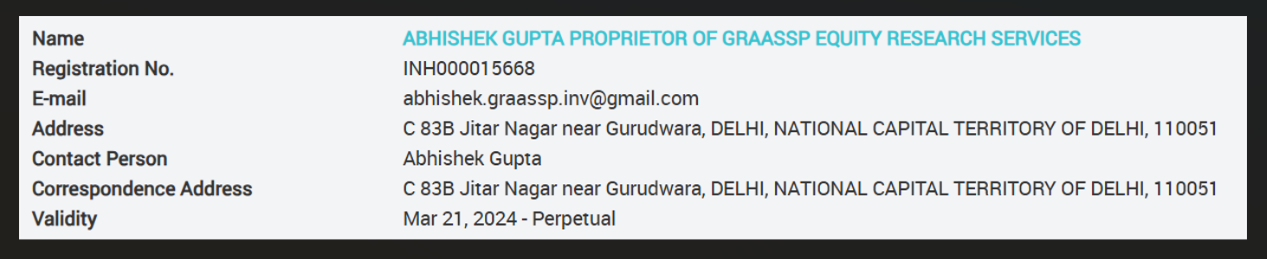
The firm’s stated mission goes beyond just generating buy-sell calls.
According to its publicly available disclosures, Graassp explicitly focuses on making financial knowledge accessible to individuals who may lack formal finance education, come from lower-income backgrounds, or have simply never been told that markets can work in their favour.
That community-first framing sets a distinct tone compared to most advisory services that speak almost exclusively to already-affluent investors.
The founding team brings over 15 years of equity market experience, and the firm offers three core service pillars: curated Smallcase portfolios (theme-based stock baskets), Equity Research Reports covering individual companies’ financials, valuations, and risk profiles, and Industry Research Reports that map sector-level dynamics, growth drivers, and competitive landscapes.
Each of these services sits clearly within what SEBI permits a registered research analyst to do.
Graassp’s disclosure page explicitly states that the firm’s research services are limited to providing independent recommendations and do not include portfolio management or advisory services.
The firm also states clearly that it does not guarantee returns, a compliance stance that not every advisory service in India is forthcoming about.
On the complaint data front, Graassp has published its SEBI complaint records openly on its website.
The numbers speak for themselves:
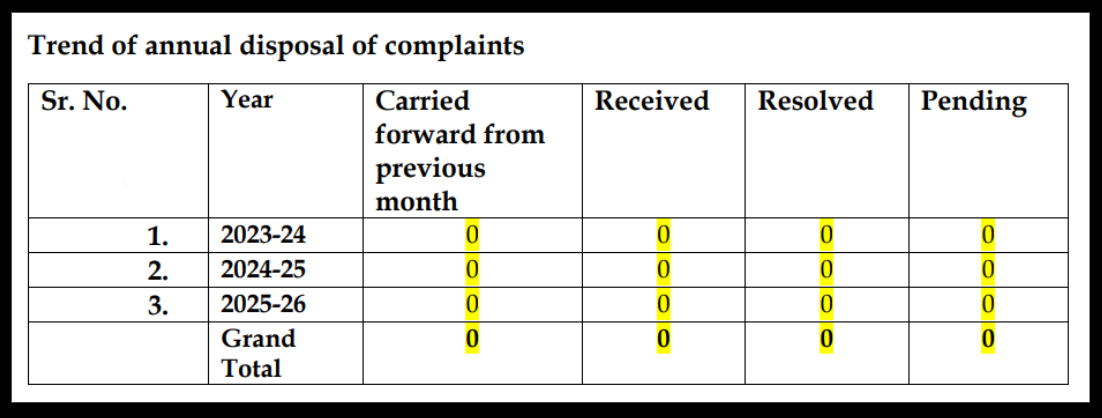
Zero complaints across three successive reporting years is a meaningful data point, especially in a segment where SEBI’s SCORES platform regularly receives thousands of grievances against research and advisory firms each year.
It does not, of course, guarantee future conduct, but it reflects a clean track record so far, and one that stands up to public scrutiny.
That said, a clean complaint record and a SEBI registration number, while genuinely reassuring, should still be viewed as the floor of due diligence, not the ceiling.
Investors are always encouraged to review the firm’s service agreement, fee structure, and risk disclosures carefully before making any commitment.
Understanding both what a registered analyst can do for you and what they are legally not permitted to do is the real starting point for a well-informed decision.
What SEBI Allows a Registered Research Analyst to Do?
The SEBI guidelines for Research Analyst entities, as defined by the SEBI (Research Analysts) Regulations, 2014, establish a clear operational scope for registered RAs.
Knowing this scope is what separates informed investors from those who rely on blind trust.
- Publish Structured Research Reports: Registered RAs may produce formal reports on listed securities, sectors, or market themes. These reports must be factually grounded, unbiased, free from undisclosed conflicts of interest, and must include relevant risk factors alongside any valuation or investment thesis.
- Issue Research-Backed Investment Recommendations: Buy, hold, or sell recommendations are permitted, provided they stem from documented analytical work. Each recommendation must carry appropriate risk disclosures and must never be presented as a guaranteed outcome.
- Offer Sector and Macroeconomic Analysis: RAs can share views on industries, index trends, policy impacts, and economic developments, purely as analytical commentary, not as fund management or execution-level advice.
- Charge a Transparent, Flat Fee: Advisory fees are permitted as long as they are clearly stated upfront, consistent with regulatory norms, and in no way linked to the client’s profits, trading performance, or capital size.
- Offer Curated Smallcase Portfolios: Where approved, RAs can create and publish theme-based portfolios on regulated platforms like Smallcase, giving retail investors access to structured, research-driven equity baskets.
What SEBI-Registered Research Analysts Cannot Do?
The regulatory guardrails that SEBI places on research analysts are designed entirely to protect investors. Understanding these limits is as important as knowing what services are on offer.
- No Guaranteed Return Promises: Claiming fixed daily income, assured profits, or certainty of positive outcomes is prohibited outright. Any service that frames its recommendations as “100% accurate” or “sure-shot” is operating outside SEBI’s permitted boundaries.
- No Loss Recovery Guarantees: Offering to “recover” a client’s prior trading losses or marketing strategies as entirely risk-free is not allowed. All markets carry inherent uncertainty; representations to the contrary are misleading.
- No Performance-Linked Fee Structures: Fees cannot be charged as a share of client profits, tied to capital growth, or deducted from trading gains. Such arrangements create a direct conflict of interest and are explicitly prohibited by SEBI regulations.
- No Unsolicited or Pressure-Based Selling: Bombarding potential clients with repeated calls, creating artificial urgency to subscribe, or using manipulative marketing tactics goes against SEBI’s fair dealing principles.
- No Portfolio Management or Fund Handling: An RA is authorized to recommend, not to manage. Handling client funds, executing trades on behalf of clients, or operating like a portfolio manager without the appropriate PMS registration is a compliance violation.
- Full Documentation Is Non-Negotiable: Every client engagement requires a clear written agreement, a risk disclosure document, and transparent communication of fees and responsibilities. Skipping these formalities is not a minor oversight; it is a red flag.
What Should You Do If Problems Arise With Your RA?
Even with a well-regulated firm, misunderstandings can occur.
If you ever feel that a research analyst has acted in a manner inconsistent with SEBI’s guidelines, whether through misleading claims, billing disputes, or failure to deliver agreed services, the investor protection system in India gives you clear avenues to seek resolution.
Need Help?
If you’re unsure about the next steps or feel overwhelmed by the process, you don’t have to manage it on your own. Simply register your complaint with us, and we’ll handle the rest.
Once you connect with us, we’ll review your situation, help structure your information, and guide you through each stage. From filing your complaint to identifying the most suitable platform, we simplify the entire process for you.
You don’t have to navigate everything alone; having the right guidance at the right time can make a meaningful difference.
Conclusion
Graassp Equity Research Services enters the advisory space with a thoughtful background, a SEBI-registered framework under proprietor Abhishek Gupta, and a clean complaint record spanning three financial years.
Its focus on the scuttlebutt research methodology, financial education for underserved investors, and clearly defined service boundaries reflects a considered approach to operating within a regulated environment.
If you are evaluating their services, approach it the way you would any significant financial decision: verify the SEBI registration independently, read the full disclosure document on their website, understand the fee structure before signing anything, and confirm that no guaranteed return language appears anywhere in the service agreement.
A SEBI registration and a zero-complaint record are meaningful indicators, but the best protection for any investor remains a thorough, unhurried review of all terms and conditions before committing.
Informed decisions made in advance are always worth more than complaints filed in hindsight.





 Add us as a preferred source on Google »

