

Quick Summary
Elite Investment Advisory Services was a sole proprietorship run by Rajiv Kumar Singh out of Indore, Madhya Pradesh, holding SEBI Investment Adviser registration INA000003668. A joint SEBI and BASL inspection in January 2024 found unqualified tele-callers, no documented risk profiling, fees charged above the legal cap, ₹2.37 crore in unexplained bank credits, and 174 unresolved investor complaints. SEBI’s final order, passed March 25 2026, imposed a ₹35 lakh penalty and cancelled the firm’s registration with immediate effect. This page covers the full inspection findings, every violation identified, and the exact steps to follow if you were a client.
Have you ever received a call from someone claiming to be a SEBI-registered investment advisor, promising guaranteed returns or a way to recover your past losses in the stock market?
If you have, you are not alone. Thousands of retail traders across India get such calls every day, and most, at some point, believe it.
The registration number gets thrown in early to build trust. The testimonials feel real. The person on the other end sounds confident.
But a SEBI registration number does not automatically make someone honest. The story of Elite Investment Advisory Services, run by proprietor Rajiv Kumar Singh, is a direct example of exactly that.
Elite Investment Advisor
Rajiv Kumar Singh was the sole proprietor behind Elite Investment Advisory Services, based in Indore, Madhya Pradesh.
| Full Name | Rajiv Kumar Singh |
|---|---|
| Firm Name | Elite Investment Advisory Services |
| Type | Individual Investment Advisor (Sole Proprietor) |
| SEBI Registration No. | INA000003668 |
| Location | Indore, Madhya Pradesh |
| PAN | BZZPS6587H |
| Current Status | Registration Cancelled by SEBI |
If you search INA000003668 on SEBI’s official database today, this registration is no longer active.
A cancelled registration means the person is no longer authorised to provide investment advisory services in India. Any advisory activity conducted after cancellation would be illegal.
On paper, this once made Rajiv Kumar Singh a legitimate, regulated intermediary. Behind the scenes, a joint SEBI and BASL inspection found something very different.
Rajiv Kumar Singh
Rajiv Kumar Singh operated Elite Investment Advisory Services alone, as an individual investment adviser based in Indore, Madhya Pradesh, without any partners or a corporate structure behind the business.
This individual status is worth understanding on its own.
Unlike a company with a board, multiple directors, or a separate legal identity, an individual registration means the person and the business are legally the same thing.
There is no internal structure separating him from the firm’s day-to-day decisions.
That is why SEBI’s investigation and final order were addressed to him personally, not to a company name.
Anyone with a complaint connected to Elite Investment Advisory Services is, in practical terms, dealing directly with Rajiv Kumar Singh, since there was never a separate corporate entity for a grievance to be routed through.
Also Read: Shubh Stocks Capital, the honest gap between what’s stated and what’s actually confirmed.
Is Elite Investment Advisor Legit?
It was supposed to be a routine inspection. SEBI and BASL officials walked into the Indore office of Elite Investment Advisory Services on January 18 2024. What followed was far from routine.
The office had 50 to 60 tele-callers pitching investment advice to clients. Most had no qualifying certifications. Many were paid in cash specifically to avoid appearing on official payroll records.
The moment the inspection team arrived, staff started running. Not figuratively, literally. Employees began leaving the premises, computers were shut down, and data was being deleted. Rajiv Kumar Singh himself was nowhere to be found and appeared only hours later.
SEBI captured staff fleeing the office on video. Rajiv later admitted he had personally instructed employees to leave the premises and delete data to obstruct the inspection.
Is Elite Investment Advisory Services Good?
The honest answer depends entirely on which side of the story you are looking at. On paper, the registration, the office in Indore, and a growing client base made this look like a professional, trustworthy advisory service.
But a professional appearance is not the same as compliant conduct.
The real answer to whether this firm was actually good sits in what SEBI found once it looked past the surface.
That answer came in the form of a formal regulatory order, and the findings inside it are detailed enough to speak for themselves.
Also Read: Wealthmax Solution Investment Advisor, proprietor Piyush Jain, named directly across both orders.
Elite Investment Advisory Services SEBI Order
SEBI and BASL passed their final order against Elite Investment Advisory Services on March 25 2026, following the joint inspection conducted in January 2024.
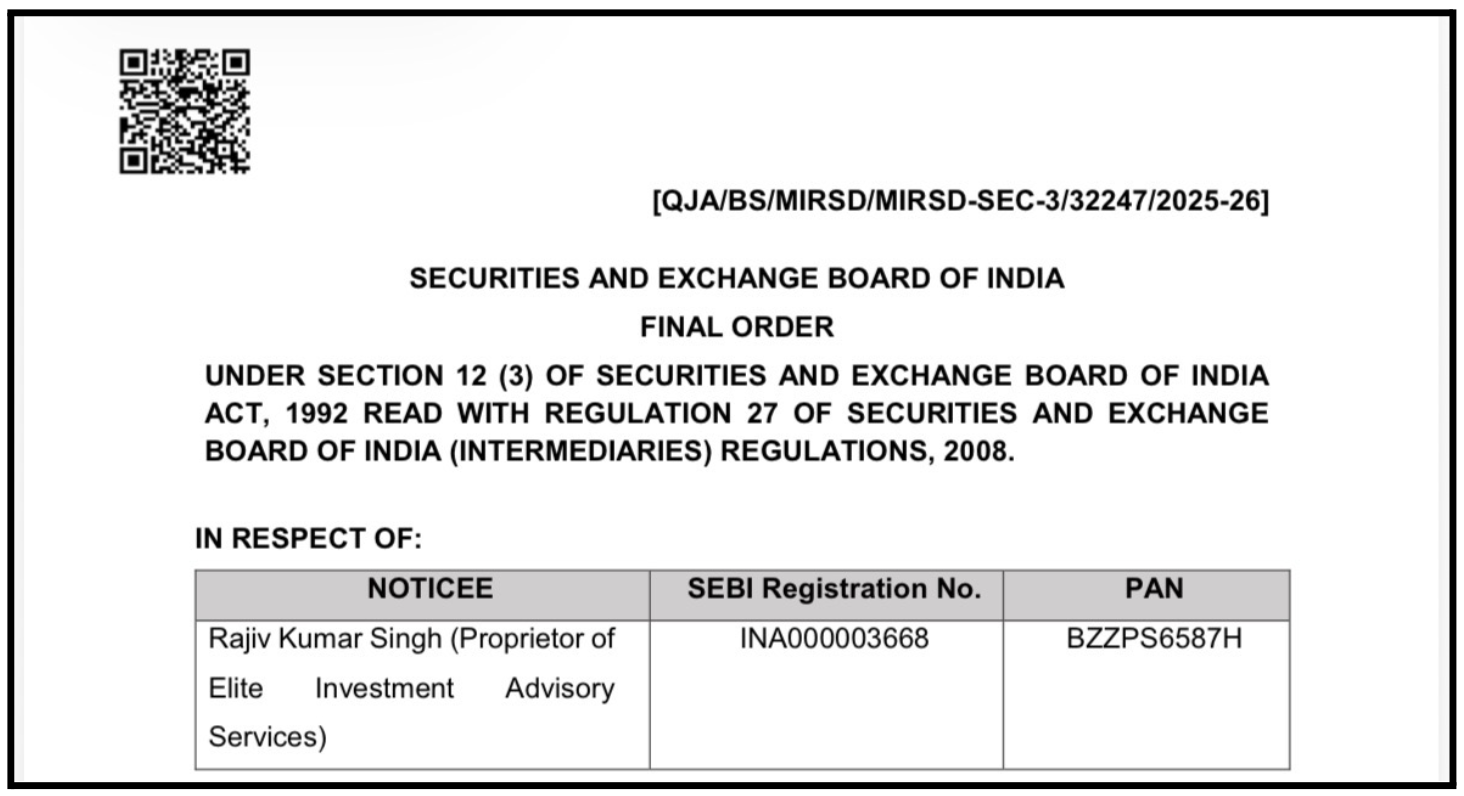
The order is a formal regulatory document, not an informal warning. It lists every violation identified during the inspection, cites the exact regulations each one breached, and concludes with the specific penalty imposed.
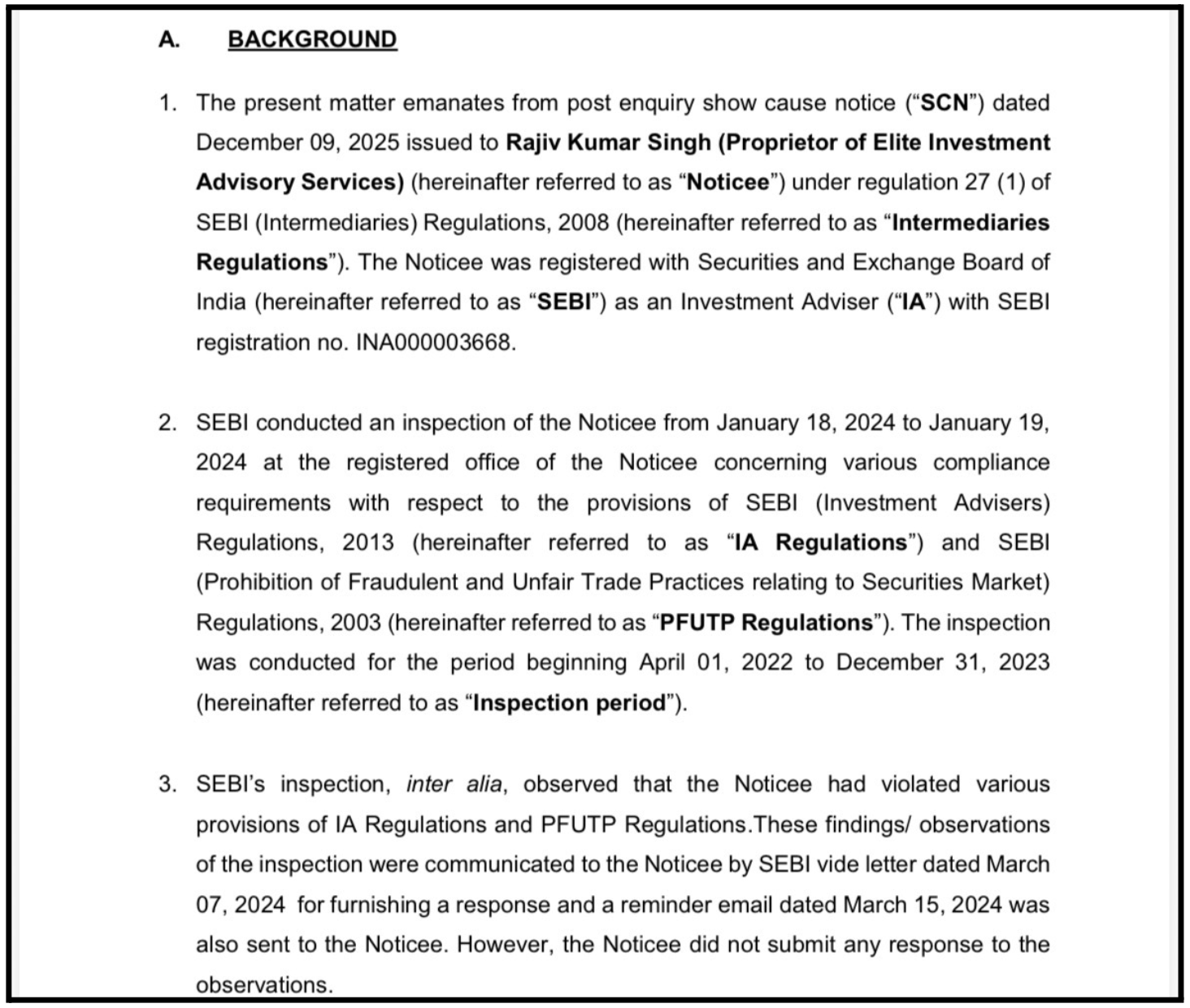
What follows below is every violation named in that order, presented in the same sequence SEBI investigated them.
1. No Valid Certifications, Operating Without Qualifications
SEBI regulations require every investment advisor and every team member interacting with clients to hold valid NISM certifications. Neither Rajiv Kumar Singh nor his employees possessed these qualifications.
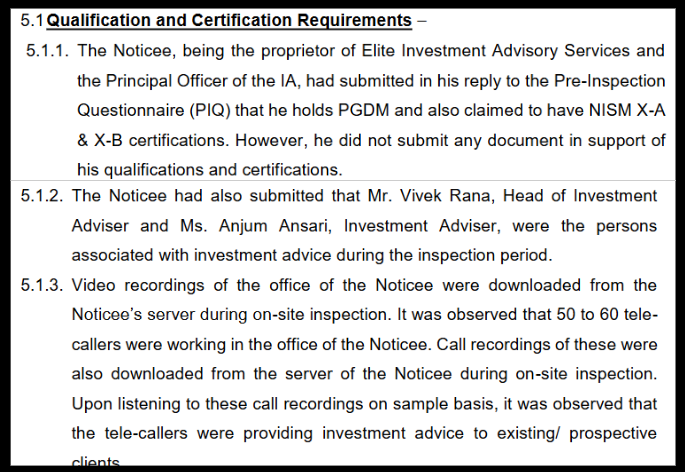
An entire office giving stock market advice, without the basic professional qualification to do so.
2. Crossed 150 Clients but Never Upgraded Registration
SEBI requires an individual investment advisor to convert to a non-individual, corporate structure once they exceed 150 clients.
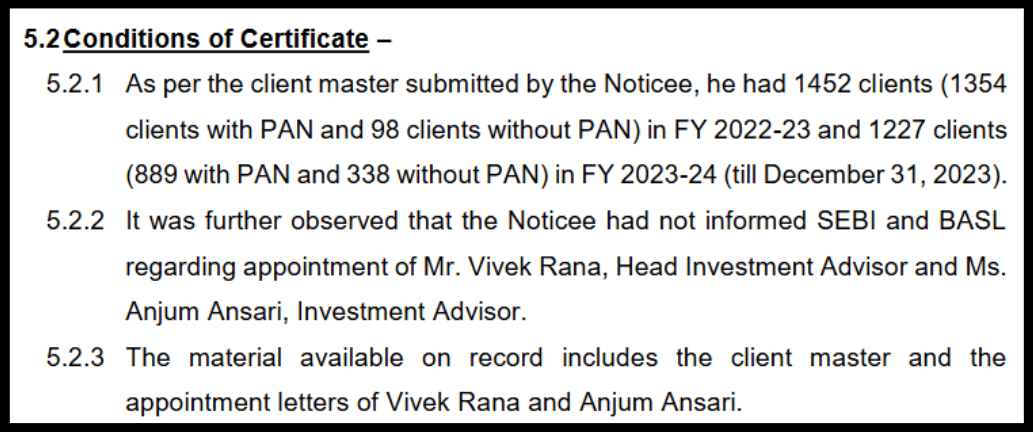
Rajiv Kumar Singh had over 1,400 clients at the time of inspection, nearly ten times the threshold, and never upgraded.
By continuing to operate as an individual, he deprived clients of the additional governance protections a properly structured entity would provide.
3. No Risk Profiling, No Suitability Assessment
SEBI found no documented risk profiling process whatsoever.
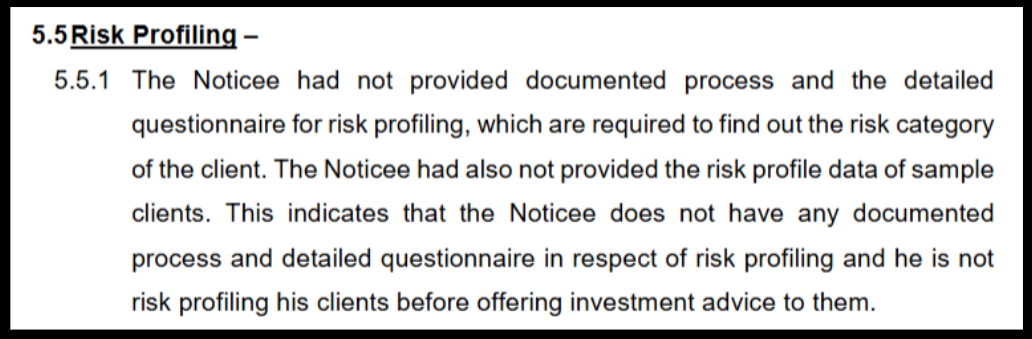
Every client, regardless of income or risk appetite, was advised to trade in F&O intraday, one of the riskiest trading formats in the market.
Many onboarding agreements were never signed at all.
4. Charging Fees Beyond the Permitted Cap
Under SEBI regulations, an investment advisor operating on a fixed-fee model cannot charge more than ₹1.25 lakh per client per year.
This cap protects clients from being overcharged for advice.
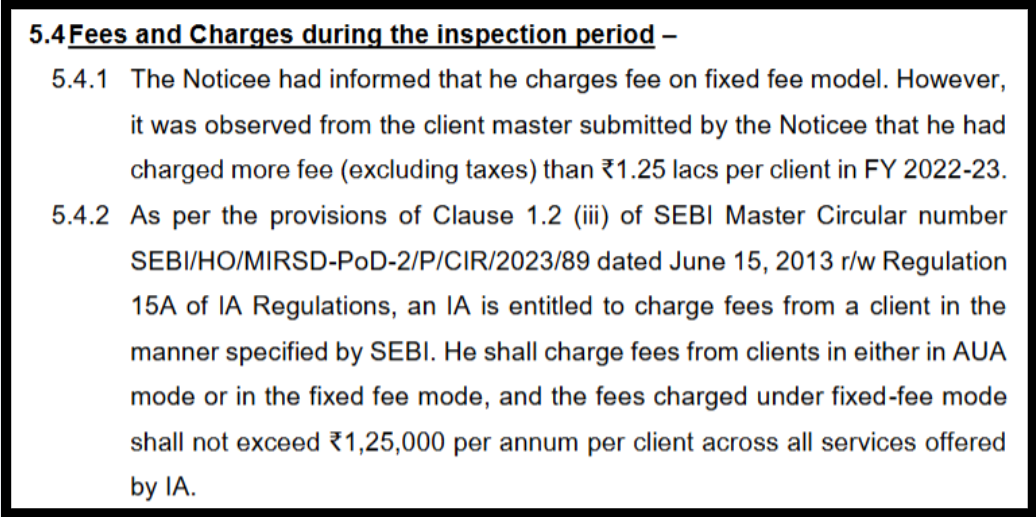
Rajiv Kumar Singh charged several clients fees exceeding this cap in FY 2022–23. In some cases, the excess was not small.
Clients were paying amounts beyond what the law allowed, and most of them probably had no idea this was happening because no proper agreements had been shared with them.
5. Promising Assured Returns and Loss Recovery
This is perhaps the most serious and most common violation in the advisory world. Promising assured returns or guaranteed recovery of losses is explicitly prohibited under SEBI regulations and PFUTP norms.
SEBI reviewed call recordings from Elite Investment Advisory Services and found clear evidence that employees regularly made such promises to clients.
Phrases like “we guarantee you will recover your losses” and “assured returns on our plan” were actively used to sell advisory subscriptions.
These promises are not just illegal; they are psychologically manipulative. They target people who have already lost money in the market and are desperate for a way back. SEBI viewed this as a fraudulent and unfair trade practice under the PFUTP Regulations.
6. ₹2.37 Crore in Unexplained Credits
One of the most alarming findings in the SEBI order was the discovery of ₹2.37 crore in unexplained credit entries in Rajiv Kumar Singh’s HDFC Bank account.
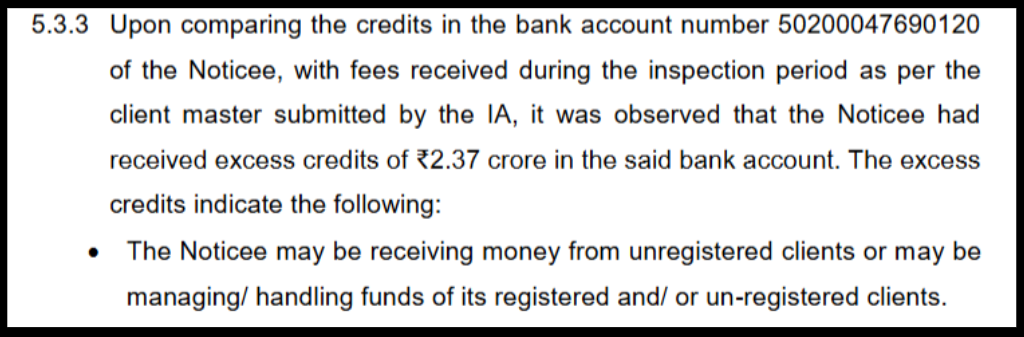
SEBI could not match these credits with any disclosed advisory fee income. This raised serious questions: was he collecting money from clients who were not on his official records?
Was he managing client funds like a Portfolio Management Service (PMS), which requires a separate and much more stringent SEBI registration? Was he charging undisclosed fees over and above the official invoices?
Rajiv did not explain. No bank statements of family members were submitted either, despite SEBI requesting them. The unexplained funds remain a significant red flag in the order.
Violation 7: Conflict of Interest, Employees Trading in Advised Stocks
SEBI also found that employees of Elite Investment Advisory Services were themselves trading in the same securities they were recommending to clients.
This is a direct conflict of interest and is specifically prohibited under investment advisory regulations.
When an advisor or their team personally trades in stocks they are simultaneously recommending to clients, the risk of front-running, manipulation, and self-serving advice becomes very real.
Violation 8: 174 Complaints, Zero Documented Resolutions
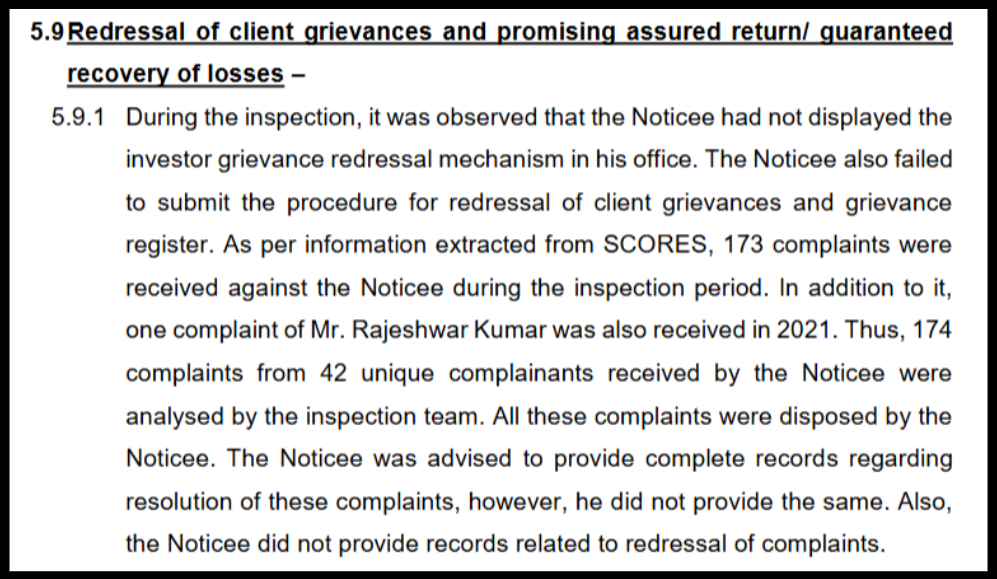
SEBI pulled data from its SCORES portal, the official complaint resolution platform for investors. and found 174 complaints filed by 42 different clients against Elite Investment Advisory Services.
Common themes across these complaints included promises of assured returns, failure to deliver on those promises, excessive fees, and demands for client login credentials.
When SEBI asked for documentation showing how these complaints had been addressed, the firm had nothing. Not a single piece of evidence shows a structured grievance redressal process, 174 complaints, and not one has been formally resolved.
Violation 9: Demanding Client Login Credentials
Multiple complaints indicated that Rajiv Kumar Singh’s team demanded login credentials for client’s trading accounts.
This is a blatant violation of investment advisory norms. A legitimate advisor gives advice; they do not operate your account.
By accessing client accounts directly, the advisor can execute trades without the client’s real-time knowledge or consent. This opens the door for unauthorised trading, overcharging on brokerage, and self-serving transactions, all at the client’s expense.
Violation 10: Deliberate Obstruction of SEBI Inspection
As described earlier, when SEBI arrived for the inspection, Rajiv Kumar Singh instructed his staff to flee, directed employees to delete data from servers, and failed to appear at the office for hours.
He later admitted to these actions.
SEBI categorised this as deliberate obstruction of a regulatory inspection, one of the most serious offences an intermediary can commit.
It reflects not just non-compliance, but an active attempt to hide wrongdoing from the regulator.
The Penalty: ₹35 Lakh and Immediate Cancellation
Based on the volume and gravity of the violations, SEBI imposed a total monetary penalty of ₹35 lakh on Rajiv Kumar Singh under three separate regulatory sections.
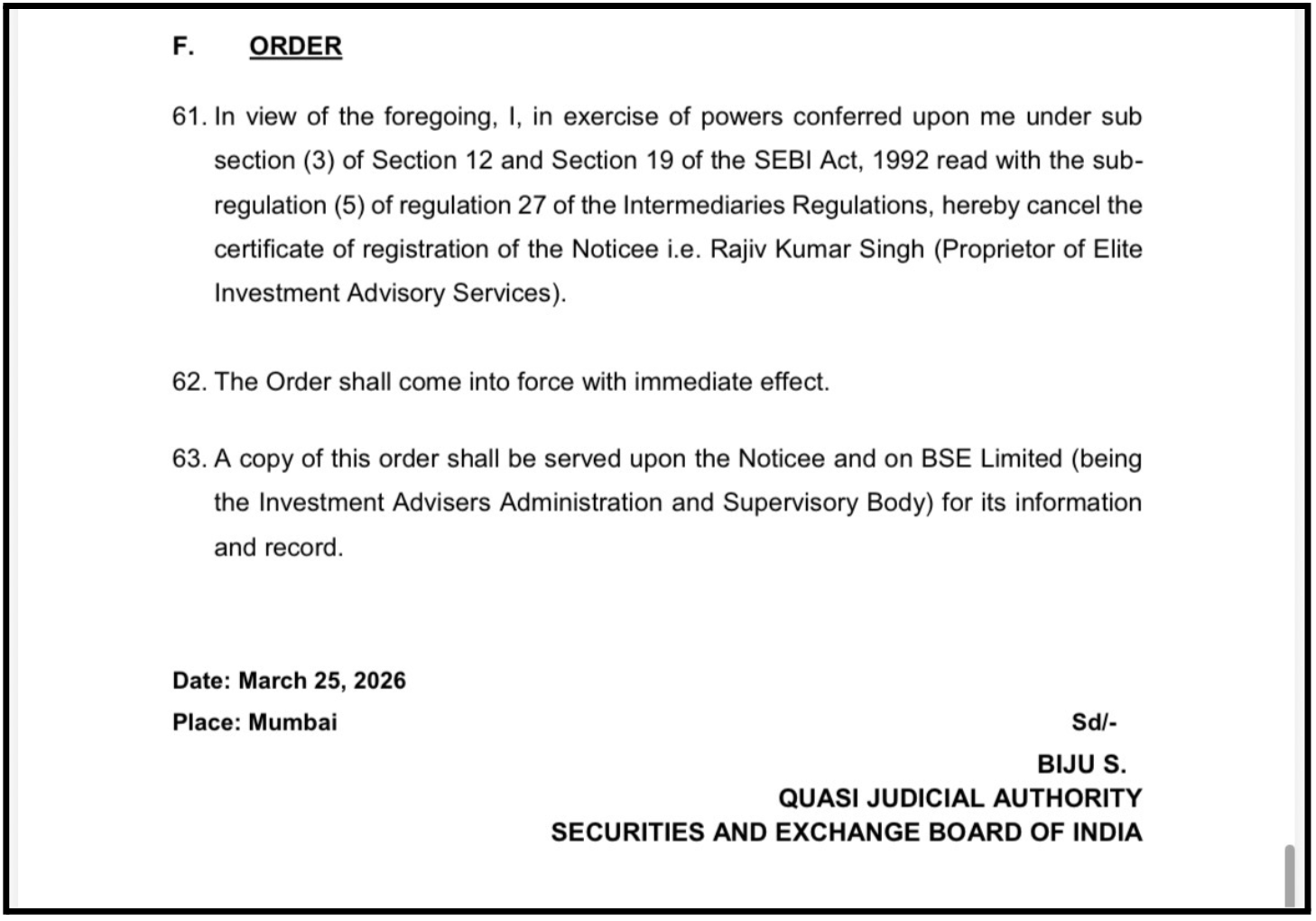
Beyond the financial penalty, SEBI’s final order, dated March 25, 2026, cancelled the SEBI registration of Elite Investment Advisory Services with immediate effect.
This is not a fine that can simply be paid to continue operating. It removed the legal right to function as a SEBI-registered investment adviser entirely.
Also Read: Ayushi Chauksey Adviser, a well-structured website, and a formal order sitting behind it.
What Every Investor Should Learn From This Case?
The violations in this case are not unique to Elite Investment Advisory Services.
They follow a pattern seen repeatedly across advisory scams in India, which is exactly why they are worth turning into a checklist you can apply to any adviser, not just this one.
- Never accept “guaranteed returns.” No legitimate adviser can promise this in a market that carries inherent risk.
- Always verify current registration status directly on SEBI’s website, not from what a website or salesperson claims.
- Insist on a documented risk profiling process before accepting any recommendation. If an advisor skips this step, that alone is a red flag.
- Never share your trading account login credentials with anyone. A legitimate advisor gives advice; they do not operate your account.
- If an adviser hides records or avoids direct questions during a review, treat that as a serious warning sign, not a minor inconvenience.
Did you pay for services from Rajiv Kumar Singh or Elite Investment Advisory Services and experience any of the issues described above?
Our team will review your documents, identifies every applicable violation, and prepares your case for formal escalation.
What Should You Do If You Have an Issue With an Investment Advisor?
The correct complaint path depends entirely on one thing: whether the entity you dealt with still holds a valid SEBI registration.
Elite Investment Advisory Services no longer does, since its licence was cancelled with immediate effect. That distinction changes which authority can actually act on your behalf, so read the section that matches your situation before proceeding.
If the Firm Is Still SEBI Registered
- Stop further payments and cut access. Pause all additional payments immediately. Avoid sharing OTPs, UPI PINs, remote-access permissions, or screen-sharing access. If someone else is controlling your account, regain access without delay.
- Collect and organise your evidence. Secure WhatsApp or Telegram chats, call recordings if available, payment receipts, bank statements, UPI screenshots, and any promised returns or projections. Build a simple timeline of dates, commitments, payments, and outcomes.
- Submit a SEBI SCORES complaint. Include all supporting documents and your timeline, clearly describing whether the issue involves misleading claims, excessive fees, refusal to refund, or account access demands.
- Escalate through the SMART ODR portal if your complaint remains unresolved. This offers a structured online dispute resolution mechanism when the initial complaint does not lead to action.
- Move to stock market arbitration as a final step. An independent arbitrator evaluates the evidence before issuing a binding decision, particularly important when the financial loss is significant.
If the Registration Has Been Cancelled or the Entity Was Never SEBI Registered
This is the path that applies specifically to Elite Investment Advisory Services, since its licence no longer exists as of SEBI’s final order.
- File a complaint through the cyber crime portal, the Government of India’s official platform for reporting financial fraud. Submit your evidence and note down the acknowledgement number.
- Lodge an FIR at your local police station. Every state has a cybercrime division, and under Section 154 CrPC, your local station is bound to accept the complaint even without visiting a specialised cyber cell.
- Inform your bank immediately if any payment was made through a traceable channel, since early notification improves the chance of tracing or freezing funds.
- You can still send a written email to SEBI flagging the individual or entity, since this helps ensure any future licence application from the same person is properly scrutinised.
Conclusion
Elite Investment Advisory Services is not just a regulatory story. It is a wake-up call for every retail investor in India.
A SEBI registration number on a website or a confident voice on a phone call does not guarantee honesty or competence.
Behind the professional front were unqualified tele-callers, broken promises, and 174 unresolved complaints from real people who trusted the wrong person with their savings.
Always verify an advisor’s registration status on SEBI’s official portal before paying a single rupee. In the stock market, trust without verification is a risk you cannot afford.
Report. Recover. Stay Fraud Free.
Frequently Asked Questions
No. SEBI's final order dated March 25 2026 cancelled registration INA000003668 with immediate effect. Verify the current status directly at sebi.gov.in under Investment Adviser.
SEBI imposed a ₹35 lakh monetary penalty across three separate regulatory sections, in addition to cancelling the firm's registration entirely.
SEBI's SCORES data showed 174 complaints filed by 42 different clients, covering assured return promises, excessive fees, and demands for account login credentials. None had documented resolutions when SEBI reviewed the firm's records.
Stop any further payments immediately, never share trading login credentials, and collect all payment records, chats, and call recordings. File a complaint on SEBI SCORES first, escalating to SMART ODR and arbitration if the matter remains unresolved.
His SEBI Investment Adviser registration has been cancelled entirely, meaning he cannot legally provide investment advisory services under any name without obtaining a fresh registration. If you encounter him or anyone connected to this firm still offering advisory services, verify their current registration status independently before engaging.





 Add us as a preferred source on Google »

