

Choosing an investment adviser is a lot like picking a pilot for your flight. You expect them to know the route, respect the safety protocols, and have the proper license to be in the cockpit.
But what happens when the regulator grounds the “pilot” you trusted with your savings for breaking every rule in the book?
Many of you have been searching online to ask: is elite investment advisor legit?
It is a fair question, especially in a world where anyone can create a professional-looking website or a slick social media profile. But the truth is rarely found in an “About Us” page or a catchy sales script.
Sometimes, the most polished facade is hiding a complete disregard for your financial security.
In this blog, we are going to look past the marketing, dig into the reality of the situation, and give you the facts you need to protect your wealth from those who do not play by the rules.
Is Elite Investment Advisor Legit Or Not?
When you ask if a service is “legit,” you are essentially asking: are they doing things the right way, according to the law?
For a long time, Elite Investment Advisory Services presented itself as a registered entity with SEBI, holding the registration number INA000003668.
By definition, a legitimate investment adviser is not just someone giving “tips”; they are a fiduciary who is legally required to put your interests above their own.
They should conduct detailed risk assessments, create suitable portfolios, and charge fees strictly within the limits set by SEBI.
However, legitimacy isn’t a static status but is a continuous commitment to compliance.
The moment an adviser starts cutting corners, whether by ignoring qualification requirements, hiding conflicts of interest, or making wild, illegal promises of guaranteed returns, they lose their legitimacy.
When SEBI investigated this firm, they didn’t just find a few clerical errors; they uncovered a systemic pattern of behavior that put investors at significant risk.
So, to answer your question: while they were once registered, their actions led to a final order that permanently revoked their standing.
They are no longer permitted to operate as a SEBI-registered investment adviser.
If you encounter them offering services today, the answer to whether they are legit is a resounding no.
SEBI Order Against Elite Investment Advisor
SEBI is the primary guardian of India’s financial markets. Their job is to ensure that when you invest, you are not being tricked by manipulative schemes or unprofessional conduct.
They don’t just look for small mistakes; they look for patterns that threaten the integrity of the market.
When SEBI initiates an inspection and reaches a final order, it is usually because the entity involved has demonstrated a total lack of respect for the rules that keep investors safe.
Understanding The Order
The final order against Rajiv Kumar Singh, the proprietor of Elite Investment Advisory Services, was passed on March 25, 2026.
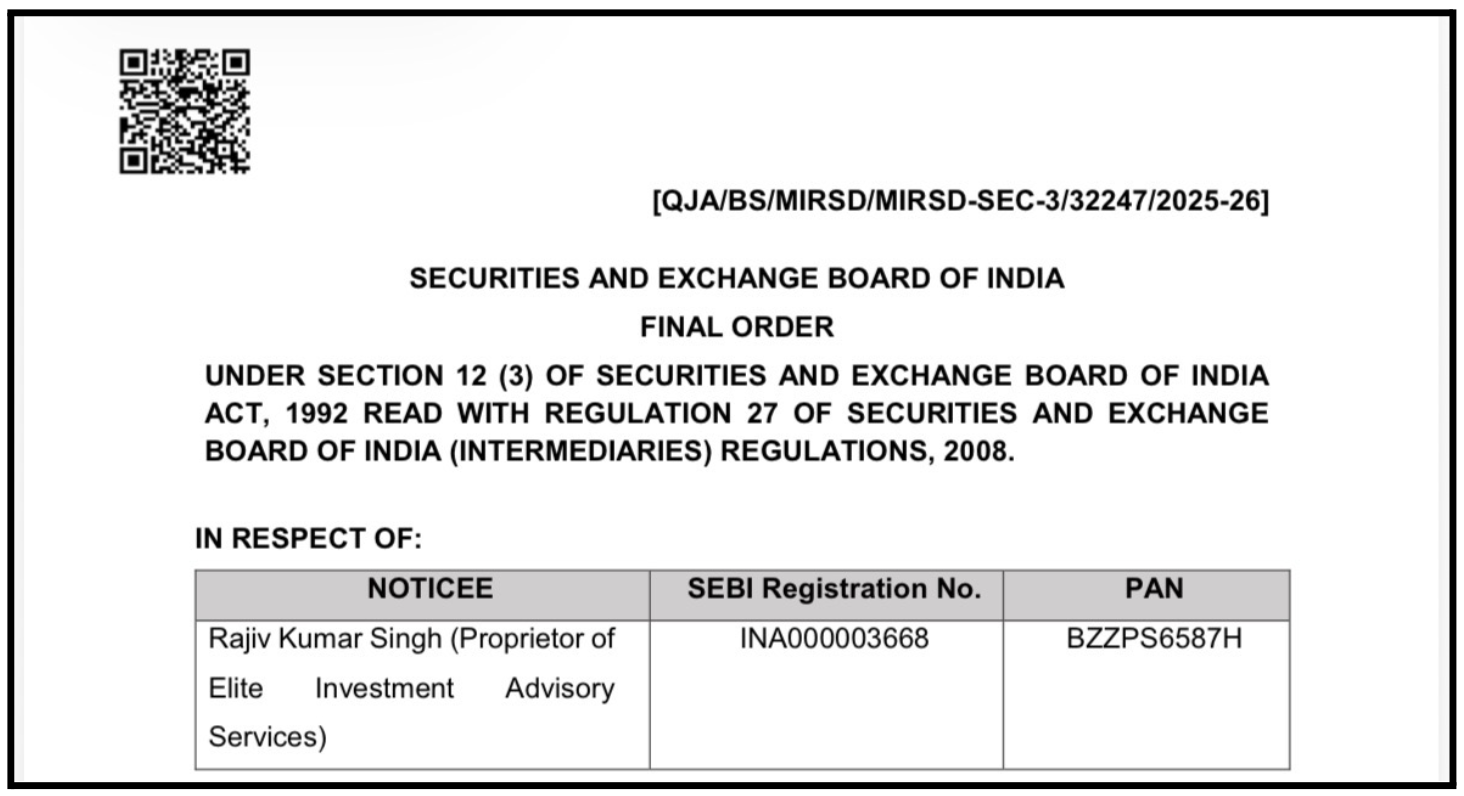
This was not a warning; it was a firm conclusion that the firm’s conduct was detrimental to the capital markets.
Why was this order issued?
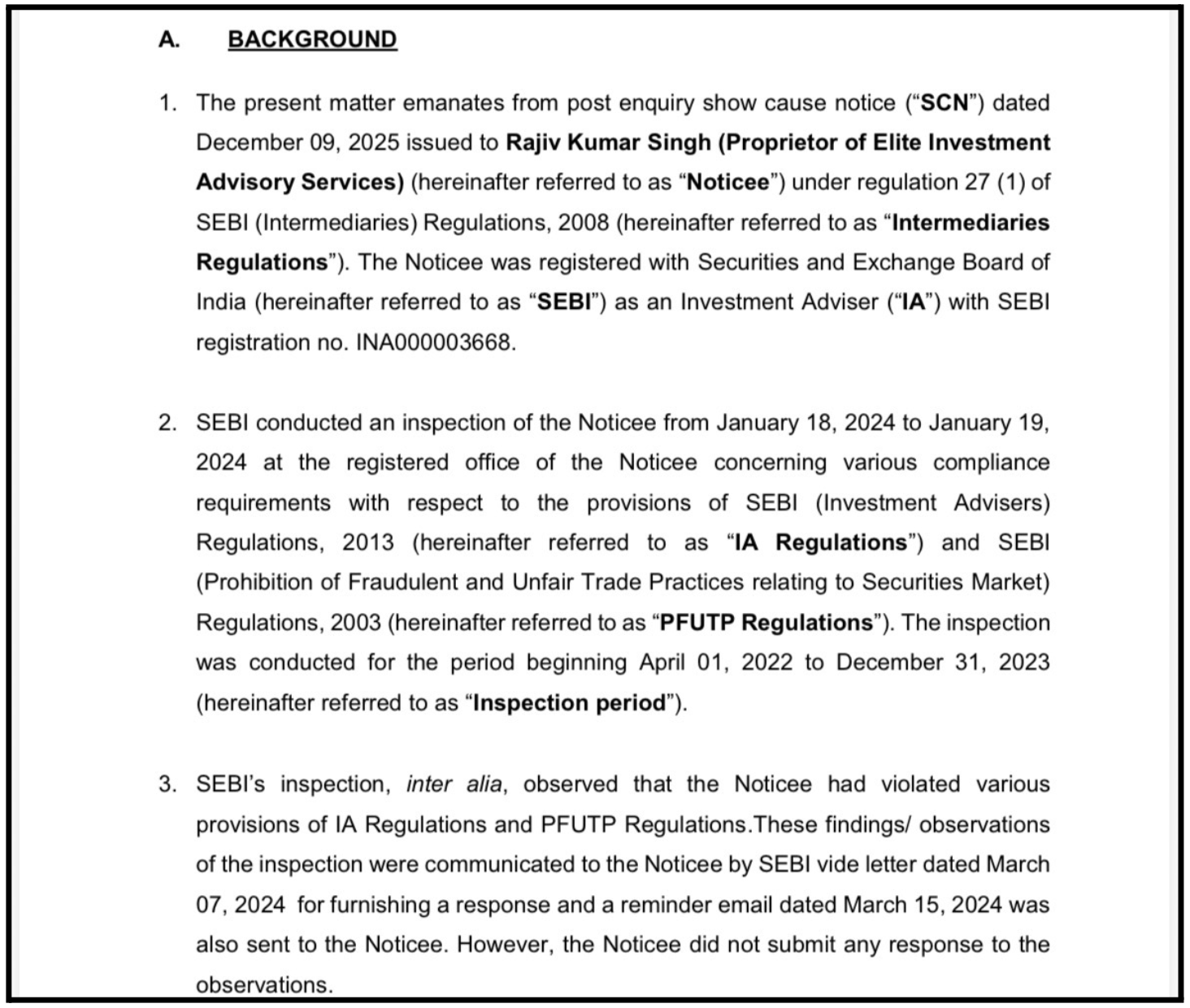
SEBI found a laundry list of serious violations that demonstrate why the firm failed the legitimacy test:
- Lack of Professionalism: The proprietor and employees lacked the mandatory NISM certifications and proper qualifications required to offer advisory services.
- Scaling Without Registration: Even after crossing the threshold of 150 clients, the firm did not upgrade to the non-individual category as required by law.
- Financial Irregularities: Investigators found unexplained credits of ₹2.37 crore, which suggested the firm might have been handling client funds inappropriately or engaging in undeclared distribution services.
- Failure of Duty: There were no documented processes for risk profiling or suitability assessments, meaning advice was being handed out blindly without considering the client’s financial health.
- Fee Overcharging: The firm violated the fee cap of ₹1,25,000 per year per client, effectively charging more than what the regulations allow.
- Misleading Conduct: The firm’s employees were caught promising assured returns and guaranteed recovery of losses, which is a massive red flag and a direct violation of securities law.
- Obstruction of Justice: When the inspection team arrived, the firm attempted to hide records, delete data, and instructed employees to flee the premises. It was a clear sign that they had something to hide.
The Penalty Imposed
The hammer came down in the form of a cancellation of the certificate of registration. This means the firm is legally prohibited from carrying out any investment advisory business with immediate effect.
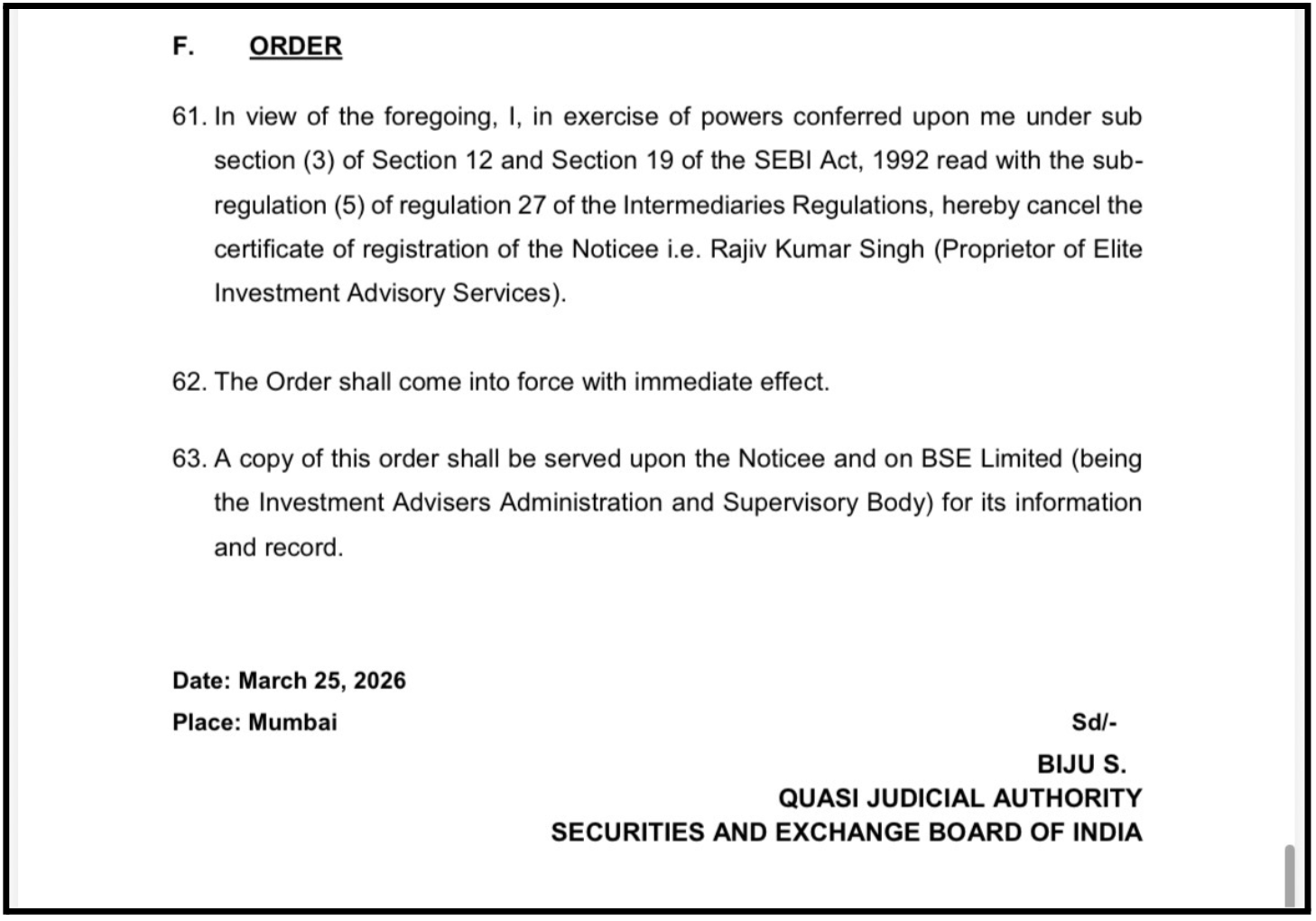
It wasn’t just a fine; it was a total shutdown of their professional capacity to act as an intermediary.
Key Learnings For Every Investor
If you are worried about whether your current adviser is “legit,” use this case as your blueprint for safety:
- Never believe in Guaranteed Returns: In the stock market, risk is inherent. Anyone who guarantees profit is selling a fantasy, not advice.
- Verify on the SEBI Website: Always look up your adviser on the official SEBI portal to see their current status.
- Ask for the Process: A real adviser will spend time learning about your risk tolerance and financial goals. If they are in a rush to take your money, walk away.
- Transparency is Non-Negotiable: Insist on a written agreement and clear disclosure of fees and potential conflicts of interest.
- Check the Receipts: If the fee structure seems off or if you are asked to pay into an account that doesn’t match the registered business name, report it.
How to Report Against SEBI Registered Investment Advisor?
If you feel stuck with an advisory firm, don’t wait for “one last trade” to recover your losses.
Treat it like a structured case and take action step by step.
1. Stop payments and cut access
Immediately pause any further payments. Do not share sensitive details like OTPs, UPI PINs, remote-access permissions, or allow screen sharing during trading.
If they are operating your account, take back control right away. The longer it continues, the harder it becomes to establish accountability.
2. Gather all evidence
Preserve every piece of proof, including:
- WhatsApp or Telegram chats
- Call recordings (if available)
- Payment receipts
- Bank statements
- UPI screenshots
- Invoices
- Any profit projections shared
Also, prepare a simple timeline: dates, promises made, payments done, and actual outcomes.
3. Ask for a written resolution
Send a clear, concise email or message to the advisor stating your issue and request (refund or closure).
Keep it factual and brief. If they threaten or pressure you, document that as well; it strengthens your case.
4. File a Complaint in SCORES
File a SEBI complaint against advisory company online through SCORES.
Submit your complaint on SEBI’s SCORES platform.
Attach all evidence, including your timeline, and clearly state the issue, such as unregistered advisory, misleading claims, profit-sharing, non-refund, or harassment.
5. Register a Complaint with Smart ODR
If the issue remains unresolved, move to SEBI’s Smart ODR platform.
This provides a structured, online dispute resolution process and is useful when complaints get stuck.
6. File Stock Market Arbitration
If there is still no resolution, escalate the matter to arbitration through exchanges like the National Stock Exchange of India or BSE Limited.
An independent arbitrator will review your case, documents, and responses before issuing a binding decision.
This step is crucial if the financial loss is substantial.
Need Help?
If you’re unsure how to proceed, you don’t have to handle it alone.
You can register with us for assistance. We help you organise your case, guide you through complaint filing, and support you during arbitration and dispute resolution.
We aim to simplify the process and ensure you move forward with clarity and confidence.
Conclusion
The question “is Elite Investment Advisor legit?” serves as a vital reminder that in the financial world, you are your own first line of defense.
The order against this firm shows that even those who look professional can be operating outside the law.
When you choose a partner to guide your investments, you are handing them the keys to your future; never give those keys to someone who hides their records, makes impossible promises, or avoids the regulator.
Always prioritize transparent firms, follow the rules, and treat compliance as a core value rather than a burden.
Your financial journey is too important to be built on the advice of those who disregard the very rules that exist to protect you.
Stay alert, stay informed, and always choose to walk with those who value your trust.





 Add us as a preferred source on Google »

