

Quick Summary
Essential Investment Managers Private Limited is a Bengaluru based SEBI registered investment adviser under INA000017912. It also holds an IRDAI composite corporate agent registration and works with banks and NBFCs. Its monthly disclosure shows two complaints received and two resolved between September 2024 and August 2026. Public pricing is not shown. This guide explains how to read its conflict disclosure, which grievance route fits which service, and what to ask in writing before you pay.
You see a short website, a few document links and no price list, and you wonder whether that is normal for a SEBI registered adviser. That is often the moment people search Essential Investment Managers Private Limited before agreeing to anything.
The firm sits on the lighter side of what we usually review. Its registration is in place, its complaint numbers are small, and its disclosures are fairly open about group links.
Still, a thin website leaves gaps, and this guide helps you fill them with the right questions.
What Is Essential Investment Managers Private Limited?
Essential Investment Managers Private Limited, often shortened to EIMPL, is a company incorporated in Bengaluru on 9 March 2021.
It runs an investment advisory service through what it calls a separately identifiable department.
The firm says it looks at your investment objectives, your risk profile and your financial situation before it gives advice.
That is the standard SEBI expects from any investment adviser, so treat it as the baseline and not a special feature.
EIMPL is a non individual adviser, which means a company holds the registration and not a single person.
For you, that usually means advice comes through a team and a documented process, so ask who exactly will talk to you and who signs off on the advice.
The firm does more than advise. It is also a composite corporate agent for insurance, and it says it offers other services through partnerships with banks and NBFCs.
Those extra services shape which rulebook protects you, and we cover that below.
Its parent is CASE Platforms Private Limited, and it names Windmill Capital Private Limited as an affiliate that is a SEBI registered research analyst.
In plain terms, EIMPL is one part of a wider group, and a careful reader should see the advisory arm as one piece of that picture.
Is Essential Investment Managers Private Limited SEBI Registered?
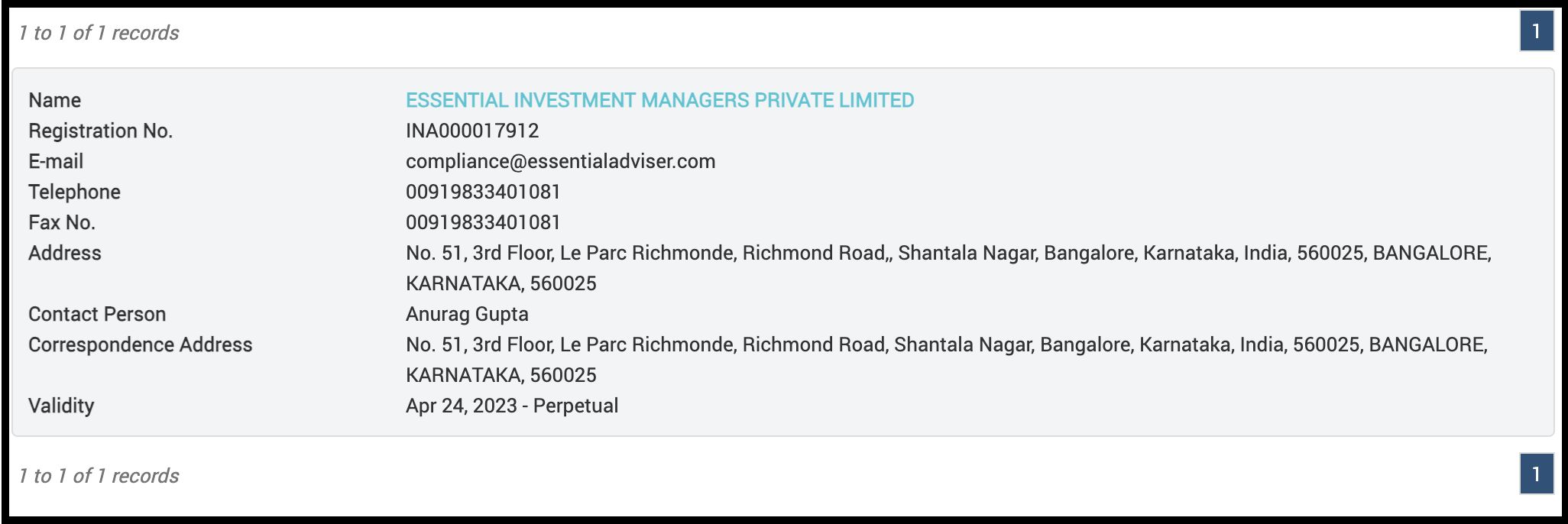
The research doc shows that Essential Investment Managers Private Limited holds SEBI registration as an investment adviser.
Here are the details as the firm discloses them.
The registration number is INA000017912. The INA prefix marks an investment adviser, as against INH for a research analyst.
The registration is effective from 24 April 2023 and is described as perpetual, so there is no renewal date to track on the SEBI side.
The firm is enlisted with BSE Limited as an investment adviser administration and supervision body member, with enlistment number 1981. This is the body that supervises many advisers on SEBI’s behalf.
The corporate identification number is U66190KA2021PTC145058. You can use it to look up the company’s filings with the registrar of companies.
The IRDAI composite corporate agent registration is CA1071, valid until 15 September 2028. This one is separate from the SEBI registration and covers insurance distribution only.
The registered office is on the third floor of Le Parc Richmonde, Richmond Road, Shantala Nagar, Bengaluru 560025.
Anurag Gupta is listed as the compliance and grievance officer, and Shubham Shreshtha is listed as the principal officer. We name them only because the firm lists them in that role.
A registration number is a starting point and not a verdict.
We suggest you confirm the number on SEBI’s intermediary search before paying, because details can change over time.
In the sources we reviewed, we found no SEBI order against the firm as of 10 October 2026, and we want to be clear that this is not a clean certificate. Our search covered public records only and one source listing for the registration.
EIMPL Business Lines and Which Grievance Route Applies
This is the part of the disclosure that deserves the most careful reading.
The firm does more than one thing, and your complaint route depends on which one you used.
The four areas below come from the firm’s own description of itself.
Use them as a checklist when you decide who to write to if something goes wrong.
1. Investment Advisory Services
This is the regulated advice business under INA000017912.
The firm says clients sign an Investment Advisory Agreement before advice starts or fees are charged.
If your dispute is about advice, risk profiling, fees or conduct under that agreement, the SEBI framework is the natural home for it.
2. Insurance As a Composite Corporate Agent
The IRDAI registration CA1071 covers insurance distribution.
A grievance about a policy sold through this route normally follows the insurance regulator’s process and the insurer’s own channels.
Keep policy documents and the point of sale record handy, because they decide where your complaint can go.
3. Services With Banks and NBFCs
The firm says it provides non advisory services through partnerships with RBI regulated banks and NBFCs.
The research doc mentions credit facilities in this context.
Here the lender or partner usually holds the customer relationship, so its grievance process comes first.
The firm’s own statement says SEBI recourse is not available for grievances about non advisory services or services outside SEBI’s purview.
4. Group Entities
CASE Platforms Private Limited is the parent, and Windmill Capital Private Limited is a SEBI registered research analyst in the same group.
A product or report from a group company has its own registration and its own complaint path.
Many readers lose time at exactly this point. They write to the wrong body, wait for a reply, and then find the service sat outside that body’s reach.
Before you pay for anything, ask the firm to state in writing which entity provides the service and which regulator oversees it.
Bought more than one service from the same group and not sure which regulator will hear your complaint?
Our team reads your agreement, invoices and messages, works out which entity and forum your dispute belongs to, and prepares the complaint for the right one. Register with us for a free consultation.
The firm’s statement about SEBI recourse is a disclosure, not a warning, and it is useful because it is plain.
It tells you the boundary in advance. What it leaves to you is the work of checking, for each service, which side of that boundary you are standing on.
Also Read: Dolat Finserv Private Limited lists one resolved complaint despite showing zero received, leaving the January 2026 entry unexplained.
EIMPL Conflict of Interest Disclosure Explained
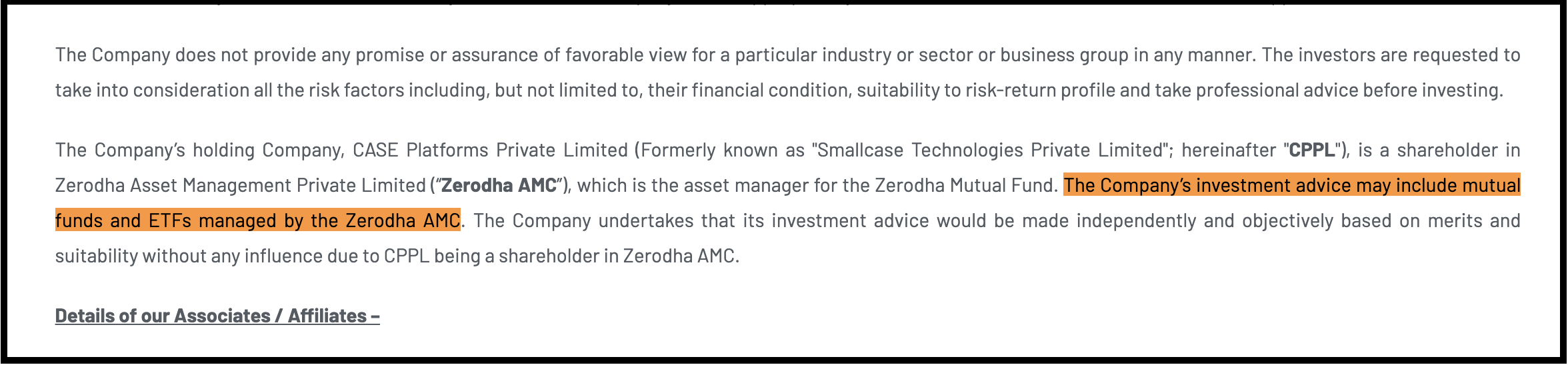
The firm discloses that its parent, CASE Platforms Private Limited, holds a shareholding in Zerodha Asset Management Private Limited. Mutual funds from that fund house may feature in the advice EIMPL gives.
EIMPL says its advice will stay independent and objective.
We cannot test that claim from public papers, and the research doc does not show any case where it was breached.
A disclosure like this does one useful thing.
It tells you the link exists before you pay, so you can weigh it. It does not tell you how the firm manages the link day to day.
Think of it the way you would think of a doctor who tells you she part owns a pharmacy. Telling you is good.
What matters next is whether she still prescribes only what you need, and whether you can check.
Here are practical ways to test any adviser’s conflict disclosure, using EIMPL’s own facts.
1. Ask How Many Fund Houses Appear In Its Recommendations
If a single group linked fund house dominates your portfolio, the disclosure matters more.
If your plan spreads across many fund houses by merit, it matters less.
2. Ask For The Reasoning Behind Each Recommendation
A written rationale for each fund lets you see whether the choice rests on your risk profile or on something else.
SEBI expects advice to fit your profile and your goals.
3. Ask Whether Any Group Company Earns From Your Investment
SEBI keeps advice and distribution of products separate for the same client.
Ask for written confirmation that no group entity earns commission from what you buy on its advice.
4. Ask Which Plan Type You Will Be Placed In
Mutual funds come in direct and regular plans, and the cost difference shows up in your returns over years.
Ask the firm to confirm in writing which plan type it recommends and why.
Affiliation with the research analyst Windmill Capital adds another question.
Ask whether you will receive reports or calls from that entity, and whether any such service needs its own agreement and fee.
None of this suggests the firm falls short. These are routine questions that any careful investor can put to any adviser with group links.
EIMPL Fees and What You Are Actually Paying For
The About Us page describes the services but does not show a price.
The firm says it charges either a fixed fee or a percentage of assets under advice, which is called AUA, as agreed with each client under SEBI guidelines.
So the real figure sits in your advisory agreement, and we could not find a public price list when we checked the research doc.
Neither mode is unusual. What matters is that you see the number before you commit.
SEBI sets the outer limits for each mode.
A fixed fee is capped at 1,51,000 per client family per year, and a fee based on AUA has its own annual percentage ceiling.
Here is a worked example with simple numbers of our own. They are not EIMPL prices.
Suppose a family places 20 lakh under advice and the agreed rate is 1 percent a year. The fee would be 20,000 a year before taxes.
Now suppose the firm quotes a flat fee. If the quote is close to 1,78,180, check the arithmetic.
That figure equals 1,51,000 plus 18 percent GST, so it sits at the cap and does not cross it. Ask the firm to confirm in writing how it treats GST.
The SEBI fee cap applies to the fee, and tax comes on top. A clear invoice should show the base fee and the GST on separate lines.
The research doc also notes that the page lacks payment frequency and any extra charges.
Those are the items most likely to surprise you later, so ask about each of them.
Ask these questions before you sign.
1. Which Mode Applies To Me
Ask whether you pay a fixed fee or a share of AUA. The answer changes how the cost grows when your portfolio grows.
2. When Is The Fee Due And For How Long
Ask for the billing period, the renewal terms and what happens if you stop midway. A clear refund or exit clause protects both sides.
3. Are There Any Other Charges
Ask whether platform use, reports or any group service carries a separate charge. Ask for the answer in the agreement.
Because the firm says the agreement is signed before advice or fees, you have a natural moment to ask.
Use it, and keep a copy of every version you receive.
What Does EIMPL Website, Terms and Investment Charter Actually Tell?
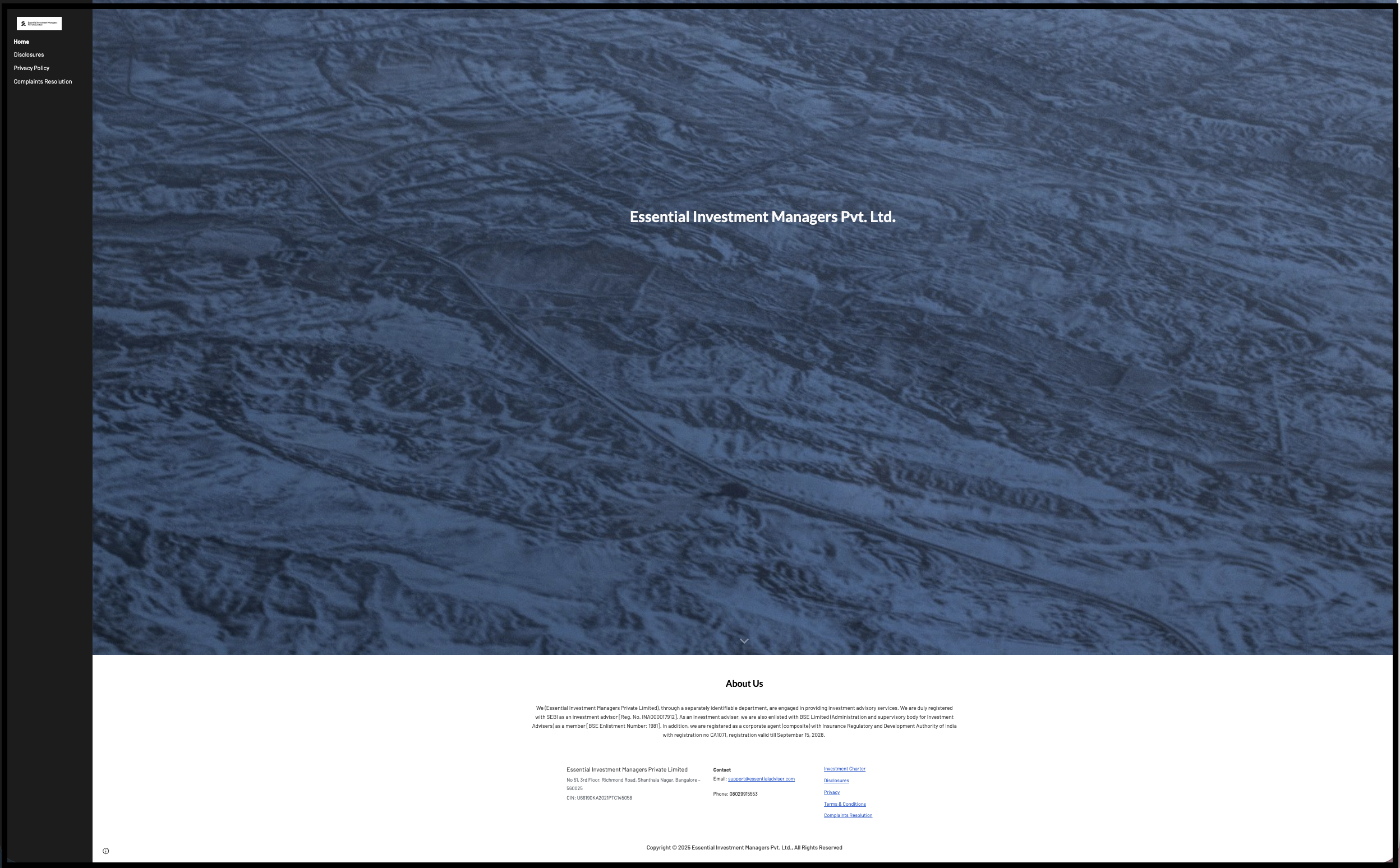
The research doc describes the website as largely blank, with a few lines about the company, basic contact details and links to documents.
Those documents include an Investment Charter, disclosures, a privacy policy, terms and conditions and a complaints resolution process.
A thin website is a fact and not a finding. Some firms keep their public pages short and share the detail inside the onboarding process.
Others simply have not published much. From outside, the two look alike.
Here is how to read a thin disclosure without guessing.
Treat each missing item as a question for the firm, and treat each answer as something to get in writing.
First, read the Investment Charter. It should tell you how the firm approaches advice, so compare it with what the sales conversation promises.
Next, read the terms and the privacy policy.
Look at how the firm handles your financial data, whether it shares data with group companies and how you can withdraw consent.
Then, look for the most important investor documents. SEBI expects advisers to give you a Most Important Terms and Conditions document, risk profiling results and an agreement before they take fees.
The research doc does not list a standalone version of each of these, so ask for all three.
Also look for what a website cannot show. It cannot show your suitability assessment, your recommendation history or how the firm reviews your plan. Those live in your client file, and you can ask to see them.
The research doc does not mention any return claims on the pages it describes, and it did not include platform reviews.
We therefore have no review quotes to share. If you read reviews elsewhere, remember they are individual opinions that nobody has verified, and the firm may dispute them.
Also Read: Eminent Investments promotes multibagger portfolios, but its website lacks publicly visible MITC, terms and privacy policy documents.
Does Essential Investment Managers Private Limited Complaints Data Need a Closer Look?
Every SEBI registered adviser must publish complaint figures by the 7th of each month.
The tables below come from the firm’s published data in the research doc, and we added every column again ourselves. They run from September 2024 to August 2026.
Read the table by row. Each row shows what the firm carried forward, what it received, what it resolved and what stayed open at month end.
We grouped the quiet months to keep it short.
|
Period |
Carried forward | Received | Resolved | Pending at month end |
|
Sep 2024 to Dec 2025 (16 months) |
0 | 0 | 0 | 0 |
|
January 2026 |
0 | 1 | 0 | 1 |
|
February 2026 |
1 | 0 | 1 |
0 |
| March and April 2026 | 0 | 0 | 0 |
0 |
| May 2026 | 0 | 1 | 0 |
1 |
| June 2026 | 1 | 0 | 1 |
0 |
|
July and August 2026 |
0 | 0 | 0 | 0 |
| Grand total shown | 2 | 2 | 2 |
2 |
The annual table is even shorter. It shows zero complaints for 2023 to 2024 and for 2024 to 2025.
It shows one received and one resolved in 2025 to 2026, and one received and one resolved in 2026 to 2027.
The grand total is two received, two resolved and zero pending.
1. What The Numbers Say
Two complaints came in, one in January 2026 and one in May 2026. The firm shows each resolved in the following month.
That is a quick turnaround on paper, though the research doc does not describe what either complaint was about.
2. Why The Monthly And Annual Pending Totals Differ
The monthly grand total shows two pending, while the annual total shows zero. The reason is the way the monthly column is added.
Each month’s pending figure is a snapshot taken at month end, and the grand total adds those snapshots together.
Here, one complaint was open at the end of January and another at the end of May.
Adding those two snapshots gives two, even though nothing was open by the end of August.
So the real pending count at the end of the period is zero. The same logic explains the carried forward total of two.
We read the discrepancy as a presentation choice, not a contradiction.
Still, a reader scanning the grand total row alone could think two complaints are open today, so it is worth asking the firm to label the row clearly.
3. Why Zero Complaints Is Not Proof Of Satisfaction
The monthly records show no complaints from September 2024 to December 2025.
A long quiet stretch is a good sign on its face. It does not tell you how many unhappy clients simply left without complaining, or raised their issue elsewhere.
The tables also begin in September 2024, although registration dates from April 2023.
We could not tell from the doc whether earlier months were published somewhere else.
Complaint tables show only what reached the firm or a platform it reports on.
If you want a wider picture, read the nature of any complaint the firm is willing to share, and read how it handled each one.
A dispute that reached the regulator’s complaint system is a separate record, and filing one is not hard when you know the route.
The guide on SCORES SEBI complaint walks through how the portal treats a complaint against a registered intermediary, which helps you see where such figures come from.
Also Read: Clearsharp Technology Private Limited highlights return claims and has a monthly table containing future months.
How To File a Complaint Against EIMPL?
This section tells you where the firm’s own contacts are and where to read more.
We do not repeat the full filing steps here, because the guides below cover them in detail.
Start with the firm. The compliance and grievance officer listed is Anurag Gupta. Write to the email so you have a dated record.
Keep your message short and factual. State the date, the service, the amount and the outcome you want, and attach the agreement and your payment proof.
If your concern relates to the advice itself, the guide on SEBI complaint against investment advisor explains how such a dispute is framed and which papers help.
Reading it before you write to the firm saves you a round of back and forth.
Remember the boundary in the firm’s own statement.
A complaint about advice follows the SEBI route. A complaint about insurance, lending or other non advisory services follows the route for that service.
When the firm’s reply does not settle the matter, the next step for an eligible dispute is online dispute resolution.
The SMART ODR portal page explains how that process works, so you can judge whether your case fits before you start.
Keep every email, invoice and chat message in one folder until the matter closes.
Some disputes go further than a complaint.
If you want to understand the formal option and its time limits, the explainer on arbitration in share market shows when that path applies and what it asks of you.
What to Ask Before You Sign With an Adviser Like This
Because the website is short, the conversation matters more.
The questions below come straight from the gaps in the research doc, and each one asks for something in writing.
1. Which Entity Gives Me This Service
Ask for the legal name, registration number and regulator for each service you buy. This answers the grievance question before it arises.
2. What Is My Exact Fee And What Does It Cover
Ask for the base fee, GST, billing period and any extra charge in one document. A fee you cannot find in the agreement is a fee to ask about.
3. How Are Conflicts Handled
Ask how the firm separates advice from any group activity, and who reviews its recommendations. Ask for the answer in the agreement.
4. What Happens If I Want To Stop
Ask for the exit terms, any refund rule and how the firm handles the data it holds on you. A short written answer now beats a long argument later.
5. Which Documents Do I Receive On Day One
Ask for your risk profile result, the agreement, the most important terms document and the Investment Charter.
Check that your risk profile matches what you told the firm.
Take your time. A SEBI registered adviser should be comfortable with unhurried questions, and a calm written reply tells you a lot about how the relationship will run.
Disclaimer
This blog is based on the firm’s published disclosures and publicly available SEBI records as of 10 October 2026. It does not allege wrongdoing, and the firm is welcome to share its side. We could not independently confirm the firm’s internal processes, the nature of the two complaints, or its pricing.
Conclusion
Essential Investment Managers Private Limited shows a clear SEBI registration, a small complaint record and an open note about its group links. It also shows a thin website and no public price.
Treat those gaps as questions and not as conclusions.
Ask which entity provides each service, what you pay in full, and how conflicts are managed.
Get the answers in writing before you transfer any money, and save the agreement, invoices and emails.
If a service sits outside SEBI’s reach, as the firm itself says, know your other route in advance.
Check the registration on SEBI’s own search yourself, and compare any adviser’s complaint table month by month.
Careful reading protects you better than any single number.
Report. Recover. Stay Fraud Free.
Frequently Asked Questions
The research doc shows registration number INA000017912 as an investment adviser, effective 24 April 2023 and perpetual. It is also enlisted with BSE under number 1981. Confirm the current status on SEBI's intermediary search before you pay.
The firm names CASE Platforms Private Limited as its parent. It discloses that the parent holds a shareholding in Zerodha Asset Management Private Limited, and it lists Windmill Capital Private Limited, a SEBI registered research analyst, as an affiliate.
The firm says it charges either a fixed fee or a percentage of assets under advice, as agreed in the advisory agreement. We could not find specific prices on the pages in the research doc, so ask for the figure in writing.
The firm's data shows two complaints received, in January 2026 and May 2026, and two resolved by the following month, with zero pending in the annual table. The tables cover September 2024 to August 2026.
Not necessarily. The firm states that SEBI recourse is unavailable for its non advisory services and services outside SEBI's purview. Advisory issues follow the SEBI route, while insurance or lending issues follow the relevant regulator or partner process.





 Add us as a preferred source on Google »