
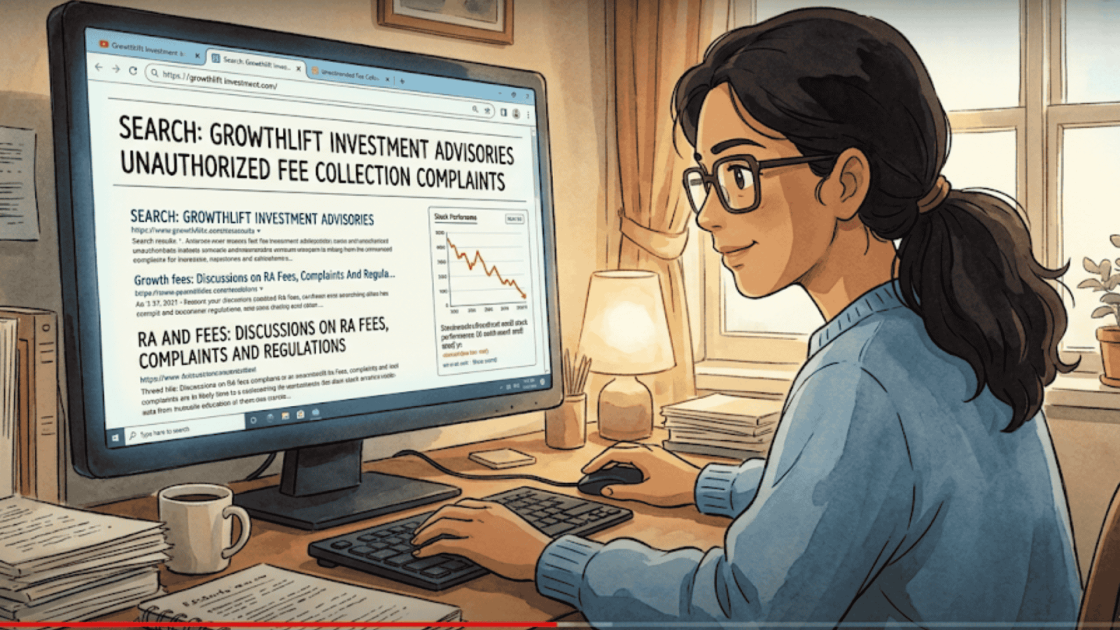
You trusted a SEBI-registered firm with your money, but what if that trust was quietly being exploited through fees you never agreed to pay?
The case of Growthlift Investment Advisories is a wake-up call for every retail investor in India.
The blog covers every detail related to the Growthlift Investment Advisories Unauthorised Fee Collection case. Let’s deep dive into it.
Growthlift Investment Advisories Review
Growthlift Investment Advisories Pvt Ltd is a Bangalore-based stock market advisory company that offers paid trading tips and investment recommendations across equity, futures, options, and commodities.
The firm has been operating since 2018, marketing itself aggressively to retail investors looking for intraday and positional trading calls.
On the surface, it presents itself as a trustworthy, tech-enabled advisory platform but a closer look tells a very different story.
Is Growthlift Investment Advisories SEBI Registered?
Yes, Growthlift Investment Advisories Pvt Ltd holds a valid SEBI registration INA200014283, from December 09, 2019, on a perpetual basis.
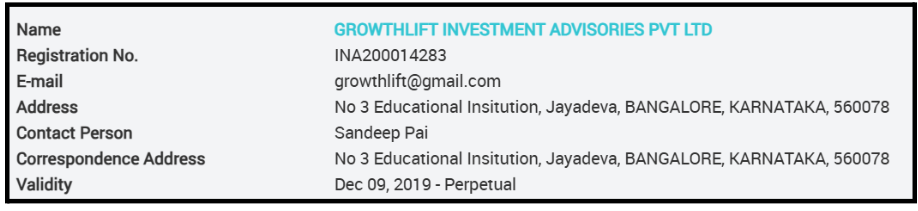
The contact person listed on the SEBI registry is Sandeep Pai, and the firm operates from No. 3, Educational Institution, Jayadeva, Bangalore, Karnataka, 560078.
Being SEBI RIA does not, however, mean the firm has always operated within the legal boundaries set by SEBI, as a formal adjudication order has now confirmed.
Pricing Structure How It Collects Fees?
Growthlift operates across a wide range of service packages spanning Stock Cash, Stock Future, Stock Option, Index Options, Commodities, Bullion, and combo plans.
On their website, individual service packages are priced as follows:
| Service | Plan/Tier | Monthly | Quarterly | Half-Yearly |
| Stock Cash | Basic | ₹14,999 | ₹29,999 | ₹59,999 |
| Stock Option | Basic | ₹14,999 | ₹29,999 | ₹59,999 |
| Index Option | Basic | ₹14,999 | ₹29,999 | ₹59,999 |
| Energy | Standard | ₹9,999 | ₹19,999 | ₹39,999 |
| Base Metal | Standard | ₹9,999 | ₹19,999 | ₹39,999 |
| Commodity | Standard | ₹24,999 | ₹49,999 | ₹72,999 |
| Equity Combo | Standard | ₹34,999 | ₹59,999 | — |
| Option Combo | Standard | ₹24,999 | ₹49,999 | ₹72,999 |
But, here’s the problem: SEBI’s fixed fee ceiling for Investment Advisers is ₹1,25,000 per annum per client across all services.
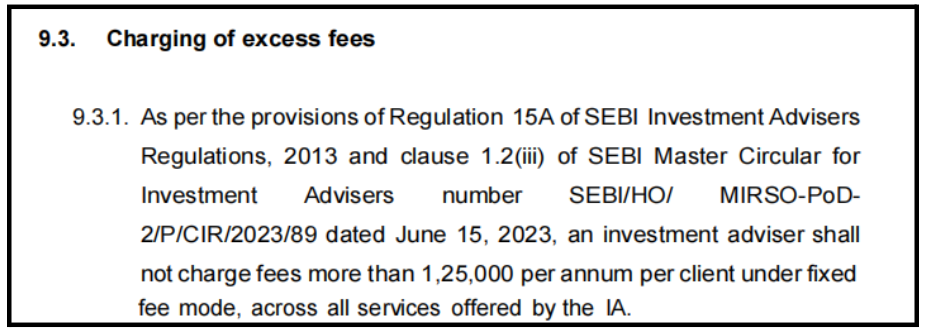
When a client subscribes to multiple plans, or a relationship manager convinces them to upgrade or add services, the cumulative fees can quietly exceed this legal limit.
Also Read: Misleading Investment claims by Sai Proficient, why generic risk disclaimers can’t cancel bold profit claims.
Growthlift Investment Advisories Unauthorised Fee Collection Issue
A client subscribing to even just two plans simultaneously, say Stock Option HNI Half-Yearly (₹90,000) + any Commodity plan (₹72,999), would cross ₹1,62,999 in a single year, breaching the ceiling by over ₹37,000.
The website shows no warning, no mention of this SEBI limit, and no indication that combining plans could put the client in a legally non-compliant billing situation. That silence is itself the problem.
Growthlift collects fees directly via its payment gateway, and the SEBI order confirms that 16 clients were charged beyond this ceiling, while 3 clients were billed ₹1,90,678 in total without even having their PAN details on record.
This is not a grey area; it is a clear instance of Growthlift Investment Advisories unauthorized fee collection.
Growthlift Investment Advisories SEBI Order
On April 16, 2026, SEBI’s Adjudicating Officer Sudeep Mishra passed a formal Adjudication Order (No. Order/SM/SM/2026-27/32351) against Growthlift Investment Advisories Private Limited.
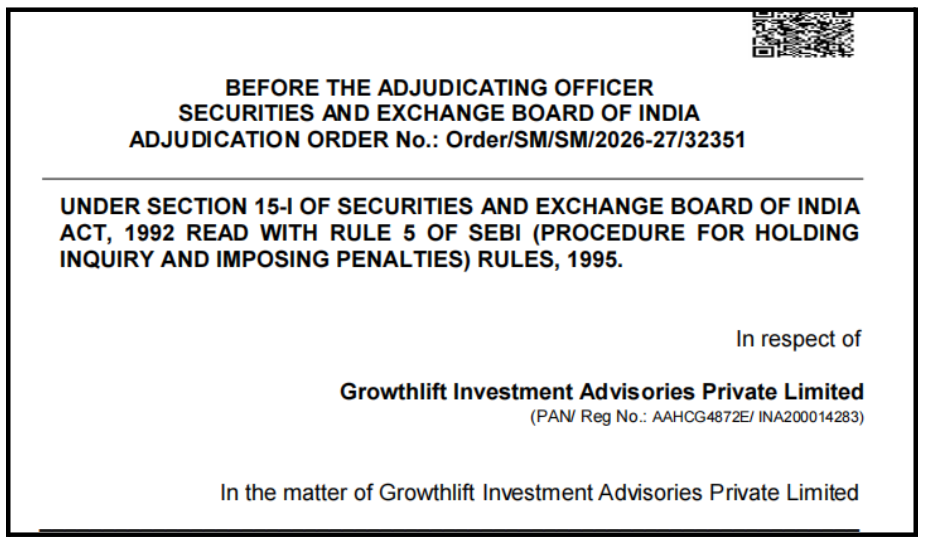
The inspection was conducted by BASL covering April 2022 to October 2023.
While the order covers multiple violations, Growthlift Investment Advisories unauthorized fee collection sits at the heart of it.
1. Charging Fees Beyond the Legal Ceiling (The Core Issue)
SEBI’s inspection found that the firm charged more than ₹1,25,000 per annum from at least 16 clients.

Additionally, it collected ₹1,90,678 from 3 clients whose PAN card details were not even on record with the firm, meaning fees were being collected from clients who had not completed basic identification requirements.
2. Collecting Fees Without Proper KYC
During the entire inspection period, Growthlift had not obtained CKYCR registration and had not uploaded client KYC records as required.
The firm attempted to claim compliance by submitting a CKYC registration email but the email referenced only “yesterday” with no formal date, making it clear registration happened only after the Show Cause Notice was issued.
The direct consequence: fees were being collected from clients whose identities had not been properly verified or registered with any regulatory system.
3. Unqualified Staff Involved in Client-Facing Fee Collection
The firm operated a client-facing sales team of 98 employees, none of whom were certified, qualified, or disclosed to SEBI or BASL as PAIAs.

These were the very people approaching clients, convincing them to subscribe to packages, and facilitating fee collection.
Growthlift argued its employees only handled “onboarding” but SEBI held that onboarding clients is itself a client-facing advisory function, and all such employees fall squarely within the definition of PAIA under Regulation 2(r).
Unqualified staff driving fee collection is not a technicality; it is a structural violation.
4. AML Non-Compliance Creating an Accountability Gap
The firm failed to inform FIU-IND about these appointments throughout the inspection period.
Evidence submitted by Growthlift itself showed that this intimation was made only on February 5, 2024, months after the inspection window closed.
This gap meant that during the period when excess fees were being collected, there was no designated accountability officer formally registered with the financial intelligence authority, creating a complete blind spot in oversight.
Breakdown of SEBI Rules Against Growthlift’s Actual Practices
Here’s a structured breakdown of the key violations identified in the SEBI order.
The table compares what SEBI regulations mandate against what Growthlift actually did during the inspection period.
This makes it easier to see where the firm crossed clear regulatory boundaries.
| Violation | What SEBI Mandates | What Growthlift Did |
| Excess Fee Collection | Max ₹1,25,000 per annum per client under fixed fee mode (Regulation 15A) | Charged beyond this limit from 16 clients; admitted the violation, called it a “calculation error” |
| Fees Without PAN | Client PAN must be recorded before any fee is collected (KYC norms) | Collected ₹1,90,678 from 3 clients with no PAN details on record |
| KYC & CKYC Non-Registration | Client KYC must be filed with CKYCR within 10 days of account opening (Para 115, Master Circular) | Not registered with CKYC during the entire inspection period; registered only after receiving the Show Cause Notice |
| Unqualified Sales Staff | All client-facing staff must be NISM-certified and registered with SEBI as PAIA (Regulation 7(1)(c)) | Ran a 98-member client-facing sales team, none certified, none disclosed to SEBI or BASL |
| AML Non-Compliance | Principal Officer and Designated Director must be intimated to FIU-IND (Clauses 61 & 62, AML Master Circular) | Made this intimation only on Feb 5, 2024, well after the inspection period ended |
-
Final Penalty
SEBI considered factors under Section 15J, including disproportionate gain, investor loss, and the repeat nature of the violation.
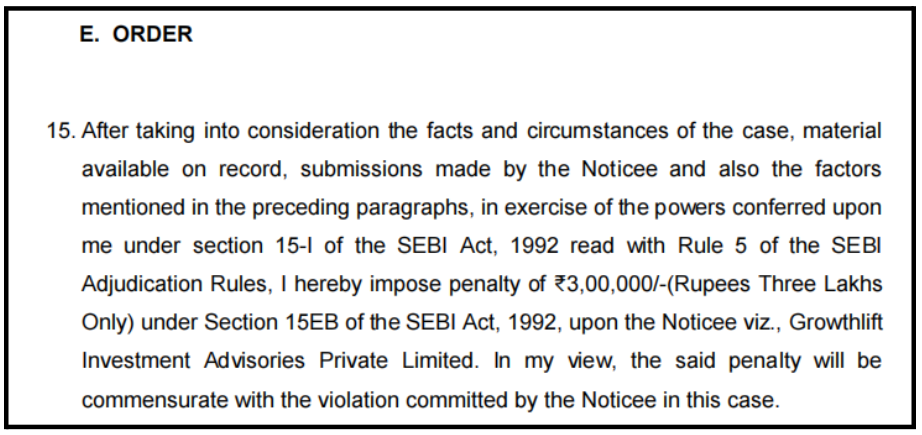
It noted no quantifiable investor loss and no repetition, while acknowledging partial refunds as a mitigating factor.
- ₹3,00,000 penalty imposed under Section 15EB of the SEBI Act, 1992
However, SEBI clarified that compliance is mandatory regardless of later corrections and directed payment within 45 days, failing which recovery action under Section 28A may follow.
How to Avoid Unauthorised Fee Collection?
The Growthlift case is not unique; it reflects a broader problem in India’s unregulated grey-area advisory industry.
Here’s how you can protect yourself before signing up with any investment adviser:
- Verify SEBI registration via the Securities and Exchange Board of India website, not the firm’s claims
- Know the fee limit ₹1,25,000 per year per client is the cap under fixed fee mode
- Complete KYC before paying never transfer money without PAN Aadhaar verification
- Question sales pressure check if the person is NISM certified before trusting advice
- Demand a written agreement no contract means non compliant service
- Check compliance audits missing or outdated audits are a warning sign
Even basic checks like these can prevent costly mistakes before they happen.
If something feels rushed, unclear, or exceeds regulatory limits, pause and verify before you pay.
Also Read: SEBI action against Wealthmax Solution, two separate orders, two years apart, same underlying pattern.
What To Do In Such Cases?
If you suspect you have paid excess fees to Growthlift or any other investment adviser, know this: the law is on your side, and there are formal, official channels to seek redress.
You do not need to stay silent.
Here is where and how to report SEBI registered investment advisor:
Step 1: Complain to the Firm’s Grievance Officer
Securities and Exchange Board of India requires every registered adviser to maintain an internal grievance system.
Send a written complaint to Growthlift’s grievance officer with payment details and a clear refund demand.
Keep records of all communication as non response itself strengthens your case for escalation.
Step 2: File a Complaint in SCORES
Register on the SCORES portal, select Growthlift Investment Advisories, and submit your complaint with payment proof.
The platform tracks your case and legally obligates the firm to respond, making it one of the strongest formal channels available.
Step 3: Raise a Complaint in SMART ODR
If SCORES does not resolve the issue, escalate to SMART ODR for structured dispute resolution. Upload payment proof, agreements, and prior complaint records as evidence.
The process is faster than courts and handled by trained conciliators and arbitrators within the securities ecosystem.
Step 4: Initiate Stock Market Arbitration
If all prior steps remain unresolved, proceed with arbitration through the stock exchange mechanism as the final legal remedy. Submit all evidence, payment records, trade details, and prior complaint references so the arbitrator can evaluate the case and deliver a binding resolution.
Need Help?
If you or someone you know has been a victim of excess or unauthorized fee collection by an investment adviser like Growthlift, professional legal and regulatory assistance can make all the difference. Here is how we help:
- Free Case Assessment: We review your receipts, agreements, and communications to check if you were charged beyond SEBI’s ₹1,25,000 annual limit.
- SCORES & BASL Support: We file structured complaints on SEBI SCORES and BASL with proper documentation.
- Legal & Consumer Action: We draft legal notices and represent you before Consumer Forums to pursue refunds and compensation.
- End-to-End Guidance: We handle the entire process from first complaint to final resolution with clear, step by step support.
Register with us. You focus on recovery, we handle the fight.
Conclusion
The SEBI adjudication order against Growthlift Investment Advisories Pvt Ltd is clear, unauthorized fee collection, absence of client KYC, unqualified sales staff posing as advisers, and anti-money laundering lapses.
A ₹3 lakh penalty has been imposed, but the real cost was borne by the clients who overpaid.
The lesson is simple: SEBI registration is a starting point, not a safety guarantee. Know your rights, verify before you pay, and report without hesitation if something feels wrong.





 Add us as a preferred source on Google »

