

Quick Summary
Gajnidhi Research is a one-person, SEBI-registered Research Analyst firm run by Shishant Bhargava under registration number INH000011097. No official website, social media presence, or public track record could be found for the firm anywhere online, and this absence itself raises a specific compliance question under SEBI’s 2024 rules requiring every registered analyst to maintain a working website. Because no online presence exists to check, this blog also covers general warning signs common to low-transparency advisory firms, along with what his registration actually permits and how to file a complaint if needed.
A single stock market call can change your portfolio, but the wrong advice can change your peace of mind too.
As more people start investing in India, many are searching online before paying for any stock market service, and they’re right to do that.
Gajnidhi Research is run by Shishant Bhargava, a SEBI-registered Research Analyst, which naturally makes people curious about how genuine and safe the service actually is.
This blog covers who he is, what his registration actually lets him do, what’s been reported by users, and how you can file a complaint if something feels wrong.
Gajnidhi Research Details
Gajnidhi Research is a small, one-person stock market advisory firm.
It isn’t a big company with many employees; it’s run as what’s called a sole proprietorship, meaning one person owns and runs the whole thing.
The firm’s main work is giving research and stock recommendations to people who want help deciding where to invest.
Like most Research Analyst businesses of this size, it doesn’t have a large team or office setup behind it.
Because the firm is this small and personal, everything about trusting it really comes down to trusting the one person behind it.
That’s why it matters to know exactly who that person is, and whether his registration is genuine.
Shishant Bhargava
Shishant Bhargava is the owner of Gajnidhi Research. He runs the firm on his own, which is a common setup among independent analysts in India who work outside the big brokerage names.
Beyond his SEBI registration, there isn’t much publicly available information about his past work or professional background.
No detailed profile, no interviews, no public history beyond what’s officially recorded with SEBI.
Is Gajnidhi Research SEBI Registered?
Yes. Shishant Bhargava holds a valid Research Analyst registration with SEBI, under the number INH000011097.
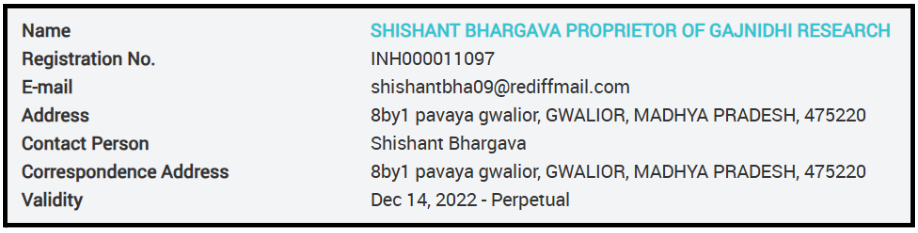
His name shows up in SEBI’s own official list of registered Research Analysts, and this list was last confirmed as recently as March 2025.
You can check this for yourself anytime by going to SEBI’s website and searching either his name or his registration number.
Having this registration means he’s officially allowed to write research reports, give stock recommendations, and share his views on the market.
But here’s something worth remembering clearly: this registration doesn’t promise you accurate calls, doesn’t promise profits, and doesn’t promise your money is safe.
It only means he’s following the basic rules SEBI has set for people in this line of work.
Is Shishant Bhargava Legit?
This is really the question most people came here to ask. Let’s look at it fairly, both the good and the concerning parts.
1. A Real, Active SEBI Registration
His SEBI registration is genuine and shows up in the official list, confirmed as recently as March 2025.
This isn’t something he’s just claiming himself; anyone can go check it directly on SEBI’s own website in a few minutes.
2. No Public Complaints or Regulatory Action Found
We searched through SEBI’s enforcement records, investor forums, complaint websites, and review platforms.
At the time of writing, nothing publicly visible came up against him or his firm: no fraud warnings, no official action.
3. No Website, No Social Media, No Presence Anywhere
This is the biggest gap in this whole review.
Even though he’s an active, registered analyst, Gajnidhi Research has no website you can visit. No Instagram, no YouTube, no LinkedIn, no Twitter.
No client reviews or feedback anywhere online either.
For a business asking people to trust it with their investment decisions, that much silence makes it very hard to check anything for yourself before you pay.
Here’s why this matters more than it might seem: SEBI’s updated 2024 rules say every registered Research Analyst must have a working website with certain required information on it.
Since Gajnidhi Research doesn’t seem to have one, that’s not just a marketing gap; it’s a real compliance question worth asking directly.
Without a website, it’s also hard to know the pricing, what exactly you’re signing up for, or how to properly contact the firm if something goes wrong.
4. No Track Record You Can Actually Check
With no published research anywhere, no website, and no public feedback from real clients, there’s simply no way to judge how good or accurate this firm’s work actually is before you decide to pay.
Also Read: Yadnya Academy Private Limited, a review flagging app crashes and login failures.
Gajnidhi Research: Warning Signs Worth Knowing Before You Pay
Since Gajnidhi Research has no visible online presence, there’s no way to independently confirm client experiences with this specific firm.
What follows instead are patterns commonly reported across smaller, low-transparency advisory services generally, worth watching for here and with any similar firm you’re evaluating.
1. Advice With Exact Buy Quantities
Watch out if you’re told exactly how many shares to buy, not just which stock to look at. A Research Analyst is allowed to share research and general recommendations.
Telling someone a precise number of shares starts to look more like personal investment advice, and that needs a completely different type of registration.
2. Profit Screenshots Used to Attract Clients
Be cautious if screenshots of past profitable trades are shown during sales conversations, almost like proof of how good a service is.
Many retail investors often wonder: can a research analyst show past performance under SEBI guidelines?
Sharing past results isn’t automatically against the rules. But showing only the winning trades, without mentioning any losses or risks, gives a false picture.
This makes people believe profits come easily and consistently, which just isn’t how the stock market actually works.
3. Talk That Sounds Like Profit-Sharing
Watch for any suggestion that a subscription fee will easily come back through profits made from following the calls.
This is a real problem because SEBI doesn’t allow anything that sounds like a guaranteed return or a profit-sharing deal.
Markets are unpredictable by nature, and nobody can honestly promise a fee will definitely come back through profits.
4. Being Pushed to Buy More Plans After a Loss
Be alert if, after a loss, you’re encouraged to buy a bigger or upgraded plan to “recover” what was lost.
This matters a lot because “recovering your loss” talk plays on emotions, especially when someone is already stressed about money.
No Research Analyst is allowed to promise that losses will definitely be recovered through more recommendations.
5. Being Told to Hold Losing Trades Indefinitely
Watch for advice to keep holding a stock even as it keeps losing value, instead of being told clearly when to exit and limit the damage.
Sometimes holding a position can genuinely be part of a longer-term plan. But you should always be told clearly what the downside risk looks like before continuing to hold a losing trade.
Doing this blindly, just hoping the price bounces back, can turn a small loss into a much bigger one.
6. Unclear Communication About Risk
Be cautious if the actual risk involved in a trade isn’t properly explained before the recommendation is given.
Good advice always comes with a clear picture of what could go wrong, not just what could go right.
Also Read: Barkat Capital, An RA Offering AI-Based Trading Claims, With Missing Plan Durations & Backtests Available Only On Request.
Why These Situations Can Be Risky for You?
Even without confirmed claims tied to this specific firm, these patterns carry real risk whenever they show up with any advisory service.
- You might start making decisions based on emotion instead of a clear plan.
- You could end up taking bigger positions than you can actually afford to lose.
- The pressure to “recover losses” can push you into paying again and again.
- Seeing only profit examples can make you expect results that aren’t realistic.
- Poor risk management can make your losses worse during a shaky market.
- You might avoid setting a stop-loss while hoping the trade turns around.
- A lack of transparency can make it much harder to get your complaint resolved later.
The stock market rewards patience, discipline, and clear thinking. It doesn’t reward pressure, urgency, or promises of guaranteed profit.
What Gajnidhi Research Is Actually Authorised to Do?
SEBI created the Research Analyst guidelines back in 2014 specifically to bring structure and accountability to stock market advisory services in India.
Here’s how his actual registration compares against the general warning signs worth watching for with any low-transparency firm.
| His Registration Allows | Watch For This Instead | Why That’s a Mismatch |
|---|---|---|
| Publishing research reports and general recommendations | Exact share quantities told directly to a client | Personal, quantity-specific advice needs a separate Investment Adviser registration |
| Charging a plain fee for research | A fee framed as recoverable through future profits | A fee can never be tied to or promised back through trading profits |
| Sharing balanced views, including risk | Only profit screenshots shown, no losses mentioned | Selective sharing creates a false, misleading picture of results |
| Explaining risk clearly with every recommendation | Being told to hold a losing trade with no clear exit plan | Risk has to be explained upfront, not discovered after the loss |
| No promise of any return, ever | Suggestions that losses could be recovered through more plans | Promising loss recovery is one of SEBI’s clearest, hardest rules |
| Operating a working website with required disclosures | No website found anywhere | Since 2024, this isn’t optional; it’s a mandatory requirement |
Being registered doesn’t mean SEBI is personally standing behind everything he does.
SEBI’s job is to set the rules and check qualifications, not to guarantee that every analyst’s advice will be accurate or fair.
What Investors Should Keep in Mind?
Before you engage with Shishant Bhargava, or any SEBI-registered Research Analyst, a few simple habits protect both your money and your rights.
- Check the SEBI registration yourself before paying anything or sharing personal details.
- Never pay in cash. Always pay through proper banking channels and keep the receipt.
- Ask for the disclosure document. SEBI requires every Research Analyst to keep one, covering fees, conflicts of interest, and how they do their research.
- Don’t act on any promise of guaranteed returns. Any analyst promising fixed or assured profits is already breaking SEBI’s rules.
- Ask for a sample research report before subscribing, so you know what quality to expect.
- Check SEBI’s SCORES portal to see if any past client has complained about the analyst.
- Confirm a working website exists with the disclosures SEBI now requires.
Investing is your own decision, and no registration replaces doing your own homework. If something feels rushed, unclear, or too good to be true, trust that feeling.
Not sure if what happened to you is serious enough to report?
We look at your specific situation and help you figure out whether it’s worth filing a formal complaint.
How to Complain Against Gajnidhi Research?
If you feel you’ve been misled by Gajnidhi Research, or by any Research Analyst, there’s a proper, step-by-step way to raise your concern in India.
Start by collecting your proof. Save your chat messages, payment receipts, call recordings, and any screenshots showing what was promised versus what actually happened.
This is the single most important step, since everything after it depends on having real evidence.
Once you have your evidence ready, first speak directly with the analyst in writing and give him a chance to respond.
If that doesn’t help, file a SEBI SCORES portal complaint, which is SEBI’s official system for tracking complaints against registered people like him.
If SCORES still doesn’t resolve things, you can move to the SMART ODR login platform, which helps settle disputes through mediation instead of going straight to court.
And if that mediation also fails, formal stock market arbitration is the final step, where an independent person reviews everything and gives a binding decision.
For the complete, detailed steps at every one of these stages, our guide on complaint against SEBI registered research analyst walks you through exactly what to do.
Conclusion
Shishant Bhargava’s Gajnidhi Research does hold a real, checkable SEBI Research Analyst registration. That part is clear and settled.
What’s harder to settle is everything else: no website, no research you can look at, no client reviews anywhere, and a real gap around SEBI’s 2024 website rule that’s worth asking him about directly.
Given that lack of visibility, general warning signs common to low-transparency advisory firms are worth watching for here too.
Because of all this, it’s smart to stay careful, ask clear questions, and never rely only on conversations or screenshots before you decide to pay for any research service.
A SEBI registration matters, but so does how honestly and openly a firm actually treats the people paying it. Take your time, check what you can, and decide based on facts, not pressure.
Report. Recover. Stay Fraud Free.
Yes. Shishant Bhargava holds a valid SEBI Research Analyst registration under number INH000011097, confirmed in SEBI's official list as recently as March 2025. That's not clear, and it's worth asking directly. SEBI's 2024 rules require every registered Research Analyst to have a working website with certain disclosures, so its absence here is a real question, not just an inconvenience. Not really. He can share research and general recommendations, but telling someone an exact number of shares starts to look like personal investment advice, which needs a separate type of registration. None came up in our search across SEBI's enforcement records, investor forums, or review platforms at the time of writing. That doesn't rule out private complaints that were never made public, but nothing has surfaced so far. Ask for his official disclosure document, a sample research report, and confirmation that he has a working, compliant website. If any of these are missing or he seems reluctant to share them, treat that as a serious warning sign. Start by collecting your evidence, payment proof, messages, and any promises made in writing, then raise the issue with him directly before escalating it through SEBI's official channels.Frequently Asked Questions





 Add us as a preferred source on Google »

