

Something in your IIFL Securities account doesn’t look right.
Maybe a trade you didn’t place. A charge you don’t recognise. A withdrawal that hasn’t come through. Or a complaint you raised weeks ago that’s still going nowhere.
Whatever the issue is, you’re not alone. IIFL Securities complaints have risen from 354 in 2022–23 to 588 in 2024–25, and the resolution rate dropped to 91% in 2025–26, leaving dozens of cases unresolved.
This page walks you through what investors are actually complaining about, what the official data shows, and exactly what you can do to get your issue resolved, including escalation to SEBI and arbitration if needed.
We’ll go through official complaint data, see how many issues actually get resolved, check whether cases reach arbitration, and understand what real users are saying.
Because choosing a broker is easy. Dealing with one when things go wrong, that’s what really matters.
What Investors are Complaining About IIFL Securities?
Every broker receives complaints. But the type of complaint and how it gets handled tells you far more than the brand name ever will.
When you go through user feedback around IIFL Securities, a few patterns start to appear.
If you’re facing one of these issues right now, know that others have reported the same — and there is a structured process to escalate each one.
- Delays in fund withdrawals
- Account-related discrepancies
- App or platform glitches during trading
- Slow or unclear customer support responses
- Charges or deductions that users didn’t fully understand
Again, none of this is unusual on its own.
But when the same issues repeat, it tells you where users actually struggle. And that’s important, because this is exactly what you might face if something doesn’t go as expected.
For now, this gives you a basic idea.
But instead of relying only on user feedback, it makes more sense to look at official data from the exchanges, where complaints and resolutions are recorded properly.
Let’s look at that next.
IIFL Complaint Data on NSE
Instead of guessing, let’s look at official data.
Stock exchanges like NSE track complaints against brokers, how many get resolved, and whether cases move to arbitration.
This gives you a clearer picture of how things actually work.
Here’s the complaint data for IIFL:
| Financial Year | Total Clients | No. of Complaints | % of Complaints | Resolved Complaints | % Resolved | Arbitration |
|---|---|---|---|---|---|---|
| 2022–23 | 948,372 | 354 | 0.037% | 343 | 96.89% | 5 |
| 2023–24 | 948,372 | 371 | 0.039% | 360 | 97.04% | 3 |
| 2024–25 | 1,062,551 | 588 | 0.055% | 588 | 100% | 1 |
| 2025–26 | 1,018,744 | 533 | 0.052% | 486 | 91.18% | 0 |
At first glance, the complaint percentage looks very low. It stays below 0.06% across all years. But don’t stop there.
Look at the actual number of complaints. It increases from 354 to 588 within two years.
That’s a clear rise. Even after client growth, the complaint rate itself also moves up. That tells you more users started facing issues, not just that the platform added more users.
Now look at the resolution. IIFL resolves most complaints. The numbers stay above 96%, and in 2024-25, the company closes 100% of complaints.
But then 2025–26 tells a different story.
The resolution rate drops to 91.18%. That means dozens of complaints remain unresolved. This shift matters more than the earlier perfect numbers.
Now, come to arbitration.
The data clearly shows arbitration cases: 5, 3, 1, and then 0. So yes, disputes do reach arbitration. But don’t misread the decline.
Low arbitration does not mean users don’t face serious issues. Most investors don’t go that far. They either settle earlier, lose interest, or don’t know the process.
Also, exchanges don’t publish detailed arbitration case files.
These proceedings stay confidential. So even when arbitration happens, you won’t find case documents in the public domain.
So, how should you see this overall?
- Complaints increased over time
- Resolution stayed strong but dropped recently
- Arbitration remained low but present
Put this together, and you get a balanced picture.
IIFL handles most complaints, but issues do come up, and the experience may not stay consistent for every user.
Numbers give you the scale. But what do these complaints actually look like in practice? Here are the most commonly reported issues.
Also Read: Bonanza Portfolio complaints, a full four-year exchange table, read line by line.
Types of Complaints Reported Against IIFL Securities
Not every investor who faces a problem with their broker knows what category their issue falls under. Understanding the type of complaint matters because it determines where you escalate, what evidence you need, and how strong your case is.
Here are the most commonly reported complaint types against IIFL Securities.
IIFL Securities Unauthorised Trading
One of the most serious complaints reported against IIFL Securities involves trades executed without the client’s clear knowledge or consent.
In several cases, investors have noticed positions in their accounts that they never approved. The trade size was larger than discussed, the quantity higher than instructed, or the order type different from what was agreed upon.
In one such case, an investor noticed multiple intraday positions opened in their account on a day they had not logged in or placed any instructions. When they raised the issue, the broker’s response was delayed and did not address whether proper authorisation had been taken before executing those trades.
This is not a market loss situation. If a trade was placed without your explicit consent, it is a regulatory violation — and SEBI’s 2018 circular on prevention of unauthorised trading by stock brokers holds brokers directly accountable for maintaining evidence of client authorisation.
IIFL Securities Account Handling
Several investors have reported concerns related to how their accounts are managed — particularly around transparency, communication, and proper record maintenance.
Case Study: Real Example of IIFL Account Mishandling
To understand how these issues unfold in real life, here is one of the reported cases of a retail investor who trusted an IIFL Securities relationship manager to execute trades based on clear verbal instructions.
Over a brief period, the investor began noticing strange anomalies and execution discrepancies in their portfolio that simply did not align with the directives they had given over the phone.
When the investor grew suspicious and formally requested official trade confirmations, call recordings, and relationship logs to verify the entries, the broker went silent.
IIFL was unable to produce the complete, auditable compliance documentation required to back up those transactions.
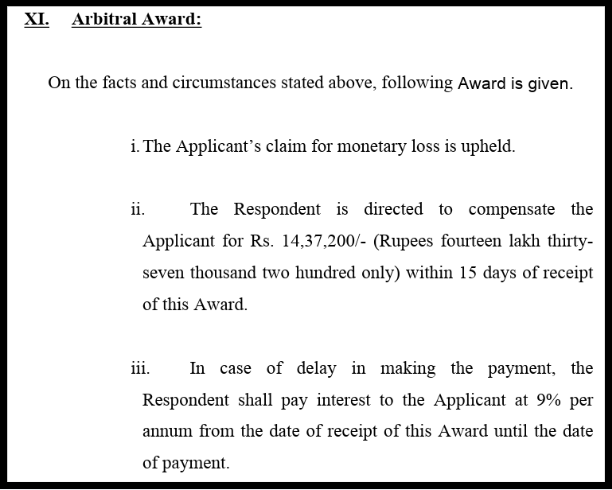
This is when the victim reached out to us, and by following the right steps and process, we helped him recover ₹14.37 Lakh.
IIFL Securities Excess Charges
Complaints around unexplained or excessive charges are among the more frequently reported issues with IIFL Securities.
Investors have reported instances where the brokerage charged was significantly higher than what was communicated at the time of account opening. In some cases, DP charges, transaction fees, and other deductions appeared in the ledger without adequate prior disclosure.
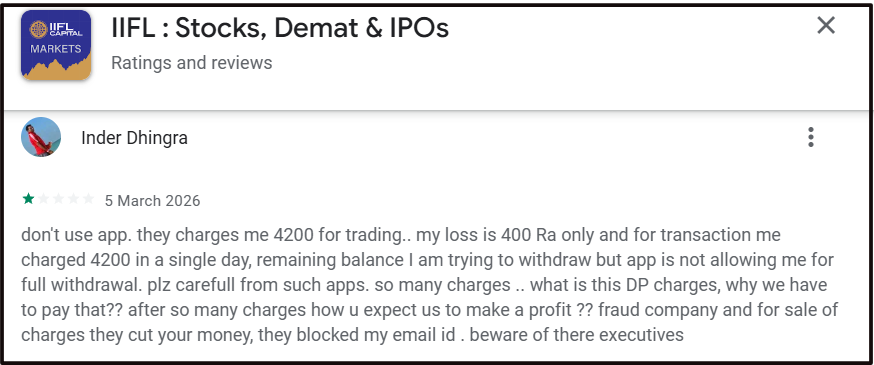
In one specific case, an investor trading in futures noticed that their brokerage outgo over a quarter was disproportionate to the volume of trades placed. When they requested a detailed fee breakup, the explanation provided did not match the figures in their contract notes.
High charges are not always illegal — but undisclosed charges, charges inconsistent with the agreed fee structure, or deductions that the broker cannot clearly explain are legitimate grounds for a formal complaint.
SEBI requires that all charges be disclosed upfront and applied consistently. If your ledger contains deductions you do not fully understand, do not assume they are correct.
A detailed breakdown of what constitutes excess charges and how to dispute them is available on the IIFL Securities excess charges page.
IIFL Securities Technical Glitch
Technical issues on a trading platform are not always minor inconveniences — when they occur during market hours, they can directly result in financial loss.
Investors have reported that the IIFL Securities platform experiences lag, freezing, and sudden logouts, particularly during market opening and closing hours — the periods when execution speed matters most.
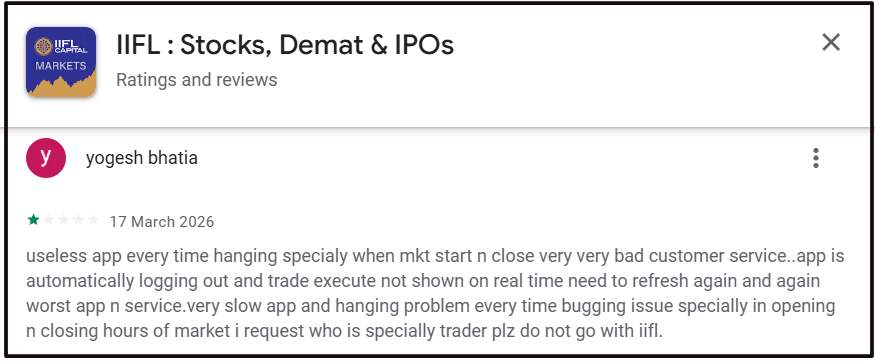
In one reported case, an investor attempting to square off an open position during market close was unable to execute the order due to platform unresponsiveness. By the time access was restored, the price had moved significantly against them, resulting in a loss they argue was caused by the platform failure and not a market decision on their part.
In another instance, real-time price feeds stopped updating mid-session, causing the investor to make a decision based on stale data.
Also, a few reported about the negative margin without any clear explanation from the broker.
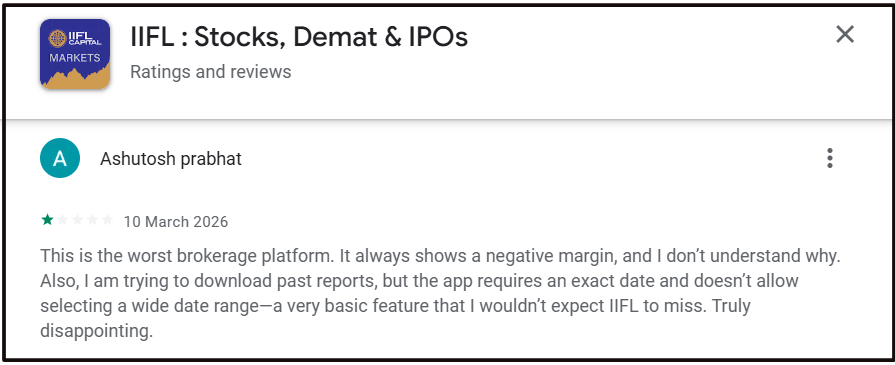
When a technical failure directly causes a financial loss, it is not something you simply absorb. Brokers are expected to maintain platform stability and have clear redressal mechanisms for losses caused by system failures.
The IIFL Securities technical glitch page covers how to document such incidents and what options you have for seeking compensation.
When To Take Action Against a Broker?
Not every issue with your broker needs escalation. Delays happen, Apps glitch, and support sometimes takes time to respond.
But you shouldn’t ignore everything and assume it will fix itself.
The real skill is knowing when to wait and when to act. Here are situations where you should stop waiting and take things seriously:
1. When your money gets stuck
If you request a withdrawal and the money doesn’t arrive within the expected time, don’t ignore it. Follow up once.
If you still don’t get a clear answer, treat it as a red flag. Your funds should never stay stuck without a proper explanation.
2. When you see trades you didn’t place
This is not something you observe for a few days. If you notice any unauthorised trade, act immediately.
Take screenshots and raise a complaint right away. Delaying this can make things worse.
3. When the broker avoids your complaint
If you keep receiving vague replies or no response at all, don’t keep waiting.
A reliable broker gives clear updates within a reasonable time. If that doesn’t happen, you need to escalate.
4. When charges don’t make sense
If you see deductions in your account and you can’t clearly understand them, don’t assume they are correct.
Ask for a proper breakdown. If the explanation still feels unclear, push further.
5. When your issue doesn’t move forward
Every complaint should show progress. If days pass and nothing changes, stop depending only on the broker. That’s your signal to take the issue beyond them.
You don’t need to panic over every small issue. But you also shouldn’t stay passive. If something affects your money, your trades, or your account access, take action at the right time.
The longer you wait, the harder your case becomes to build. Act while the trail is fresh.
How do I File a Complaint With IIFL?
If you face an issue with your broker, don’t jump straight to legal action.
Follow the process step by step. Each level exists for a reason, and if you skip steps, your complaint may not get proper attention.
Here’s how you should approach it:
Step 1: Raise a Complaint with IIFL Support
- Visit the broker’s support portal.
- Call to their customer care
- Send an email drafting your complaint.
Keep records of your complaint ID and email acknowledgment.
IIFL Securities Complaint Email ID
If you prefer documenting your issue in writing, you can reach out directly via email. Depending on the nature of your problem, you should send your concern to the respective IIFL Securities Grievance Cell email ID:
- Standard Customer Support: [email protected]
- Broking Grievance Cell: [email protected]
- DP (Depository Participant) Grievances: [email protected]
When emailing the grievance cell, always include your Client ID (UCC) in the subject line.
You can also file a complaint against a broker in NSE by registering on the portal NICE Plus for quick resolution at the broker level.
IIFL Securities Complaint Number
If you are wondering how do i file a complaint with IIFL quickly or need an immediate resolution during market hours, you can call their official helpline numbers:
- Primary Customer Service Numbers: +91-22 4007 1000/+91 22 6150 2000
- Official WhatsApp Support: +91 98926 91696
Step 2: File a Complaint in SCORES
If your issue is not resolved within 15 working days, file a complaint in SEBI at the SCORES portal. Make sure you keep the following details handy:
- Client ID
- Broker name
- Trade or transaction proof
- Written complaint trail
Step 3: File a Complaint in SMART ODR
If your complaint is not resolved through SCORES, you can escalate to the SMART ODR platform, an online dispute resolution mechanism specifically designed for securities market complaints. Once filed, the platform facilitates resolution within a defined timeline
Step 4: Arbitration in Share Market
If you’re seeking financial compensation, you can opt for Exchange Arbitration, a quasi-legal process to resolve unresolved claims.
In arbitration, your case is heard by an independent arbitrator appointed by the stock exchange. Both sides present their case, and the arbitrator issues a binding award.
Need Help?
If your complaint is stuck, your broker is not responding, or you are unsure whether what happened in your account even qualifies as a formal complaint, do not keep waiting.
At FraudFree, we help investors facing issues with IIFL Securities and other brokers understand their situation, build their case, and take it to the right forum — whether that is SEBI, the stock exchange, or arbitration.
We assist with:
- Reviewing your account activity and identifying the nature of the issue
- Organising contract notes, ledger statements, and communication records
- Drafting a structured complaint with relevant regulatory provisions
- Representing your case in arbitration proceedings
How you present your case directly affects how it gets resolved. Register with us today.
Conclusion
The data is clear: complaints against IIFL Securities are rising, and resolution is no longer guaranteed.
Reviewing real IIFL Securities arbitration cases can help you understand what the process actually involves, what evidence matters most, and what kind of outcomes other investors in similar situations have achieved.
If you are already facing an issue, the worst thing you can do is wait and hope it resolves on its own. Limitation periods apply, evidence fades, and brokers are better equipped to handle complaints than individual investors acting alone.
Know your rights. Document everything. And if you need help navigating the process, we are here.
Frequently Asked Questions
1. How do I know if my issue with IIFL Securities is worth filing a formal complaint?
If trades were placed without your approval, charges appear that were not disclosed, your withdrawal is stuck without explanation, or your complaint has gone unanswered for more than 15 working days — these all qualify for formal escalation. When in doubt, get your account activity reviewed before deciding.
2. What is the first step to file a complaint against IIFL Securities?
Start by raising a written complaint directly with IIFL’s grievance redressal officer via email. Keep your complaint ID and acknowledgment. If the issue is not resolved within 15 working days, escalate to SEBI via the SCORES portal.
3. Can I get compensation for losses caused by IIFL Securities?
If your losses resulted from unauthorised trading, excess charges, or platform failure, not just market movement, you may have grounds to claim compensation through arbitration. The outcome depends on the strength of your documentation and how the case is presented.
4. What documents do I need to file a complaint against IIFL Securities?
Contract notes, ledger statements, margin statements, bank transaction records, and all written communication with the broker, including emails, WhatsApp messages, and any recorded calls. The stronger your documentation, the stronger your case.
5. Is arbitration against IIFL Securities expensive?
Exchange arbitration is designed to be accessible for retail investors and is not prohibitively expensive. However, how your case is prepared and presented significantly affects the outcome, which is where professional assistance makes a real difference.





 Add us as a preferred source on Google »

