
Quick Summary
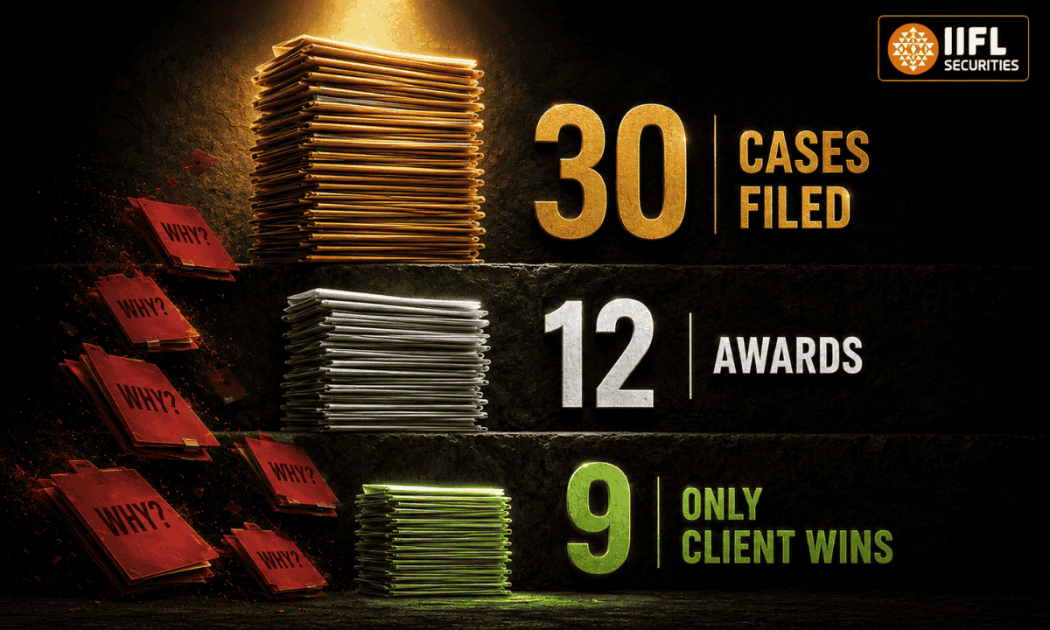
We reviewed 12 NSE and BSE arbitration awards involving IIFL Securities Limited from 2021 to 2025, drawn from 30 arbitrations filed over that period. In 9 of the 12 awards, the tribunal directed IIFL to pay the client. Two went to the broker, and one was at the appeal stage of a case already counted. The wins ran from a few hundred rupees to ₹36,04,575, with three separate awards above ₹11 lakh. This page sets out the numbers. The linked pages below break down each type of case and show how the clients who recovered actually did it.
Here is what most people miss. Arbitration is not another complaint form that disappears into a support queue. It is a neutral tribunal that hears your dispute and passes an award the broker has to honour.
For anyone who lost money and got nowhere with the grievance desk, that is the stage where the fight becomes real. So we pulled the IIFL Securities arbitration cases across five years and counted, award by award, based on what has been published as of this review.
Those numbers tell a clearer story than any brochure, so let us start there.
IIFL Securities Arbitration Cases: The Numbers
Here is the shape of the reviewed set.
| Count | |
|---|---|
| Arbitrations filed (2021 to 2025) | 30 |
| Awards granted | 12 |
| Of those, awards to the client | 9 |
| Awards to the broker | 2 |
Note: The remaining 1 case represents an appeal stage of a case already counted.
The nine client wins are what this cluster is about. Their amounts:
| Year | Issue | Awarded |
|---|---|---|
| 2021 | Square-off despite margin paid | ₹36,04,575 |
| 2023 | Unauthorised trading (2FA and IP failure) | ₹22,74,539 |
| 2022 | Unauthorised trading (IP not produced) | ₹14,71,471 |
| 2024 | Unauthorised and unsuitable trading | ₹11,83,473 |
| 2022 | Account opened via OTP deception | ₹6,04,419 |
| 2021 | Square-off despite RM assurance | ₹4,61,280 |
| 2025 | Platform glitch on expiry day | ₹1,79,000 |
| 2022 | Delivery failure after agreeing to sell | ₹5,961.86 |
| 2022 | Wrongful penalty charge | ₹454.88 |
Nine clients recovered money. The spread runs from a symbolic few hundred rupees to over thirty-six lakh, which tells you these disputes come in every size.
The obvious question is what separated the nine who won from the rest. The answer runs through almost every case.
What Actually Decides These Cases
Read the nine wins together, and one thread ties most of them: IIFL could not stand behind its own records or its own systems.
In the biggest win, the broker squared off a client’s hedged position at 10:22 in the morning even though the client had already wired ₹20 lakh in margin and shared the transfer proof, which the relationship manager had confirmed.
In a ₹22.7 lakh win, the tribunal found the broker had not implemented the two-factor login security that regulations required, and then could not produce complete records of the internet addresses behind the disputed trades. Then, in another, a senior citizen’s trading account was opened using a one-time password obtained from his wife under the guise of a routine update.
That is the pattern. When the broker could not produce the proof, the notice, the authentication, or the records that its own systems were supposed to hold, the client won.
Now look at the cases that failed. They were not thrown out because the client had no grievance. They fell on what could be proved. The tribunals were not saying the client was wrong. They were saying the record did not establish it.
That gap between having a grievance and proving one is the whole game, and it is where most claims are quietly lost.
A claim rarely fails because the case was weak. It fails because the case was half-presented. The grievance was real, but the right records were never demanded, the burden of proof was never met, and the regulation that would have forced the broker to answer was never argued.
That gap is exactly where we work. Need Help on that?
We build the claim the way the winning nine were built, on the documents, the circulars, and the authentication trail that leave the broker nowhere to hide. Register with us to get assistance around your case.
IIFL Securities Arbitration Cases by Type
The wins fall into clear categories. Each page below takes the strongest case in its group and walks through how the client recovered.
| Case type | Page | Arbitration Case |
|---|---|---|
| Trades you never placed | iifl unauthorised trading arbitration |
|
| Positions closed without proper notice | iifl wrongful square off arbitration |
|
| Losses from a platform or system fault | iifl technical glitch arbitration |
|
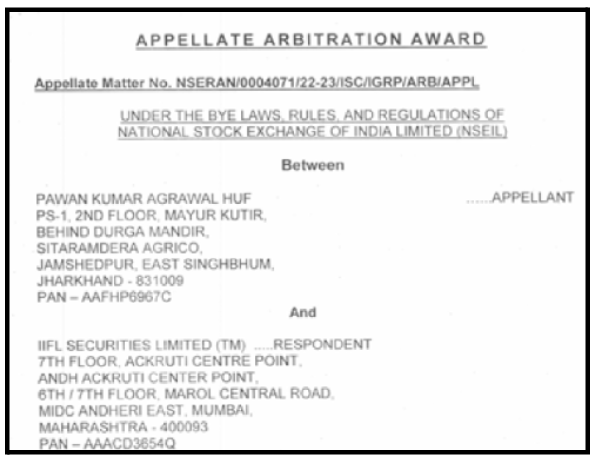
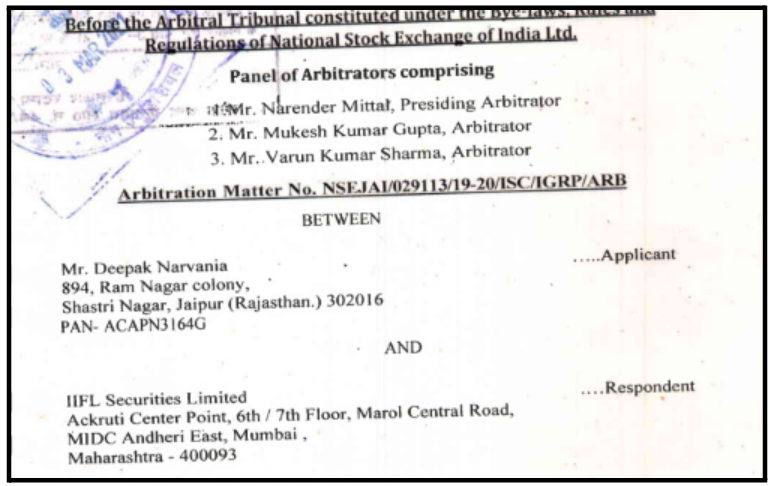
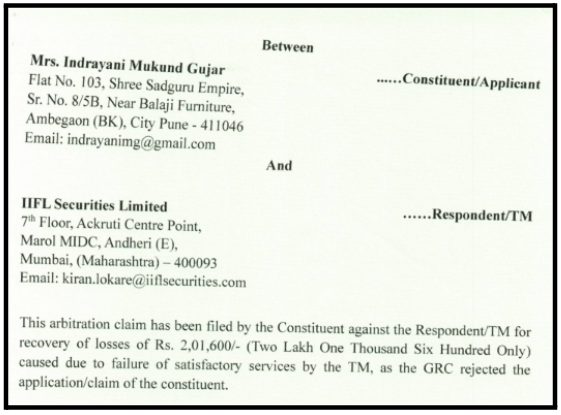
If you are not sure which fits your situation, the unauthorised trading page covers the largest group and the highest-value scenario.
How These Disputes Reach Arbitration
Arbitration is not the first step. It is the one after your complaint has already failed.
The path usually runs like this. First you complain to the broker. Then, if that goes nowhere, to the exchange grievance cell, which refers it to the Investor Grievance Redressal Committee for conciliation. Only if that does not resolve it do you file for arbitration, where a tribunal hears the whole dispute and passes a binding award.
The data carries one lesson that should stop anyone from giving up early. Several of the biggest wins came at the arbitration or appeal stage, after the client had already been rejected at conciliation. The ₹22.7 lakh award and the ₹11.8 lakh award were both won on appeal, after earlier forums had dismissed or reduced the claim. An early rejection is often just the point where the case had not been built properly yet.
If you are still at the complaint stage, the full escalation route is set out on our guide to filing a complaint against IIFL Securities. This page picks up where that one ends.
Conclusion
Across the awards reviewed, the IIFL scoreline is 9 client wins in 12 awards, drawn from 30 arbitrations filed. The wins ranged from a few hundred rupees to over ₹36 lakh.
None of the nine came down to luck. They came down to one thing: whether the broker could be forced to stand behind its records, its notices, and its login security, and whether the client built the case to make that happen.
If you lost money with IIFL and your complaint hit a wall, arbitration is the stage where it can still turn into a real payment. What decides which side of the nine-and-three you land on is how the claim is put together.
Report. Recover. Stay Fraud Free.
Frequently Asked Questions
In the set of 12 awards reviewed from 2021 to 2025, tribunals directed IIFL to pay the client in 9 cases. Two went to the broker, and one was an appeal of a case already counted. These awards came from 30 arbitrations filed over the period, and the figures are based on awards published as of the review.
In the reviewed awards, the nine wins ranged from ₹454.88 to ₹36,04,575, with three awards above ₹11 lakh. Several carried additional interest of 9 to 12 percent. What any client recovers depends entirely on the facts and the loss proven.
The largest in the reviewed set was ₹36,04,575, for squaring off a client's hedged positions even though he had already paid ₹20 lakh in margin and shared the transfer proof. The tribunal held the square-off was against natural justice.
Mostly for lack of proof, not lack of a real grievance. Dismissed claims tend to fail where the client could not establish the disputed facts, while the wins turned on the broker's own failure to produce records, notices, or authentication logs it was required to hold.



 Add us as a preferred source on Google »

