

Quick Summary
An NSE tribunal directed IIFL Securities to pay a client ₹1,79,000 plus 12% interest and ₹20,000 cost after its trading app failed on a Free & Options expiry day, leaving her unable to square off a position while staff told her to check it herself instead of helping. The tribunal held that a technical glitch does not excuse a broker from its duty to provide a working alternative and proper service. This page explains when a platform failure is challengeable and how the client recovered.
Most broker conflicts stem from decisions: someone executed a trade, closed out a position, or pushed a bad call.
Technical glitch cases are different. Here the culprit is the platform itself: an app that freezes, an order that will not go through, a position stuck open while the market moves against you.
These feel hopeless, because the broker controls the technology and can wave any failure away as a one-off beyond its control. But the responsibility of failure? Broker’s.
A clear example of this is the recent IIFL technical issue, where a reviewed case shows exactly where that responsibility bites.
The Case That Defined the Duty
The client traded options through IIFL using an algorithmic trading app. On a Free & Options expiry day, the kind of day when timing is everything, the app stopped working for over an hour in the morning.
She needed to square off a position and tried repeatedly, order after order, and could not. She was in constant contact with the broker’s people throughout, messaging that the app was not working, that her losses were climbing, and asking again and again how she was supposed to close her position.
What she got back was a stream of instructions to check her position on a different screen, cancel orders, reconcile, and manage it herself.
What she did not get was anyone actually squaring off the stuck position for her. By the time it was closed, a position that had been showing a profit had turned into a loss of ₹1.79 lakh.
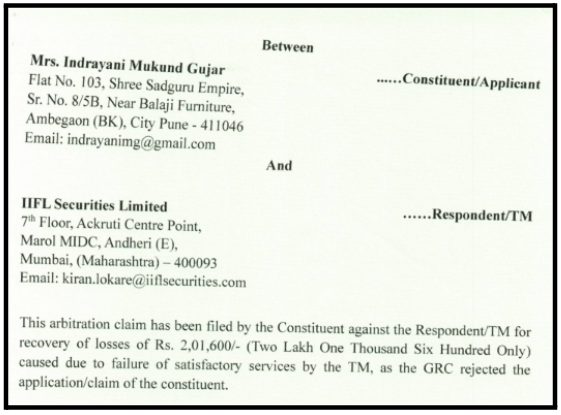
Why IIFL Securities Lost The Case?
The broker’s defence was the standard one: the glitch was beyond its control, it had reported the incident to the exchange, and the client should have contacted customer service or managed her positions herself.
The tribunal did not accept it, and the reasoning is the useful part.
It found that the WhatsApp record showed the client was in continuous contact with the broker’s representative during and after the glitch, plainly asking for help to square off.
The broker’s people knew her position was stuck and her losses were mounting.
In that situation, the tribunal held, it was the broker’s duty to resolve the issue by squaring off the position for her, from another system or offline, rather than repeatedly telling her to check the screen herself.
It pointed to the exchange requirement that every trading member maintain the infrastructure, staff, and facilities to service clients satisfactorily, and to the regulatory duty to exercise due skill, care, and diligence.
The conclusion was clear. A broker cannot hide behind a technical glitch when it had a backup available and failed to use it despite the client’s repeated requests.
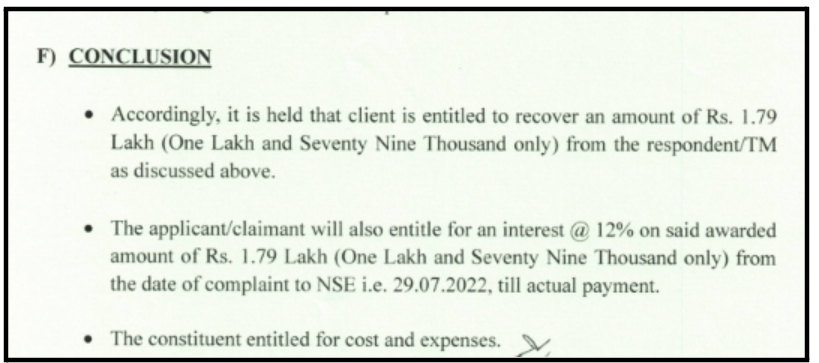
IIFL was held liable for the actual loss and directed to pay ₹1,79,000, with interest and cost on top.
The Wider Lesson on Records and Systems
This was not the only reviewed case where IIFL’s systems and record-keeping decided the outcome, and the connection is worth drawing.
In a separate matter, a client’s account ran up large losses through margin-funded and derivative trading, and when he disputed it, the broker could not submit complete logs of the SMS, email, and login records that would have shown what he had authorised.
The appeal tribunal held that the duty of oversight rests more heavily on the trading member than on the investor, found the broker more liable for the lapses, and restored an award of ₹11,83,473 in the client’s favour.
Different facts, same underlying theme. A broker owns the reliability of its systems and the completeness of its records, and when either fails, the client and the broker answer for it.
In one case, the platform failed, and no backup was offered. In the other, the records that were supposed to prove authorisation could not be produced. Both landed on the broker.
IIFL Technical Glitch: What to Do If It Costs You?
A technical glitch claim depends on capturing the failure and your response to it before the record goes cold, so move quickly.
Pull these together now:
- Screenshots of the error itself, the frozen app, the rejected orders, timestamped where possible
- Your complete chat or call record with the broker during the glitch, showing you asked for help
- Your contract notes and ledger showing what the position was before and after
- The exact times: when the glitch began, when you tried to act, when the position was finally closed
- Any incident report or acknowledgement the broker made to the exchange
The move that wins it: show that you asked for help and the broker failed to provide a working alternative. In the winning case, the WhatsApp record of the client repeatedly asking to square off, and the broker telling her to manage it herself, is what decided it. The glitch alone was not enough; the broker’s failure to help despite the backup being available is what shifted liability.
Preserve the chat completely. These conversations are the heart of a glitch claim. Export the full thread, not a few screenshots, because the sequence of your requests and their non-answers is the evidence.
If your complaint has not yet reached the escalation stage, our guide on filing a complaint against IIFL Securities covers the route up to arbitration.
Did an IIFL platform failure cost you money while staff told you to manage it yourself?
We preserve the glitch record and your requests for help, line them up against the broker’s duty to provide a working alternative, and build the claim on the exact failure the tribunal acted on. Register with us to get the assistance.
An Honest View of the Odds
Here is the honest position. Glitch claims are winnable, but they hinge on two things: proof the platform failed, and proof you asked for help that did not come.
If you captured the error and the chat where you asked the broker to act, you are in strong territory, because the tribunal treated exactly that as decisive.
If the only record is your memory, and there is no trail of you seeking help, it is much harder, because the broker will argue you should have managed your own positions.
There is also a limit worth being honest about. The award compensated the actual loss on the stuck position, not any imagined profit. Glitch awards restore what the failure cost you, not what you hoped to make.
Conclusion
The ₹1.79 lakh award rests on a duty brokers cannot wave away: when the platform fails, and the client asks for help, the broker must provide a working alternative, not tell the client to manage it alone.
The ₹11.8 lakh records case reinforces the wider principle that the trading member carries the heavier duty of oversight and answers when its systems and records fall short.
If a glitch costs you money and the broker left you to fend for yourself, that loss is not simply yours to absorb. Captured properly, it is a claim.
Report. Recover. Stay Fraud Free.
Frequently Asked Questions
Yes, but the glitch alone is usually not enough. In the reviewed case, the tribunal held IIFL liable because the client had repeatedly asked for help to square off during the glitch and the broker failed to provide a working alternative despite having a backup. The broker's failure to help, not just the glitch, decided it.
The client's WhatsApp record showed she was in continuous contact with the broker asking for help to close her stuck position, while the broker told her to check and manage it herself. The tribunal held this breached the duty to service clients satisfactorily and to exercise due skill, care, and diligence.
The tribunal awarded ₹1,79,000 for the actual loss on the stuck position, plus 12% interest from the date of complaint and ₹20,000 towards cost and expenses.
Timestamped screenshots of the failure, your complete chat or call record showing you asked the broker for help, your contract notes and ledger, and the exact timeline of the event. The record of you seeking help and the broker not providing a working alternative is the most important part.





 Add us as a preferred source on Google »

