

Quick Summary
Investogainer Research is run by proprietor Deepak Pal under SEBI registration INH000012856. It is a genuinely registered Research Analyst entity. But its own website shows five of six subscription plans breaching SEBI’s ₹1,51,000 annual fee cap for individual clients. One plan exceeds it by as much as 178%. The site also carries two different refund policies and two different grievance timelines. It even lists two different registered addresses across its own pages. This Investogainer Research review lays out every pricing breach and inconsistency, sourced directly from the firm’s own website.
If you have already paid Investogainer Research, something about the billing may feel off.
If the refund process feels off too, you are not overreacting. Multiple pages on the firm’s own website disagree with each other on what you are entitled to.
This Investogainer Research review blog walks through what the SEBI registration actually covers. It checks the published prices against SEBI’s fee rules.
It also flags where the firm’s own disclosures contradict one another. None of what follows relies on rumour. Every claim traces back to a specific page on Investogainer Research’s own site.
Investogainer Research Review: Registration and Compliance Status
When reviewing any research analyst firm, the first question that comes to mind is: Is Investogainer Research SEBI registered?
Rest assured, the firm operates with a valid SEBI Research Analyst registration (INH000012856) and carries BSE enlistment number 5845.

The registration itself is not in question. What matters more for your decision is what the firm does with that registration on its pricing and disclosure pages.
The proprietor, Deepak Pal, is shown on the About page with a claim of 12 plus years of experience. Yet Investogainer Research itself was only registered around September 2023.
Prior market experience before SEBI registration is not illegal on its own. But the website nowhere clarifies what capacity that earlier experience was in.
It also does not say whether paid calls were given before the SEBI licence existed. That gap alone does not make the firm unsafe to deal with.
The pricing does that on its own, and that is where this review turns next.
Do not just trust the website’s own claims. Verify any RA’s SEBI registration yourself in a few minutes. The steps are here: how to check if a research analyst is SEBI registered.
Also Read: Waves Strategy Advisors, a firm whose public reviews raise questions about pricing.
Investogainer Research Pricing vs SEBI’s ₹1,51,000 Fee Cap
This is the single biggest compliance issue found on the Investogainer Research website. SEBI’s December 2024 amendment updated the fee rules for research analysts.
The January 2025 Master Circular carried this forward. Together, they cap RA fees for individual and HUF clients at ₹1,51,000 per year, per family.
This cap applies across all research services combined. Advance fee collection cannot exceed one quarter at a time for these clients.
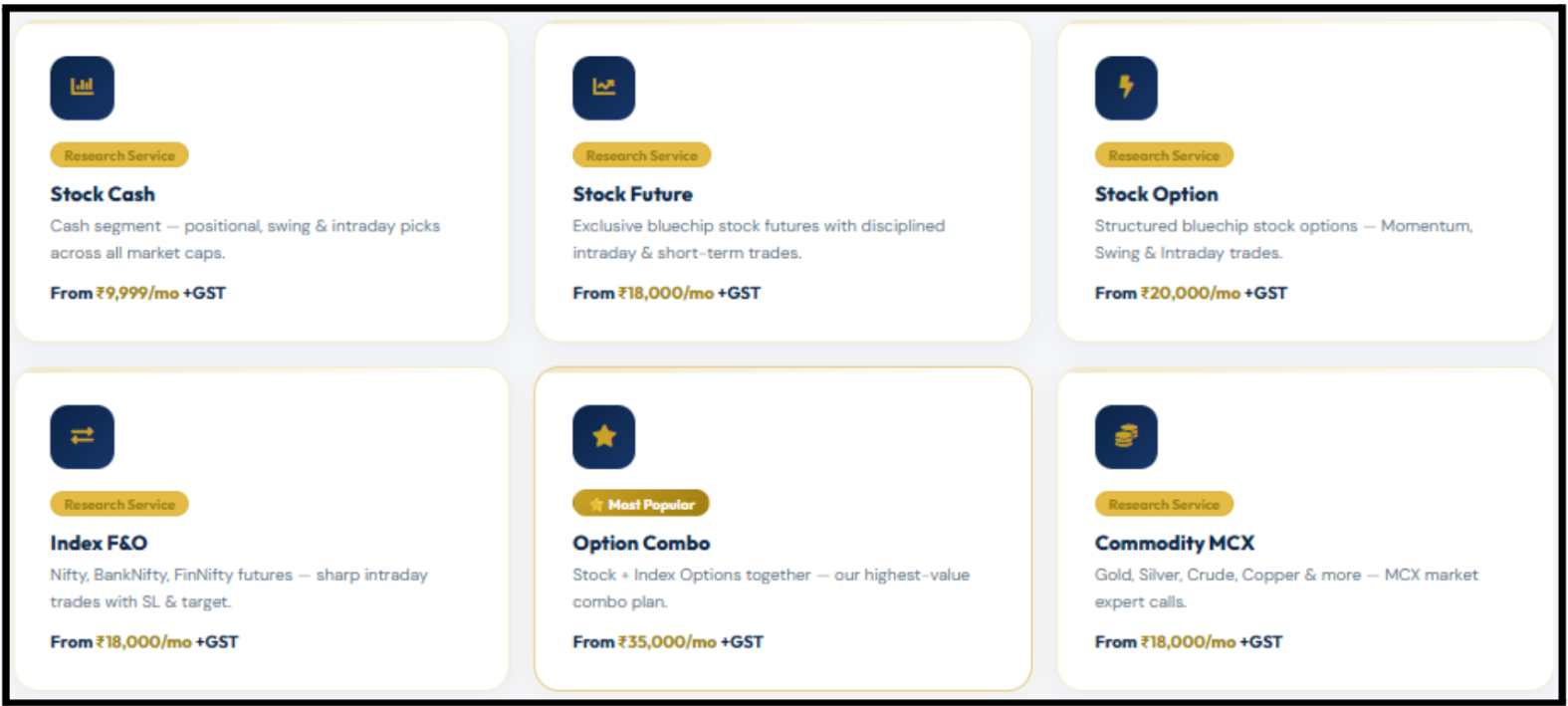
Investogainer Research publishes six subscription plans on its Services page. Laid out against the annual cap, the picture looks like this.
|
Plan |
Monthly Fee | Annualised (x12) | Exceeds ₹1,51,000 Cap? |
| Stock Cash | ₹9,999 | ₹1,19,988 |
Within cap alone |
|
Stock Future |
₹18,000 | ₹2,16,000 | Exceeds by ~43% |
| Stock Option | ₹20,000 | ₹2,40,000 |
Exceeds by ~59% |
|
Index F&O |
₹18,000 | ₹2,16,000 | Exceeds by ~43% |
| Option Combo | ₹35,000 | ₹4,20,000 |
Exceeds by ~178% |
|
Commodity MCX |
₹18,000 | ₹2,16,000 |
Exceeds by ~43% |
Every Plan Except One Breaches the Cap
Only the base Stock Cash plan stays within the ₹1.51 lakh ceiling on its own. Every other plan sits above it as a standalone subscription.
Combine any two plans, including Stock Cash, and the family total breaches the cap regardless.
This would only be acceptable if every subscriber were non-individual, institutional, or SEBI-accredited. The fee cap applies specifically to individual and HUF clients.
The firm’s own marketing language works against that reading. Phrases like “for beginners,” “for small investors,” and “1000+ traders” describe retail individuals, not institutions.
Half Yearly Plans Break the Advance Fee Rule Too
Investogainer Research also offers half yearly plans. These collect six months of fees upfront, from roughly ₹55,000 to ₹1,50,000 in one payment.
SEBI permits RAs to collect no more than one quarter’s fee in advance from individual and HUF clients. A six month advance collection breaches that rule on its own, separate from the annual cap issue.
Quarterly plans sit closer to compliant on advance collection timing, since three months equals one quarter.
But the annualised value of nearly every quarterly plan still crosses the ₹1.51 lakh yearly ceiling. GST is correctly listed as an extra charge on every plan. That is the one clearly compliant pricing detail on this page.

The frequency of recommendations adds another layer of concern. The Services page promises 2 to 3 recommendations every day across multiple paid segments running at once.
Nothing about that frequency is explicitly illegal for a registered RA. But pair that frequency with pricing that already breaches the fee cap.
It reads closer to high frequency tip selling repackaged as research. This is the exact pattern SEBI has repeatedly acted against among unregistered finfluencers.
Two more gaps sit on the same page. There is no sample research report shown anywhere. SEBI requires RAs to issue reports with reasoning, target price, risk factors, and analyst disclosures.
The Subscribe Now buttons also route straight to an eKYC portal. They do this without first showing any risk profiling or suitability assessment, which SEBI mandates before onboarding a client.
Also Read: Yash Dipak Rachh, Review his professional background and the research services offered to investors.
Website Red Flags: Contradicting Policies Across Pages
A SEBI registered intermediary is expected to state its own rules consistently everywhere. Investogainer Research does not.
Three separate policy conflicts show up once you compare pages that should say the same thing.
Refund Policy Says Two Opposite Things
The homepage’s Refund Policy promises a pro-rata refund with no penalty on early cancellation. The Terms and Conditions page, on the same domain, states that “fees once paid are non-refundable and non-transferable.”
These two statements cannot both be true. SEBI’s January 2025 circular requires RAs to refund unutilised, pro-rata advance fees on premature termination.
No breakage fee is allowed. A blanket non-refundable clause conflicts directly with that right, and with the firm’s own homepage promise.
Grievance Timeline Also Contradicts Itself
The homepage’s Grievance Redressal Policy states complaints are “acknowledged in 48 hours and resolved in 7 working days.”

The separate Investor Charter page states a 21 day resolution timeline for the same commitment. An investor reading only one page walks away with a completely different expectation than one reading the other.
Registered Address Changes Depending on the Page
The About page lists the registered address as Plot No. 93A, Setelite Vally, Mirzapur Road, Tejaji Nagar, Indore 452020.
Other pages on the same domain list a different address entirely. A blog post and the grievance policy text both show 301-C Om Shree Apartment, Shivdham Colony, Limbodi, Indore 452001.
The Contact page repeats this pattern. The “View on Map” link for the registered address points to the Om Shree Apartment location.
But the text beside it reads the Tejaji Nagar address instead. The correspondence address shows the same mismatch. The map link points to Sairam Plaza, Mangal Nagar, while the text reads C.S Nayudu Arcade, Old Palasia.
A single SEBI registered entity should have one consistent registered office listed everywhere. Multiple different addresses across the same site is a documentation integrity problem.
It is one an investor should notice before paying, not after.
A few smaller issues sit alongside these. The Compliance Officer and Principal Officer contact is listed under a personal Gmail address.
This sits in place of an official domain email, a verifiability concern for a regulated entity. The footer’s “Grievances Policy” link also points to a broken URL with a typo.
None of these individually proves wrongdoing. Taken together, they describe a website that was not carefully checked before it went live. That carelessness sits on pages that carry legal weight.
Investogainer Research Complaint Disclosure: What the Data Actually Shows?
SEBI requires every registered RA to publish monthly, updated investor complaint data on its website. Investogainer Research does publish a complaint page.
But the way the numbers are laid out raises its own concern.
The complaint page header reads “Reporting Period: 30 June 2025.” Yet the monthly trend table below it already shows rows for July 2025 through June 2026, all marked zero.
These are months that had not even occurred yet when the reporting period was dated. A genuinely monthly refreshed disclosure would not pre-populate a full year of future months with zeros in advance.
The table below shows the year by year complaint figures as published on the site.
|
Financial Year |
Carried Forward | Received | Resolved | Pending |
| 2022-23 | 0 | 0 | 0 |
0 |
|
2023-24 |
0 | 0 | 0 | 0 |
| 2024-25 | 0 | 1 | 1 |
0 |
|
2025-26 |
0 | 0 | 0 |
0 |
Across more than two years of operation, the site shows exactly one complaint total. It was filed and resolved in January 2025.
That is not impossible for a small proprietorship. But it is unusually low for a firm running six paid research services. Testimonials on the same site describe many active clients.
The complaint data trend, read line by line, tends to reveal more than a single headline figure. Before trusting any RA’s self reported numbers, read them properly. That guide is here: how to check SEBI complaint status.
What Investogainer Research’s Website Does Not Disclose?
Beyond the contradictions above, several disclosures SEBI expects from a registered RA are simply missing. Reviewing what is absent matters as much as reviewing what is shown.
These gaps limit how much an investor can verify before paying.
- No disclosure of disciplinary history or past SEBI action against the firm or Deepak Pal, whether any exists or not.
- No visible NISM Series XV certification number for Deepak Pal. Only the SEBI registration number is shown, though NISM certification is what actually qualifies someone as a research analyst.
- No sample research report showing target price, rationale, risk factors, or analyst disclosure. A prospective client cannot see what a paid recommendation looks like.
- No visible risk profiling or suitability questionnaire before payment. Clients are routed straight from Subscribe to the eKYC and payment page.
- No dedicated conflict of interest disclosure policy page. A generic Investor Charter line states such disclosures “are made,” without showing the policy itself.
- No disclosure of AI tool usage in research generation. SEBI’s December 2024 amendment specifically requires RAs to state this.
The Disclaimer page adds one more gap of its own. It states that some information is sourced from third party vendors, and disclaims liability for inaccuracies.
RAs remain responsible for reasonable basis and due diligence on their report data, regardless of the source. A blanket liability disclaimer does not remove that duty.
The same page also skips a mandatory disclosure. It does not describe the required per report disclosure of an analyst’s own holding in recommended securities.
Facing Problems with Investogainer Research? Take These Steps Today
If any of the pricing or disclosure issues above match your experience, filing a complaint helps. It puts your grievance on the regulatory record.
It stops the issue from staying an unresolved conversation.
Here is the path specific on how to file a complaint against Investogainer Research:
- Gather your documentation first: Collect your subscription invoice, the plan you were sold, and any WhatsApp or call records of the recommendations sent. Save screenshots of the pricing and refund pages as they appeared when you subscribed.
- File on SEBI SCORES against registration number INH000012856. Cite the fee cap breach or the refund and grievance timeline contradiction as your grounds.
- Escalate to SMART ODR: If the complaint involves a direct financial dispute. A refund the firm is refusing, despite its own pro-rata promise, qualifies.
- Move to NSE or BSE arbitration: If SCORES and SMART ODR fail to resolve your financial loss claim.
Filing correctly the first time saves weeks of back and forth. The complete step by step process is covered in full here: how to lodge a complaint in SCORES.
Once SCORES and SMART ODR are exhausted, understanding how the arbitration stage works helps you prepare stronger documentation. That process is explained here: arbitration in the stock market.
If the fee cap breach touches money you already paid, you do not have to work this out alone.
Our team reviews your subscription documents. We tell you plainly whether the pricing you were charged breached SEBI’s fee cap.
Conclusion
Investogainer Research’s SEBI registration is genuine, and that much is not in dispute.
What the firm’s own website does not hold up is its pricing against the fee cap. Its own policies do not hold up against each other either.
Five of six plans breach the ₹1,51,000 annual cap. The refund policy contradicts the Terms and Conditions. The grievance timeline changes depending on which page you read.
If you paid into any plan above the cap, that is worth acting on now. The same goes if a promised refund is being denied.
Frequently Asked Questions
Investogainer Research's registration number INH000012856 covers research analyst services broadly. It is not restricted to a single asset class by the registration itself. The Commodity MCX and Index F&O plans on the Services page fall under this same registration. That is why their pricing is measured against the same ₹1,51,000 annual cap as the equity plans.
The non-refundable clause in the Terms and Conditions conflicts with SEBI's January 2025 circular. That circular mandates a pro-rata refund of unutilised advance fees on premature termination, with no breakage fee. Investogainer Research's own homepage Refund Policy already promises this pro-rata refund. Citing that page alongside the SEBI circular strengthens a refund complaint filed on SCORES.
Claiming prior market experience predating SEBI registration is not itself against the rules. The concern is that the website gives no clarity on what capacity that experience was in. It also does not say whether any paid recommendations were given before the firm's September 2023 registration existed. That context gap is worth asking the firm to clarify directly.





 Add us as a preferred source on Google »

