

Quick Summary
Stock Option Research is a SEBI registered Research Analyst under registration number INH000015321, held individually by Anjali Tiwari, active since March 1, 2024. The firm’s Growth Plan, once GST is added, costs ₹1,77,000 a year, ₹26,000 above SEBI’s ₹1,51,000 cap for individual analysts. Its complaint disclosure tables contain internal contradictions between the monthly and annual figures. Its homepage advertises an unverified 87% success rate, its consent policy treats DND registered numbers as opt-in, and its refund clause specifically excludes the one situation most clients would actually want a refund for.
An 87% success rate. Zero verification behind it. That’s the first thing Stock Option Research wants you to see.
The second thing is buried much deeper, in the firm’s own disclosures, its own pricing terms, its own refund clause, and it tells a very different story than the homepage does.
This page pulls all of it together. The registration record. The real, GST-inclusive pricing. The complaint disclosures that don’t quite add up.
The specific clauses written into the fine print. Everything you’d need to decide with the full picture in front of you, not just the marketing.
Is Stock Option Research SEBI Registered?
Yes, Stock Option Research holds an active SEBI Research Analyst registration.
Here’s exactly what the firm’s own official disclosure page shows, matched directly against SEBI’s own record.
- Registered Name: Anjali Tiwari, Proprietor of Stock Option Research
- SEBI Registration Number: INH000015321
- Registration Date: March 1, 2024, Perpetual
- BSE Enlistment Number: 6074
- Email: [email protected]
- Contact Person: Anjali Tiwari
- Registered and Correspondence Address: Office No. 401, New Techno City, Above HDFC Bank, MBP, Mahape, Navi Mumbai, Maharashtra, 400710
Both the registered address and the correspondence address are identical, meaning there’s no separate mailing address; everything routes to the same Navi Mumbai location.

You can verify every one of these details yourself. Go to SEBI’s official intermediary search portal and search registration number INH000015321. Confirm the name, the validity status, and the address all match what’s shown above.
One detail worth understanding about this specific registration type. This sits under the individual category, held personally by one person, not a company.
That matters because SEBI’s fee cap rules for individual analysts are stricter than for larger corporate entities, a distinction that becomes directly relevant in the pricing section below.
What Does Stock Option Research Actually Offer?
Stock Option Research positions itself as a research-driven alternative to unregulated tip providers, offering options-focused recommendations built around technical and fundamental analysis rather than rumours.
Each recommendation is stated to include a researched entry, target, and stop-loss level, delivered to subscribers over email and WhatsApp.
The firm operates out of Office No. 401, New Techno City, Above HDFC Bank, MBP, Mahape, Navi Mumbai, Maharashtra 400710.
Its stated mission is to blend cutting-edge market analysis with transparent, SEBI-aligned guidelines to help retail traders make confident investment decisions.
Also Read: Bullgains Research, where the RA claimed something outside its license through taglines on the website.
Stock Option Research: What a SEBI Research Analyst Can and Cannot Do?
Holding registration INH000015321 means Stock Option Research operates within a specific, defined boundary. Some of what it markets sits well inside that line. Some of it doesn’t.
Inside the boundary, this is genuinely permitted.
- Publishing research reports and issuing buy, sell, or hold recommendations, exactly the format its Normal and Growth Plans are built around.
- Charging a fixed subscription fee, provided the total stays within SEBI’s ₹1,51,000 annual cap for an individual analyst like Anjali Tiwari.
- Sharing market views and technical analysis with subscribers over email and WhatsApp, its stated delivery channels.
Outside the boundary, no amount of confident marketing changes this.
- Managing a client’s trading account or funds directly, something no Research Analyst registration extends to.
- Promising or implying guaranteed returns, the exact territory an “87% success rate” banner risks stepping into.
- Charging fees tied to a client’s trading profits, rather than a flat, disclosed subscription.
- Advertising a fixed win rate without an independent, SEBI-approved audit sitting behind it, which is precisely what’s missing here.
SEBI continuously monitors registered firms like this one through compliance audits and tracks complaints publicly on the SCORES portal, the exact mechanism the complaint data section below draws from directly.
For the fuller, general breakdown of what any SEBI-registered Research Analyst can and cannot do, our what can a SEBI registered research analyst do page covers it in more depth.
Stock Option Research Pricing
The firm’s pricing page lists three distinct plans, and understanding the real, GST-inclusive total for each is where the actual compliance question begins.
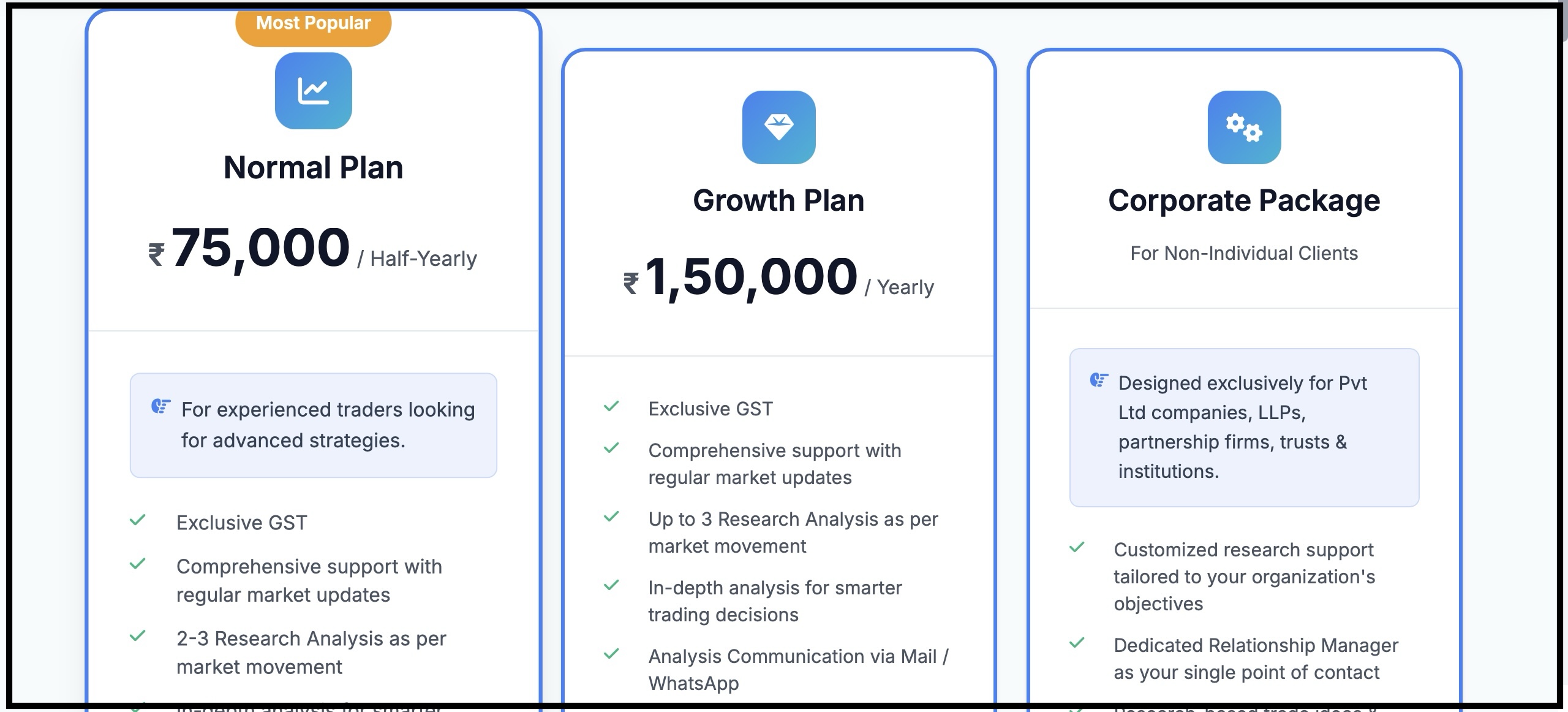
- Normal Plan: ₹75,000 for six months, marketed toward experienced traders looking for advanced strategies, GST charged separately, 2 to 3 research analyses provided per market movement.
- Growth Plan: ₹1,50,000 for a full year, GST charged separately, up to 3 research analyses per market movement, communication via mail or WhatsApp.
- Corporate Package: Custom priced, designed exclusively for private limited companies, LLPs, partnership firms, trusts, and institutions, including a dedicated Relationship Manager. No fixed price is disclosed anywhere on the site.
Why the Growth Plan Crosses SEBI’s Fee Cap on Its Own?
SEBI caps what an individual Research Analyst can charge a single client family at ₹1,51,000 per year, combined across every plan that client holds.
Add the mandatory 18% GST to the Growth Plan’s ₹1,50,000 base price, and the total comes to ₹1,77,000 for the year.
That’s ₹26,000 above SEBI’s limit, for a single yearly plan, with no other subscriptions involved.
Why Does the Normal Plan Reach the Same Total Through Renewal?
The Normal Plan looks cheaper at first glance, ₹75,000 for six months, but GST brings that to ₹88,500 per term.
A client who renews it twice to cover a full year ends up paying ₹1,77,000, the same total as the Growth Plan, and the same amount above the legal cap.
Structuring two plans that both land on the same non-compliant annual total, whether by design or by accident, doesn’t change what a client actually ends up paying.
GST is a mandatory tax added to the base fee, not a separate service. Structuring a plan so the base price sits just under the cap, with GST billed as an addition, doesn’t change the total amount a client actually bears in a year.
Also Read: Global Vision Research Indore, nine plans listed, seven breaching the legal cap outright.
Stock Option Research Complaints
Every SEBI-registered analyst is required to publish investor grievance data on both a monthly and annual basis.
Reading these two tables side by side is where the real story sits.
Current Month Summary, Data for Month Ending March 2025
| Source | Pending Carried Forward | Received | Resolved | Pending | Avg. Resolution |
|---|---|---|---|---|---|
| Direct from Investor | 0 | 0 | 0 | 0 | — |
| SEBI (SCORES) | 0 | 3 | 3 | 0 | 5 days |
| Other Sources | 0 | 1 | 1 | 0 | 5 days |
| Grand Total | 0 | 4 | 4 | 0 | 10 days |
Trend of Annual Disposal of Complaints
| Year | Carried Forward | Received | Resolved | Pending |
|---|---|---|---|---|
| 2023-24 | 0 | 0 | 0 | 0 |
| 2024-25 | 0 | 0 | 0 | 0 |
| 2025-26 | 0 | 3 | 3 | 0 |
| 2026-27 | 0 | 1 | 0 | 1 |
| Grand Total | 0 | 4 | 3 | 1 |
That same March 2025 reporting period should carry forward into the 2024-25 row of the annual table.
Instead, the annual table shows zero received and zero resolved for the entire 2024-25 year, a direct contradiction of the four complaints the monthly summary reports for March 2025 alone.
Two tables published by the same firm, covering the same period, cannot both be accurate.
The monthly disposal table also lists individual rows running from April 2025 through March 2027, every one filled in as zero, including months that hadn’t occurred yet at the time of publication.
Trend of Monthly Disposal of Complaints
| Period | Carried Forward | Received | Resolved | Pending |
|---|---|---|---|---|
| April 2025 – May 2026 | 0 | 0 | 0 | 0 |
| June 2026 | 0 | 1 | 0 | 1 |
| July 2026 – March 2027 | 0 | 0 | 0 | 0 |
| Grand Total | 0 | 1 | 0 | 1 |
A table with pre-filled zero entries for periods that hadn’t occurred yet points to a template that was copied and populated with placeholder data, rather than one genuinely updated in real time as the site’s own disclosures claim.
Both the monthly and annual tables do agree on one thing. Each shows a single complaint received in June 2026 that remains pending, carried forward with zero resolutions against it.
That specific complaint is the one figure that stays consistent across both formats, which makes it the one number here worth treating as reliable.
Also Read: Aakash Rathore, one registered name, and why matching it matters before you pay.
Stock Option Research Red Flags
Beyond pricing and complaint reporting, the firm’s own website and legal documents carry four additional patterns worth understanding before you subscribe.
1. The Unverified 87% Success Rate Claim
The homepage prominently advertises an 87% success rate, the kind of figure that creates immediate confidence and urgency.
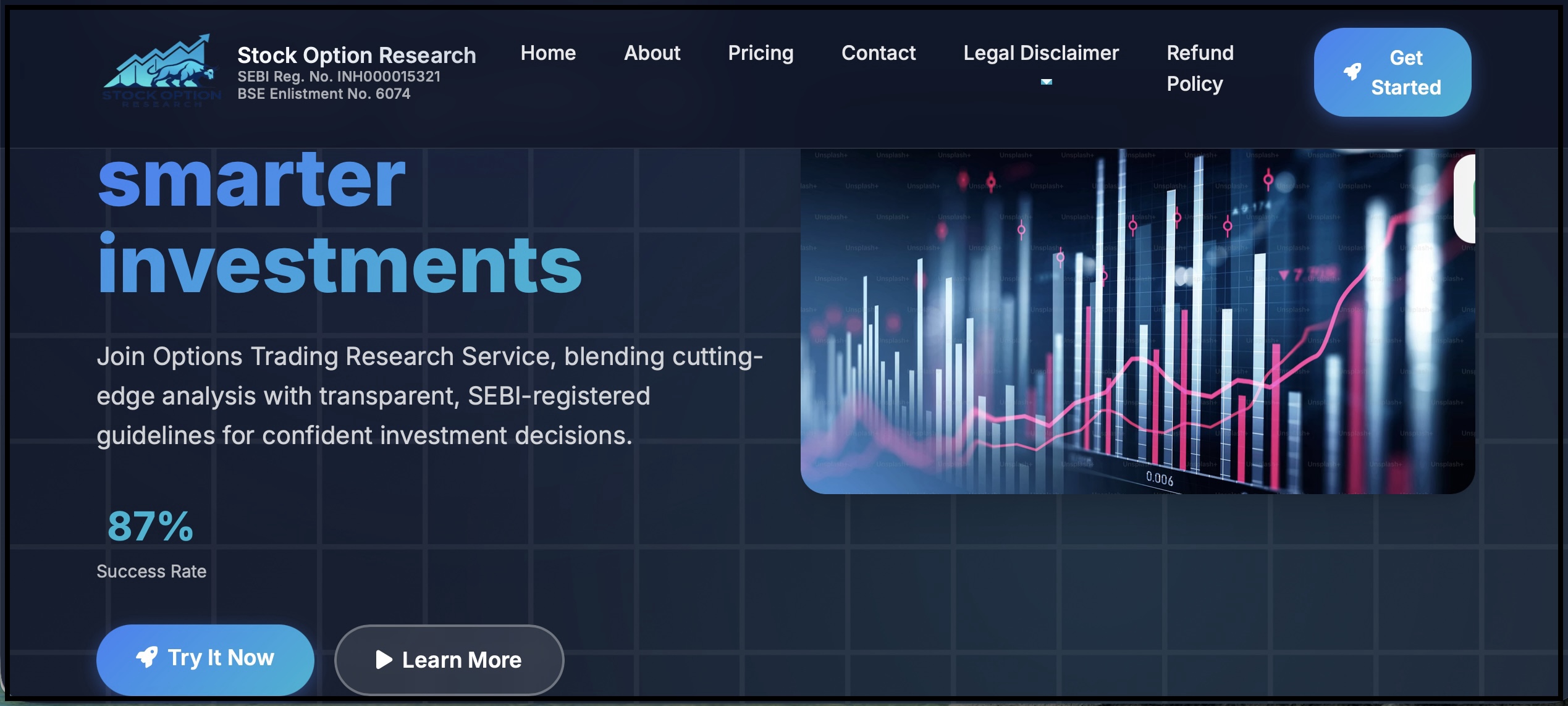
SEBI’s advertising rules for research analysts prohibit publishing fixed win rates or accuracy percentages to attract clients, unless that figure is backed by an independent, SEBI approved audit.
Nothing on the site indicates such an audit exists behind this specific number, which places the claim itself in direct conflict with SEBI’s advertising code, regardless of whether the underlying percentage happens to be accurate.
2. No Independently Verifiable Public Reviews
There are barely any publicly available user reviews for Stock Option Research on any major platform, no Google reviews, no independently verifiable social media testimonials.
For a firm whose marketing implies a track record worth trusting, the absence of any verifiable public feedback is conspicuous.
It means a prospective subscriber has essentially no independent source to check the firm’s real-world reputation against, beyond what the firm publishes about itself.
3. Treating Any Entered Phone Number as Consent
The firm’s own consent policy states plainly: “If your number is registered in the DND (Do Not Disturb) registry, this registration will be treated as an ‘opt-in.'”
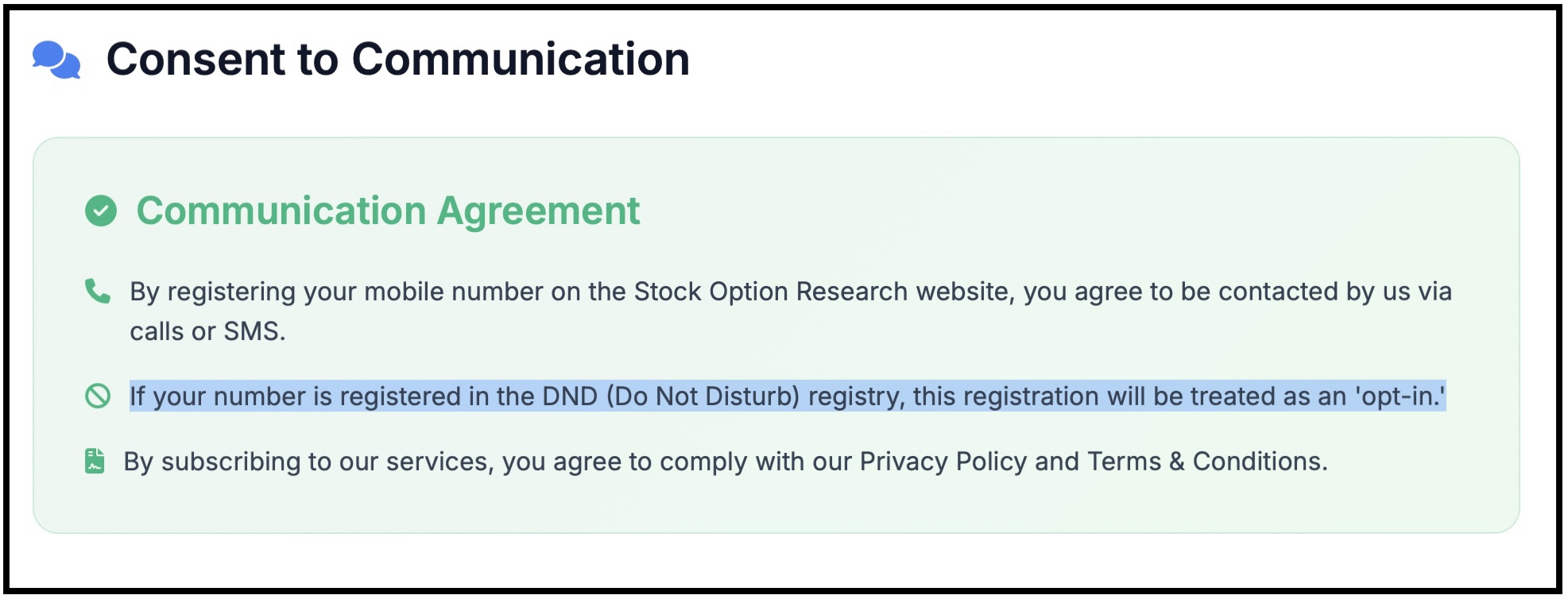
A DND registration exists specifically to block this kind of unsolicited contact. A policy that overrides it by default puts the burden on the client to notice and object, rather than on the firm to respect the registry in the first place.
4. A Refund Clause That Locks in Losses
The firm states it follows SEBI’s pro rata refund guidelines. Its own terms specify something else entirely.
“The client cannot terminate the agreement solely based on not achieving the desired returns or incurring the losses from trading on the recommendations.”
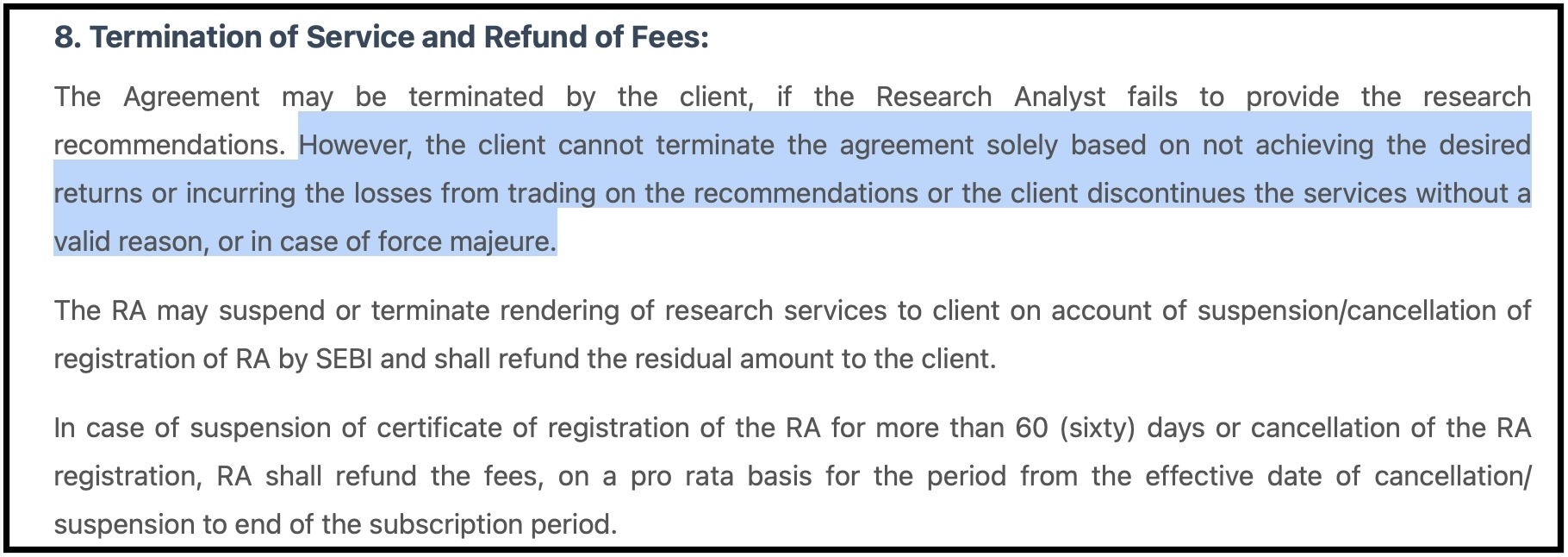
In practice, this means the one situation most likely to make a client actually want a refund, poor-performing advice, is the exact situation the clause is written to exclude.
The agreement does allow termination if the Research Analyst fails to provide recommendations at all, or if SEBI suspends or cancels the registration, in which case a pro rata refund applies.
What Should You Verify Before Paying Stock Option Research?
A few concrete checks, done before any money changes hands, tell you more than the homepage ever will.
- Check the analyst’s credentials directly. Review qualifications, certifications, and regulatory disclosures against what SEBI’s own portal shows, not just what the website states.
- Read the risk disclosures in full. Pay specific attention to warnings about high-risk trading and loss potential, not just the headline success claims.
- Review the complete Terms and Conditions and refund policy, including clauses like the one covered above, before you subscribe, not after a dispute arises.
- Ask directly whether the specific plan you’re considering, once GST is added, stays within SEBI’s ₹1,51,000 annual cap. Get the answer in writing.
How to File a Complaint Against Stock Option Research?
A fee cap breach, an unresolved complaint, or advice that didn’t match what was promised are all real, valid reasons to escalate.
Knowing the right order to escalate matters is just as important as knowing you have a case.
Here’s the defined path, step by step.
- Gather your evidence first. Payment receipts, advisory emails, WhatsApp conversations, call recordings, and any signed agreements, organised in chronological order.
- Send a formal written complaint to the firm directly, specifying a reasonable response window. If the firm doesn’t respond or fails to resolve the issue, that inaction itself strengthens your position later.
- If unresolved, file a SEBI SCORES complaint, citing registration number INH000015321 and attaching your documentation.
- If SCORES doesn’t bring resolution, escalate through the SMART ODR portal, where a neutral mediator helps both sides reach an agreement.
- If mediation still fails, share market arbitration is the final, binding step, producing a legally enforceable decision.
For the complete, detailed process, exactly what evidence to prepare, and how to structure your written complaint, our complaint against SEBI registered research analyst page covers every stage.
Paid the Growth Plan, or renewed the Normal Plan twice?
That means you paid ₹26,000 more than SEBI allows for that year, and that overcharge alone is grounds for a formal complaint, separate from anything related to trading outcomes.
Disclaimer: This page reflects publicly available information and Stock Option Research’s own published disclosures at the time of writing. No SEBI adjudication order or enforcement action has been identified against the firm as of this writing.
Conclusion
Stock Option Research holds a genuine, verifiable SEBI registration under Anjali Tiwari, active since March 2024. That registration is real.
What sits around it deserves equal weight. Its own published pricing exceeds the legal fee cap by ₹26,000 a year regardless of which plan a client chooses.
Its complaint disclosure tables contradict each other and contain data for months that hadn’t happened yet. Its homepage advertises an unaudited success rate with no independently verifiable reviews to check it against.
Its consent policy overrides a client’s own DND registration by default. And its refund clause specifically excludes the one scenario most clients would actually want a refund for.
None of this requires reading between the lines. It’s what the firm has published about itself.
Report. Recover. Stay Fraud Free.
Frequently Asked Questions
SEBI's fee cap represents the total cost a client bears for research analyst services in a year, and GST is a mandatory tax added to the base fee, not a separate service. Stock Option Research listing its Growth Plan as "₹1,50,000, Exclusive GST" doesn't change the actual total a client pays.
A SEBI registration confirms Stock Option Research is authorised to operate as a Research Analyst. Its BSE Enlistment Number 6074 is a separate exchange listing used for administrative tracking, and holding both doesn't mean the firm is automatically compliant with every operational rule, including pricing and advertising.
No, not under the guidelines it claims to follow. SEBI's pro rata refund rules exist to protect clients from being locked into services that aren't delivering value. Stock Option Research's own Clause 8 excluding refunds specifically for poor performance or trading losses works against the purpose those guidelines are meant to serve.
You can file a complaint through the National Do Not Disturb registry directly with your telecom provider, and separately report unsolicited commercial communication to TRAI. Since Stock Option Research is a SEBI registered entity soliciting paid services, that pattern is also worth including as supporting context in a SCORES complaint.
No. The website does not display an independently audited or officially certified track record behind this figure, which places the claim in direct conflict with SEBI's Advertisement Code for research analysts.
Charging beyond this SEBI mandated cap for an individual client is a regulatory violation. Both the Growth Plan and a twice-renewed Normal Plan reach ₹1,77,000 once GST is added, ₹26,000 over the limit, and this can be reported directly through SEBI SCORES.





 Add us as a preferred source on Google »

