

Every week, thousands of Indian retail traders sign up for advisory apps chasing better calls, faster alerts, and that one edge that finally makes trading click.
Some find it. Many do not, and end up with losses they did not sign up for.
Traders Circuit is one such app that has been gaining traction fast, marketing itself as a complete trading companion for Indian retail investors through stock alerts, options calls, and subscription-based advisory plans.
Before you pay, or if you already have, the question worth asking is: is Traders Circuit app genuine?
In this blog, we cut through the marketing and give you a clear, honest look at what the platform offers, what its SEBI registration actually covers, what real users are saying, and what steps you can take if the experience did not match the promise.
Traders Circuit Review
Traders Circuit app is a mobile-based stock market research and advisory platform built for Indian retail traders. It combines stock research, options signals, swing trading ideas, and portfolio solutions inside one app, delivering alerts through in-app notifications, Telegram, and WhatsApp.
The platform supports direct broker integrations, letting users execute trades through connected accounts.
Unlike unstructured Telegram channels, it presents itself in an organised, subscription-based format across four main plans: Trade Options, Swing Master, Portfolio 365, and a free research feature called Explore the Unseen.
On the regulatory side, Traders Circuit is connected to a SEBI registered Research Analyst entity, which means it is authorised to provide research services under SEBI regulations.
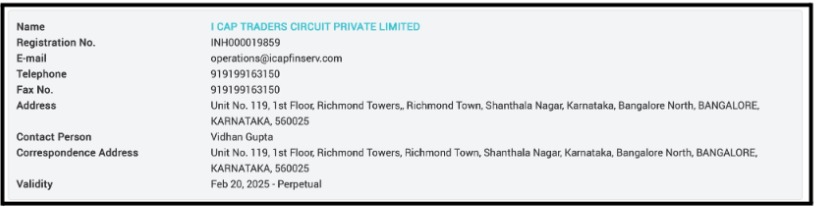
That said, SEBI registration is not a performance guarantee. It does not verify strike rates, certify recommendation accuracy, or promise profits.
Always confirm registration details directly on SEBI’s official intermediary database rather than relying on what the app displays.
Is Traders Circuit App Genuine or Not?
When you first land on an app like Traders Circuit, the professional dashboard and talk of SEBI registration make it look like a safe bet. But if you’ve already put your money in and felt like something was off, you aren’t alone.
While the platform has a regulatory identity, being “genuine” on paper is very different from being transparent with your hard-earned capital.
One of the biggest problems you might notice is how hard it is to actually find their SEBI registration number clearly displayed on their website.
For any legitimate advisor, this should be front and center, not something you have to hunt for.
Then there’s the issue of accountability. Legitimate SEBI-registered analysts are expected to disclose their complaint data publicly so you can see their track record of resolving issues.
However, Traders Circuit seems to keep this data hidden, leaving investors in the dark about how many other people are facing the same frustrations you might be.
Moreover, there are other major red flags such as:
1. Internal Strike Rates Are Not Independently Verified
One interesting aspect inside the app is the display of highly precise strike-rate numbers like:
- 100.0%
- 86.84%
- and 25.0%
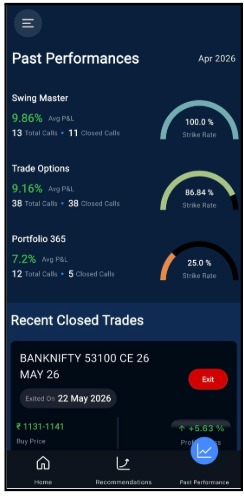
At first glance, these numbers look convincing because they appear highly specific instead of overly exaggerated.
But investors need to understand something important. These performance metrics are self-reported inside the application.
There is no publicly available third-party audit proving that average users actually achieved those same execution results in real live-market conditions.
SEBI registration does not mean SEBI verifies internal dashboard strike rates.
2. The Delayed Alert Problem in Live Options Trading
This is one of the biggest practical risks in app-based options trading.
In fast-moving Bank Nifty or expiry trading conditions, option premiums change within seconds. By the time a notification reaches the trader and the order gets executed, the actual entry price may already be very different.
This creates slippage. As a result, the app may record a profitable “paper entry,” while the real trader may experience a poor entry and eventual loss.
This issue is commonly discussed by retail traders across many advisory-based options trading platforms.
3. High Strike Rate Does Not Automatically Mean Profitability
Many beginners think: “If the app has 80% or 86% accuracy, I will automatically make money.”
But trading does not work that way.
Even with a high win rate, a few large losses can wipe out multiple profitable trades if:
- Stop-loss execution fails.
- Risk management is poor.
- Quantities become too large.
In options trading, risk-reward structure matters much more than screenshots or strike-rate percentages alone.
Also Read: Is Dil Se Trader genuine, only winning trades shown, according to the reviewed content.
Traders Circuit User Complaints
It’s helpful to look at what other traders have actually experienced with the app.
Many users have shared their frustrations, and reading these stories might help you understand if you are facing similar issues.
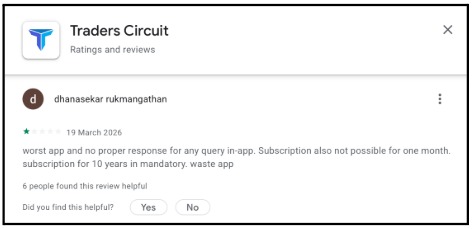
1. Being locked into long-term plans without support
Many users have shared that it is nearly impossible to get a response from the support team when they have a question or an issue.
To make matters worse, some traders feel forced into very long subscription plans, sometimes up to 10 years, with no option for a simple monthly trial.
Once you pay, it can feel like you are on your own, as the team often stops responding to messages, leaving you stuck with a service that isn’t providing the help you expected.
2. Losing money due to slow app alerts
A major complaint from many users is that the trading recommendations often arrive too late.
Because the app can be slow or laggy, by the time you get a notification to buy or sell, the market price has already moved well past the entry point.
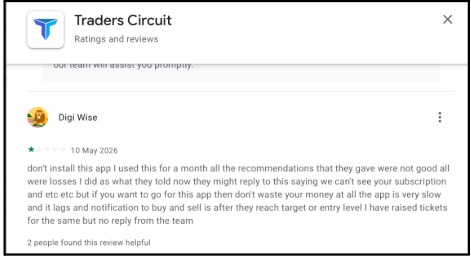
This makes it very difficult to trade successfully, as you end up entering the trade at the wrong time, which often leads to losses.
Users also report that when they try to tell the support team about these technical problems, they don’t get a reply.
3. Technical issues after app updates
After some recent updates, several users have noticed that the app isn’t working as well as it should. Specifically, option trade signals are appearing late, which makes it almost impossible to trade properly.
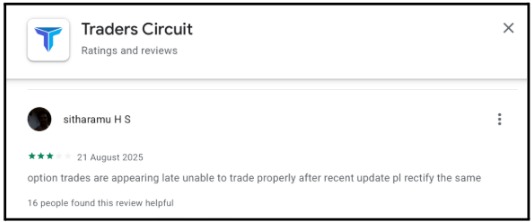
For active traders, timing is everything, and these technical glitches that appeared after an update have made it very frustrating to use the app for the purpose it was designed for.
4. Getting exit alerts only after the trade is over
Another common issue is receiving notifications to close a trade long after it has already finished or after the market has moved against the position.
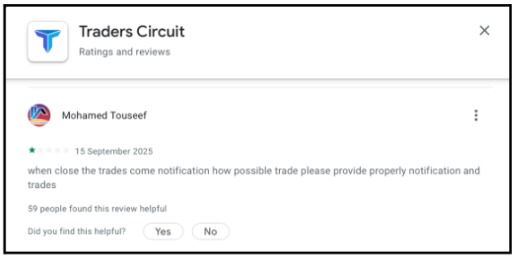
This makes it impossible to manage your risks or take profits when you are supposed to.
Traders end up feeling confused because they aren’t getting the timely information they need to close their trades properly, leaving them with no control over their money.
How to Complain Against Traders Circuit?
If you feel a research advisory service misled you, pressured you into risky trades, or failed to deliver services properly after taking subscription fees, you should take formal action.
Here are the steps to raise a complaint:
Step 1: Collect All Important Evidence
Start by gathering every important document connected to the advisory service.
This includes payment receipts, WhatsApp chats, Telegram messages, screenshots of advertisements, trade calls, emails, and subscription invoices.
If any promises were made during phone calls, keep call recordings if available.
Also, prepare a simple timeline explaining when you joined, what was promised, what services were delivered, and what issues happened later.
A properly documented complaint becomes much stronger.
Step 2: Send a Written Complaint to the Advisory Firm
Before approaching SEBI, first file a formal complaint directly with the advisory company or its compliance department.
Clearly explain your issue, mention your subscription details, payment information, and the resolution you expect.
Always prefer written communication through email because it creates a proper record of the complaint.
In many cases, disputes get resolved at this stage itself.
Step 3: Verify Whether the Firm is SEBI Registered
Next, check whether the advisory entity is actually registered with SEBI.
You can verify this through SEBI’s official intermediary database using the company name, proprietor name, or registration number.
This step is important because platforms like SCORES and SMART ODR mainly apply to SEBI-registered intermediaries.
Step 4: File a Complaint with SEBI SCORES
If the issue remains unresolved, you can escalate the matter through the SEBI Complaints Redress System (SCORES).
While filing the complaint, explain the issue properly and upload all supporting evidence.
Mention dates, communication records, and transaction details clearly instead of writing emotional allegations without proof.
A structured complaint generally receives better attention.
Step 5: Raise a Complaint with SMART ODR
If the dispute still continues, investors can approach the SMART ODR platform for online dispute resolution.
This platform helps investors and registered intermediaries resolve disputes digitally through mediation and conciliation.
It is especially useful in financial disputes where both parties are willing to formally discuss settlement.
Step 6: File Arbitration in NSE
If the matter becomes serious and no resolution is reached, arbitration may become necessary.
In arbitration, an independent authority reviews all evidence, communication records, agreements, and transactions before giving a legally binding decision.
This process is commonly used for major disputes involving stock market intermediaries.
Need Help?
If you’ve used the Traders Circuit app and ran into issues, faced losses, or feel they haven’t delivered on what they promised, it’s normal to feel unsure about what to do next.
You don’t have to navigate this alone.
Our team is here to guide you through the process, help you organize your evidence, and show you how to move forward with official channels like SCORES or SMART ODR if needed.
If you’re looking for support regarding advisory disputes, register with us now.
Conclusion
At the end of the day, whether the Traders Circuit app is genuine or not matters less than your personal experience.
If you’ve faced losses, felt misled, or found that the services didn’t live up to the promises made, you shouldn’t just walk away. You have options.
Taking action isn’t just about recovering potential losses; it’s about holding platforms accountable. If you feel your experience didn’t match the promises made, don’t stay silent.
You have clear, formal steps available to seek resolution.
Your financial well-being is worth protecting, so take the initiative to address your concerns today.
Disclaimer: User reviews in this blog are publicly available opinions and are not authored, verified, or endorsed by any regulatory authority. We do not guarantee the accuracy, completeness, or reliability of any user-submitted experiences or claims.
Frequently Asked Questions
1. Are the performance metrics displayed on the app dashboard audited by third parties?
No, the strike-rate percentages and performance metrics displayed are self-reported by the platform and are not independently verified or audited.
2. Does SEBI registration guarantee profitable trades on the app?
No, SEBI registration confirms the entity is authorized to provide research services but does not certify the accuracy of recommendations or guarantee any profit.
3. What should I do if I am unhappy with the service quality after subscribing?
You should first file a written complaint via email directly to the firm’s compliance department; if unresolved, escalate the matter using SEBI SCORES or SMART ODR.
4. Why might my actual returns differ from the app’s claimed strike rate?
Differences often arise due to slippage during fast-moving market conditions, delays in receiving notifications, or variations in individual broker execution speed.
5. How can I verify the SEBI registration details of the firm?
You should check the firm’s details directly through SEBI’s official intermediary database using the company name, proprietor name, or registration number to ensure they are authorized to provide research services.





 Add us as a preferred source on Google »

