
Quick Summary
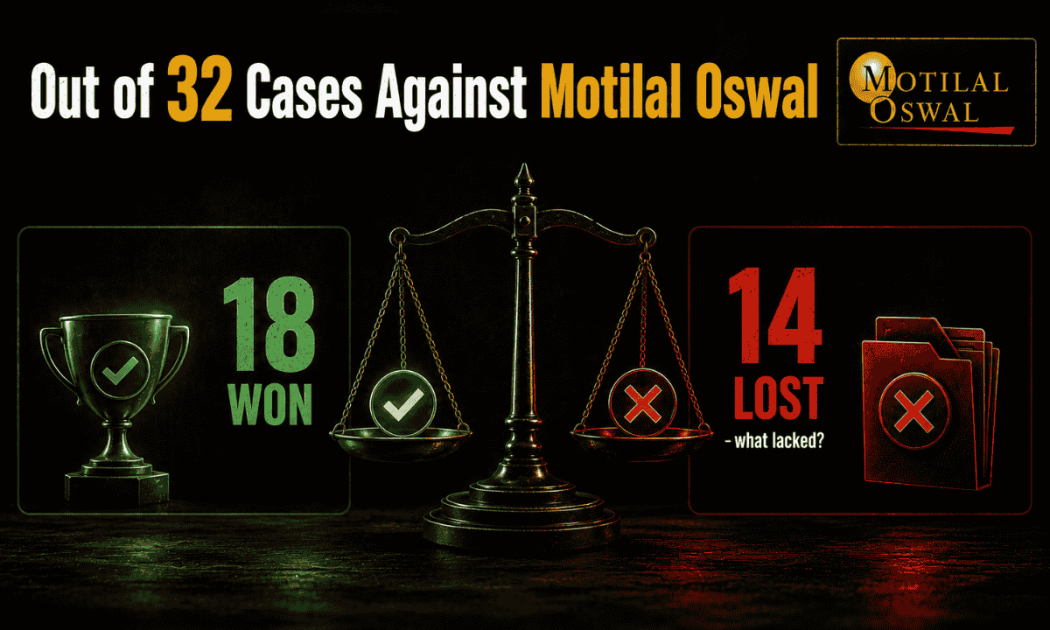
We went through 32 NSE and BSE arbitration awards involving Motilal Oswal Financial Services from 2021 to 2024. In 18 of them the tribunal directed the broker to pay the client. The rest were dismissed or decided in the broker’s favour. The wins ran from ₹26,000 all the way to ₹2.54 crore, and two separate awards crossed the one-crore mark. This page lays out the numbers. The linked pages below break down each type of case and show how the clients who recovered actually did it.
Here’s what most people miss about arbitration. It isn’t another complaint form. It’s a neutral tribunal that hears your dispute and passes an award the broker has to honour.
For anyone who lost money and got nowhere with the grievance desk, that’s the stage where things get real.
So we pulled the Motilal Oswal record across four years and counted, award by award. Not the marketing version. What the tribunals actually decided, based on the awards published as of this review.
Motilal Oswal Arbitration Cases: The Numbers
Start with the count, since that’s what you came for.
| Count | |
|---|---|
| Total awards reviewed (2021 to 2024) | 32 |
| Client won or partly won | 18 |
| Dismissed or broker won | 14 |
That win rate is worth sitting with for a moment, because it’s much higher than most people expect. And the amounts tell their own story.
The two largest awards alone are staggering for retail disputes:
| Year | Issue | Awarded |
|---|---|---|
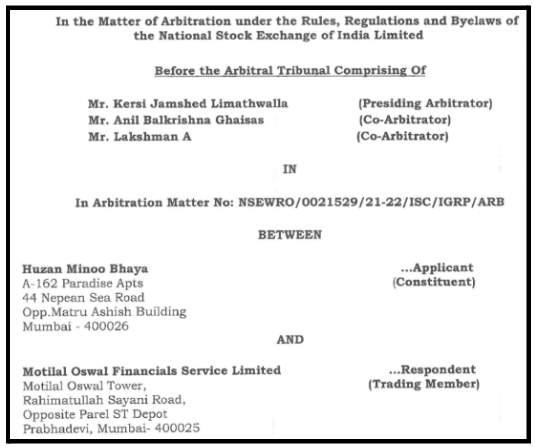
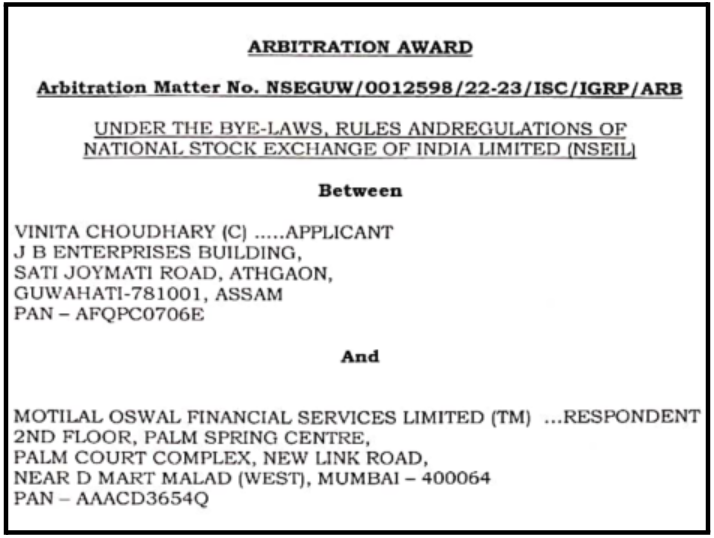
| 2023 | Wrongful liquidation (no MTF agreement) | ₹2,54,35,606 + 10% interest |
| 2023 | Unauthorised trading (back-door PMS) | ₹1,12,48,910 + 12% interest |
| 2023 | Broker acting as advisor (churning) | ₹7,39,592 + 12% interest |
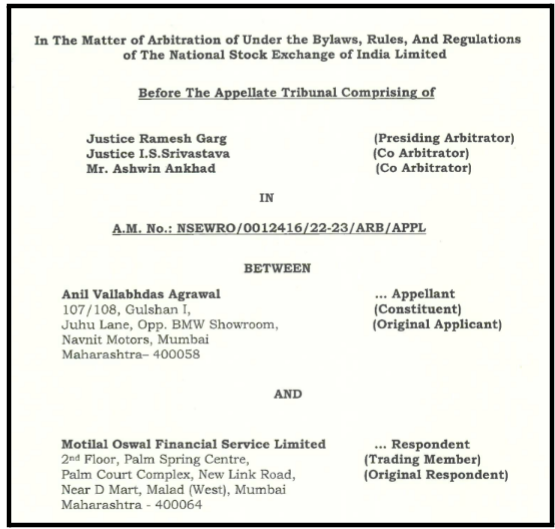
| 2023 | Shares sold despite objection | ₹6,44,200 (appeal) |
And below those sit a long run of unauthorised-trading wins in the one-to-four lakh range, plus a cluster of brokerage-refund awards. Eighteen clients, in total, walked away with money.
The obvious question is what separated those eighteen from the fourteen who lost. The answer runs through every single win.
What Actually Decides These Cases
Read all eighteen wins together, and one thread ties them: the broker could not stand behind its own records.
In the ₹2.54 crore case, the broker liquidated a client’s shares claiming he was on a margin trading facility, then couldn’t produce the agreement proving he’d ever signed up for one.
Another case of ₹1.12 crore where an authorised person ran a back-door portfolio scheme in a conservative elderly investor’s account and had no pre-trade confirmation for any of it.
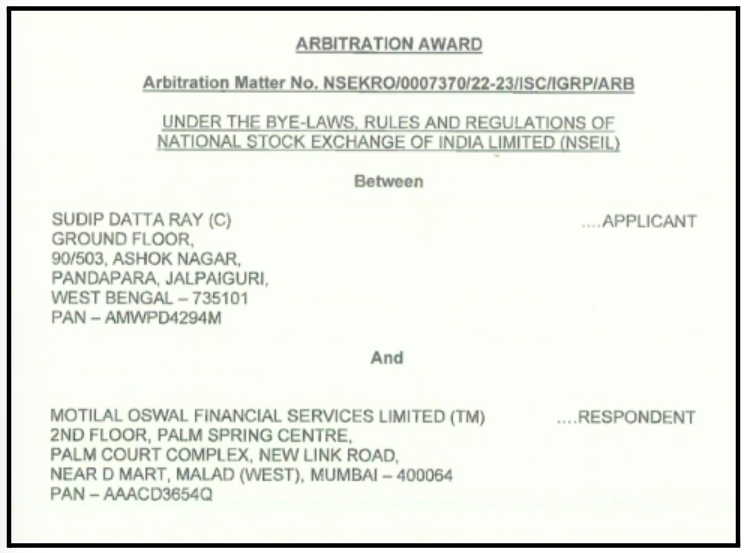
In case after case in the one-to-four lakh range, the client alleged unauthorised trades and the broker simply could not produce the call recordings or order logs that would prove otherwise.
That’s the pattern. When the paperwork failed, the client won.
Now look at the fourteen who lost. They weren’t thrown out because they had no grievance. They were thrown out on how the case was built.
The awards are full of the same lines: “the applicant has not produced,” “no evidence to corroborate,” “the claim is not substantiated.” The tribunals weren’t saying the client was wrong. They were saying the client hadn’t proved it.
That difference between having a grievance and proving one is the whole game, and it’s where most claims are quietly lost.
A claim rarely fails because the case was weak. It fails because the case was half-presented. The grievance was real, but the right records were never demanded, the burden of proof was never met, and the regulation that would have forced the broker to answer was never argued.
That gap is exactly where we work. We build the claim the way the winning eighteen were built, on the documents and the rules that leave the broker nowhere to hide. Register with us to take the first step in making your case strong.
Motilal Oswal Arbitration Cases by Type
The eighteen wins fall into four clear categories. Each has its own page below that walks through the strongest case and how the client recovered.
| Case type | Arbitrations | Pages |
|---|---|---|
| Trades placed without your authorisation |
|
motilal oswal unauthorised trading arbitration |
| Shares liquidated or squared off wrongly |
|
motilal oswal wrongful liquidation arbitration |
| Over-trading to generate brokerage |
|
motilal oswal churning brokerage refund |
| Losses from a platform or system fault |
|
motilal oswal technical glitch arbitration |
If you’re not sure which fits your situation, start with the unauthorised trading page. It covers the most common scenario and the largest group of wins.
How These Disputes Reach Arbitration
Arbitration isn’t the first step. It’s the one after your complaint has already failed.
The path usually runs like this. First you complain to the broker. Then, if that goes nowhere, to the exchange grievance cell.
The matter then goes to the Investor Grievance Redressal Committee for conciliation. Only if that doesn’t resolve it do you file for arbitration, where a tribunal hears the whole dispute and passes a binding award.
The data carries one lesson that should stop anyone from giving up early. Several of the biggest wins came at the arbitration or appeal stage, after the client had already been rejected.
The ₹2.54 crore award was overturned and re-decided only after the matter travelled all the way to the Bombay High Court and back. An early rejection is often just the point where the case hadn’t been built properly yet.
Motilal Oswal has also drawn regulatory attention separately from these disputes.
Our breakdown of the Motilal Oswal SEBI penalty covers a ₹5 lakh order for compliance lapses, which sits alongside this arbitration record as a second, separate line of accountability.
Conclusion
Across the awards reviewed, the Motilal Oswal scoreline is 18 wins in 32, and the wins ranged from ₹26,000 to over ₹2.5 crore.
None of those eighteen came down to luck. They came down to one thing: whether the broker could be forced to stand behind its own records, and whether the client built the case to make that happen.
If you lost money with Motilal Oswal and your complaint hit a wall, arbitration is the stage where it can still turn into a real payment. What decides which side of the eighteen-and-fourteen you land on is how the claim is put together.
Report. Recover. Stay Fraud Free.
Frequently Asked Questions
In the set of 32 awards reviewed from 2021 to 2024, tribunals directed Motilal Oswal to pay the client in 18 cases. The rest were dismissed or decided for the broker. These figures are based on awards published as of the review and do not represent every dispute ever filed.
In the reviewed awards, wins ranged from ₹26,000 to ₹2,54,35,606, with two separate awards crossing one crore. Many carried additional interest of 8 to 12 percent. What any client recovers depends entirely on the facts and the loss proven.
The largest in the reviewed set was ₹2,54,35,606 plus 10% interest, for wrongful liquidation of shares where the broker could not produce the margin trading facility agreement it relied on. The case went to the Bombay High Court before being re-decided in the client's favour.
Mostly for lack of proof, not lack of a real grievance. The dismissed awards repeatedly note that the client did not produce the necessary records, did not demand call recordings, or did not substantiate the claim. In arbitration, the burden sits with the client.



 Add us as a preferred source on Google »

