

If you are searching whether NA Supreme Research Private Limited is real or fake, you have probably already paid for the service, or you are very close to doing so.
The simple answer is that NA Supreme Research Private Limited is a real company.
It holds a valid SEBI registration under number INH000017745, and it is a legally incorporated private limited company.
But the more important question behind your search is not whether the company legally exists. It is whether it behaves the way a trustworthy firm should.
Those are two very different things.
This page answers both.
Is NA Supreme Research Private Limited Real or Fake?
NA Supreme Research Private Limited is real.
The company is a legally registered private limited entity incorporated in Madhya Pradesh. Its CIN is U73200MP2024PTC070946.
It holds an active SEBI Research Analyst registration under number INH000017745, which means SEBI has authorised it to provide stock market research services to retail investors.
Neeraj Sen is the registered proprietor. If you have separately searched NA Supreme Research owner name to confirm this yourself, that search should lead you to the same person, since he is the one listed on SEBI’s official records.
You can verify the SEBI registration yourself by going to sebi.gov.in and searching the registration number.
So the company exists. The registration is real. Neeraj Sen is a real person running a real business.
But here is where it gets important. NA Supreme Research’s own publicly disclosed grievance data show 51 investor complaints in 2025-26 alone.
Of those, 22 were carried forward unresolved from the previous year.
That means at the start of 2025-26, the firm already had 22 investor grievances that had not been fixed.
A company can be 100 percent real on paper and still have 51 reasons why investors are unhappy. Real and trustworthy are two different standards.
One is about legal existence. The other is about how you are treated once you become a paying client.
This blog is about the second standard.
Also Read: Is Springpad AI real or fake? The same word keeps showing up across reviews.
Real vs. Trustworthy: The Truth Behind the Numbers
This distinction is the heart of what most investors are actually trying to figure out when they search “is NA Supreme Research real or fake.”
When you search this phrase, you are not really asking whether the company’s PAN number is valid. You are asking something more personal.
You are asking whether the promises made to you were genuine. Whether the service will deliver what was described. Whether the firm will treat you fairly if things go wrong.
Whether you will be able to get your money back if the recommendations do not work.
None of those questions are answered by a SEBI registration number.
A SEBI registration tells you the company has cleared the eligibility criteria to register as a Research Analyst. It does not tell you whether the sales representative told you the truth.
It does not tell you whether the research reports are useful. It does not tell you whether the firm will respond when you raise a concern.
The complaint data gives you a clearer picture.
51 complaints in one year, 22 of which were already waiting to be resolved when the year began, tell you that a meaningful number of investors found the gap between what was promised and what was delivered significant enough to file formal grievances.
7 Warning Signs That a Registered Firm Isn’t Trustworthy
These warning signs come directly from the pattern of investor complaints and documented grievances against NA Supreme Research. Each one has context.
None of them should feel like a random checklist.
Warning Sign 1: You were told trades or strategies would deliver specific returns
The Indian stock market does not work on guarantees. No research analyst, no matter how experienced, can reliably predict whether a specific trade will be profitable.
Under SEBI Research Analyst Regulation 16(b), no registered RA can promise returns of any kind.
If a representative used language that made it sound like following their calls would lead to predictable profits, that is a SEBI violation in the moment it was said.
Write down what was said and when, because that note is valuable evidence.
Warning Sign 2: You were pushed to upgrade to a more expensive plan
The documented case from the NA Supreme Research complaint record shows an investor who paid Rs. 40,000 for the index options plan and was then pushed into stock options trades outside that plan.
After those trades resulted in losses, a recovery upgrade was pitched at Rs. 1,00,000.
This pattern, where losses are used as a reason to sell a more expensive product, is prohibited under SEBI regulations. If you experienced this, you likely have grounds for a formal complaint.
Warning Sign 3: Promises were verbal, and nothing was in writing
SEBI requires Research Analysts to provide written service agreements before any money is collected.
If the fee, the scope of services, and the refund policy were communicated only on a call and never confirmed in writing, that is a compliance failure on the firm’s part.
It also makes your complaint harder to prove, which is why you should start collecting whatever written evidence you do have right now.
Warning Sign 4: Recommendations kept changing without explanation
Good research comes with reasoning.
If you received calls or messages telling you to buy or sell without any clear explanation of the analysis behind the recommendation, you were not receiving research as SEBI defines it.
You were receiving execution instructions, which is a different category of service requiring a different registration.
Warning Sign 5: Risk was not explained before you invested
Before recommending any product, a SEBI-registered RA must ensure you understand the risks involved.
If no one explained that the trades you were being guided into could result in losing your entire capital, the risk disclosure requirement was not met.
This matters especially if you were guided into options or futures trades without being clearly told that these products can result in losses exceeding your initial investment.
Warning Sign 6: Communication slowed down or stopped after you had problems
Multiple investor accounts describe a common pattern with firms like NA Supreme Research. Before you pay, calls are frequent and the support is responsive.
After you pay, and especially after losses appear, the communication becomes slower, more generic, and harder to get. If this has happened to you, document every unanswered message with the date and time.
That pattern of non-communication is part of your complaint record.
Warning Sign 7: You were asked to arrange more capital after a loss
“Arrange more funds, and we will recover your losses” is one of the most dangerous things a research firm can say to an investor.
It is both a prohibited recovery promise and a tactic that leads investors to throw good money after bad.
If this was said to you, it is likely the most important piece of evidence in your complaint.
What the Official Complaint Data Tells Us?
NA Supreme Research is required by SEBI to publish its complaint data on its own website. Here is what the data shows.
In 2024-25, the firm had zero formal complaints on record. In 2025-26, 22 complaints were carried forward from a previous period and 29 new complaints were received, bringing the total to 51.
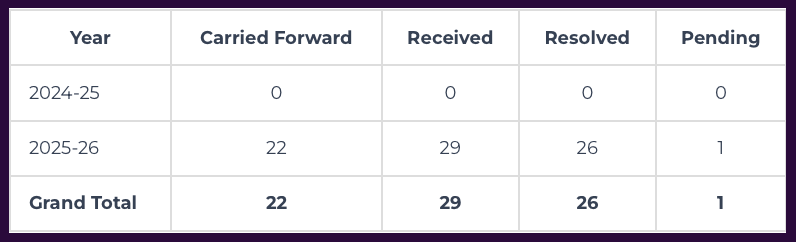
Of those, 26 were resolved, and 1 was still pending at the time of the latest update.
The jump from zero to 51 in a single year is notable.
It means that within a relatively short period, a significant number of investors found their experience with the firm unsatisfactory enough to go through the formal process of filing an official complaint.
The data does not tell you what those complaints were about.
But the warning signs above, which come from the documented complaint pattern, give you a reasonable picture of the issues that are most likely driving those numbers.
If you look up NA Supreme Research reviews on public platforms separately, you will likely find the same recurring themes described by users in their own words, echoing what this official grievance data already suggests.
Also Read: Is Fusiontech Research legit, a SEBI number that checks out, per public records.
What Should You Do If Your Experience Matches What Is Described Here?
If you are reading this page and recognising your own experience in the warning signs or the complaint pattern, here is the most important thing to understand.
You have options. This is not a situation where you have to simply accept the loss or walk away frustrated.
Because NA Supreme Research is SEBI registered, you have access to a formal regulatory complaint process that is specifically designed for situations like yours.
The process works. We have helped investors recover money through this system from firms with similar patterns of conduct.
The first step is evidence. Before you do anything else, collect every piece of communication you have with the firm. WhatsApp messages, payment receipts, emails, any recording of calls where promises were made.
Do this right now, before anything gets deleted or the platform changes.
The second step is a written complaint to the firm at [email protected]. State clearly what you paid for, what was promised, what was delivered, and what you are asking for.
If the firm does not respond satisfactorily within 30 days, the third step is to escalate your grievance using official regulatory channels to file a complaint.
You can log onto the SEBI SCORES platform, where you should select “Research Analyst” as the intermediary type and enter their registration number INH000017745.
If the issue remains unresolved through SCORES, you can further pursue your dispute by utilizing the SMART ODR platform or opting for formal arbitration to legally recover your funds.
For the complete process from SCORES through SMART ODR to Stock Exchange arbitration, read: how to complaint against NA Supreme Research.
Already paid NA Supreme Research and something feels wrong?
Our team files your SEBI SCORES complaint, prepares the documentation, and represents you through SMART ODR and arbitration.
Conclusion
NA Supreme Research Private Limited is real. It is a legally incorporated company with a valid SEBI Research Analyst registration under INH000017745. None of that is in question.
What is in question is the gap between being real and being trustworthy.
A firm with 51 investor complaints in a single year, 22 of which were already unresolved when the year started, and a documented pattern of recovery pitches, out-of-scope recommendations, and communication dropping after losses, is a firm where that gap is worth taking seriously.
Frequently Asked Questions
1. Is NA Supreme Research SEBI registered?
Yes. NA Supreme Research Private Limited is registered with SEBI as a Research Analyst under registration number INH000017745.
You can verify this at sebi.gov.in by searching the registration number or the company name.
2. How many complaints does NA Supreme Research have?
The firm’s own publicly disclosed grievance data show 51 total investor complaints in 2025-26.
Of those, 22 were carried forward unresolved from the previous year, and 29 were newly received. 26 were resolved, and 1 was still pending at the time of the latest disclosure.
3. Can NA Supreme Research promise guaranteed returns?
No. Under SEBI Research Analyst Regulation 16(b), no registered RA can promise or imply guaranteed returns of any kind.
If a representative made a return promise to you verbally or in writing, that is a documented SEBI violation and the starting point of a formal complaint.
4. What services does NA Supreme Research offer in India?
NA Supreme Research offers three main services under its SEBI registration: Quantum Stocks Trade for equity stock recommendations, Prime Index Hub for Nifty and Bank Nifty index options, and Elite Intraday Combo covering intraday cash, futures, and commodity trades.
All three are delivered primarily through SMS alerts with a defined entry, target, and stop-loss.
5. I lost money after following NA Supreme Research recommendations. What can I do?
Collect all your evidence first: payment receipts, WhatsApp messages, trading statements, and any documentation of promises made.
Write a formal complaint to the firm at [email protected].
If unresolved within 30 days, file on SEBI SCORES at scores.gov.in, selecting Research Analyst and entering registration number INH000017745.
6. What is the difference between a company being real and being trustworthy?
A company being real means it legally exists, has valid corporate registration, and holds SEBI authorisation to operate.
Being trustworthy means it behaves ethically, delivers what it promises, and treats investors fairly when things go wrong. A company can be fully real on paper while still being untrustworthy in practice.
The complaint data and documented cases for NA Supreme Research show that this gap between real and trustworthy is worth taking seriously.
7. Is there a time limit to file a complaint against NA Supreme Research?
Yes. File within 3 years of the incident. The earlier you act, the better your evidence trail. Communication records get deleted over time, and cases become harder to reconstruct with delay.
If you are unsure whether your situation qualifies, a free consultation can help you assess before the window closes.





 Add us as a preferred source on Google »