

Stock market advisory services often appear highly convincing online.
You may see screenshots of profits, bold accuracy claims, premium trading packages, and constant promises of “expert research.”
For many retail traders, especially beginners entering futures, options, or intraday trading, these services can feel like a shortcut to market success.
If you are searching for Profit Vista Financial Research complaints before making a payment or joining a stock advisory package, it is important to look beyond advertisements and understand what public records and investor reviews actually show.
This blog brings together publicly available information, SEBI findings, and online complaint themes in one place so readers can make better-informed financial decisions.
Profit Vista Financial Research Review
Profit Vista Financial Research is an Indore-based investment advisory firm registered under SEBI since February 2015.
Its proprietor, Gaurav Agrawal, held SEBI Registration No. INA000002678, a licence that authorised the firm to provide paid investment advice to retail clients under the SEBI (Investment Advisers) Regulations, 2013.
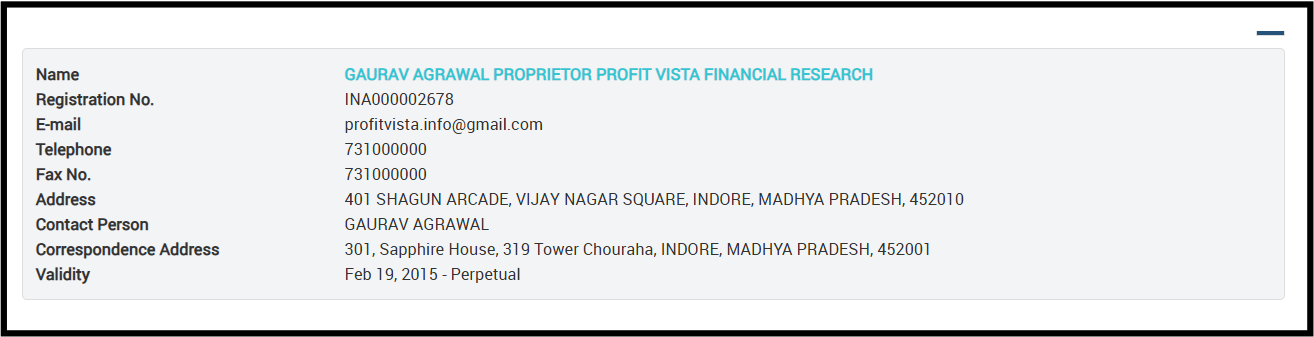
On the surface, an SEBI registration signals a firm that has cleared baseline regulatory requirements.
But over the years, Profit Vista accumulated a trail of investor complaints, regulatory red flags, and ultimately a formal SEBI enforcement action.
Profit Vista Financial Research’s Certificate of Registration is suspended for 6 months, effective March 7, 2025, by SEBI Order.
The firm may not legally offer investment advisory services during this period.
If you have used, are considering, or have lost money with Profit Vista Financial Research, this report tells you exactly what public records say, and exactly what you can do about it.
Profit Vista Financial Research SEBI Order
In March 2025, the Securities and Exchange Board of India (SEBI) passed an order in the matter of Profit Vista Financial Research and the proprietor, Mr. Gaurav Agrawal.
The order drew significant attention because it involved disciplinary action against an SEBI-registered Investment Adviser.
1. Background of the Order
According to the publicly available SEBI order, the regulator examined the operations and compliance framework of Profit Vista Financial Research under the Investment Adviser Regulations.
SEBI reviewed whether the entity was complying with the obligations and standards expected from registered investment advisers operating under the regulatory framework.
Following this examination, SEBI identified multiple compliance-related deficiencies and violations connected to regulatory obligations applicable to investment advisers.
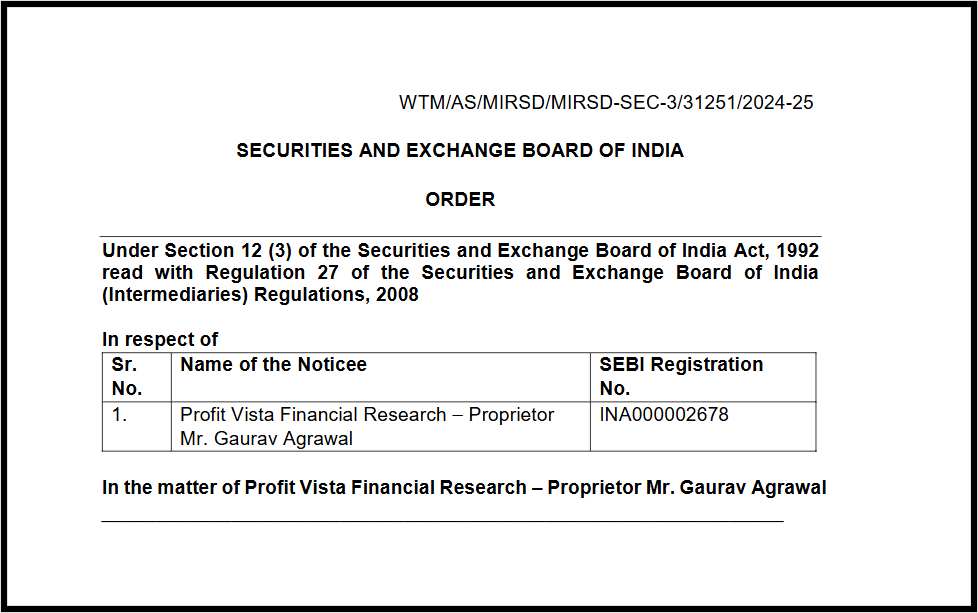
The matter later resulted in disciplinary action by the regulator.
2. Violations Found by SEBI
The following violations were documented in SEBI’s order after formal examination. Click each to read the full finding:
|
Violation |
Details |
| Employees Conducting Advisory Without Mandatory Qualifications |
|
| Non-incorporation with SEBI Inspectors |
|
| Registered Office Found Closed During Multiple Inspection Visits |
|
| Client Complaints on SEBI SCORES Left Unresolved for Extended Periods |
|
3. Penalty Imposed
The primary regulatory action imposed by SEBI was the suspension of the Investment Adviser registration of Profit Vista Financial Research for six months.
The suspension was ordered to come into effect after 30 days from the date of the order.
This effectively meant that during the suspension period, the entity would not be permitted to operate as an SEBI-registered Investment Adviser.
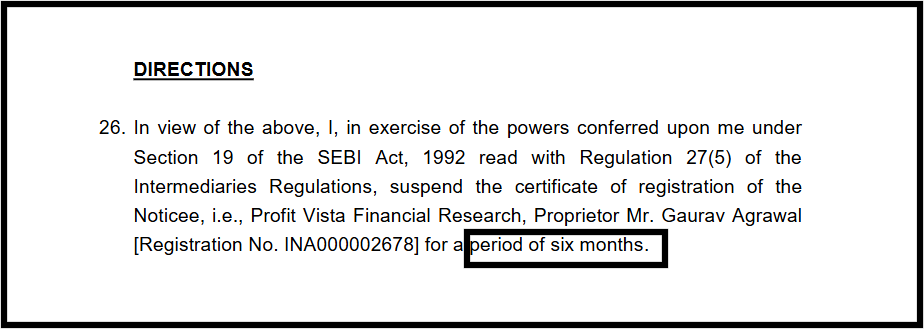
For investors, a suspension order is generally considered a significant regulatory action because it reflects SEBI’s conclusion that the identified issues justified the temporary restriction of the registration.
Profit Vista Financial Research User Complaints
Apart from the SEBI order, several publicly visible online reviews also raise concerns about investor experiences with Profit Vista Financial Research.
While online complaints should always be evaluated carefully and fairly, certain recurring themes appear across multiple reviews.
The complaints reviewed here are publicly visible reviews shared online by users and should be understood as individual customer experiences rather than proven legal conclusions.
A question that comes up frequently in investor forums is: is Gaurav Agrawal Investment Advisor trusted or not?
Based on the pattern of complaints below, alongside SEBI’s own findings, the concern appears well-founded.
1. Poor Call Accuracy & Financial Loss
One of the most common themes across the reviews relates to dissatisfaction with the perceived accuracy of trading recommendations.
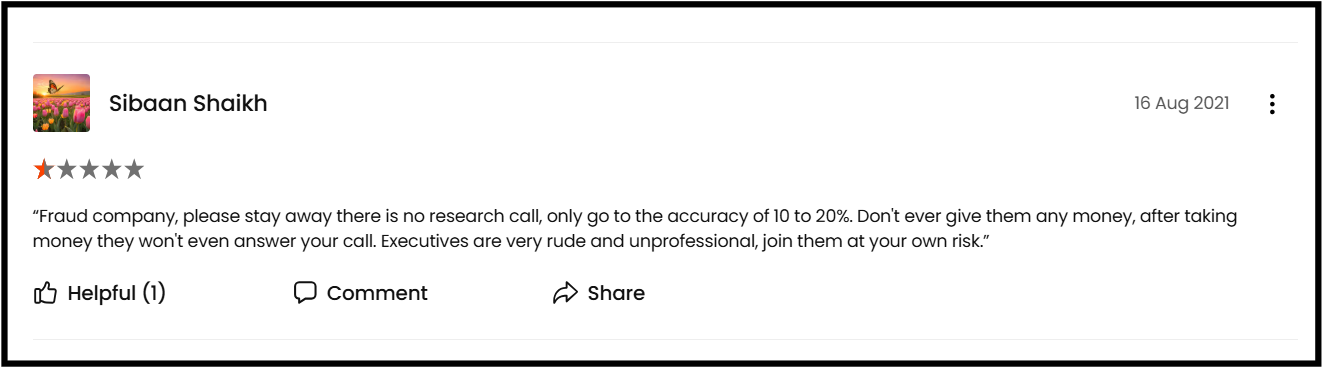
The user reported that the accuracy was as low as 10-20%. Paid advisory services carry an implied expectation of professionally researched calls; the gap between that expectation and what users report receiving is stark.
SEBI’s finding that 46 employees provided advice without mandatory qualifications directly explains how this pattern may have developed.
2. Losses and Risk Exposure
This is the most damaging and consistent theme. One user reported total losses of ₹1.5 lakh on a single monthly plan due to calls that consistently hit stop-losses.

Now, it is important to understand something critical here:
Stock market trading itself carries substantial risk, especially in leveraged segments like futures and options.
Losses can occur even when trades are based on professional research because markets remain unpredictable.
At the same time, complaints involving concerns about risk communication or aggressive confidence in recommendations are still relevant factors investors may wish to evaluate before joining any advisory service.
3. Unprofessional Conduct
Users describe staff as rude, dismissive, and offering nothing but excuses when clients raised concerns about losses.
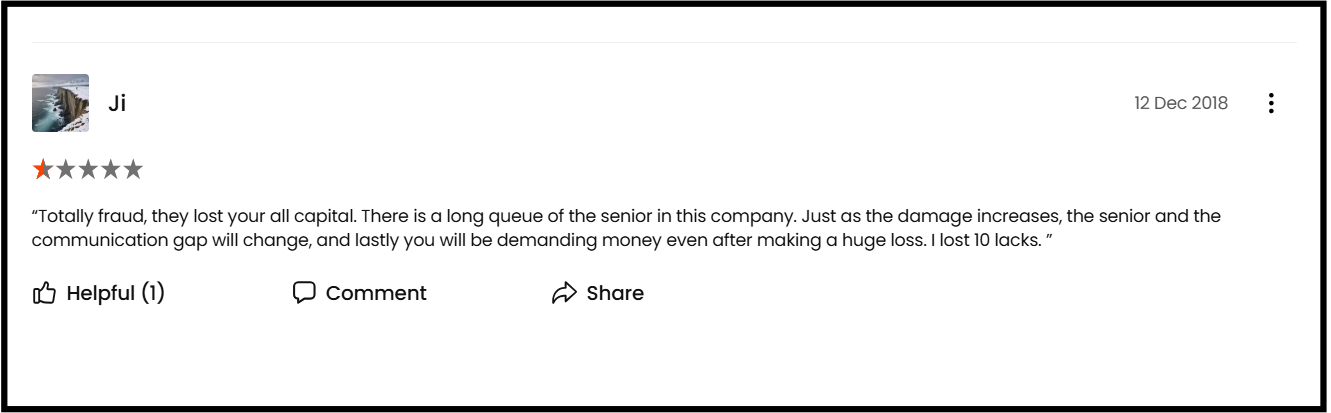
One reviewer described being pushed into higher-risk instruments, futures, and options, even though his capital was already being eroded by bad calls.
How Can I Report Against RIA in India?
If you’ve had a negative experience with Profit Vista Financial Research or any investment adviser, here is a step-by-step guide to escalating through official channels.
Step 1: Write Formally to the Firm First
Send a written email complaint clearly stating what you paid for, what you received (or didn’t), and what resolution you want: a refund, explanation, or service.
Give a 15-30 day deadline.
Most regulatory bodies require evidence that you attempted direct resolution before escalating.
Step 2: File a Complaint in SCORES
File against Profit Vista Financial Research (Reg. No. INA000002678) in the SEBI SCORE portal.
Upload all supporting documents. SEBI forwards the complaint to the entity and monitors resolution. Average turnaround: 25-30 days.
You can track your complaint status in real time.
Step 3: Lodge a Complaint with SMART ODR
If SCORES doesn’t deliver a satisfactory outcome, escalate to SMART ODR.
It is SEBI’s Online Dispute Resolution platform. It handles investor-intermediary disputes through conciliation and arbitration. Free for investors.
Legally binding once resolved.
Step 4: Stock Market Arbitration
If all prior mechanisms fail, formal arbitration under NSE or BSE rules is available.
At this stage, strong documentation, timely, detailed, and complete, is the single most important factor in how your case is likely to be received.
Need Help?
Many investors feel overwhelmed after facing losses or disputes connected to financial advisory services.
Understanding regulatory procedures, complaint mechanisms, and documentation requirements can feel confusing, especially for first-time complainants.
If you need help understanding your available options, you can register with us, gathering all your records and communication history for initial guidance.
Conclusion
Profit Vista Financial Research entered the market in 2015 with a genuine SEBI registration and a mandate to provide quality investment advice to retail clients.
That initial credential was real and should be acknowledged.
But the decade that followed tells a different story.
Different user reviews concerning inaccessible staff, and a firm that prioritised upselling over client outcomes.
SEBI’s own inspection found 46 unqualified employees providing advice, a firm that closed its office during regulatory visits, and an entity that failed to resolve client complaints for months on end.
The 2025 enforcement order and 6-month suspension are not aberrations; they are the regulatory system catching up with a documented pattern.
For investors who have already been affected, the complaint process is clear and accessible.
For those who have not yet engaged: the public record is now before you, and it speaks for itself.





 Add us as a preferred source on Google »

