
Quick Summary
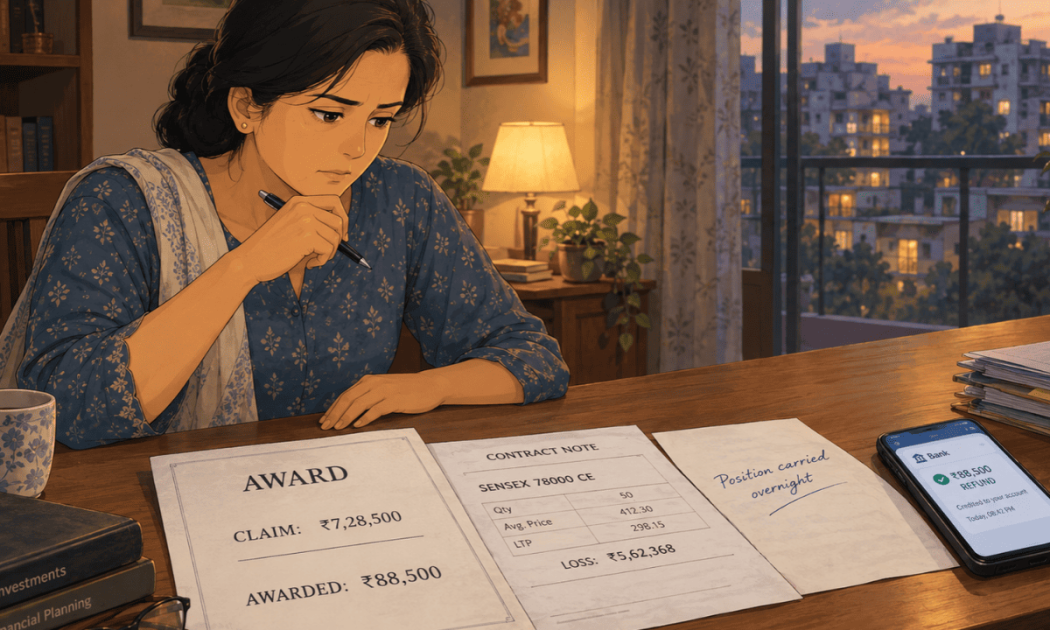
Sarita Sharma, a retail investor from Delhi, claimed ₹7,28,500 from Stock Option Research, a SEBI registered Research Analyst, made up of ₹88,500 in service fees and ₹6,40,000 in trading losses. After conciliation and an arbitration filing guided by our team, the Sole Arbitrator directed the firm to pay the full ₹88,500 fee within ten days but rejected the trading loss claim and awarded no interest. The loss claim failed on evidence, and the case was decided ex parte because she did not attend the hearing. The arbitration fee was also directed to be refunded.
Imagine claiming ₹7,28,500 in arbitration and getting ₹88,500 back.
The ₹6.4 lakh trading loss claim was rejected in full, and the hearing went ahead without the claimant.
That is what happened to Sarita Sharma, a retail investor from Delhi, in her case against Stock Option Research.
Here is what the arbitrator weighed, and what you can learn before your own hearing.
The Growth Plan & Demo Trade: How the F&O Advice Started
Sarita had traded equities for several years. She had never traded futures and options.
In April 2026, a representative of Stock Option Research contacted her.
According to her Statement of Claim, the representative induced her to subscribe after a personalised demo trade that showed a small profit. She told him she did not know F&O trading.
On 28 April 2026, Sarita subscribed to a “Growth Plan” and signed a Research Analyst agreement.
The plan promised daily F&O research recommendations by WhatsApp. She paid ₹88,500 in four installments by 29 April.
The Claimant said only one invoice, for ₹51,000, was issued.
She said the balance of ₹37,500 was also paid for research services.
Breakdown of 7 F&O Trades: Profit & Loss Analysis
Between 28 April and 5 May 2026, Sarita executed seven F&O trades. She also sold portions of her existing equity portfolio.
She said she acted on specific, real-time recommendations from the firm’s representatives.
Her HDFC Securities records, filed with the claim, showed this result:
| Trade | Result |
|---|---|
| BANKNIFTY 28 April 55800 PE | Profit of ₹15,478 |
| SENSEX 30 April 76300 PE | Profit of ₹11,647 |
| SENSEX 30 April 77600 CE | Profit of ₹36,691 |
| SENSEX 30 April 77800 CE | Profit of ₹59,751 |
| SENSEX 30 April 77900 CE | Profit of ₹31,633 |
| SENSEX 30 April 78000 CE (1,880 lots) | Loss of ₹5,62,368 |
| NIFTY 5 May 24000 CE (1,950 lots) | Loss of ₹41,314 |
Five trades made money. Two lost money.
One position, the SENSEX 78000 call, produced almost the entire loss.
The Arbitration Claim: Demanding ₹7.28 Lakhs for Deficiency in Service
Sarita asked the Tribunal for ₹7,28,500, plus 18 percent interest from 5 May 2026 and the costs of arbitration.
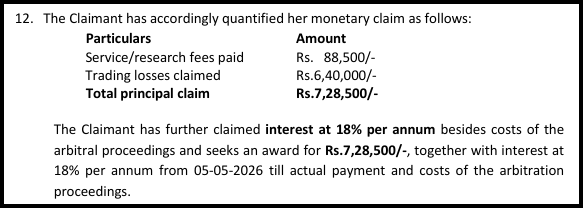
She built her claim on deficiency in service, unfair trade practice, and violations of the SEBI Research Analysts Regulations, 2014.
Her case, in short, was that the firm induced her through a demo trade. It collected fees without full invoicing. It gave personalised trading instructions, and it told her to sell only after a direct call.
She said her losses followed from that advice.
Anyone weighing a similar dispute can first review how a complaint against SEBI registered research analyst works before choosing a forum.
Stock Option Research’s Defence in the Arbitration
The firm denied every material allegation. Its arguments, as recorded in the award, were precise.
The losses were her own decisions. The firm said it only supplied trading calls.
It did not operate or control her account, and it never had her credentials or OTPs. Every trade was entered through her own broker account.
Some trades came before the relationship existed. The BANKNIFTY trade of 28 April was entered and squared off before payment and before she accepted the terms.
The first tranche of equity sales also preceded the terms.
She ignored the stop loss. The firm said its WhatsApp call on the SENSEX 78000 call carried an entry price, a stop loss, and a target.
She bought the position on 29 April in several tranches, kept it overnight after the stop loss was reached, and sold it shortly after the next day’s open.
She averaged her way into the NIFTY loss. On 5 May, she entered and re-entered the NIFTY position at progressively lower prices.
The firm argued this showed independent decision-making.
The equity sales were not its advice. Some shares sold on 29 April were repurchased by her in identical quantities the same day.
The fees were fully invoiced. The firm said ₹37,500 and ₹51,000 invoices were emailed to her, covering all ₹88,500.
It also said the fee was within the annual limit and that she never asked for a refund.
The terms recognised market risk. The agreement she accepted on 28 April stated that returns were not assured and that losses were not recoverable from the Research Analyst.
Without admitting liability, the firm said it was willing to refund the entire ₹88,500 fee. It said it had offered this during conciliation.
Ex Parte Proceedings: Why the Hearing Continued Without the Claimant?
The oral hearing was first set for 11 September 2026 at 11:30 AM. Sarita asked for a time after 3 PM.
The firm asked for a time before 2 PM. The Tribunal moved the hearing to 1:30 PM.
On 10 September, Sarita asked again to move the hearing, this time to 23 September. The Tribunal refused.
It cited the strict timelines of the SMART ODR framework and ordered that no further adjournment would be granted.
The Tribunal warned that if either party did not appear, the proceedings would continue.
On 11 September, the firm appeared through its proprietor and an authorised representative. No one appeared for the Claimant.
The award records the case as ex parte, with reasons.
The Tribunal decided it on the pleadings and documents filed.
How Did the Arbitrator Reason on the Research Analyst Claims?
Arbitrator Ashok Kumar Jalan framed six issues. He answered jurisdiction in the Claimant’s favour on the narrow question of authority to hear the case.
On the substance, he found for the Respondent on almost every point.
1. Demo Trade Before Subscription Not Treated as Inducement
The Tribunal held that the inducement allegation was not backed by cogent documents. It said that simply levelling an allegation does not suffice.
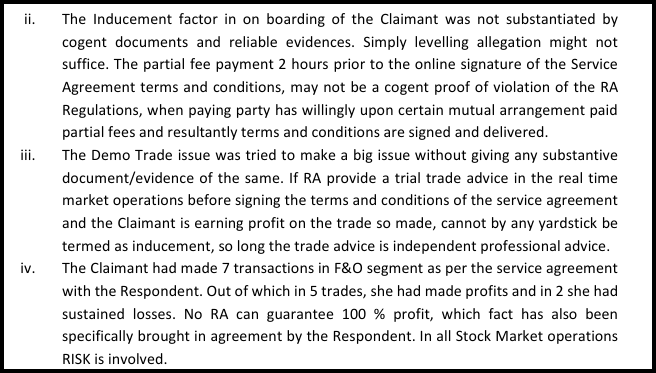
It also held that a trial trade given by a Research Analyst before the terms are signed is not inducement if the advice is independent and professional.
A profit on that trade does not change the position.
2. Research Analyst Fee Paid Before the Agreement Was Signed
Part of the fee was paid about two hours before the terms were signed. The Tribunal did not treat that as proof of a regulatory violation.
It reasoned that the client had paid willingly under a mutual arrangement, and the terms were then signed and delivered.
3. Research Analyst vs Investment Adviser Scope
The Plan document promised “dedicated RM allocation for real-time support.” The Tribunal held this was within the scope of a Research Analyst.
The research reports showed targets and stop-loss levels but no quantities to trade.
So long as the firm did not advise or insist on a quantity, the Tribunal found the service did not stray into Investment Adviser territory.
Why the SENSEX 78000 Call Loss Was Not Refunded?
This trade decided the case. The Claimant bought it on 29 April in 14 successive tranches between 10:29 and 10:40, as the price slid from ₹315 to ₹278.35.
She then carried it overnight into expiry day.
The Tribunal also found that the claim had presented this as an expiry day trade made on 30 April. The contract notes showed otherwise.
It described that presentation as misleading.
The firm said the calls usually came around noon, and that she had entered much earlier. It said the trade hit its entry level and later its stop loss at 1:38 PM.
The Tribunal noted that this data was stated at the hearing without supporting records.
Even so, it held that carrying the position overnight was the Claimant’s own decision, and she must bear its consequences.
Market Losses & Portfolio Sales: Why RAs Don’t Guarantee Profits
The NIFTY trade lost ₹41,314 in the ordinary course. A SENSEX trade the same day made money.
The Tribunal said that blaming the Research Analyst whenever a trade loses is not a justified outcome of the professional relationship.
It also noted that five of seven trades made profits, and that no Research Analyst can guarantee profit.
The equity sales were outside the Research Analyst agreement altogether.
Arbitration Award Breakdown: ₹88,500 Refund Granted via SMART ODR
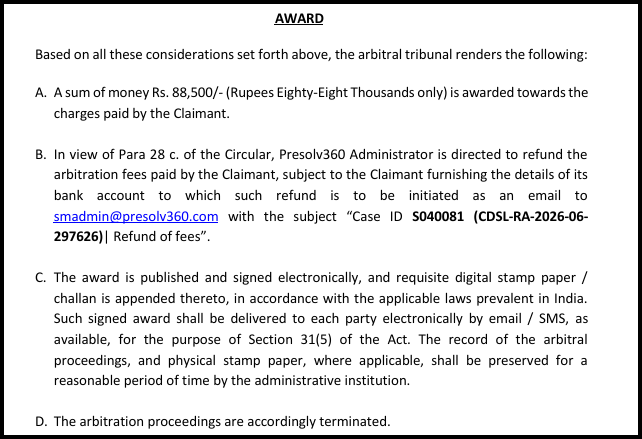
The Tribunal made three orders. Stock Option Research must pay ₹88,500, the service fee, within ten days of publication of the award through a banking channel.
No interest and no costs were awarded.
The Presolv360 Administrator was also directed to refund the arbitration fee paid by the Claimant, once she emails her bank details.
The proceedings were terminated.
Of ₹7,28,500 claimed, ₹88,500 was awarded, about 12 percent. The ₹6,40,000 trading loss claim was rejected in full.
Facing an Arbitration Hearing Against a Research Analyst? Our Team Can Help
Sarita’s award shows how much the hearing itself matters. If your matter is headed to arbitration, block the hearing date now, gather your contract notes and chats, and let us prepare your case.
Register with us and we will take it from there.
Conclusion
This award is a candid reminder of how share market arbitration works. The fee refund came because the Respondent had already offered it and the Tribunal saw no reason to refuse.
The trading loss claim failed on evidence, not on sympathy. Contract notes contradicted the way a key trade was described.
The stop loss in the firm’s call was said to have been ignored. The claim of inducement had no documents behind it.
And without the Claimant at the hearing, nobody was there to answer those points.
Our lessons are practical. Attend every hearing, in person or through an authorised representative.
Present each trade exactly as the contract notes show it, because a tribunal will check.
Separate your fee claim from your loss claim, and prepare each with its own evidence. Keep the call or chat that shows the entry, stop loss, and any instruction you received.
Report. Recover. Stay Fraud Free.
The Respondent had offered the fee refund during conciliation. The trading loss claim failed because the Tribunal found the losses arose from the Claimant's own trading decisions. It means one party did not take part in the hearing. The Tribunal decides the case on the documents and the party that appeared. Not by itself. The Tribunal held that independent trade advice given before signing, which earns a profit, cannot be termed inducement without further evidence. The research call carried a stop loss. The Claimant held the SENSEX 78000 call overnight after that level was reached, and the Tribunal treated the overnight carry as her own decision. The Tribunal here held that alleged violations of the Research Analyst Regulations fell beyond its jurisdiction. Those matters may suit a complaint to SEBI rather than an award.Frequently Asked Questions





 Add us as a preferred source on Google »

