
Quick Summary
A fake SEBI notice copies SEBI’s letterhead, logo and seal and demands money for penalties, compliance charges or unpaid STT. SEBI said in its press release of 26 February 2026 that it does not issue notices to collect STT, and that its official emails come only from addresses ending in @sebi.gov.in. Check any enforcement action on SEBI’s website, verify contacts in the SEBI Directory and pay only through the official payment gateway. If you already paid, call 1930 and tell your bank at once.
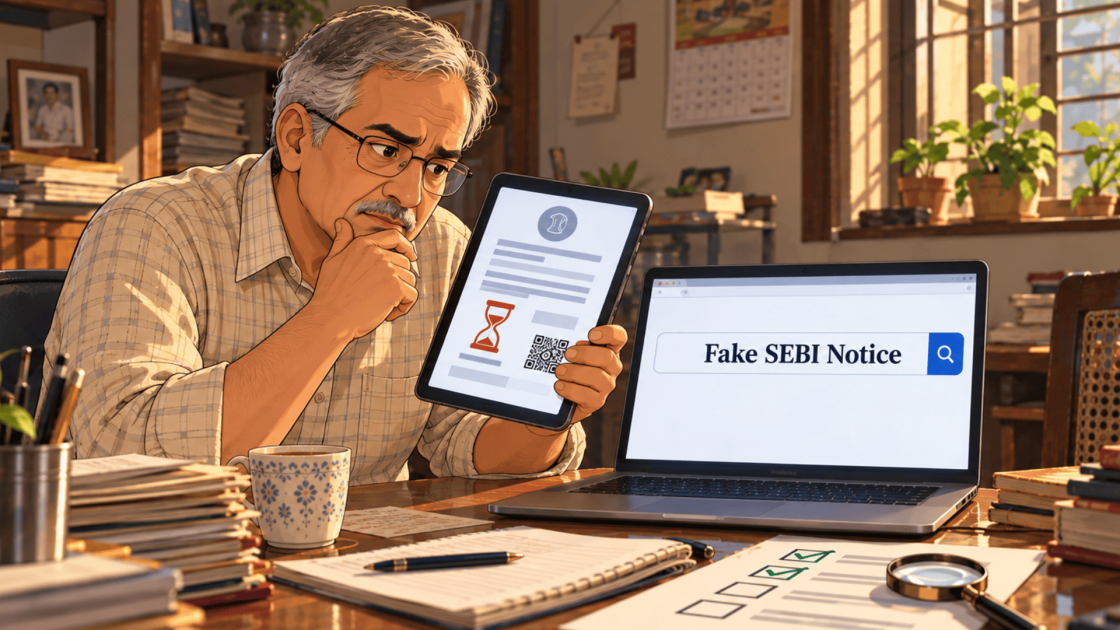
The email looks serious. It carries a logo, a reference number and a line that says your trading account owes “outstanding STT” and must clear it within 48 hours.
A fake SEBI notice works because it borrows trust from a regulator you already respect.
The good news is that you can test one in a few minutes, and the tests do not depend on how real the paper looks.
What Is a Fake SEBI Notice and How Does It Reach You?
A fake SEBI notice is a document or message that pretends to come from SEBI and asks you for money or personal details.
It copies the regulator’s letterhead, logo and seal to look official.
SEBI has warned the public that fraudsters impersonate its officials and offices, and use forged notices sent by email and social media.
The notices demand payments toward penalties, compliance charges or settlement amounts.
The sender often chooses a topic you recognise.
Notices about Securities Transaction Tax are common, because every investor who trades pays STT and few know how it is collected.
Some senders target people who recently lost money in the market.
They offer to “help recover” funds, or claim that a case is pending against you.
Treat every unexpected notice as unverified until you have checked it through channels you find yourself.
Does SEBI Send Notices to Collect STT?
No. SEBI’s press release of 26 February 2026 states that SEBI does not issue notices to remit STT amounts.
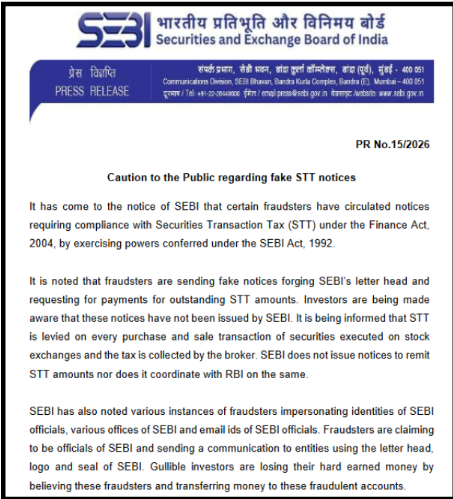
It also said SEBI does not coordinate with the Reserve Bank of India on such payments.
STT is levied on every purchase and sale of securities executed on an exchange.
Your broker collects it as part of the transaction, so you do not pay it later to a regulator.
This single fact breaks the most common version of the fake. If a notice asks you to send STT to SEBI, it is not a genuine SEBI notice.
Other reasons for a fake notice vary. The notice may talk about a fine, a hearing fee or a “clearance certificate.”
The same checks below apply to all of them.
SEBI has also cautioned about unregistered “account handling” services in the same release, so do not assume a financial service is safe only because it mentions SEBI.
How Do You Check Whether a SEBI Notice Is Genuine?
Four checks take about five minutes, and each one stands on its own. Do all four before you pay or reply.
- Check the sender’s email: SEBI says its official emails come only from addresses ending in @sebi.gov.in. A different domain, a free email service or a lookalike spelling is a warning.
- Check for the action on SEBI’s website: Go to the SEBI website yourself and open the Enforcement section. A genuine action against you or your entity will be listed there.
- Check the contact details: Look up the name and the number in the SEBI Directory, which sits under the About section. Compare them with the notice.
- Check the office address: SEBI publishes the addresses of its offices on its website. If the notice gives an address or a phone number that is not on that list, do not use it.
Type the website address into your browser by hand. Do not click links in the notice, because they may lead to a copy of the real site.
If all four checks fail, you have your answer. If any one fails, stop and ask a trusted person before you do anything else.
Where Can You Safely Pay a Genuine SEBI Demand?
SEBI says online payments for orders, settlements or recoveries go only through the official payment gateway on its SI Portal.
Reaching that gateway from the SEBI website, and not from a link in a message, is the safe way.
SEBI does not ask you to pay penalties into a personal bank account, a UPI ID or a wallet.
A notice that gives such details is not following SEBI’s own process.
Even for a genuine order, take a moment to confirm it.
Read the order on the website, note the amount and the deadline and compare them with your notice.
When you pay a genuine amount, keep the receipt and the order together. They prove that the matter is closed.
What Red Flags Appear in Most Fake SEBI Notices?
Scammers rely on pressure, and the same signs repeat. Learn them, and you will spot most fakes at a glance.
- Urgency: The notice sets a deadline of hours or a day, and warns of arrest or account freezing if you delay.
- Payment to individuals: The notice names a personal account, a UPI handle or a wallet for payment.
- Secrecy: The sender asks you not to tell your broker, your family or your lawyer.
- A fake officer’s name: The notice carries a name, a designation and a “case number” that you cannot find on SEBI’s site.
- Unusual delivery: The notice arrives on WhatsApp, Telegram or a free email account, not through the registered address you gave your broker.
No single sign proves a fake, but two or three together are enough reason to stop. When in doubt, wait a day and verify through official channels.
Can Fake Notices Claim to Come From a SEBI Registered Analyst or Adviser?
They can. Some senders do not use SEBI’s name at all.
They use the name of a registered analyst or adviser, quote a real registration number and claim that you owe money under an agreement.
A real number on a notice proves nothing about the person who sent it.
A real number on a notice proves nothing about who sent it, and verify research analyst INH number shows how to match the name and contact details.
Compare three things on the record: the name, the registered contact details and the payment account.
A notice that differs on any of them needs a written question.
For advisers, the same logic applies. Adviser numbers need the same care, and verify investment adviser INA number tells you what to compare before you trust a demand.
Do not rely on a phone call to settle the doubt. Write to the registered contact and keep the reply.
Borrowed identities are on the rise, and identity misuse of SEBI registered advisers and analysts explains how the pattern works.
If a notice names a registered entity, contact that entity through the details on SEBI’s record and ask whether they sent it.
Do not use the phone number on the notice.
What Should You Do If You Already Paid on a Fake Notice?
Act fast, because speed decides whether any money can be stopped. Follow these steps in order.
- Call helpline: This is the national helpline for cyber financial fraud. Give the transaction details as soon as you can.
- Inform your bank: Tell the bank the amount, the time and the receiving account, and ask it to flag the transaction.
- Report on the national cyber crime portal: File a report with every detail, and keep the acknowledgement number.
- Save the evidence: Keep the notice, the email headers, the chat and the payment proof. Do not delete anything.
- Do not pay again: People who have paid once are often contacted again with an offer to “recover” the money for a fee.
Write down the timeline while your memory is fresh: when the notice arrived, when you paid and when you noticed the problem.
Sent money against a notice that carried SEBI’s name?
Send us the notice and the transfer proof, and we will tell you what to do in the next hour and the next week. Register with us for a free consultation.
Keep a single folder for the case, with the notice, the receipts and every reference number you receive.
Places to report, and the details each one needs, are listed in how to report investment scams.
How Do You Stop “Recovery” Offers After a Loss?
After a loss, many people receive calls or messages from someone who offers to get the money back.
They may claim to be from SEBI, a cyber cell or a “recovery department.”
These offers usually ask for an upfront fee, a tax payment or a verification charge.
A genuine authority does not charge you to return your own money.
If you receive such an offer, do not reply. Take a screenshot, note the number and add it to your complaint file.
What real recovery looks like, and how to tell it from a second round of the same trick, is explained in trading scam recovery.
Be gentle with yourself. These messages are designed to reach people at a vulnerable moment, and being targeted twice does not mean you did something wrong.
How Can You Protect Family Members From Fake SEBI Notices?
Older relatives and new investors are common targets. A short conversation at home does more than any warning on a website.
Share the three facts that matter: SEBI does not ask for STT, official emails end in @sebi.gov.in, and payments go only through the official gateway.
Ask family members to forward any such notice to you before they act. A second pair of eyes catches many fakes.
Help them set up a habit. Open SEBI’s website by typing the address, check the Enforcement section and call the number listed in the SEBI Directory.
If the notice reached them because of a trading account, tell the broker too.
The broker can confirm whether any such demand exists on its side.
Conclusion
A fake SEBI notice is built to rush you. Slow down and run the four checks: the sender’s email, the Enforcement section, the SEBI Directory and the office address.
Remember the facts from SEBI’s own release.
It does not issue notices to collect STT, and genuine payments go only through the official gateway.
If you already paid, call helpline, tell your bank and keep your evidence. Early action is your best chance to stop the money.
Report. Recover. Stay Fraud Free.
Frequently Asked Questions
No. SEBI stated on 26 February 2026 that it does not issue notices to remit STT amounts. Your broker collects STT on each exchange trade. A notice asking you to send STT to SEBI is not genuine.
SEBI says its official emails come only from addresses ending in @sebi.gov.in. Check the sender's address carefully, and verify any action on SEBI's website under Enforcement before you reply or pay.
Pay only through the official payment gateway on SEBI's SI Portal, reached from the SEBI website. Do not pay into personal bank accounts, UPI handles or wallets, even if the notice looks official.
Call the national cyber financial fraud helpline immediately, then tell your bank the amount, time and receiving account. Save the notice and payment proof, and file a report on the national cyber crime portal.
Yes. A real number on a notice does not prove the sender owns it. Contact the registered entity using the details on SEBI's record and ask whether they sent the notice before you pay anything.




 Add us as a preferred source on Google »

