
Quick Summary
An INA number is the registration code SEBI gives an Investment Adviser. Verify it on SEBI’s intermediary search, then match the name, the fee mode and the payment account. An adviser can charge a fixed fee of ₹1,51,000 per client family per year or up to 2.5% of assets under advice, and the total cannot pass the higher of the two. An adviser who also sells products for commission breaks the separation SEBI requires. This guide shows the checks that matter before you sign.
Your cousin says his “financial planner” has a SEBI number and a holiday photo on the website. That is not a check. To verify investment adviser INA number details, use SEBI’s list, and then read how the adviser plans to get paid.
Investment advisers differ from research analysts in a way that changes your risk.
They give personal advice on your money, so the fee, the product link and the conflict of interest matter as much as the registration itself.
How Do You Verify an Investment Adviser INA Number on SEBI’s List?
Open SEBI’s website, go to the Intermediaries section and then Recognised Intermediaries.
Select Investment Adviser from the category dropdown and search by name or registration number.
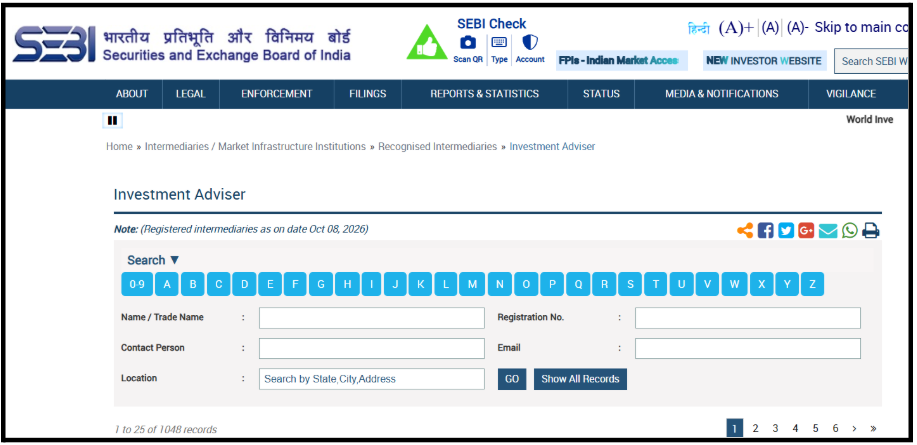
Run this search yourself. A link or screenshot that the adviser sends you proves nothing about today’s record.
Look for four points on the record:
- The INA number is identical to the one quoted to you.
- The registered name matches the name on the agreement, invoice and payment account.
- The registration is current, with no cancelled or suspended status.
- The type of adviser fits the service, whether an individual or a firm.
When these four line up, you have confirmed identity. You have not confirmed that the plan suits you, so keep reading before you pay.
What Is the Difference Between INA and INH?
INA is the prefix for Investment Advisers, and INH is the prefix for Research Analysts.
The two work under separate regulations, and the difference shapes what each can do for you.
An investment adviser gives personalised advice that considers your goals, your income and your risk appetite.
A research analyst publishes research and recommendations that are not tailored to you in the same way.
If someone sells you “calls” with targets and stop loss and quotes an INA number, ask which service you are buying.
The mismatch between the label and the product is worth a written question.
Analysts sit under a different prefix, and the steps to verify research analyst INH number cover how a certificate can outlive its registration.
How Can an Investment Adviser Charge You Under SEBI Rules?
SEBI lets an adviser choose one of two fee modes for each client.
Understanding both modes protects you from a bill that quietly grows.
In the fixed fee mode, the adviser can charge up to ₹1,51,000 per client family per year across all services.
In the assets under advice mode, the adviser can charge up to 2.5% of the assets under advice per client family per year.
The adviser can change the mode for a client, but the total cannot exceed whichever limit is higher.
The fee limit covers all services together, not each service separately.
Ask for the mode in writing before you pay. If the agreement does not name a mode and a number, you have no way to check the bill later.
Add up everything you pay during the year, including add on services with fancy names. They all count toward the same limit.
Can an Investment Adviser Sell You Products and Earn Commission?
No, not to the same client. SEBI requires advisers to keep advice and distribution apart at the client level.
An adviser who advises you cannot also earn commission from you on products.
The idea is simple. If a person is paid to sell a product, their advice about that product is no longer neutral.
Watch for the soft versions of this conflict.
A “free advice” offer that nudges you toward one platform, a partner firm that holds your investments or a bonus for opening an account all deserve a question.
Ask three things in writing: who executes your investments, who gets paid when you invest, and whether the adviser or a related person receives any commission.
A clear answer is a good sign. A vague answer, or “we only help you, others pay us,” is a reason to pause before you sign.
Does a Valid INA Number Mean the Adviser Has Checked Your Risk Profile?
It should, but registration alone does not prove it.
A genuine adviser assesses your risk profile and suitability before recommending anything, and records it.
Ask to see the risk profile document and the signed agreement.
They should show your goals, your time horizon and the limits the adviser will respect.
If an adviser recommends a high risk product in the first call, before asking about your income, loans or family, that tells you how seriously the process is taken.
Also ask for the Most Important Terms and Conditions document.
It sets out the services, fees, refund terms and the adviser’s grievance details in one place.
Keep copies of all of these. They are the first documents any regulator will ask for if you file a complaint.
What Should You Do If the INA Number Does Not Match or Is Not Listed?
Stop the payment and take a dated screenshot of your search. Save the chat or email where the person quoted the number. Those two items are your evidence.
Ask for the exact registered name and number, then search again.
A trade name that differs from the registered company name is the usual innocent explanation.
If the person cannot point to a live record, treat them as unregistered.
A person with no live record on SEBI’s list falls into the pattern that unregistered advisory firms in India lays out.
Do not delete anything from your phone while you sort this out.
Chats, call logs and payment alerts are the proof that a reviewer will ask for first.
Did an adviser take your fee without ever showing a live INA record?
We go through your agreement and receipts and map the first complaint you should file. Register with us for a free consultation.
How Do You Check an Adviser’s Complaint Record Before You Pay?
A registered adviser must publish complaint data on its own website.
This is a quick way to see how the firm handles unhappy clients.
Find the monthly complaint disclosure and note the date. Check whether the data is present, absent, outdated or hard to confirm, and take a dated screenshot either way.
The absence of data does not prove a problem, because a page may exist with placeholder data.
But a firm that publishes nothing at all has told you something about its transparency.
Cross check with the SEBI website for any public order against the adviser.
If there is no order, say so to yourself plainly, and base your decision only on records you can see.
Avoid screenshots from group chats. They can be edited, and they carry no source you can verify.
Does a Registered Adviser Ever Promise Guaranteed Returns?
A registered adviser cannot promise or assure returns. Any person who says your capital is “safe” or your profit is “fixed” is breaking the basic rule that investment advice carries risk.
SEBI orders against advisers often cite misleading claims and missing disclosures.
The orders are public, and they are the right place to read what actually happened.
When a promise arrives in writing, keep it. It can support a complaint later, and it shows the exact words used.
Keep every promise in writing, and use report assured return stock advisor to see what else deserves a screenshot.
Can an Investment Adviser Handle Your Trading or Demat Account?
An investment adviser gives advice. You place the trades, and your money stays in accounts that you control.
An adviser should not ask for your login, your OTP or your demat password.
Services that offer to “handle your account” for a share of the profit sit in a very different place.
SEBI has warned investors about such offers, and its February 2026 caution on fake notices also named account handling services.
Hand over a password and you lose the protection that normal channels give you.
If something goes wrong, there is no easy way to show who placed which order.
Why the word registered does not make this model acceptable becomes clear in SEBI registered account handling.
An adviser should also not take your investment money into a personal bank account.
Money for investments goes directly to the broker, fund house or product provider.
Which Questions Should You Ask on the First Call?
The first call is your best chance to test an adviser, so plan it.
Write down the questions before you pick up the phone, and note the answers.
Ask for the INA number and the registered name, and check them while the person is still on the call. A genuine adviser will wait.
Ask which fee mode applies and what the total will be for twelve months.
Then ask how a refund works if you stop in the middle.
Ask how the adviser is paid when you invest. The right answer is that advice fees are the only income from you.
Ask what the adviser will do if the market falls twenty percent after your first purchase.
A sensible answer mentions your risk profile and your time horizon, not a promise to recover your loss.
Finally ask where complaints go. The adviser should give you the grievance contact without hesitation.
Any answer that comes with pressure, such as “pay today for the discount,” is an answer in itself.
Is Advice on WhatsApp From a Registered Adviser Safe to Act On?
A registered adviser may use WhatsApp to talk to clients, but the rules on advice do not disappear on a chat app.
The agreement, the risk profile and the fee record should exist outside the chat.
Be careful when the sender uses a personal number and a profile photo that looks like a corporate logo.
Check the number against the contact details on the SEBI record.
What registered entities may and may not send on messaging apps is covered in WhatsApp stock tips from a SEBI registered RA are legal.
If a stranger adds you to a group and offers “free advice” before pushing a paid plan, assume you are being marketed to.
Check registration first, and keep the group messages as proof.
How Do You Complain Against a Registered Investment Adviser?
Begin with a written complaint to the adviser’s grievance contact and keep a copy. If the reply does not settle it, move to SEBI’s system.
The full procedure sits on one master page so that every guide stays consistent.
The full complaint procedure for advisers, with its document list, waits at file complaint against RIA.
Keep a dated log while you wait: when you paid, when you wrote and when the adviser answered.
These dates decide which stage you can move to next.
Once the adviser has replied, a SCORES SEBI complaint gives you a registration number and sets a deadline for answers.
Read that answer closely. Check whether it deals with each point you raised, and whether the refusal, if any, comes with a written reason.
For a money dispute that needs a ruling, the SMART ODR portal offers conciliation followed by arbitration.
Both routes depend on good records, so keep the INA number, the agreement and the payment trail together in one folder from day one.
Conclusion
An INA number tells you who you are dealing with, not whether the plan is good.
Verify it on SEBI’s list, match the name to your payment account and read the fee mode in writing before you sign.
Know the two limits, ₹1,51,000 fixed or 2.5% of assets under advice per family, and ask who earns commission when you invest.
Those two questions expose most conflicts.
If the record does not match, or you already paid someone who failed the check, keep every document and start your complaint early.
Report. Recover. Stay Fraud Free.
Frequently Asked Questions
Search SEBI's Recognised Intermediaries list under Investment Adviser, using the name or INA number. Do it yourself rather than using a link from the adviser. The name, number and current status must match what you were told.
Yes. An adviser can charge up to 2.5% of assets under advice per client family per year, or a fixed fee of up to ₹1,51,000. The total across all services cannot exceed the higher of the two limits.
No. SEBI requires advice and distribution to stay separate at the client level, so an adviser cannot earn commission from you on products it advises. Ask in writing who gets paid when you invest.
INA is for Investment Advisers who give personalised advice, and INH is for Research Analysts who publish research and recommendations. They follow different regulations, so check the prefix against the service you bought.
Do not pay further. Save the messages, payment proof and your dated search screenshot. An unregistered person cannot give paid personal investment advice, and you can start a complaint with those documents.





 Add us as a preferred source on Google »

