
Quick Summary
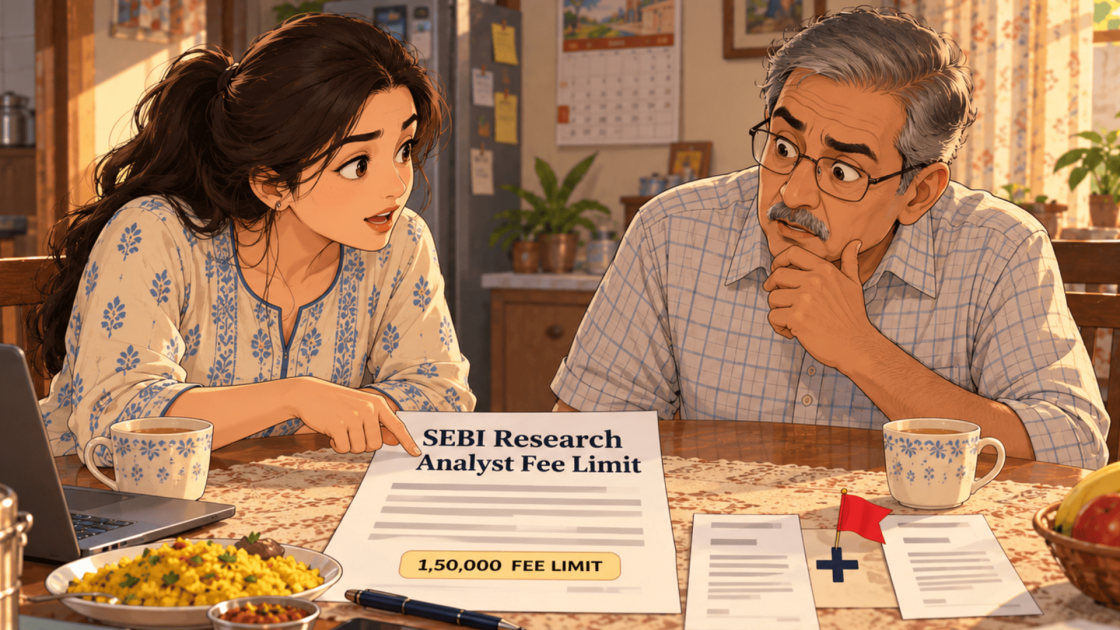
The SEBI research analyst fee limit is ₹1,51,000 per client family per year for individual and HUF clients. The limit counts every service together, so a “premium” upgrade does not reset it. Taxes such as GST sit outside the cap. Advance fees cannot exceed one quarter, and unused fees must come back on a pro rata basis if you leave early. The cap does not cover institutional or accredited clients. This guide shows how to add up what you paid and what to do if the total crosses the line.
Picture a family WhatsApp group. Your father pays ₹90,000 for a “swing trading plan,” and you pay ₹90,000 for an “options plan” from the same analyst. Neither bill looks big on its own.
Together they come to ₹1,80,000, and the SEBI research analyst fee limit treats them as one family.
That single fact catches more investors than any clever sales pitch, so it is worth understanding properly.
What Is the SEBI Research Analyst Fee Limit?
SEBI allows a registered research analyst to charge an individual or HUF client a maximum of ₹1,51,000 per client family per year.
The limit exists so that a registered analyst cannot turn a research subscription into a very expensive habit.
The cap works on a yearly basis and applies to the family as a unit.
It does not matter how many products, tiers or WhatsApp groups the analyst sells you.
Think of the cap as a ceiling on the whole relationship.
Whatever you buy, from one analyst, in one year, for one family, has to fit under ₹1,51,000.
This rule applies to registered research analysts, the entities that carry an INH number.
If you are unsure the seller is registered, start with verify research analyst INH number before you read any plan details.
Who Does the Fee Limit Protect?
The cap protects individual and HUF clients. These are the people most analysts sell to through ads, group chats and phone calls.
Institutional clients and accredited investors fall outside the cap.
Their fees are agreed commercially, since they are better placed to negotiate and assess the terms.
If you invest from your own savings and do not run a company or a fund, assume the cap protects you.
If an analyst tells you that you are “an accredited client” so the limit does not apply, ask for the formal accreditation in writing.
Never accept that label only because the analyst says it. Accreditation is a formal status, not a sales description.
How Do You Count the ₹1,51,000 Limit for a Family?
A family here means the people who share the relationship with the analyst, such as you, your spouse and your dependants.
Fees paid by or for any of them from the same family pool count together.
Add up four types of payment over the twelve months:
- The base subscription or plan fee.
- Any upgrade, add on or “premium” tier.
- Fees paid by other family members for the same analyst.
- Fees paid under a different brand name, when the same registered entity sits behind it.
Taxes such as GST are generally treated as outside the cap, but check how your agreement shows them.
Look at the base amount before tax when you compare against the limit.
Here is a simple example. A client pays ₹1,20,000 for a plan, then adds a ₹60,000 “VIP upgrade” in month five.
The total is ₹1,80,000, which is ₹29,000 above the cap.
That extra ₹29,000 is the amount to question. The first ₹1,51,000 is the most the analyst could lawfully take in that year.
Can a Research Analyst Take the Whole Fee in Advance?
No. A research analyst cannot take more than one quarter of fees in advance.
If the service ends early, the analyst must return the unused part pro rata.
So a plan billed yearly in a single payment is a red flag, unless the structure was set up as quarterly collections.
Ask how the fee is split and when each part is taken.
Pro rata means a fair share of the period you did not receive.
If you paid for three months and used one, you should get two months back, subject to what the agreement and the rules say.
Always ask for the refund rule before paying. A clear refund clause tells you the analyst expects clients to leave on occasion and has a plan for it.
A line like “no refund under any circumstances” deserves a written question, because it may clash with the pro rata rule.
Does the Fee Limit Apply to Profit Sharing or Performance Fees?
The fee you pay a research analyst is the registered fee for research services.
Profit sharing models work differently, and they raise their own concerns.
Offers that ask for a share of your trading profits are common in group chats. They often come from people who are not registered at all.
Promises that sound like “we earn only when you earn” get a closer look in profit sharing in the stock market.
Keep one rule in mind. If a person takes money linked to your gains and cannot show a live registration, you have two problems, the unlicensed activity and the unclear fee.
Do Investment Advisers Have the Same Fee Limit?
Investment advisers follow a related but different structure.
They can charge a fixed fee of up to ₹1,51,000 per client family per year, or up to 2.5% of assets under advice, and the total cannot pass the higher of the two.
So the headline number looks familiar, but the choice of fee mode is the difference.
Advisers work with two fee modes rather than one flat cap, which verify investment adviser INA number explains with examples.
Do not apply the adviser’s percentage option to a research analyst.
A research analyst plan has the flat yearly limit as the key test.
Which Fee Plans Fit Under the Limit and Which Do Not?
Numbers become clear with cases. The three examples below use simple amounts, and each one is a situation we see often.
Read the one closest to yours and copy the arithmetic.
- A ₹1,40,000 yearly plan paid in four instalments of ₹35,000. The total is under ₹1,51,000, and each instalment is one quarter, so the structure fits the rules.
- A ₹1,00,000 plan plus a ₹55,000 “options module.” The total is ₹1,55,000, which is ₹4,000 above the cap. The add on is the part to question.
- A husband and wife who each pay ₹80,000 to the same analyst. Together they pay ₹1,60,000 as one family, which is ₹9,000 above the cap, even though neither bill looks large.
Notice that the excess is always a specific, small, checkable amount.
That is good news, because a precise number is easy to put in a refund request.
Do not worry if your case does not match perfectly. Add the amounts, subtract the taxes shown separately and compare the result with ₹1,51,000.
What Should the Fee Section of Your Agreement Say?
A good agreement shows the fee clearly, in rupees, in one place.
If you have to piece it together from chat messages, the agreement is not doing its job.
Check that it names the exact amount, the period it covers and the number of instalments.
It should show taxes separately, so you can compare the base amount with the cap.
It should also state the refund rule for early exit, written as a formula or a clear example, not as a promise to “consider” your request.
Finally, it should give a grievance contact. A fee dispute starts with that contact, and you want it on paper from day one.
Before any renewal, read the new agreement as carefully as the first one.
Compare the new total with the previous payments in the same twelve months, since the cap counts the year and not the invoice.
What Should You Do If You Paid More Than the Limit?
Start by working out the exact excess. Add up every payment for the year, subtract the taxes shown separately and compare the result with ₹1,51,000.
Then write to the analyst. State the dates, the amounts and the cap, and ask for a refund of the excess in writing, with a date for payment.
Keep the payment proof, the plan description and the chat messages in one folder.
A clear paper trail turns a complaint into a simple arithmetic question.
Does your total for the year look higher than ₹1,51,000?
We add up your invoices against the cap and show you the exact excess to claim. Register with us for a free consultation.
If the analyst refuses or stays silent for more than a week or two, note the date of your last message.
That date helps when you move to the next stage.
If the analyst refuses, you can take the matter to the regulator. The full procedure for taking a fee dispute further sits at SEBI complaint against research analyst.
Can the Fee Be Higher If the Analyst Calls It a Different Service?
Renaming does not change the limit. A fee for “mentoring,” “training,” “portfolio support” or “priority access” counts toward the cap if it is paid for research services.
Watch for bundles that split one payment into several invoices.
Two bills of ₹80,000 each from the same entity are still ₹1,60,000.
Ask which registered entity issues each invoice. If different brand names sit behind one company, the company’s total is what counts.
Education is a separate matter. A genuine course that teaches market skills is not the same as research recommendations, but the two should be clearly separate in the agreement and the invoice.
If the language of the invoice blurs the line, ask for a plain description of exactly what each rupee buys.
How Does the Fee Limit Connect to the Rest of Your Complaint?
An excess fee is one of the clearest grounds for a complaint, because it rests on a number and not on an opinion. The arithmetic either works or it does not.
A SCORES SEBI complaint lets you attach the invoices and the payment trail to a single filing.
The entity then has a fixed period to respond.
Keep your complaint narrow. State the limit, the total you paid and the excess, and avoid adding claims you cannot document.
Should the matter need a binding decision, the SMART ODR portal is where conciliation and arbitration take place.
Conclusion
The SEBI research analyst fee limit is a clear number: ₹1,51,000 per client family per year, with taxes outside it and advance fees held to one quarter.
Add every payment from every family member, whatever the plan is called, and compare the total with that number.
If the total is higher, you have a concrete amount to ask back.
Write to the analyst, keep your records together and use the regulator’s complaint route if the reply does not settle it.
Act on the arithmetic early. Small excesses grow into large ones when a renewal or an upgrade lands on the same account.
Report. Recover. Stay Fraud Free.
Frequently Asked Questions
A registered research analyst can charge an individual or HUF client up to ₹1,51,000 per client family per year. The cap applies to all services together, and taxes such as GST are treated separately from it.
Advance fees cannot exceed one quarter. If the analyst wants a full year in one payment, ask how it fits the quarterly rule and what refund applies if you stop early. Save the answer in writing.
No. The cap protects individual and HUF clients. Institutional and accredited investors fall outside it. If an analyst claims you are accredited so the cap does not apply, ask for the formal accreditation in writing.
Their payments count together under one family limit. If your spouse and parents each pay the same analyst, add all the amounts for the year and compare the combined total with ₹1,51,000.
Work out the excess, write to the analyst with dates and amounts, and ask for a refund by a set date. If there is no reply, file a complaint with the regulator and attach your payment proofs.




 Add us as a preferred source on Google »

