
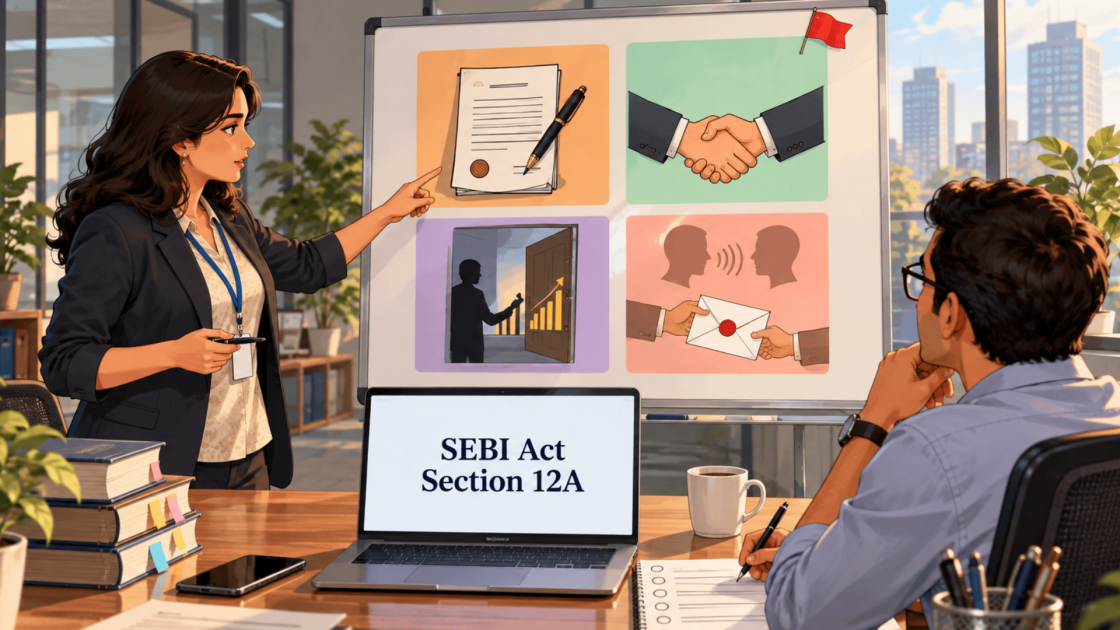
Quick Summary
SEBI Act Section 12A bars manipulative or deceptive devices, schemes to defraud, fraudulent acts, insider trading and dealing on unpublished price sensitive information, all in connection with listed or soon to be listed securities. Penalties can reach ₹25 crore or three times the profit, and criminal liability can mean up to 10 years in prison. The section is separate from the registration rules that stop unregistered advice. This guide explains each limb in plain words and shows where an investor can use it.
A man in a Telegram group claims he knows a company will announce a big contract next Monday. He sells “early access” for ₹10,000.
The price does move, though you cannot tell if his claim was true or lucky.
Whether the claim was real or not, SEBI Act Section 12A is the law that sits behind conversations like this.
Its list is short, and each line describes a different type of misconduct.
What Is Section 12A of the SEBI Act?
Section 12A is the part of the SEBI Act, 1992 that prohibits certain dishonest conduct in the securities market.
It states what no person may do, directly or indirectly.
The wording speaks of “any person,” so it reaches company insiders, intermediaries, advisers, tip sellers and ordinary traders.
A visiting card or a licence does not decide whether it applies.
Section 12A works with the PFUTP Regulations, which fill in specific practices.
The detailed list of practices sits in PFUTP regulations advisor, while Section 12A supplies the broad ban in the Act itself.
Think of the Act as the parent and the regulations as the detailed children.
A SEBI order often cites both, because the Act gives the power and the regulations describe the conduct.
What Does Section 12A Prohibit, Point by Point?
Section 12A lists six limbs, marked (a) to (f). Each one covers a different behaviour, and most of them are limited to securities listed or proposed to be listed on a recognised stock exchange.
Here is each limb in everyday words:
- Limb (a) bans using or employing any manipulative or deceptive device in connection with issuing, buying or selling such securities.
- Limb (b) bans using a device, scheme or artifice to defraud in connection with issue or dealing.
- Limb (c) bans any act, practice or course of business that operates or would operate as fraud or deceit on any person.
- Limb (d) bans insider trading.
- Limb (e) bans dealing in securities while in possession of material or non public information, or passing that information to another person, in breach of the Act or its rules.
- Limb (f) bans acquiring control of a listed company, or crossing the equity threshold, in breach of the takeover regulations.
For an investor following tips, limbs (a) to (e) matter most. Limb (f) deals with takeovers and rarely touches a retail complaint.
What Does “Listed or Proposed to Be Listed” Mean for You?
Most limbs of Section 12A apply to securities listed, or proposed to be listed, on a recognised stock exchange.
This keeps the section focused on the regulated market.
The words matter because many tip groups deal in other things, such as unlisted shares, offshore platforms or “pre IPO” deals.
Those activities may fall under other rules, and the regulator may treat them differently.
If a seller offers you shares of an unlisted company with a big promise, do not assume Section 12A is the right label.
Describe the facts and leave the section to the regulator.
If the shares are listed, or about to list, the picture changes.
Hype around a coming listing, for example, falls squarely in the territory this section guards.
How Does Section 12A Differ From the Rule Against Unregistered Advice?
Section 12A and the registration rule do different jobs. Mixing them up is one of the most common mistakes in complaints.
Section 12A targets dishonest conduct, whoever does it.
The registration rule, which sits in the adviser and analyst regulations, targets doing the work of an adviser or analyst without a licence.
So an unregistered tip seller can break both.
He breaks the registration rule by selling advice without a certificate, and he may break Section 12A if his claims or methods were deceptive.
The licence side of the story is told in unregistered advisory firms in India.
Here we stay with conduct, because that is what Section 12A addresses.
This difference helps you write a cleaner complaint. State first whether the person showed a registration, then describe what the person said and did.
What Are the Penalties Under Section 12A?
Section 12A itself is a prohibition. The penalties sit in other sections of the Act, and they can be heavy.
For fraudulent and unfair trade practices, Section 15HA provides a penalty of at least ₹5 lakh and up to ₹25 crore, or three times the profit made, whichever is higher.
For general contraventions with no separate penalty, Section 15HB sets a range from ₹1 lakh to ₹1 crore.
On the criminal side, Section 24(1) allows imprisonment of up to 10 years, a fine of up to ₹25 crore, or both.
Failure to pay a penalty or comply with an order can also lead to imprisonment under Section 24(2).
These are ranges, not fixed amounts. The actual outcome depends on the facts, the order and any appeal.
Do not quote a penalty figure for a named person unless a final order says it.
Always check the order date, because appeals can change the figure.
How Does Insider Trading Under Section 12A Work in Practice?
Insider trading means dealing in securities while holding unpublished price sensitive information, or passing that information on.
The detailed rules sit in the insider trading regulations, while Section 12A gives the legal base.
For a retail investor the practical question is simple. If someone offers you “inside news” for a fee, what are you actually buying?
If the information is genuine, using it may expose you to risk. If the information is invented, you have paid for a story.
In both cases the offer deserves caution.
Never act on a tip because the sender says it is “from inside.”
Check the registration of the person, the source of the claim and the official disclosures on the exchange website first.
Weighing a tip whose source you cannot check gets practical treatment in risks of following unverified stock tips.
If the sender has no registration to show, say so plainly in your notes.
Then keep the original messages on your phone and back them up. Screenshots without the original chat are easier to question later.
Bought a tip that claimed inside news?
Send the messages and the receipt, and we will check how the claim lines up with the rules and which route suits you. Register with us for a free consultation.
What Counts as Material Non Public Information?
Material non public information is news that is not yet public and would likely move a share price once it becomes public.
The term sounds technical, but the idea is easy to picture.
Typical examples include quarterly results before the exchange filing, a big contract win before the announcement, a merger plan under discussion or a change in the board’s dividend plan.
Rumours do not count automatically. A guess about a company’s results is not the same as knowing the numbers before they are released.
When a seller says “I know the result,” ask how.
A person with real inside access has a legal duty to keep it quiet, and a person without access is selling a story.
Check the exchange website for the company’s announcements.
If the news appears there after the tip, compare the timing, but do not treat a lucky match as proof of a source.
What Happens After SEBI Finds a Section 12A Violation?
SEBI follows a process before it passes a final order.
It starts with an investigation, then a show cause notice, then a hearing where the person can reply.
After that, a final order lists the findings and the directions. These can include penalties, bans from the market and orders to return gains.
The person can appeal to the Securities Appellate Tribunal, and the tribunal can uphold, reduce or set aside an order.
So an old headline may not show the current position.
Always check the date and the latest status before you quote any figure or finding.
For your own complaint, do not wait for such an order. Your redress track runs separately and starts with the entity’s reply to your written complaint.
Can Section 12A Apply to a Telegram or WhatsApp Tip Group?
It can. The medium does not matter. If a group pushes a listed stock using deceptive claims, or if members pass on non public information, the conduct can fall under the section.
Group organisers sometimes hide behind the claim that they only share “views.”
The regulator looks at what was said, what was promised and what followed in the market.
Evidence is your friend here. Save the group name, the admin’s number, the messages with dates and the price moves that followed.
Check whether the admin claims to be a registered analyst.
Whether or not an admin claims registration, verify research analyst INH number takes only a few minutes and goes into your notes.
Take care to describe, not accuse. Write what the group posted and what you did, and leave the legal label to SEBI.
How Do You Use Section 12A in a Complaint?
You do not have to cite the section. A clear account of events is enough, and the regulator decides which provisions apply.
If you want to help the reviewer, add one plain sentence linking facts to conduct.
For example, state that the group claimed advance knowledge of a company announcement and that you paid on that basis.
After that, your evidence can go onto a SEBI complaint SCORES as one organised set.
Keep the tone factual. Use dates, amounts and screenshots, and avoid adjectives that you cannot support.
Waiting on a reply? SCORES complaint status explains how to read where your filing stands.
Conclusion
SEBI Act Section 12A bans deceptive devices, schemes to defraud, fraudulent acts, insider trading and misuse of price sensitive information in connection with listed securities.
It applies to any person, and its penalties can reach ₹25 crore or three times the profit.
It differs from the registration rule. One targets dishonest conduct, and the other targets doing an adviser’s work without a licence.
If a tip, a group or an adviser fits the pattern, save your evidence and describe the facts clearly. Let the regulator choose the legal label.
Report. Recover. Stay Fraud Free.
Frequently Asked Questions
Section 12A bars any person from using manipulative or deceptive devices, schemes to defraud, fraudulent acts, insider trading and misuse of non public information in connection with listed or proposed to be listed securities. It also covers breaches of takeover limits.
For fraudulent and unfair trade practices, Section 15HA allows a penalty up to ₹25 crore or three times the profit, whichever is higher. Section 24 allows imprisonment up to 10 years. Actual outcomes depend on the order and any appeal.
Most limbs apply to securities listed, or proposed to be listed, on a recognised stock exchange. Other rules may cover unlisted shares. Describe the facts in your complaint and let the regulator decide which provision applies.
Not by itself. The registration rule sits in the adviser and analyst regulations. Section 12A targets deceptive and fraudulent conduct. One person can break both rules if the advice was both unlicensed and deceptive.
No. A clear, dated account of what was said, what you paid and what followed is enough. The regulator decides which provisions apply, so focus on facts and attach your evidence.




 Add us as a preferred source on Google »

