
The risks of following unverified stock tips are far greater than most retail investors realise.
Every day, investors act on Telegram, WhatsApp, Instagram, and YouTube stock tips without asking one key question: who is giving this advice, and are they legally allowed to?
You receive a message: “Buy XYZ at ₹120. Target ₹180. Guaranteed profit.” It looks convincing. The sender has thousands of followers. You invest. The stock crashes, and your money disappears.
This cycle repeats daily across India through unverified advisors and misleading return claims.
Should I Follow Unverified Stock Tips?
No. Risks of following unverified stock tips include losing your capital, damaging your financial future, and falling for misleading advice.
Before acting on any tip, first ask: Is this person SEBI registered, and can they legally give investment advice?
If you cannot verify both, walk away immediately.
Meanwhile, the Indian stock market moves fast, and fraudsters exploit panic and greed to trap investors.
Why Investors Lose Money Following Unverified Tips?
Unregistered tip providers do not work in your interest. Instead, they focus on making profits for themselves.
Risks of following unverified stock tips become clear once you understand how these schemes operate.
First, the operator buys a low-volume stock at a low price. Then, he pushes subscribers on Telegram, WhatsApp, or YouTube to buy the same stock.
As artificial demand increases, the stock price rises sharply. Next, the operator quietly sells his holdings at the peak, while subscribers remain trapped with collapsing shares.
Moreover, these operators promote “100% guaranteed returns” to attract investors. However, no legitimate advisor can legally make such claims because SEBI explicitly prohibits them.
Even then, many retail investors trust these promises because the language sounds convincing and the profit screenshots appear real.
In short, unverified stock tips are not investment opportunities. They are carefully designed traps.
SEBI Regulations on Unverified Stock Tips and Recommendations
SEBI takes a clear and firm stand on this.
Only SEBI-registered Investment Advisers (IAs) and Research Analysts (RAs) can legally provide investment advice or stock recommendations to the public. However, investors often wonder, can a research analyst give personalized tips to individual clients?
Legally, they cannot. While an RA provides broad market research, personalized, goal-based advice requires an Investment Adviser registration. Giving stock tips outside these strict regulatory boundaries is not just risky, it is illegal. An advisor can face penalties, bans, or even imprisonment.
The dangers of unregistered operations extend beyond public Telegram channels and social media platforms.
The Platinum Portfolios fraud is a stark example of how unregistered portfolio management arrangements operating entirely through personal trust and private communication can cause equal if not greater financial damage, with an investor losing over ₹2.02 crore to someone operating without any SEBI registration whatsoever.
Key regulations you must know:
- SEBI (Investment Advisers) Regulations, 2013: Mandates registration for anyone providing investment advice for a fee.
- SEBI (Research Analysts) Regulations, 2014: Requires registration to publish stock recommendations publicly.
- PFUTP Regulations, 2003: Prohibits fraudulent, manipulative, and deceptive trade practices in the securities market.
- SEBI Act, Section 12(1): No person can act as an investment adviser without obtaining a SEBI certificate of registration.
SEBI, along with TRAI, directed that only SEBI-registered intermediaries may send SMS-based investment advice and stock tips through registered telemarketers.
Meanwhile, SEBI also warned investors about unsolicited tips circulating through websites and social media platforms.
Additionally, in September 2024, SEBI barred regulated entities from associating with unregistered finfluencers and ordered them to end existing partnerships.
SEBI action against finfluencers has intensified since then, with enforcement orders covering Telegram channels, YouTube advisors, and paid subscription services operating without registration.
The message is clear: risks of following unverified stock tips fall entirely on the investor.
SEBI Orders Against Unverified Stock Tips
SEBI does not just issue warnings. It acts. Below are three landmark enforcement actions that prove exactly how seriously the regulator treats unverified stock tips.
1. Yash Garg SEBI Order
SEBI found that Yash Garg operated multiple Telegram channels under the name “Yash Trading Academy.”
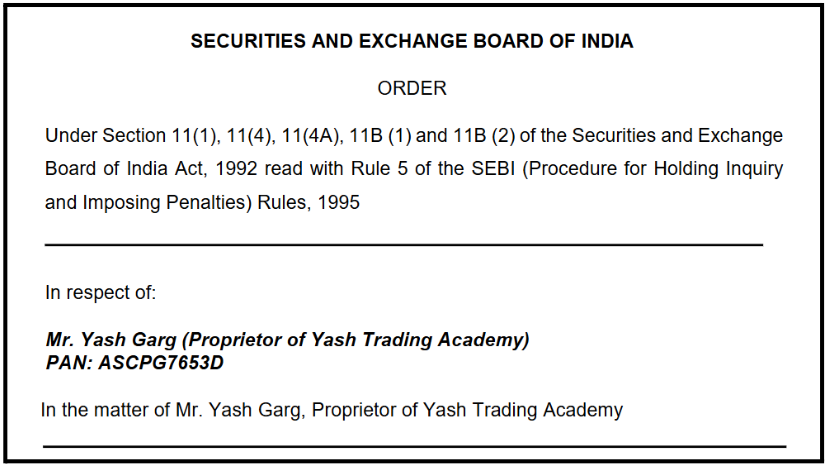
He allegedly offered paid trading tips, portfolio management services, and direct handling of client demat accounts without mandatory SEBI registration.
He lured investors with claims of “100% guaranteed profit” while falsely projecting himself as a SEBI-registered entity.
Key Violations
Garg’s operation combined two layers of fraud, collecting fees without authorisation and lying to investors about his legal standing to do so.
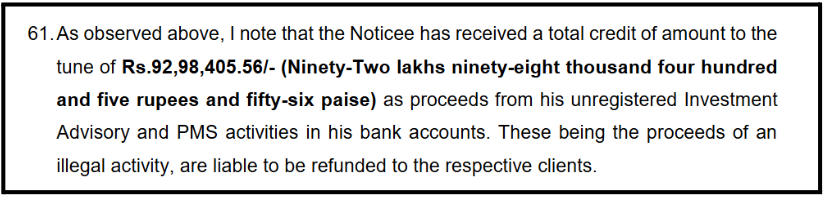
- Unregistered Investment Advisory: Garg collected ₹92.98 lakh from clients through subscription fees and profit-sharing arrangements without any SEBI registration as an Investment Adviser or Research Analyst.
- False Claims of Registration and Guaranteed Returns: Garg made misleading representations of SEBI registration status and explicitly promised guaranteed profits.
Together, these violations turned a Telegram channel into a tool for systematic retail investor fraud.
Penalty on Yash Garg
SEBI barred Yash Garg from the securities market for two years or until refunds are completed, whichever is later, and imposed a total penalty of ₹16 lakh.

It comprises ₹10 lakh for fraudulent practices and ₹6 lakh for SEBI regulation violations, along with a directed refund of ₹92.98 lakh to investors.
2. P.R. Sundar & Mansun Consultancy Pvt. Ltd. SEBI Order
SEBI received two references alleging that P.R. Sundar and his company, Mansun Consultancy, were providing investment advisory services without the requisite registration from SEBI.
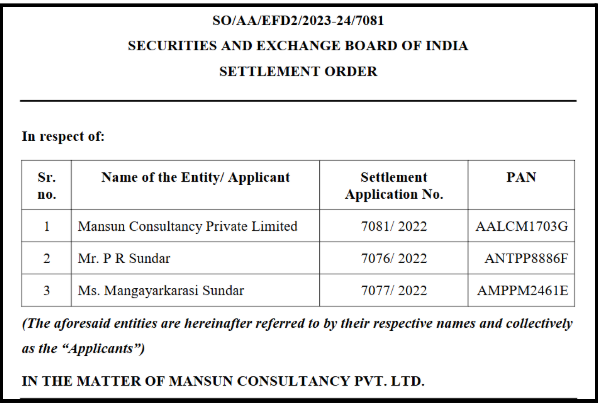
The regulator found that Sundar ran a website offering various advisory packages, with fees collected through a payment gateway linked to Mansun Consultancy’s bank account.
This became the first landmark case in India where a prominent finfluencer faced direct SEBI enforcement action.
Key Violations
Despite a large public profile, Sundar’s advisory operation lacked one fundamental requirement: a valid SEBI registration, making every fee collected under that operation unlawful.
- Unregistered Advisory Services for Fee: Sundar operated a paid advisory website without obtaining SEBI registration as an Investment Adviser, a direct violation of Section 12(1) of the SEBI Act and Regulation 3(1) of the IA Regulations, 2013.
- Systematic Fee Collection Without Compliance: Mansun Consultancy collected advisory fees through a registered payment gateway, establishing a clear commercial advisory operation that legally required SEBI registration.
This case set the precedent that social media fame carries no regulatory immunity.
P.R. Sundar & Mansun Consultancy SEBI Penalty
SEBI settled the matter for a total penalty of ₹46.80 lakh and a disgorgement amount of approximately ₹6.07 crore.

Additionally, P.R. Sundar, Mangayarkarasi Sundar, and Mansun Consultancy were barred from buying, selling, or dealing in securities for one year.
3. Avadhut Sathe & ASTAPL SEBI Order
SEBI barred finfluencer Avadhut Sathe and his firm ASTAPL from dealing in the securities market and impounded ill-got gains worth over ₹546 crore.
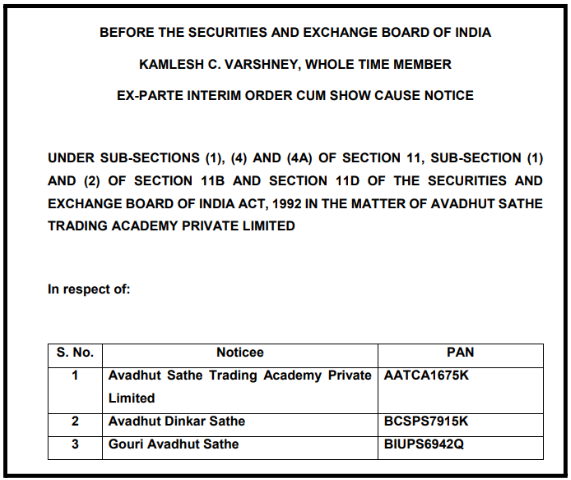
The regulator found that Sathe and his firm were not registered as investment advisers or research analysts.
Despite this, they provided investment advisory and research analyst services under the guise of stock market education to a large number of investors.
Between 2017 and 2022, ASTAPL expanded its reach with courses and mentorship programs.
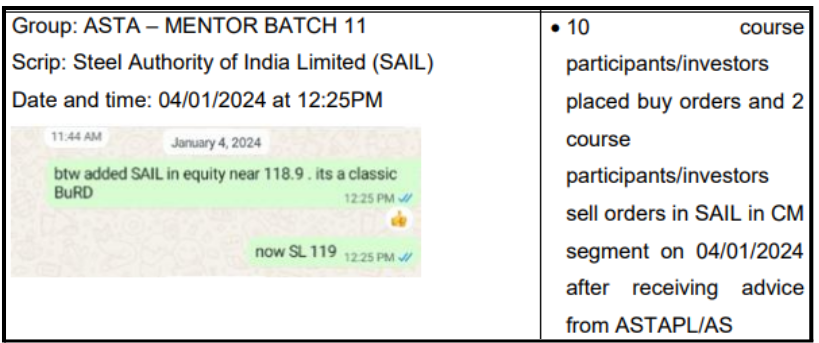
SEBI’s August 2025 raids uncovered Telegram group messages with live trade calls that confirmed active advisory operations disguised as education.
Key Violations
ASTAPL’s model was particularly dangerous because it weaponised the word “education” to sidestep regulation while running what SEBI confirmed was a full-scale, commercial investment advisory operation.
- Advisory Under the Guise of Education: ASTAPL delivered specific stock recommendations, including buy/sell calls, target prices, and stop-loss levels, to over 3.37 lakh clients. At the same time, it falsely presented these activities as financial education to avoid mandatory SEBI registration requirements.

- Misleading Advertising and False Performance Claims: SEBI found that 65% of course participants incurred losses within six months of completing the course.
This directly contradicted the academy’s advertisements claiming participants earned consistent supernormal profits.
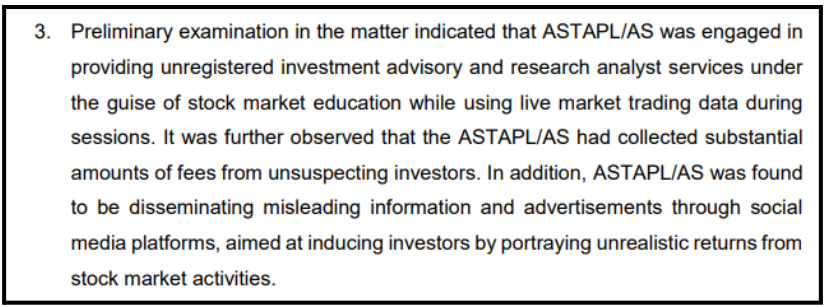
Ultimately, what ASTAPL sold as an education functioned as a paid stock tip scheme, and SEBI treated it accordingly.
Avadhut Sathe Penalty
SEBI ordered ASTAPL and Avadhut Sathe to jointly refund ₹601.37 crore collected from over 3.37 lakh investors, of which ₹546.16 crore stands classified as prima facie unlawful gains.
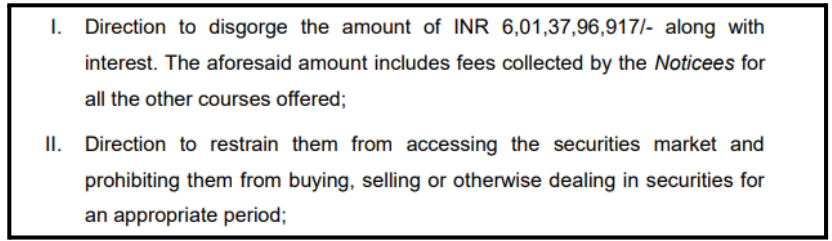
This was one of the largest enforcement actions ever taken against an unregistered finfluencer in India.
Lessons For Investors
Fraudsters build trust on Telegram, YouTube, and Instagram using market commentary, profit screenshots, testimonials, and return claims before selling paid tip services.
Investors follow the tips, lose money, and get replaced by new retail investors entering the market daily.
This cycle repeats because new retail investors enter the market every day. Each one represents a fresh target.
- SEBI monitors Telegram, WhatsApp, YouTube, and websites for illegal tips.
- “Education” label offers no protection if buy/sell recommendations are included.
- Guaranteed return promises are always a SEBI violation, no exceptions.
- Recovery is difficult even after SEBI orders refunds; do not wait to complain.
How To Avoid It: Verify SEBI registration, reject guaranteed return claims, avoid pressure tactics, and rely only on registered advisers or research analysts. If a tip arrives unsolicited, treat it as bait, not advice.
Impact on Investors and the Market: Unverified stock tips cause financial losses, emotional distress, distorted stock prices, and reduced trust in capital markets. Across the cases discussed, fraudsters collected over ₹700 crore from ordinary investors.
SEBI have tightened rules through mandatory registration disclosures, verified badges, and stricter oversight of finfluencers.
Many investors join Telegram or WhatsApp groups hoping to get quick stock market profits.
But before acting on such messages, they should first ask an important question: are WhatsApp & Telegram stock tips legal and whether such advice is actually regulated in India.
Unfortunately, many of these tips come from unverified sources with no accountability.
However, fraudsters continue evolving through AI-generated scams and offshore Telegram channels.
What To Do In Such Cases?
If you suffered losses after following unverified stock tips, act immediately because delays weaken your recovery options. The first step is to report misleading stock advisory services through official channels before evidence is lost or accounts are deleted.
Risks of following unverified stock tips increase when investors fail to preserve evidence and escalate complaints quickly.
Step 1: Preserve All Evidence
First, save every screenshot, chat, payment receipt, and transaction record linked to the unverified stock tips.
Additionally, document the platform, channel, or individual who shared the advice along with the exact losses suffered.
Strong documentation increases the credibility of your complaint and supports every later stage of recovery.
Step 2: File a Complaint in SCORES
Next, submit a complaint through SEBI’s SCORES portal and attach all supporting evidence.
Clearly explain the violation, mention the amounts involved, and describe how the unverified stock tips caused financial harm.
SEBI can monitor the complaint, seek responses, and take regulatory action against violators.
Step 3: Escalate the Complaint Through SMART ODR
If SCORES does not resolve the issue, escalate the dispute to SEBI’s SMART ODR platform for conciliation or online dispute resolution.
This process often helps investors reach faster settlements with intermediaries and financial entities.
Moreover, regulated entities must participate in the process once the dispute moves forward.
Step 4: File for Stock Market Arbitration
Finally, pursue formal arbitration if earlier remedies fail to produce a satisfactory outcome.
A securities law expert can strengthen your case, improve documentation, and increase your chances of recovering funds lost through unverified stock tips.
Arbitration awards also carry legal enforceability under securities law.
Need Help?
If you lost money following unverified stock tips, we are here to help. Our team of SEBI-specialised professionals offers the following services:
- Case Evaluation: We review your evidence, assess SEBI violations, and advise on the strength of your claim before you file.
- SEBI Complaint Drafting & Filing: We prepare and submit a precise, well-documented complaint on SCORES to maximise the regulator’s response.
- SMART ODR & Arbitration Support: We represent investors during SMART ODR conciliation and formal arbitration proceedings to strengthen recovery efforts.
Your financial loss deserves a legal remedy. Register with us today.
Conclusion
Risks of following unverified stock tips can wipe out years of savings. SEBI enforcement actions repeatedly expose the same pattern: unregistered operators, guaranteed return claims, and massive investor losses.
Yash Garg allegedly defrauded investors of nearly ₹93 lakh, while P. R. Sundar disgorged over ₹6 crore. Meanwhile, Avadhut Sathe faces a refund demand exceeding ₹601 crore.
The lesson remains clear: verify every advisor before investing, reject guaranteed profit claims immediately, and rely only on SEBI-registered professionals.
If unverified stock tips already caused financial loss, preserve your evidence and take legal action without delay.