

Did you pay for a trading advisory service, follow every tip they gave you, and still end up watching your hard-earned money disappear, trade by trade?
If that sounds familiar, here is something you need to know: you are not helpless, and you are not without options.
When a SEBI-registered Research Analyst violates the rules, through misleading promises, illegal fee arrangements, or deceptive marketing, the same regulatory system that licenses them also gives you a clear, structured path to hold them accountable.
If you are looking for how to file a complaint against Sameer Pande of Niftypro Trading Research, let’s walk you through every step, from gathering your documents to pursuing a binding arbitration award.
In this blog, we cover who Sameer Pande is, the violations SEBI documented against him, a real investor’s arbitration win, the grounds on which your complaint can stand, and the exact steps to take, in the right order.
Who is Sameer Pande?
Sameer Pande is a Nagpur-based SEBI-registered Research Analyst operating under the firm name Niftypro Trading Research.
His SEBI RA Registration Number is INH000009649, which is active and verifiable on SEBI’s official intermediary registry at sebi.gov.in.

He offers subscription-based stock market services, primarily intraday tips and equity research alerts. delivered to clients through Telegram, email, and his website niftypro.in.
Packages range up to ₹15,000 annually, and the website carries standard market-risk disclaimers as required by SEBI.
On the surface, it looks like a straightforward, compliant setup.
But SEBI’s inspection of Niftypro, covering the period May 2022 to January 2024. uncovered a different story. The regulator documented multiple violations, imposed a monetary penalty of ₹2 lakh in December 2024, and issued a formal regulatory censure in May 2025.
On top of that, an independent arbitrator awarded an investor ₹4,65,000 in full after finding that Niftypro had violated SEBI regulations and defrauded the investor through an illegal profit-sharing arrangement.
Profit sharing traps of this nature are among the most difficult to detect because they are structured to appear like a legitimate business arrangement until the losses begin and the terms are suddenly reinterpreted.
So while the registration and online presence may appear credible at first glance, the regulatory findings and arbitration outcome raise important questions for investors.
If you believe you’ve faced a similar issue while dealing with Sameer Pande or Niftypro Trading Research, the next step is understanding how to formally raise a complaint and protect your rights.
How To Register a Complaint Against Sameer Pande?
Since Sameer Pande is a SEBI-registered Research Analyst, you have a formal, legally structured path available to you.
Each step below builds on the one before it; follow them in order:
Step 1: Build Your Evidence File First
Before filing anywhere, gather everything.
This includes payment receipts and bank transfer records, subscription invoices, all Telegram messages or chat screenshots, any call recordings where profit guarantees or profit-sharing terms were discussed, and records of the trades you were advised to take and the losses that followed.
The more organised and date-ordered your evidence is, the stronger your complaint becomes. If you were advised to hold positions without a stop-loss, document that specifically.
Step 2: Send a Formal Written Complaint to Niftypro
Before escalating to a regulator, write a formal complaint to Sameer Pande / Niftypro Trading Research directly.
State the specific issue: misleading claims you relied on, the profit-sharing arrangement you entered, or losses from tips given without risk controls.
Give the firm 21 days to respond. If you receive a satisfactory resolution, document it. If you do not, that non-response or inadequate response is itself part of your case going forward.
Keep a complete copy of everything you send and receive.
Step 3: Register a Complaint with SCORES
If the firm fails to resolve your issue, file a formal complaint on SEBI’s SCORES portal (scores.sebi.gov.in).
Select “Research Analyst” as the intermediary type and enter the registration number. Describe the specific violation clearly; do not just say you lost money. Explain how the conduct violated the rules. Attach all supporting documents.
SEBI SCORES is the most important official channel for filing a complaint against Sameer Pande. This creates a formal regulatory record under your name.
Step 4: Escalate Your Complaint with SMART ODR
If SEBI SCORES does not produce a satisfactory resolution, move to the SMART ODR platform, SEBI’s Online Dispute Resolution system for investor-intermediary disputes.
Register your case, upload your evidence package, and initiate the conciliation process. This is a regulator-supervised mediation step that is faster than full adjudication and does not require legal representation to get started.
This is also the gateway to arbitration if conciliation does not succeed.
Step 5: Stock Market Arbitration
If conciliation through SMART ODR fails, formal arbitration is the final and strongest step available. An independent, empanelled arbitrator reviews all your evidence and delivers a binding decision.
Before filing a complaint, it’s equally important to understand whether any regulatory action has already been taken against the individual.
This helps investors evaluate patterns of conduct, past violations, and the seriousness of the allegations involved.
SEBI Order Against Sameer Pande
A complaint rooted in documented regulatory violations carries far more weight than a general grievance.
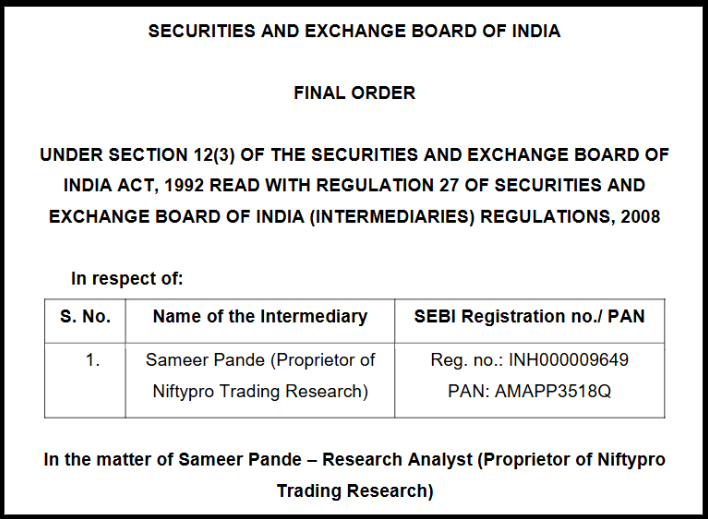
SEBI’s inspection of Niftypro Trading Research established the following violations:
- Misleading accuracy claims: Niftypro’s website claimed “Best Market Tips” and “up to 90% accuracy in intraday calls.” SEBI’s Advertisement Circular explicitly prohibits any accuracy-based or performance-based claims by Research Analysts.
- Guaranteed profit promises by sales staff: Representatives of the firm told potential clients that ₹50,000 of capital would generate ₹8,000 to ₹10,000 daily in profits, and that subscription fees could be recovered within 2 to 3 trading days.
- Superlative and prohibited marketing language: The use of terms like “best” and “accurate” in a way that implies guaranteed superiority over other analysts violated Clauses 1, 2, 6, 7, and 8 of the Code of Conduct under Regulation 24(2) of the RA Regulations.
- Deceptive client testimonials: Website testimonials portrayed consistently high returns without adequate disclaimer context, contributing to a false impression of assured profitability, a violation of Clause C of the SEBI Advertisement Circular.
- Illegal profit-sharing arrangement: SEBI regulations strictly bar Research Analysts from entering into profit-sharing or performance-linked fee structures with clients. An investor named Muhammad Chand Ansari paid ₹55,000 under a documented profit-sharing deal, which the firm later retroactively reclassified as a non-refundable service fee. The arbitrator found this to be a direct violation of SEBI rules and ordered a full refund.
Total Monetary Penalty: ₹2,00,000
If your experience involved any of the above, guaranteed return promises, a profit-sharing arrangement, misleading claims, or no stop-loss advice, your complaint has documented regulatory grounding to stand on.
One investor did not just file a complaint.
He took the case all the way to arbitration and won. Here is what happened.
Arbitration Case Against Sameer Pande
Case Reference: Arbitration No. NSE-RA-2024-12-229923
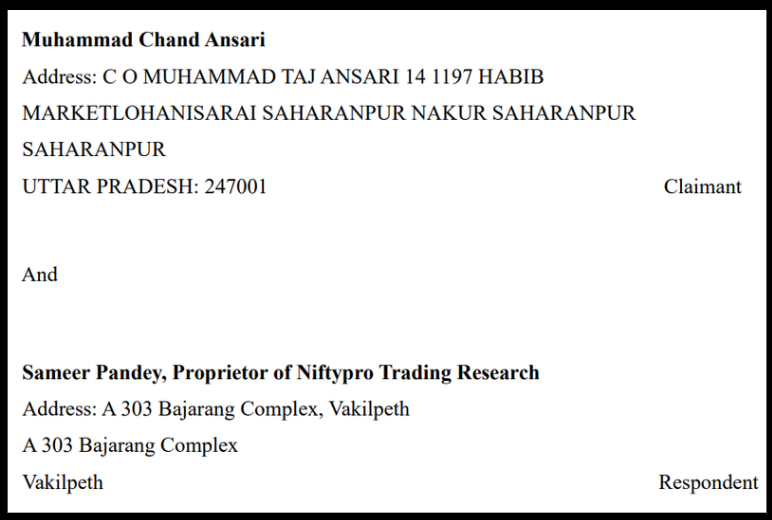
Muhammad Chand Ansari from Saharanpur, Uttar Pradesh, approached Niftypro Trading Research after discovering them on Telegram. He was offered a monthly package at ₹1,00,000, more than he could afford.
The representative then proposed a profit-sharing deal: 30% of profits, with ₹55,000 payable upfront. Chand agreed.
What followed was a series of intraday calls with no stop-loss protection. His trades went south, his capital eroded, and by the end, ₹4,65,000 of his savings was gone.
When he sought accountability, Niftypro changed its position, claiming the ₹55,000 was always a standard service fee, not a profit-sharing payment.
Chand had recorded the original conversations.
Those recordings proved the profit-sharing arrangement was real. Combined with the existing SEBI adjudication order against Niftypro, the evidence was clear.
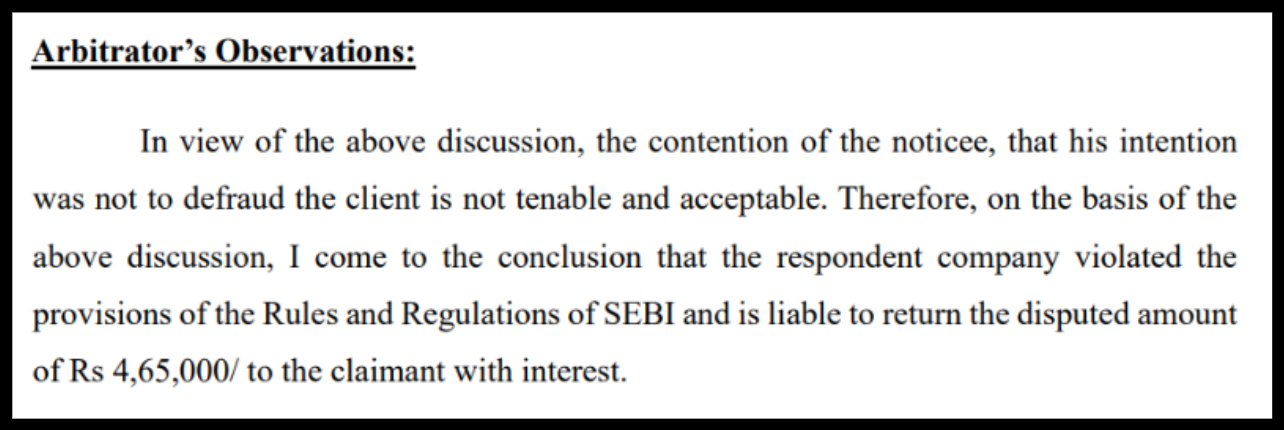
The arbitrator ruled: “The respondent company violated the provisions of SEBI Rules and is liable to return the disputed amount of ₹4,65,000 to the claimant with interest.”
Award: ₹4,65,000, to be paid within one month of the award date. Failure to pay attracts 15% annual interest until full payment is made.
This case is proof that the system works when you document everything and follow the right process.
Need Help?
Understanding how to file a complaint against Sameer Pande is one part of it. Building a case that regulators and arbitrators actually act on is another.
Here is how we help:
- Evidence Organisation: We structure your payment records, chat exports, call logs, and trade history into a clear, regulatory-ready case file.
- Complaint Drafting: We write your SEBI SCORES filing with precise language, citing each violation against the specific regulation it breaches, supported directly by your evidence.
- SMART ODR Guidance: We walk you through every stage, registration, document submission, and the conciliation session itself.
- Arbitration Support: We build your full arbitration case, documentation, written submissions, and hearing preparation, end-to-end.
- Case Monitoring: We track your complaint status across every platform and help you respond to any follow-up queries from regulators.
Every case is handled with complete confidentiality. Register with us; the earlier you begin, the stronger your position.
Conclusion
How to file a complaint against Sameer Pande follows a clear sequence: document first, write to the firm, file on SEBI SCORES, escalate to SMART ODR, and pursue arbitration if losses need to be recovered.
SEBI’s enforcement record, a ₹2 lakh monetary penalty in December 2024 and a regulatory censure in May 2025, confirms that the violations are real, documented, and regulatory-grade.
The arbitration award of ₹4.65 lakh further proves that an investor who follows the right process can recover what was wrongfully taken.
Your complaint is not just about your money. It is part of how the system holds registered intermediaries to the standard they are supposed to maintain.
Start today. The sooner you act, the stronger your case.





 Add us as a preferred source on Google »

