

What would you do if you paid a stock market advisory service, followed their calls faithfully, lost a large chunk of your capital, and then discovered the firm was never legally allowed to make those promises in the first place?
It is a question most traders never think to ask before subscribing. But thousands of retail investors in India find themselves asking it after the damage is already done.
The stock market advisory space is filled with services that look completely legitimate on the surface.
A SEBI registration number in the footer, an active Telegram channel, bold accuracy claims, and a sales team that sounds entirely convincing. But looking professional and operating professionally are two very different things.
The story of Sameer Pande Research Analyst, and his firm, Niftypro Trading Research, is exactly the kind of story that every trader should read before they put money into any advisory service.
In this blog, we cover who Sameer Pande is, what SEBI found during its inspection, an investor who fought back through arbitration and won, real client experiences, and what you can do if you have already been affected.
Sameer Pande Research Analyst Review
Sameer Pande is a SEBI-registered Research Analyst based in Nagpur, Maharashtra, and the proprietor of Niftypro Trading Research.
His SEBI RA Registration Number is INH000009649, active and verifiable on SEBI’s official intermediary registry at sebi.gov.in.

He provides subscription-based stock market services to retail traders, primarily intraday tips and equity research alerts, delivered through his website niftypro.in, Telegram, and direct client communication.
Annual packages go up to ₹15,000, and the website carries standard market risk disclaimers as required under SEBI regulations.
Many investors, when they first come across the firm, ask: is Niftypro Trading Research SEBI Registered?
The answer is yes, Sameer Pande holds a valid registration as a Research Analyst, which means he is authorised to provide research services under the SEBI (Research Analysts) Regulations, 2014.
Those regulations mandate honesty, transparency, no guaranteed return claims, and no profit-sharing or performance-linked fee structures with clients.
A registration tells you an entity is authorised to operate. It does not tell you how they have actually operated.
When SEBI conducted a thematic inspection of Niftypro Trading Research covering May 2022 to January 2024, what they found went significantly beyond the disclaimers on his website.
Let us look at exactly what SEBI found, because the gap between Niftypro’s marketing and its regulatory record is where the real story begins.
Also Read: Pankaj Garg, whose phone number differs by a few digits from the one on SEBI record, along with concerning Telegram channel activities.
SEBI Order Against NiftyPro
SEBI’s inspection was not triggered by a single isolated complaint. It covered a 20-month period and involved a thorough review of Niftypro’s website, Telegram posts, internal call recordings, lead generation sheets, and direct client communication records.
What emerged was not a one-off compliance gap. It was a consistent, documented pattern of misleading conduct directed at retail investors.
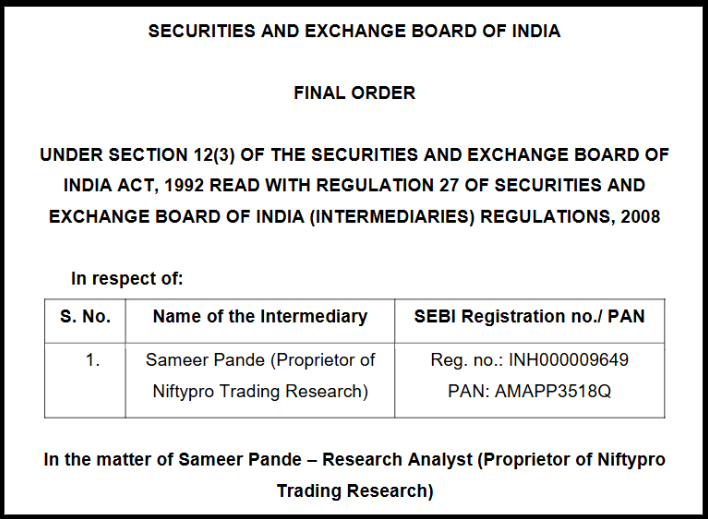
Two formal regulatory actions followed: a monetary penalty of ₹2,00,000 via Adjudication Order in December 2024, and a Regulatory Censure via Final Order in May 2025 (Order Reference: WTM/AN/MIRSD/MIRSD-SEC-6/31402/2025-26).
Here is every violation SEBI confirmed, one by one:
Violation 1: Claiming “90% Accuracy” in Intraday Calls
Niftypro’s website displayed a prominent claim: “We maintain up to 90% accuracy in intraday calls in all segments.”
SEBI’s Advertisement Circular (SEBI/HO/MIRSD/MIRSD-PoD-2/P/CIR/2023/51, April 2023) under Clause C(x) categorically prohibits Research Analysts from making any accuracy-based or performance-based representations in any marketing material.

Claiming a near-perfect accuracy rate creates an entirely unrealistic expectation.
It implies to investors that market outcomes can be reliably predicted at a 90% rate, which is misleading by definition, and a direct violation of the rules every registered RA must follow. SEBI confirmed this violation and held it as a breach of the Advertisement Circular.
Violation 2: Guaranteed Daily Profit Promises by Sales Representatives
SEBI’s inspection found that Niftypro’s sales staff were making specific, quantified income guarantees to potential clients during sales calls.
Representatives assured prospects that a capital of ₹50,000 would generate between ₹8,000 and ₹10,000 in daily profits, and that subscription fees could be fully recovered within just 2 to 3 trading days.
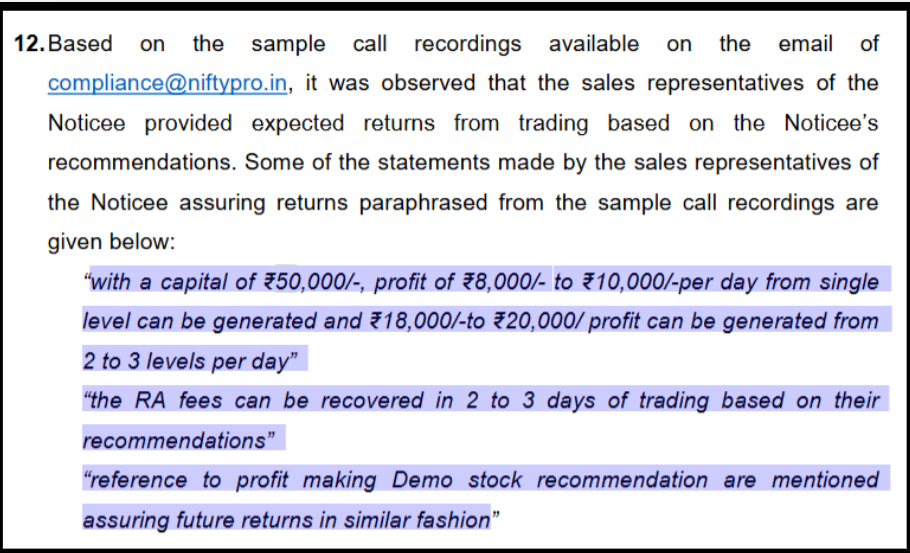
These Nifty Pro guaranteed profit claims were not isolated slips by overzealous sales staff.
SEBI found them to be a consistent and deliberate pattern of inducement, violating Regulations 3(a), (b), (c), and (d) and Regulations 4(1), 4(2)(k), (o), and (s) of the PFUTP Regulations, 2003, as well as Sections 12A(a), (b), and (c) of the SEBI Act, 1992.
Violation 3: Superlative and Prohibited Marketing Language
Niftypro’s promotional content used phrases like “Best Market Tips” and “accurate” in ways that implied guaranteed superiority over other advisory services in the market.
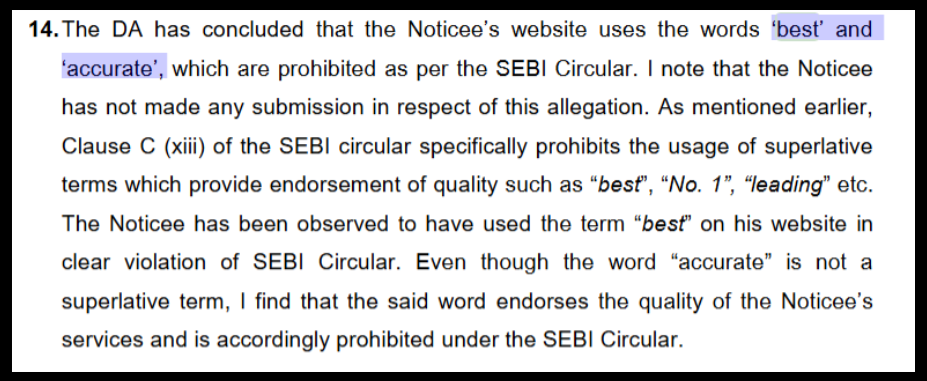
SEBI’s regulations specifically prohibit this type of language because it creates a false impression that the service has a demonstrably better and more reliable track record than it can legitimately claim.
This violated Clauses 1, 2, 6, 7, and 8 of the Code of Conduct specified under Regulation 24(2) of the Research Analyst Regulations, 2014.
Violation 4: Deceptive Client Testimonials Without Adequate Disclaimers
Niftypro’s website featured client testimonials portraying consistent high returns and “unexpected” profits, including one referencing a specific client by name.

These testimonials, displayed alongside the other misleading claims on the site and backed only by a small footer disclaimer, contributed to an overall deceptive impression: that subscribing would yield reliable, repeatable gains.
SEBI found that a single buried disclaimer at the bottom of a page is not adequate context for the misleading statements placed prominently throughout the rest of the site.
This violated Clause C of the SEBI Advertisement Circular.
Violation 5: Enticing Clients with Promises of High and Quick Returns
SEBI’s Final Order in May 2025 addressed the broader pattern of conduct.
The Whole-time Member observed: “Irrespective of the terminology used by Mr. Pande, the RA’s conduct clearly reflects an attempt to entice clients with the promise of high and quick returns, implying assured returns on availing its services, when he knew that the same were misleading.”
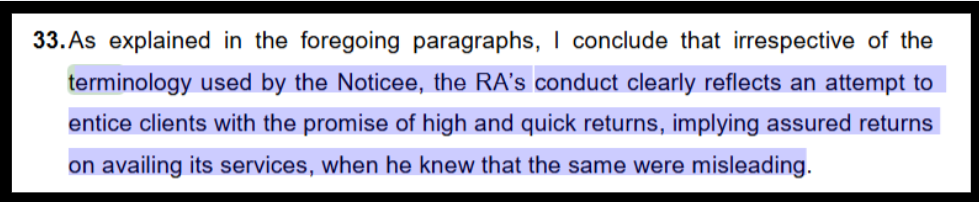
Critically, SEBI made clear that even where misleading communications occurred through internal documents like lead generation sheets, rather than public advertising, they still constituted mis-selling and inducement under the PFUTP Regulations.
The presence of a disclaimer elsewhere in the interaction does not cancel a misleading promise made in the same conversation.
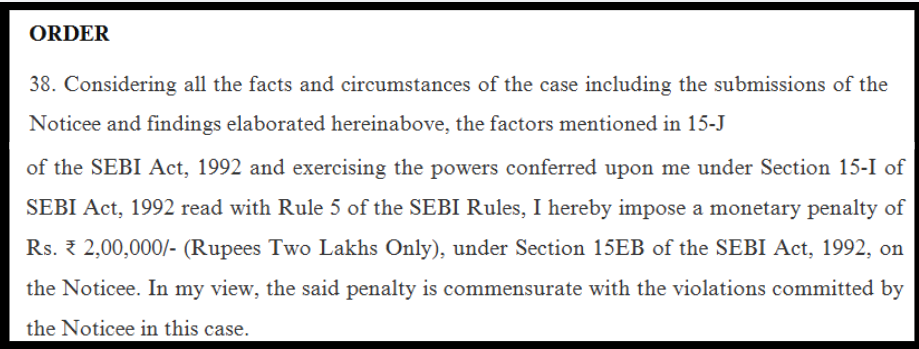
Adjudication Order Penalty (December 2024): ₹2,00,000 under Section 15EB of the SEBI Act, 1992.
SEBI’s Adjudicating Officer noted that Sameer Pande, as a registered RA, had failed in his fiduciary duties to clients and had not complied with the Code of Conduct under the RA Regulations.
SEBI applied proportionality, noting that Sameer Pande had already paid the penalty, removed the violative website content, and instructed sales staff to stop using return-based language.
The censure, however, now forms part of the permanent public record that any investor can access. And for anyone still wondering should you trust Nifty Pro, this record is the most honest answer available.
Two enforcement actions, five confirmed violations, and a pattern of conduct that SEBI described as a deliberate attempt to mislead clients is not a minor compliance slip.
It is a documented history that every prospective subscriber deserves to read before making a decision.
The regulatory orders document what SEBI found at the institutional level. What happened to one investor who lived through it and chose to fight back is a story worth knowing in full.
Also Read: Parekh Jaykumar Bipinchandra, another RA with a ₹55,020 profit claim on its Telegram channel combined with promotional language on website.
Sameer Pande Arbitration Case
Case Reference: Arbitration No. NSE-RA-2024-12-229923
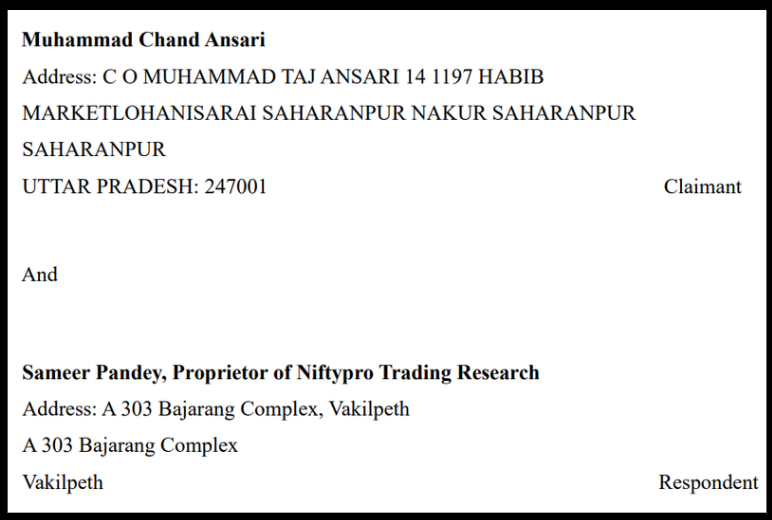
- Forum: CORD (Centre for Online Resolution of Disputes), empanelled by NSE via the SEBI SMART ODR framework
- Sole Arbitrator: Amar Sinha, Retired District Judge
- Hearing Date: 24 March 2025
- Award Date: 29 April 2025
“The respondent company violated the provisions of the Rules and Regulations of SEBI and is liable to return the disputed amount of ₹4,65,000 to the claimant with interest,” said Arbitrator Amar Sinha, 29 April 2025
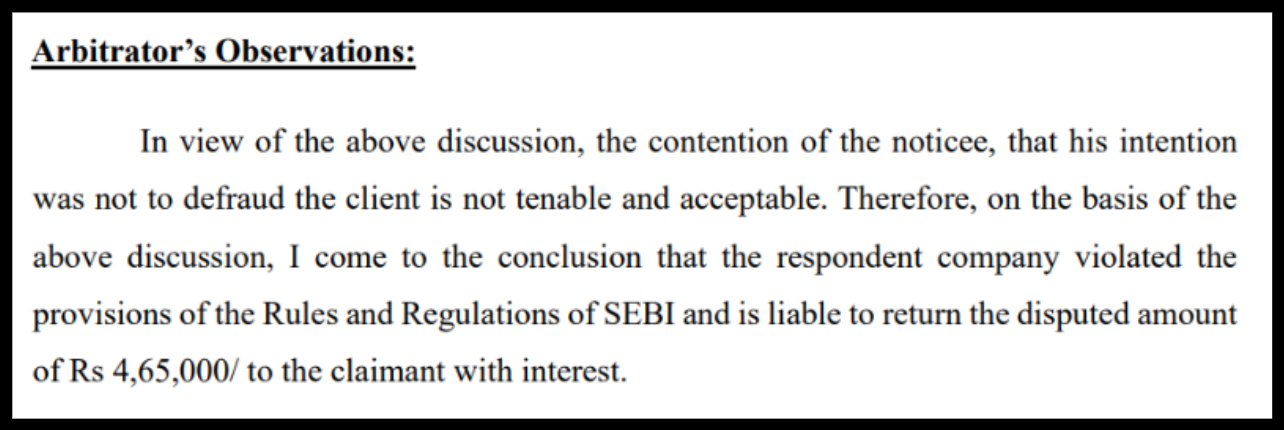
Arbitral Award: ₹4,65,000 to be paid within one month of the award date.
Failure to pay within the stipulated period attracts 15% annual interest until the full amount is recovered. Arbitration costs to be borne independently by each party.
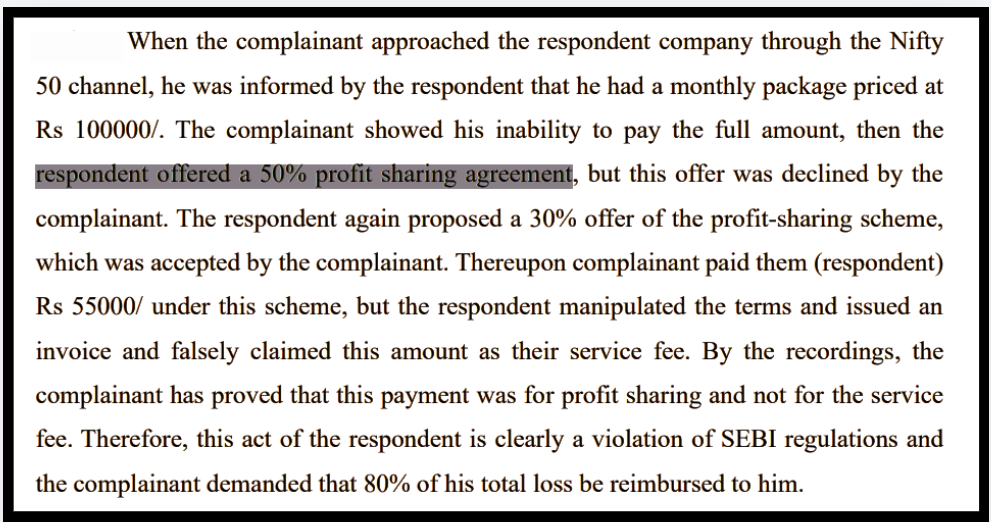
Chand’s case demonstrates something that every investor facing a similar situation needs to hear: the system works when you document everything, record conversations where legally permitted, and follow the escalation path without giving up.
A signed consent form is not a blank cheque for the firm, and an audio recording of a profit-sharing promise carries real weight in arbitration.
How to File a Complaint Against Sameer Pande?
Since Sameer Pande is a SEBI-registered Research Analyst, you have a formal, legally structured path available to you.
Follow these steps in order:
- Collect and organise your evidence first: Save all payment receipts, bank transfer records, Telegram screenshots, call recordings, trade histories, and any profit guarantees made verbally or in writing. A well-organised, date-ordered evidence file moves significantly faster through every channel below.
- Send a formal written complaint to Niftypro directly: Give the firm around 21 days to respond. If the matter is resolved satisfactorily, document it. If it is not, the non-response itself becomes part of your escalation case.
- File a Complaint with SCORES: Visit scores.sebi.gov.in, select “Research Analyst” as the intermediary type, and enter registration number. Describe the specific violation clearly, not just the loss, but the conduct that caused it. Attach all supporting documents.
- Register a Complaint in SMART ODR: If SCORES does not produce a resolution, move to SEBI’s SMART ODR platform, the same framework through which the Chand Ansari arbitration was conducted. This is a regulator-supervised conciliation process that does not require legal representation to begin.
- Share Market Arbitration: If earlier steps fail, file for formal arbitration, where an independent panel reviews the evidence and issues a legally binding award.
Need Help?
Knowing the steps is one thing. Building a case that actually gets results at every stage is another.
We help investors structure their evidence, draft precise SEBI SCORES complaints, navigate SMART ODR conciliation, and prepare full arbitration submissions from start to finish.
You do not have to navigate this alone. Register with us. The right support at the right time can completely change the outcome of your case.
Conclusion
The case of Sameer Pande Research Analyst is not just about regulatory penalties; it is about understanding the gap that can exist between what a SEBI-registered advisory service is permitted to promise and what it actually delivers on the ground.
Two SEBI orders, a ₹2 lakh monetary penalty in December 2024 and a formal regulatory censure in May 2025, confirm that the violations were real, systematic, and documented across multiple regulatory provisions.
The arbitration award of ₹4,65,000 with 15% annual interest demonstrates that an investor who followed the right process and documented the right evidence was able to recover what was taken.
The four investor reviews carry the same message in personal terms: early profits to establish trust, consistent losses once committed, financial pressure to keep paying, and a firm that changed its story the moment it was held to account.
For traders, the lesson is not to distrust every advisory service. It is to verify before subscribing, check SEBI’s enforcement database, never accept guaranteed return promises at face value, and document every interaction from the very first call.
The market will always carry risk. But being informed, knowing your rights, and understanding how the system can protect you when things go wrong, that is what separates a prepared investor from a vulnerable one.





 Add us as a preferred source on Google »

