

Have you ever received calls promoting Nifty Pro guaranteed profit claims with promises of earning ₹8,000–₹10,000 daily from just ₹50,000?
In the case of Nifty Pro Trading Research, a SEBI-registered Research Analyst, that exact promise was at the centre of two separate SEBI enforcement actions and a formal arbitration proceeding that resulted in a binding award against the firm.
Before making any judgment, it is worth understanding something clearly: disputes involving SEBI-registered entities are not always about whether every trade went wrong.
Often, the issue is whether the promises made to investors before they subscribed were legal in the first place.
In this blog, we look at the nifty pro guaranteed profit claims that investors reported, what SEBI found during its inspection, how one investor fought back through arbitration and won, and what every trader can take away from this case.
Nifty Pro Review
Sameer Pande operates Nifty Pro Trading Research. He holds SEBI Research Analyst registration number INH000009649 with an active regulatory status.
The firm is based in Nagpur, Maharashtra, and delivers stock market research alerts and recommendations through Telegram, email, and phone.
Packages range from basic to premium tiers, going up to ₹15,000 annually, with the usual disclaimers about market risk included.

At first glance, the firm appears similar to many SEBI-registered Research Analysts operating in the market today.
The company maintains a website, publishes disclosure documents, and displays an investor charter following standard SEBI requirements.
Before SEBI conducted inspections, several investors had already started sharing their experiences across online review platforms and forums.
Many of those complaints highlighted one recurring issue: strong profit promises that investors later claimed did not match reality.
As complaints increased, regulators began reviewing the firm’s advertisements, marketing methods, and profit-related representations more closely.
Niftypro SEBI Order
SEBI conducted an inspection of Nifty Pro Trading Research covering the period from May 2022 to January 2024.
The inspection reportedly examined the firm’s advertisements, client communication practices, and promotional claims.
According to SEBI’s findings, the regulator observed several instances of misleading promotional conduct and inducement-oriented marketing.
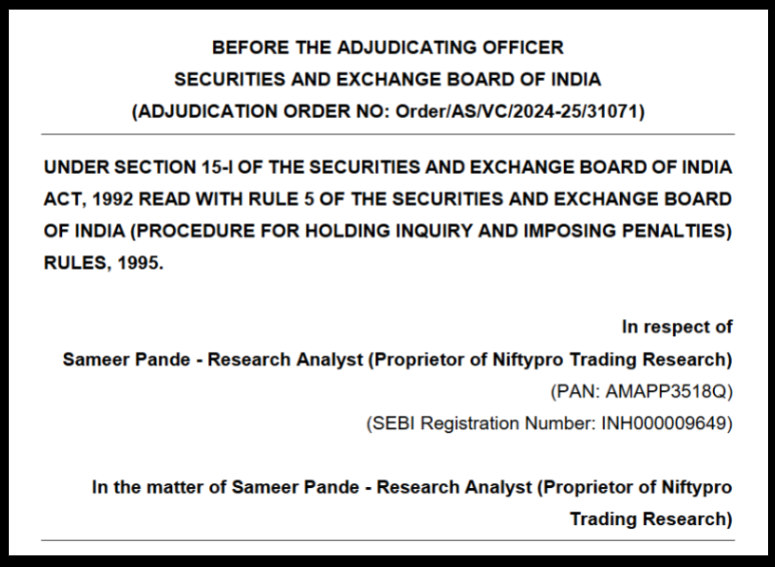
SEBI identified several misleading marketing claims used by the firm to attract retail investors and traders. The company promoted phrases like “up to 90% accuracy” and “Best Market Tips” in its advertisements and campaigns.
The firm also showcased testimonials that suggested users earned regular and consistent profits from the recommendations provided.
Sales executives allegedly told investors they could earn ₹8,000–₹10,000 daily with a capital of only ₹50,000.
Representatives further claimed that traders could recover subscription fees within a few trading sessions through their market calls.
SEBI stated that these statements created unrealistic profit expectations among investors and inexperienced market participants.
The regulator observed that such conduct violated Research Analyst Regulations as well as PFUTP Regulations governing fair practices.
SEBI also clarified that website disclaimers cannot neutralize direct profit assurances made during promotional sales conversations.
1. Claiming “90% Accuracy”
The Nifty Pro website stated: “We maintain upto 90% accuracy in intraday calls in all segments.”
SEBI’s Advertisement Code for Research Analysts, under Clause C(x), explicitly bans the use of specific accuracy percentages in any promotional material.
Claiming accuracy rates implies guaranteed performance, which no RA can legitimately promise.

Such statements can create unrealistic expectations for retail investors and influence them to subscribe based on perceived certainty of profits.
SEBI considered these types of claims misleading because market outcomes are inherently uncertain and cannot be predicted with fixed accuracy levels.
2. Promising Specific Daily Profits
Sales representatives of Nifty Pro verbally assured clients that a capital of ₹50,000 could generate daily returns of ₹8,000 to ₹10,000. They also told clients that advisory fees could be fully recovered in just 2-3 trading days.
These are not projections; they are promises, and promising specific returns is a direct violation of SEBI’s Prohibition of Fraudulent and Unfair Trade Practices (PFUTP) Regulations.
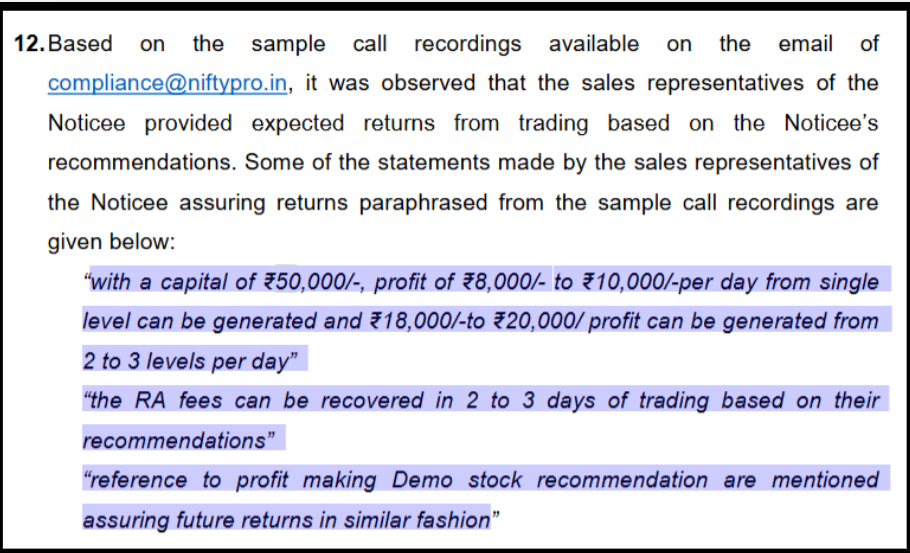
Such statements can create unrealistic expectations and push investors into taking high-risk decisions under the impression of “assured” income.
SEBI considers this kind of profit-linked marketing misleading because no Research Analyst can legally guarantee fixed returns in the stock market.
3. Using Misleading Testimonials
Client testimonials on the website portrayed consistent, large-scale gains. SEBI found these to be deceptive.
They created the impression of guaranteed success in a market where no outcome is ever certain.
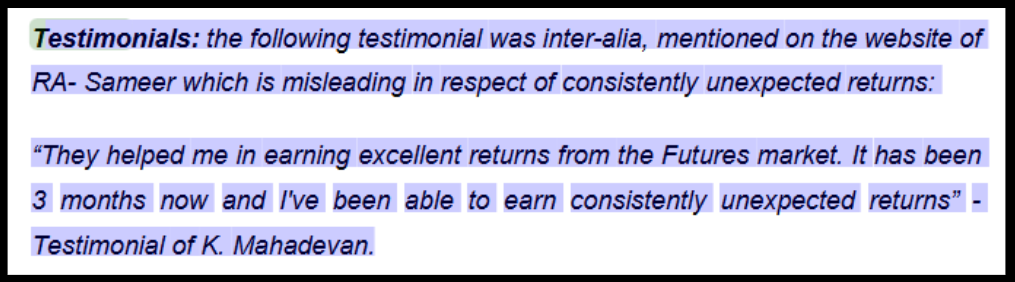
SEBI also observed that such testimonials can heavily influence retail investors by creating unrealistic expectations about profits and trading success.
Without proper context, risk disclosure, or balanced representation of losses, these testimonials may mislead investors into making decisions based on emotion rather than informed judgment.
4. Superlative and Performance-Based Language
Phrases like “Best Market Tips” and “accurate intraday calls” appeared across marketing materials.
SEBI prohibits such language for RAs because it implies either guaranteed outcomes or superiority over other market participants, neither of which any honest analyst can claim.
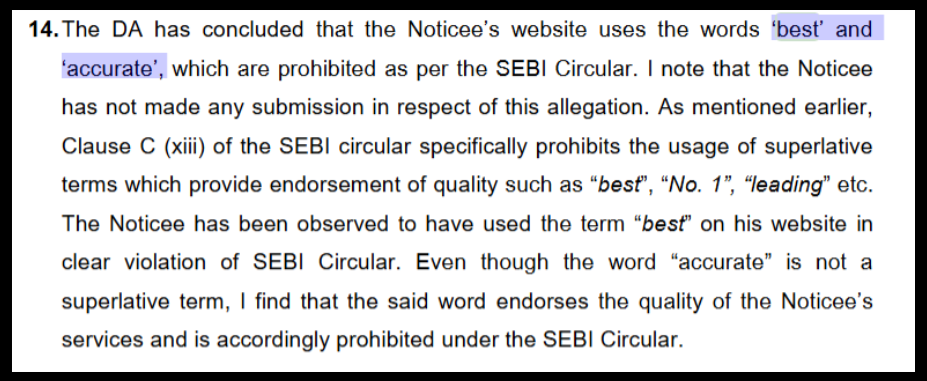
Such wording can heavily influence retail investors by creating unrealistic confidence in the service.
SEBI considers these claims misleading because market outcomes are uncertain, and no Research Analyst can legally or ethically promise consistent accuracy or superior performance.
SEBI Penalty on Nifty Pro
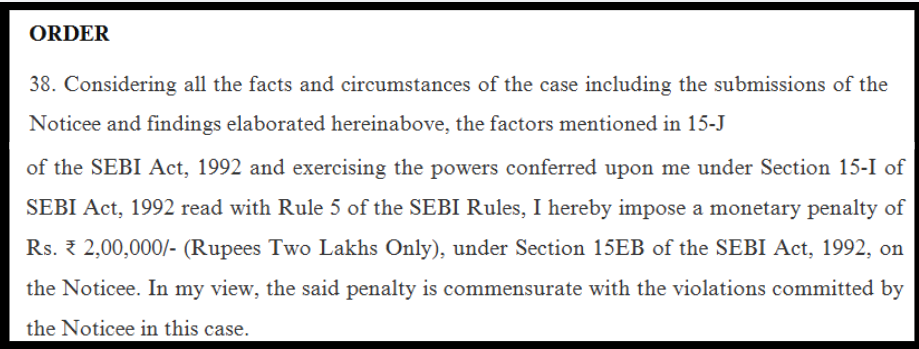
As part of the enforcement action:
- A monetary penalty of ₹2 lakh was imposed in December 2024.
- In May 2025, SEBI issued a formal censure after confirming violations related to misleading advertisements, inducement, and failure to maintain proper standards of conduct.
- SEBI noted breaches of multiple PFUTP provisions, the SEBI Act, and the Research Analyst Code of Conduct.
Nifty Pro Arbitration Case Against Guaranteed Profit Claims
The regulatory findings were later reflected in a real investor arbitration case: Muhammad Chand Ansari vs. Sameer Pandey, Proprietor of Nifty Pro Trading Research.
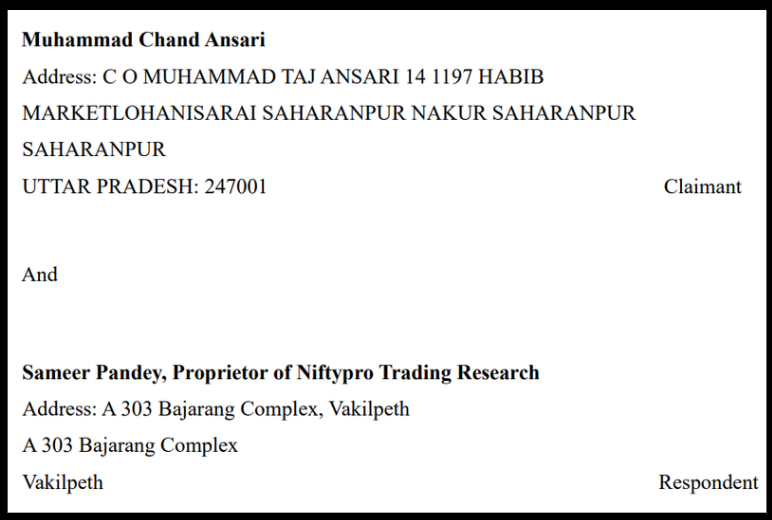
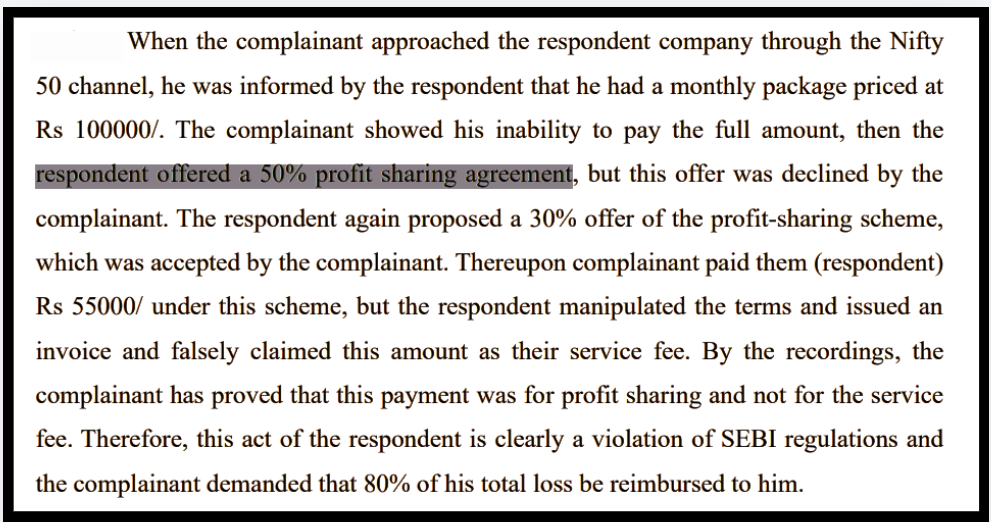
Chand Ansari said Nifty Pro representatives contacted him through the firm’s Telegram channel with a ₹1 lakh monthly package.
After he refused due to affordability concerns, the firm allegedly proposed a different payment structure for advisory services.
According to his statement, he paid ₹55,000 upfront and agreed to share 30% of future trading profits.
This arrangement later became an important point during the proceedings and attracted regulatory attention from SEBI authorities.
SEBI regulations prohibit Research Analysts from using profit-sharing models or offering services linked directly to trading profits.
Such structures can influence objectivity and encourage advisors to use aggressive or inducement-based marketing practices with clients.
Chand followed the calls provided by the firm and claimed the trades came without proper stop-loss guidance. Eventually, he suffered losses amounting to ₹4.65 lakh.
When he later questioned the arrangement, the firm reportedly changed its stance and claimed the ₹55,000 was merely a non-refundable service fee.
However, Chand had preserved audio recordings of the original conversations. During arbitration, those recordings were examined alongside SEBI’s earlier findings against Nifty Pro.
Arbitration Award
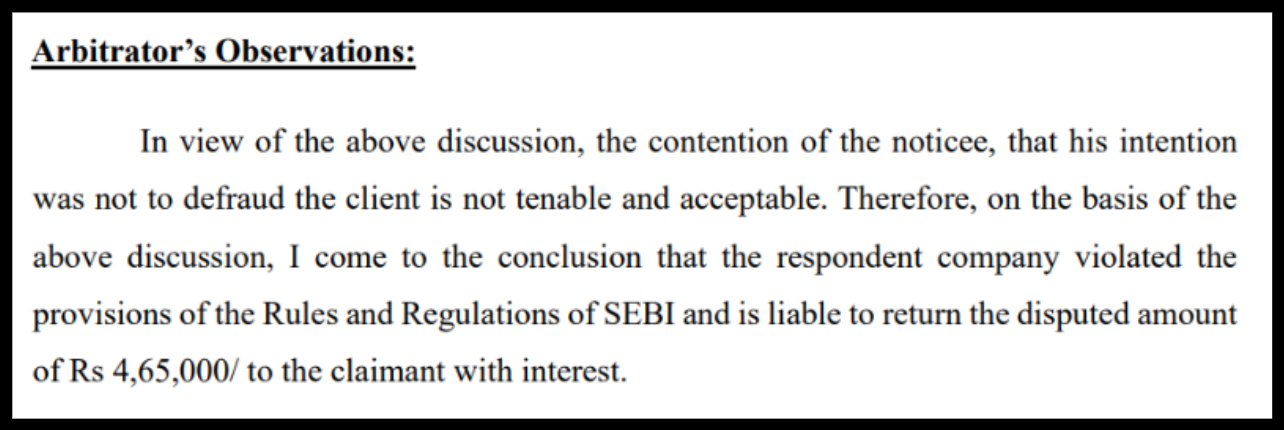
The arbitrator concluded that the profit-sharing arrangement had indeed been offered and that the firm had violated SEBI regulations.
On April 29, 2025, the Sole Arbitrator directed the respondent to refund ₹4.65 lakh to the claimant, with 15% annual interest applicable in case of delayed payment.
The case became a significant example of how guaranteed-profit style pitches and profit-sharing promises can later become strong evidence against a Research Analyst in formal proceedings.
Nifty Pro Reviews
Before looking at SEBI’s findings, it’s important to understand what actual users have been reporting online.
Multiple investor reviews describe similar experiences involving profit claims, package upgrades, and significant trading losses.
1. Guaranteed Profit Claims and Forced Package Upgrades
Ajay’s review captures two violations in one paragraph.
First: the firm explicitly guaranteed returns in exchange for the subscription fee paid, which is a direct breach of SEBI RA regulations.
Second: subscription packages auto-upgraded from premium to higher-premium tiers without any client consultation, leading to him paying around ₹60,000 in subscription fees.
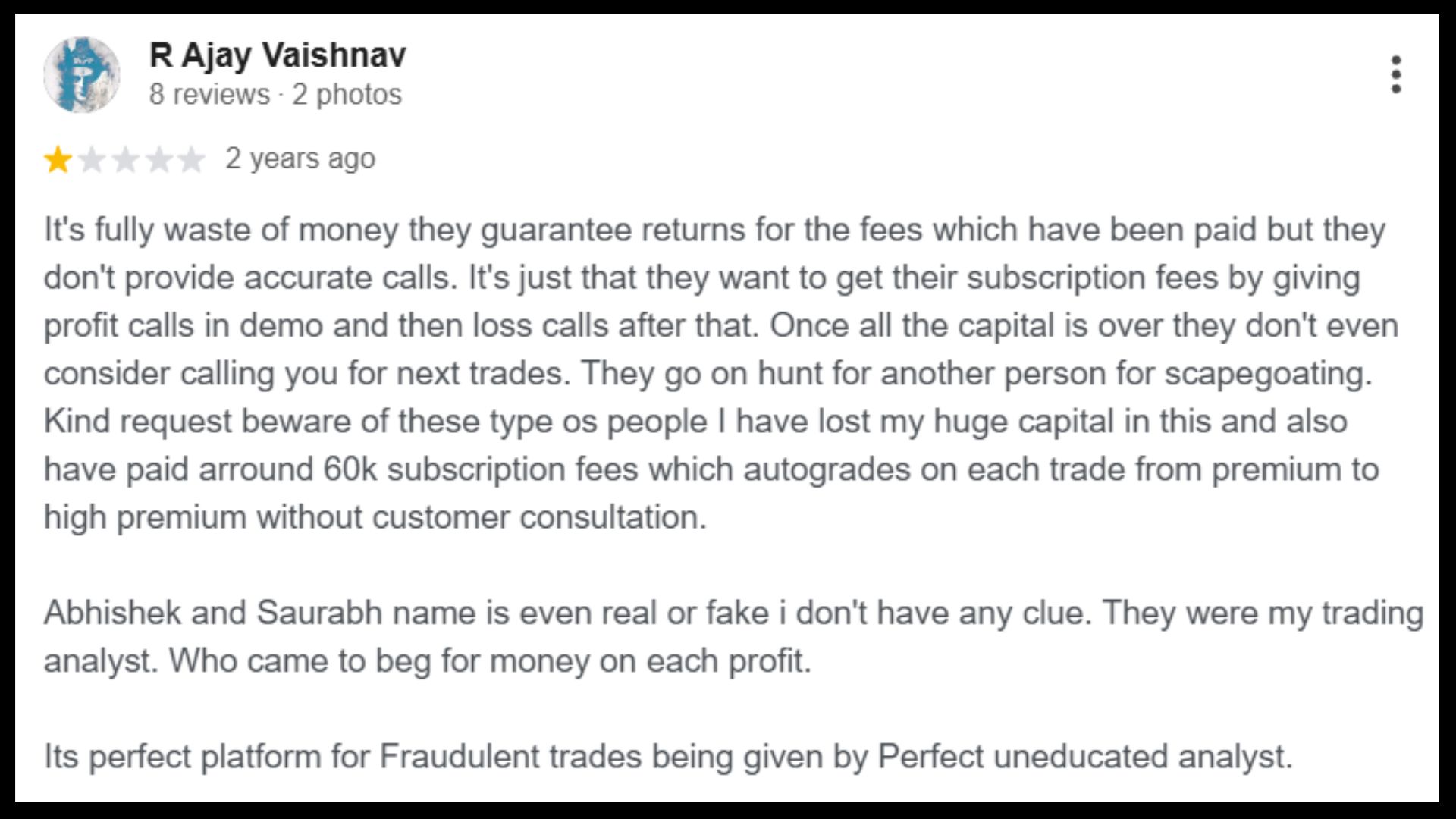
He also names his trading analysts, Abhishek and Saurabh, and questions whether they were even genuine. His closing line says it plainly: a platform for fraudulent trades run by uneducated analysts.
When a firm auto-upgrades paid packages without consent and then disappears once capital is wiped out, the red flags are impossible to ignore.
2. Early Profits Used to Build Investor Trust
User describes a calculated sequence: start with one or two profitable trades to build confidence, then push the investor to commit larger capital, at which point the losses begin.
This is not just a bad experience with volatile markets. It is a structured approach designed to exploit trust.
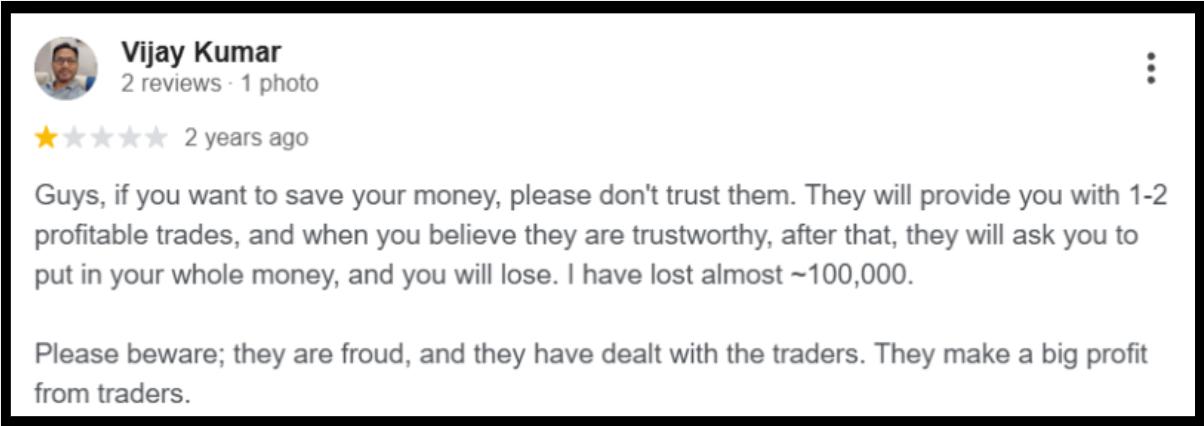
ent advice and risk disclosure, something beyond poor market timing is happening.
Vijay’s loss of approximately ₹1,00,000 is the direct financial cost of trusting that manufactured credibility.
These are not isolated incidents. They describe a consistent pattern, and that pattern is exactly what SEBI’s own inspection confirmed.
What Investors Must Keep in Mind?
The Nifty Pro case, taken together across the reviews, SEBI orders, and arbitration award, delivers a few lessons that apply to every investor engaging any research analyst service.
- SEBI registration is not a performance guarantee: Sameer Pande held a valid RA registration throughout the period these violations occurred. Registration confirms regulatory existence, not ethical conduct.
- Any promise of specific daily profits is illegal: No SEBI-registered RA can legally tell you how much money you will make per day. If they do, that statement alone is a violation.
- Profit-sharing arrangements are banned for RAs: SEBI prohibits research analysts from charging profit-sharing fees or linking payments directly to your trading performance. Avoid any analyst who promises to earn only after generating profits in your account.
- Demo trades and early profitable calls can be trust-building tactics: As both Vijay Kumar and R Ajay Vaishnav described, the pattern of a few early profits followed by pressure to invest more is a structured approach, not market luck.
- Record every conversation: Audio recordings of verbal promises were the deciding factor in the arbitration case. If someone makes you a promise over the phone, that recording is your evidence.
- Auto-upgraded subscriptions raise serious concerns: Ajay Vaishnav reported subscription fees increasing to ₹60,000 without prior consultation or approval. Investors should question such fee practices immediately. Traders must document every payment change and communication from the very beginning.
- Check SEBI SCORES before engaging: Searching a firm’s registration number on the SEBI website takes two minutes and gives you a real-time view of any pending regulatory concerns.
How to File a Complaint Against Nifty Pro?
Since Nifty Pro Trading Research is a SEBI-registered Research Analyst under registration number, SEBI has direct regulatory authority over its conduct.
That is actually good news for investors; it means the formal channels are clearly defined and accessible.
Step 1: Gather Your Documentation First
Before going anywhere, collect everything: payment receipts, invoices, call recordings, WhatsApp messages, Telegram screenshots, subscription confirmations, and any promises made in writing or verbally on the call.
The strength of your complaint is directly proportional to the quality of your evidence.
Step 2: Send a Written Complaint to the Firm
Draft a formal email to Nifty Pro’s grievance officer outlining the specific issue, whether it is a guaranteed return claim, a profit-sharing arrangement, misleading advice, or excessive subscription charges.
Give them 21 days to respond and document the date you sent it.
Step 3: File a Complaint with SCORES
File a detailed complaint citing the specific violations. Mention any guaranteed profit claims or profit-sharing arrangements explicitly; these are regulatory violations, not just service disputes.
Attach all supporting documents. SEBI’s prior enforcement action against this firm means your complaint arrives in a context regulators are already familiar with.
Step 4: Register a Complaint with Smart ODR
If SCORES does not resolve the matter, move to SEBI’s Smart ODR portal. CORD, empanelled by NSE, handles conciliation first.
This is a legally structured process that produces binding outcomes.
Step 5: Stock Market Arbitration
Formal arbitration through the Smart ODR framework results in a binding award.
The process works when the evidence is strong and the claim is well-prepared.
Need Help?
Navigating SEBI SCORES and Smart ODR alone can feel overwhelming, especially when you are also dealing with financial losses.
If you need help building your complaint, identifying the right violations to cite, or preparing for arbitration, registering with a professional who specialises in investor grievance cases is the most effective first step.
Register with us, your case is assessed confidentially, and every step is guided from documentation through to final resolution.
Conclusion
Nifty Pro Trading Research is a SEBI-registered Research Analyst. That fact is not in dispute.
What is also not in dispute is that SEBI found the firm claiming 90% accuracy, promising specific daily profits through its sales team, using misleading testimonials, and applying prohibited marketing language, all of which resulted in a ₹2 lakh penalty in December 2024 and a regulatory censure in May 2025.
Several investors lost more than ₹1,00,000 after advisors first showed small profitable trades and later demanded larger investments.
One investor accepted a profit-sharing arrangement, lost ₹4,65,000, and recovered the amount only after lengthy arbitration proceedings.
The nifty pro guaranteed profit claims that ran across websites, Telegram channels, and sales calls were not aggressive marketing. There were regulatory violations. And they caused real financial harm to real investors.
For every trader, the lesson is consistent: no registered RA can legally promise you daily profits, guarantee specific returns, or enter a profit-sharing arrangement with you.
When someone does, regardless of their SEBI registration number, that promise is not a feature of the service. It is a breach of the rules designed to protect you.
If something has already gone wrong, the formal channels exist, and as this case shows, they can deliver results.





 Add us as a preferred source on Google »

