

Have you ever subscribed to a stock market advisory, trusted their tips completely, and then realised, too late, that the promises they made were never legal to begin with?
It is a situation thousands of retail traders across India find themselves in. The service looks credible. The website has disclaimers. The registration is real. But somewhere between the sales call and the trading account, something went very wrong.
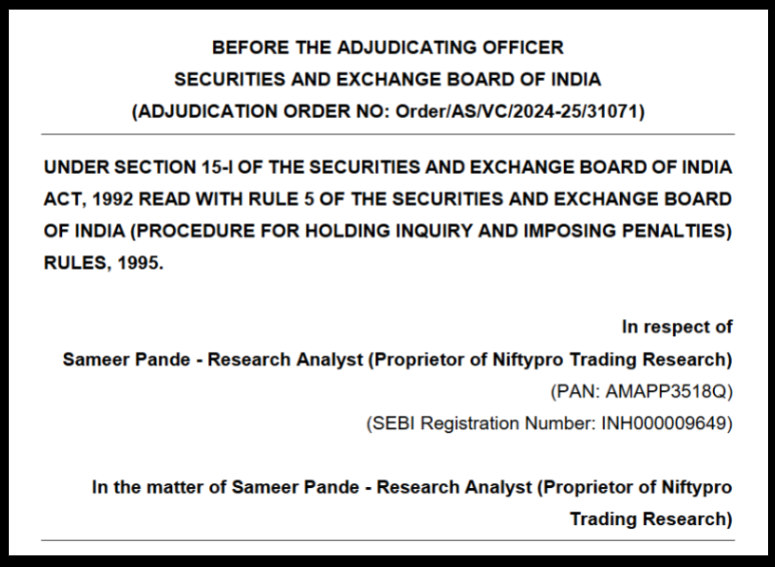
That is exactly what the Niftypro SEBI Order uncovered when it conducted a formal thematic inspection of Nifty Pro, the Nagpur-based advisory firm run by Sameer Pande research analyst.
The inspection covered 20 months of the firm’s operations. What SEBI found resulted in a formal Adjudication Order and a Final Order with a regulatory censure.
In this blog, we walk through every violation SEBI confirmed, the exact penalties imposed, the arbitration award, what retail investors can take away from this, and the steps to file a complaint if you have been affected.
Niftypro Trading Research SEBI Order
SEBI’s thematic inspection of Niftypro Trading Research covered the period 24 May 2022 to 31 January 2024, a 20-month window that examined the firm’s website content, Telegram communications, internal call recordings, lead generation records, and direct client communications.
What the inspection revealed was not a one-off compliance oversight. It was a consistent pattern of misleading conduct directed at retail investors, touching multiple regulations simultaneously.
The findings resulted in a formal Show Cause Notice, followed by a Monetary Penalty Order in December 2024 and a Final Order (Regulatory Censure) in May 2025.
Here is every violation SEBI confirmed, one by one:
Violation 1: Claiming “90% Accuracy” in Intraday Calls
Niftypro’s website prominently stated: “We maintain up to 90% accuracy in intraday calls in all segments.”
SEBI’s Advertisement Circular (SEBI/HO/MIRSD/MIRSD-PoD-2/P/CIR/2023/51, April 2023) under Clause C(x) categorically prohibits Research Analysts from making accuracy-based or performance-based representations in any marketing material whatsoever.

Claiming a near-perfect accuracy rate tells an investor that market outcomes can be reliably predicted. which is not only impossible to guarantee, but is a direct misrepresentation of how financial markets work.
Any investor who subscribed based on this claim was acting on misleading information from the very start.
SEBI confirmed this as a clear violation of the Advertisement Circular.
Violation 2: Daily Profit Guarantees by Sales Representatives
SEBI’s inspection revealed that Niftypro’s sales staff were making specific, quantified profit guarantees to potential clients during telephone calls.
Representatives were telling prospects that a capital of ₹50,000 would generate ₹8,000 to ₹10,000 in daily profits, and that subscription fees could be fully recovered within 2 to 3 trading days.
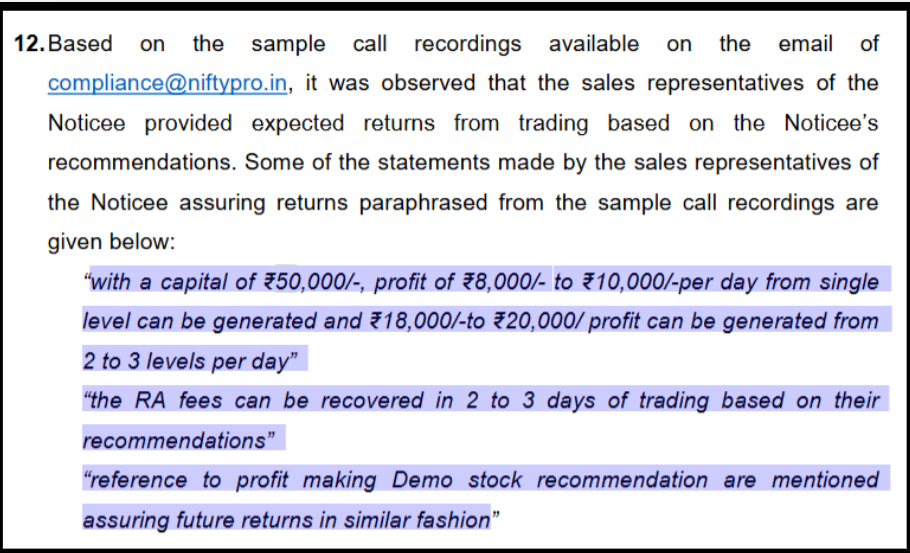
These were not vague encouragements. They were definitive, numeric assurances designed to convert a prospective lead into a paying subscriber.
SEBI classified this as inducement, a prohibited practice under Regulations 3(a), (b), (c), and (d) and Regulations 4(1), 4(2)(k), (o), and (s) of the PFUTP Regulations, 2003, and Sections 12A(a), (b), and (c) of the SEBI Act, 1992.
Guaranteeing daily returns in any form is not research advisory. It is a fraudulent inducement under the law.
Violation 3: Prohibited Superlative Marketing Language
Niftypro’s promotional materials used terms like “Best Market Tips” and described its services as “accurate” in a way that implied guaranteed superiority over every other advisory service available to investors.
SEBI’s regulations specifically prohibit superlative and comparative language in RA advertising.
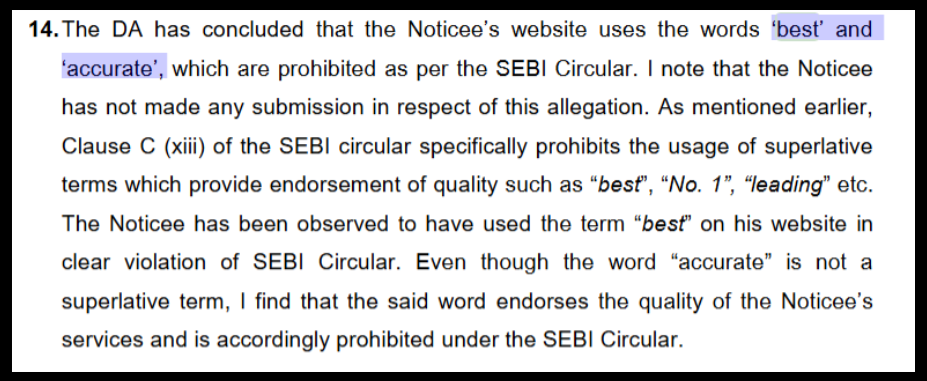
The reason is straightforward: when a firm claims to be the “best,” it creates a false impression that its service has a demonstrably superior track record, something it cannot legally claim or substantiate.
This violated Clauses 1, 2, 6, 7, and 8 of the Code of Conduct specified under Regulation 24(2) of the Research Analyst Regulations, 2014.
Violation 4: Deceptive Client Testimonials
Niftypro’s website featured client testimonials that portrayed consistent high returns and “unexpected” profits. One such testimonial referenced a specific client by name and was framed in a way that gave the overall impression of reliable, repeatable gains.
SEBI found that the presence of only a small footer disclaimer was wholly inadequate context for the misleading content displayed throughout the rest of the website.
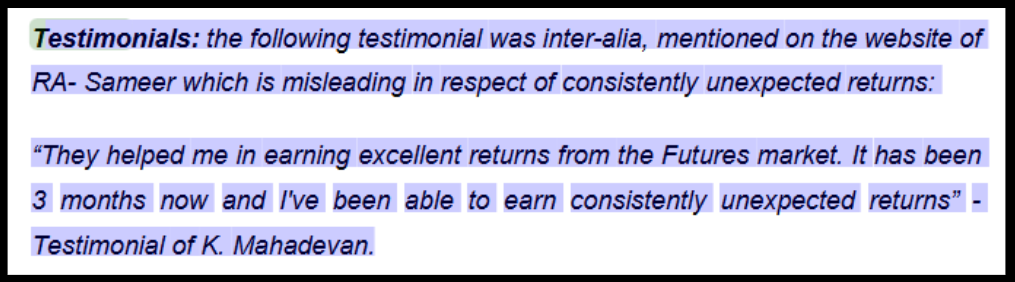
When the testimonials are read alongside the other prohibited claims, the overall impression the website created was deceptive, that subscribing to Niftypro’s services would result in assured, consistent profits.
This violated Clause C of the SEBI Advertisement Circular (SEBI/HO/MIRSD/MIRSD-PoD-2/P/CIR/2023/51).
Total Monetary Penalty (Adjudication Order, December 2024): ₹2,00,000 under Section 15EB of the SEBI Act, 1992.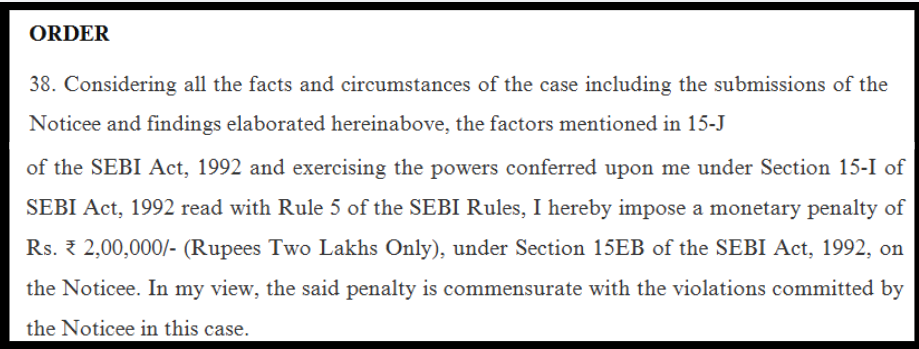
The Adjudicating Officer noted that Sameer Pande, as a registered Research Analyst, had failed in his fiduciary duties to his clients and had not complied with the Code of Conduct prescribed under the RA Regulations.
The monetary penalty was the first order. What followed in May 2025 reinforced the regulatory position and put a permanent mark on the public record.
Niftypro SEBI Final Order
Following the adjudication proceedings, SEBI’s Whole-time Member issued a Final Order on 14 May 2025 under Section 12(3) of the SEBI Act, 1992 (Order Reference: WTM/AN/MIRSD/MIRSD-SEC-6/31402/2025-26).
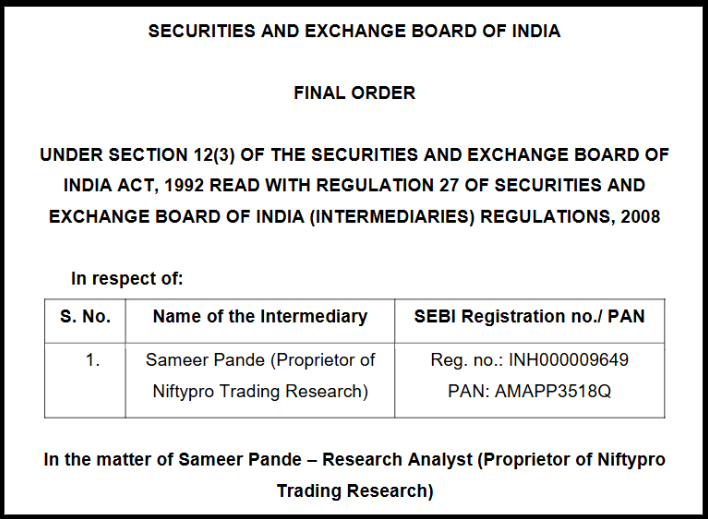
This order examined the full pattern of Niftypro’s conduct and confirmed two additional violations beyond what the adjudication order had already established.
Enticing clients with the promise of high and quick returns: SEBI’s Whole-time Member observed directly: “Irrespective of the terminology used by Mr. Pande, the RA’s conduct clearly reflects an attempt to entice clients with the promise of high and quick returns, implying assured returns on availing its services, when he knew that the same were misleading.”
SEBI also made a critical legal point that every investor should understand: disclaimers placed elsewhere in a communication do not cancel or neutralise misleading promises made within the same interaction.
The fact that a consent form existed did not provide legal cover for the verbal profit guarantees being made to clients during the same sales call.
Even communications made through internal documents like lead generation sheets, not just the public website, were found to constitute mis-selling and inducement under the PFUTP Regulations.
Outcome: Regulatory Censure, a formal, permanent entry on SEBI’s public enforcement database, accessible to any investor who chooses to verify the firm’s regulatory history before subscribing.
Two formal SEBI orders confirmed the violations at an institutional level.
What Retail Investors Can Learn From This?
The Niftypro SEBI Order is not a story about an unregistered, fly-by-night operation. Niftypro holds and continues to hold an active SEBI registration.
They were, by every formal measure, an authorised participant in the advisory ecosystem. That is precisely what makes this case so important for every retail investor to understand.
When you look at these compounding violations, it really makes you stop and think: Should you trust Nifty Pro?
Let’s break down exactly what we can learn from this situation so you can protect your hard-earned money:
- SEBI registration is the starting point of your due diligence, not the end of it: A registered RA can still violate regulations. Always check the firm’s enforcement history on SEBI’s website before subscribing to any service.
- No one can legally guarantee daily returns: If any advisory service, registered or not, tells you that your capital will generate a fixed daily income, or that your subscription fees will be recovered within 2 to 3 trading days, that is a regulatory violation in itself. Walk away.
- Profit-sharing arrangements with RAs are always illegal: If a firm proposes that you pay a percentage of profits in exchange for advisory services, they are operating outside SEBI regulations. That structure exists to exploit clients, not serve them.
- Disclaimers do not cancel misleading promises: SEBI explicitly confirmed in its Final Order that a disclaimer in a consent form or at the bottom of a website does not neutralise misleading statements made in the same sales interaction.
- A demo profit is a sales tool, not a performance preview: Multiple investors described the same pattern: a small demo profit used to build trust, followed by systematic losses once a larger commitment was made. Treat early profits from any advisory service with scepticism, not confidence.
How To Register a Complaint Against Sameer Pande?
If you have subscribed to Niftypro Trading Research and believe you were misled, here is the structured path forward, step by step.
1. Collect All Your Evidence First
Before you do anything else, gather and organise everything:
- Payment receipts and bank transfer records
- Subscription invoices and agreements
- All Telegram messages, WhatsApp chats, and email communications
- Call recordings where profit guarantees or profit-sharing terms were discussed
- A clear timeline: dates of payments, specific promises made, tips received, and losses that followed
A well-organised evidence file is the foundation of every complaint that gets taken seriously at every stage.
2. Send a Formal Written Complaint to the Firm
Write directly to Niftypro Trading Research, clearly stating the specific conduct that harmed you and the resolution you are seeking. Be factual and specific, reference dates, amounts, and what was promised versus what was delivered.
Allow 7 to 10 working days for a written response.
If they respond with denials or deflection, save that as evidence. If they do not respond at all, that non-response is itself part of your escalation case.
3. Lodge a Complaint in SCORES
If the firm does not resolve the matter adequately, escalate to SEBI’s investor grievance portal at scores.sebi.gov.in.
Select “Research Analyst” as the intermediary type and enter the registration number. Describe the specific violation clearly, not just the loss, but the conduct that caused it. Attach all documents.
SEBI SCORES creates a formal regulatory record under your name and is the most important official channel in this process.
4. Lodge a Complaint with SMART ODR
If SCORES does not produce a satisfactory resolution, move your case to SEBI’s SMART ODR platform, the same framework that handled the Chand Ansari dispute.
This enables structured online dispute resolution, including conciliation, and if that fails, formal arbitration, all without lengthy court proceedings and without requiring legal representation to begin.
5. Stock Market Arbitration
For disputes involving fee recovery or compensation for specific trading losses caused by advisory conduct, formal arbitration delivers a binding decision.
The earlier you start, the cleaner your evidence trail will be when it matters most.
Need Help?
Knowing the process is one thing. Building a case that actually gets results at every stage is another.
We help investors structure their evidence, draft precise SEBI SCORES complaints, navigate SMART ODR conciliation, and prepare full arbitration submissions from start to finish.
Register with us. Our team specialises in exactly these cases, and the right support at the right time can completely change the outcome.
Conclusion
The Niftypro SEBI Order is a reminder that SEBI takes compliance obligations seriously, regardless of how long a firm has been operating or how professional its public-facing materials appear.
The violations SEBI confirmed against Sameer Pande were not minor procedural gaps.
Claiming 90% accuracy, guaranteeing daily profits through sales calls, using prohibited superlative language, displaying deceptive testimonials, and entering into illegal profit-sharing arrangements with clients, these represent a sustained pattern of misleading conduct directed at retail investors who trusted a registered analyst.
The ₹2 lakh monetary penalty in December 2024 and the formal regulatory censure in May 2025 placed Niftypro’s violations permanently on SEBI’s public enforcement record.
For retail investors, the lesson is consistent: verify before subscribing, check the enforcement database, never accept guaranteed return promises, and document every interaction from the very first call.
Being SEBI-registered is not a free pass. Compliance is a continuing obligation, and the regulator, as this case shows, does eventually catch up.
Your capital deserves to be protected by more than a registration number and a disclaimer in the footer.





 Add us as a preferred source on Google »

