

Quick Summary
A SEBI registered research analyst is a person or firm that SEBI has authorised to publish stock research and give recommendations for a fee. They clear the NISM Series XV exam, meet SEBI’s eligibility rules, and work under the Research Analysts Regulations, 2014. This guide covers it all in plain language: what the term actually means, how to check whether an analyst is genuinely registered, the eligibility criteria and fees to become one, how Telegram and WhatsApp calls fit the rules, and where to find the official list of registered analysts.
Think of it as your starting point before you trust anyone with a single rupee of your capital.
Every day, someone in India pays for a stock tip. Some of those tips come from qualified, accountable professionals. Many come from people with no licence at all.
The line between the two has a name: SEBI registration.
A SEBI registered research analyst is the only kind of person legally allowed to sell you stock research or public recommendations in India.
This guide walks through what that means, how to verify it, what it costs to become one, and everything else worth knowing before you act on anyone’s advice.
SEBI Registered Research Analyst Meaning
Let us start with the plain meaning, because the term gets used loosely.
A SEBI registered research analyst is a person or entity that the Securities and Exchange Board of India has authorised, under the SEBI (Research Analysts) Regulations, 2014, to provide research services for a fee.
“Research services” means publishing research reports, analysing securities, and issuing buy, sell, or hold recommendations.
Under the current framework, a registered analyst must also be enlisted with a Research Analyst Administration and Supervisory Body, which is BSE.
In simple terms, they are a licensed financial researcher.
They study the market and share their analysis publicly, the same call going to every subscriber, and they answer to a regulator for how they do it.
That accountability is the whole point of registration. Before 2014, anyone could sell stock advice with no rules and no consequences. The regulations changed that.
One distinction matters from the start. A research analyst publishes general research for everyone. They are not the same as an investment adviser, who gives advice built around your personal finances.
That difference decides what an analyst is, and is not, allowed to tell you.
What a Research Analyst Can and Cannot Do?
A research analyst works inside a clearly drawn boundary.
On one side is research, publishing analysis, and general calls for everyone. On the other is anything that touches your personal money or decisions, which belongs to an investment adviser, not an analyst.
Knowing which side a given action falls on is what lets you catch the moment a service quietly steps over the line.
So here is what sits on each side:
- They can publish research and market analysis, issue general buy, sell, or hold calls that go to every subscriber alike, provide entry, target, and stop-loss levels, and charge a subscription within SEBI’s limits.
- They cannot handle your money or operate your trading account, guarantee returns or promise to recover losses, give advice tailored to your personal finances, or take a share of your profits.
The full permitted scope is on our guide to what a SEBI registered research analyst can do, and the conduct rules that bind an analyst are set out in the SEBI guidelines for research analysts.
SEBI Registered Research Analyst Check: How to Verify One?
Before you pay anyone, the single most useful thing you can do is confirm they are actually registered. It takes a few minutes and can save you lakhs.
The good news is that anyone can check research analyst in India independently, using SEBI’s own public records.
You do not need special access, just the analyst’s details and a few minutes.
Start With the INH Registration Number
Every registered analyst has a unique registration number that starts with “INH” followed by nine digits, for example, INH000017550.
That number is the thread you pull on. Ask for it, or find it on the analyst’s website, before you do anything else.
But here is the catch: a number displayed on a website proves nothing on its own.
People fake them, copy real ones, tweak a single digit, or show credentials that have already expired.
The Traps That Catch People
Most investors who get burned did technically “see a registration number.” The problem was how it was used.
A number that is real but belongs to a different entity. A registration that was genuine but has since lapsed. A single digit changed so it looks right at a glance.
Each of these passes a lazy look and fails a proper check.
That is why real verification means going to SEBI’s own records every time, and reading the details there carefully.
Run this check every single time, no matter how professional a service looks.
The ones designed to fool you are always the most professional-looking of all.
SEBI Registered Research Analyst List
SEBI maintains the official, public list of every registered research analyst, and it is the one place a registration can be confirmed beyond doubt.
The list carries each analyst’s name, INH registration number, address, and current validity status.
Because registrations are added, renewed, cancelled, or suspended over time, this official record is always the most accurate source, more reliable than any third-party site or forwarded screenshot.
You can view the full list directly on SEBI’s official website, where you can search by an analyst’s name or registration number and confirm their details in a minute.
Two things worth remembering when you use it. First, always check the current status, not just whether a name appears, since a registration that once existed may since have lapsed or been cancelled.
Second, a name on the list confirms registration, not conduct. Being listed means an analyst is authorised; it does not guarantee they always follow the rules.
How to Read the Official SEBI List?
When you open the list on SEBI’s official site, each registered analyst appears as a block of details. It looks dense at first, but every field tells you something useful, and knowing what to look for turns it into a quick, reliable check.
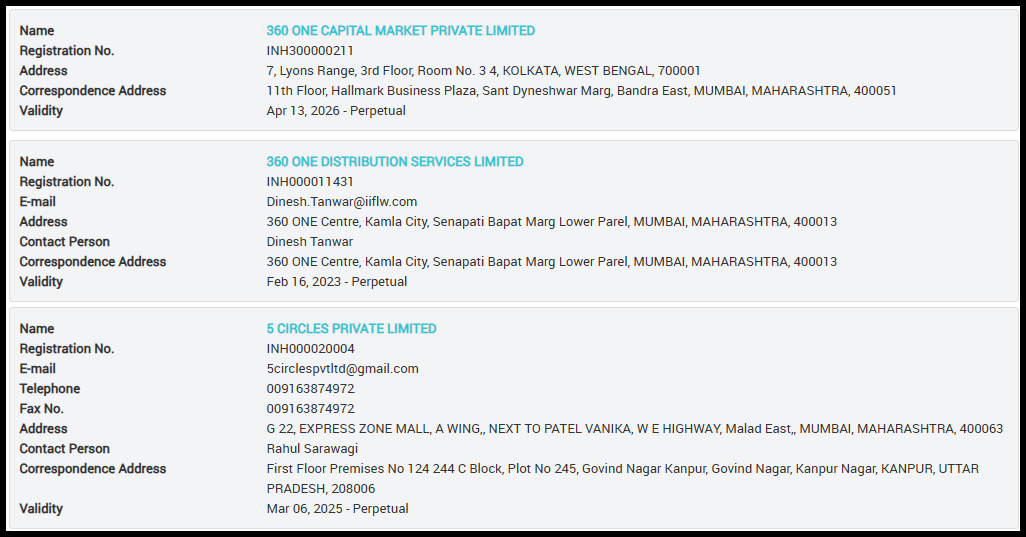
Here is what each field means, using three real entries from the SEBI list.
1. Name
The registered entity’s legal name, for example 360 ONE Capital Market Private Limited, 360 ONE Distribution Services Limited, or 5 Circles Private Limited.
This is the exact name the registration belongs to.
If the service contacting you uses a slightly different name, that mismatch is a warning worth pausing on.
2. Registration No.
The unique INH number, such as INH300000211 for 360 ONE Capital, INH000011431 for 360 ONE Distribution, or INH000020004 for 5 Circles. This is the number you match against whatever the analyst showed you. One changed digit means a different entity, or a fake.
3. Address
The registered office address on record with SEBI. If an analyst’s stated location does not line up with this, ask why.
4. Correspondence Address
The address for official communication, which can differ from the registered office. 5 Circles, for instance, lists a Mumbai office alongside a correspondence address in Kanpur.
A legitimate entity has no problem with these being on record.
5. Contact Person and E-mail
Where listed, the official contact name and email, such as Dinesh Tanwar for 360 ONE Distribution.
Genuine communication should come through the official channel, not a random personal number.
6. Validity
The registration’s start date and status. All three examples show a date followed by “Perpetual,” which means the registration stays valid indefinitely unless SEBI cancels or suspends it.
If you ever see an expired or cancelled status here, that analyst cannot legally operate, and that is your signal to stop.
Reading these fields takes a minute, and it is the difference between trusting a claim and confirming a fact. Whatever an analyst tells you, this is where you check it against SEBI’s own record.
SEBI Registered Research Analyst Eligibility Criteria
A lot of people search this for one of two reasons: they want to become an analyst themselves, or they want to know how hard the registration is to earn before trusting someone who holds it.
Either way, here is the full current picture.
To register as a research analyst with SEBI, an applicant has to meet requirements across three areas: qualification, certification, and the financial and setup conditions.
Here is what each one involves:
1. Educational Qualification
The rules here have recently been relaxed to open the field up.
A graduate degree is now the baseline most applicants work from, and the earlier requirement of several years of experience for non-finance graduates has been eased.
A finance postgraduate degree, or a professional qualification such as CA, CFA, or an MBA in Finance, also qualifies.
Because SEBI has been actively amending these criteria, anyone applying should confirm the exact qualification currently notified on SEBI’s latest circular before starting, since the position has been shifting toward broader eligibility.
2. NISM Series XV Certification
This is the non-negotiable step. Every applicant must clear the NISM Series XV Research Analyst Certification exam, the only certification SEBI recognises for research analyst registration.
The syllabus was revised with effect from January 20, 2026, and now covers Indian securities markets, equity research methods, financial analysis, and SEBI’s rules.
The exam costs ₹1,500 per attempt, and anyone can sit it, graduate, student, or working professional.
The certificate stays valid for three years.
To keep it active, an analyst must renew before expiry, either by retaking NISM Series XV or by clearing the NISM Series XV-B renewal exam.
3. Enlistment, Deposit, and Setup
Before applying to SEBI, an applicant must first enlist with the BSE Administration and Supervision Limited (BASL), which acts as the Research Analyst Administration and Supervisory Body.
SEBI has also replaced the old net-worth certificate with a security deposit system.
Instead of proving a fixed net worth, the applicant keeps a deposit (cash, fixed deposit, or liquid funds) with BASL, and that deposit rises as the client base grows.
Finally, the applicant pays the registration fee, around ₹15,000 plus GST for an individual or partnership firm, and must have the basic infrastructure and record-keeping systems in place before the certificate is granted.
SEBI Registered Research Analyst Fees
“Fees” means two very different things here, so let us split them clearly, because people search this phrase for both reasons.
The fee to become a registered analyst.
To register, an individual or partnership firm pays around ₹15,000 plus GST, while a private limited company or LLP pays around ₹5,50,000 plus GST.
There is also a deposit requirement that scales with client base, along with the NISM exam fee.
The fee an analyst can charge you.
This is the one most investors actually care about.
A registered analyst is capped in what they can charge individual and HUF clients, with strict rules on advance fees, refunds, and payment methods.
Since that second question, what an analyst is allowed to charge you, is where most disputes begin, we cover it in full on our guide: SEBI registered research analyst fees in India.
Are SEBI Registered Research Analyst Telegram Channels Legal?
This comes up constantly, because so many analysts now share calls through Telegram channels and WhatsApp groups.
The honest answer: the medium itself is not the problem. A registered analyst can share research through Telegram or WhatsApp.
What matters is whether the same research goes to every subscriber equally, or whether it becomes personalised advice dressed up as a group message.
A research report broadcast to all subscribers at once can be perfectly fine. But an “exclusive” call tailored to you, or a group that quietly pushes personalised buy-and-sell instructions, crosses into territory a research analyst is not licensed for.
Where that line falls is set out on our page on whether a research analyst can give personalized tips.
So before you join any paid Telegram channel, the same rule applies as everywhere else: check the registration first, and watch how the calls are actually being given.
How a Registered Analyst Sometimes Crosses the Line?
Registration proves an analyst is qualified and accountable.
It does not promise they always behave, and SEBI’s own enforcement record makes that plain.
It helps to know the common ways a registered name slips past the rules, so you can recognise it early.
- Promising returns: No analyst can legally guarantee profit or promise to recover your losses, yet some build their whole pitch on it. SEBI has penalised registered operators for exactly this, and we walk through real orders on our page on whether a research analyst can guarantee returns.
- Running your account. An analyst may research and recommend, but never handle your funds or place your trades. When a “research” service starts operating your account, it has crossed a hard line, covered in full on our page on unauthorized trading by research analysts.
- Trading their own calls: An analyst is barred from trading the very stocks they recommend, inside a set window around their advice. Can SEBI registered research analyst trade the securities they push to you is set out in full on its own page.
- Dressing up a track record. Showing only winning calls while hiding the losses is one of the most common ways investors get misled, which we break down in our guide to how research analysts in India mislead investors.
The pattern across all of them is the same: registration is the floor, honest conduct is the test, and the two do not always travel together.
Dealing with a registered analyst who does not feel right?
We will review what happened, measure it against what an analyst is actually allowed to do, and help you act if their conduct broke SEBI’s rules.
How to Act If a Registered Analyst Broke the SEBI Rules?
If an analyst handled your money, promised returns, or advised on their licence, the fact that they are registered actually works in your favour, because it gives you a formal route to a claim.
You start with a written complaint to the firm. If that goes nowhere, you can file complaint in SCORES, SEBI’s official grievance system.
From there, the SMART ODR complaint procedure is the next stage, with arbitration as the final step if the dispute stays unresolved.
For the complete route and what each stage can realistically recover, see our full guide to filing a SEBI complaint against research analyst.
Conclusion
A SEBI registered research analyst is your legitimate, accountable source of stock research, a qualified professional in a market otherwise crowded with unlicensed noise.
Registration proves someone cleared the exam, met the criteria, and answers to a regulator. What it does not prove is that they will always act in your interest.
So use this the right way.
Confirm the INH number against SEBI’s records, understand what an analyst can and cannot do, know what they are allowed to charge, and keep your guard up even after the badge checks out.
Frequently Asked Questions
It is a person or firm authorised by SEBI, under the Research Analysts Regulations 2014, to publish stock research and recommendations for a fee. They must clear the NISM Series XV exam and follow SEBI's conduct and disclosure rules.
Take their INH registration number and verify it directly on SEBI's official records, not the firm's website. Confirm the number, entity name, and that the status is active before you pay or act on any recommendation.
You need a qualifying graduate or finance degree, or a professional qualification like CA, CFA, or MBA Finance, and you must clear the NISM Series XV certification. The older five-year experience rule for non-finance graduates has been removed.
To register, individuals and partnership firms pay about ₹15,000 plus GST, and companies or LLPs about ₹5,50,000 plus GST, along with a deposit. Separately, what an analyst can charge clients is capped under SEBI's fee rules.
A registered analyst can use Telegram, provided the same research reaches all subscribers equally. It becomes a problem when a channel gives personalised, individual advice, which falls outside a research analyst's licence.





 Add us as a preferred source on Google »

