
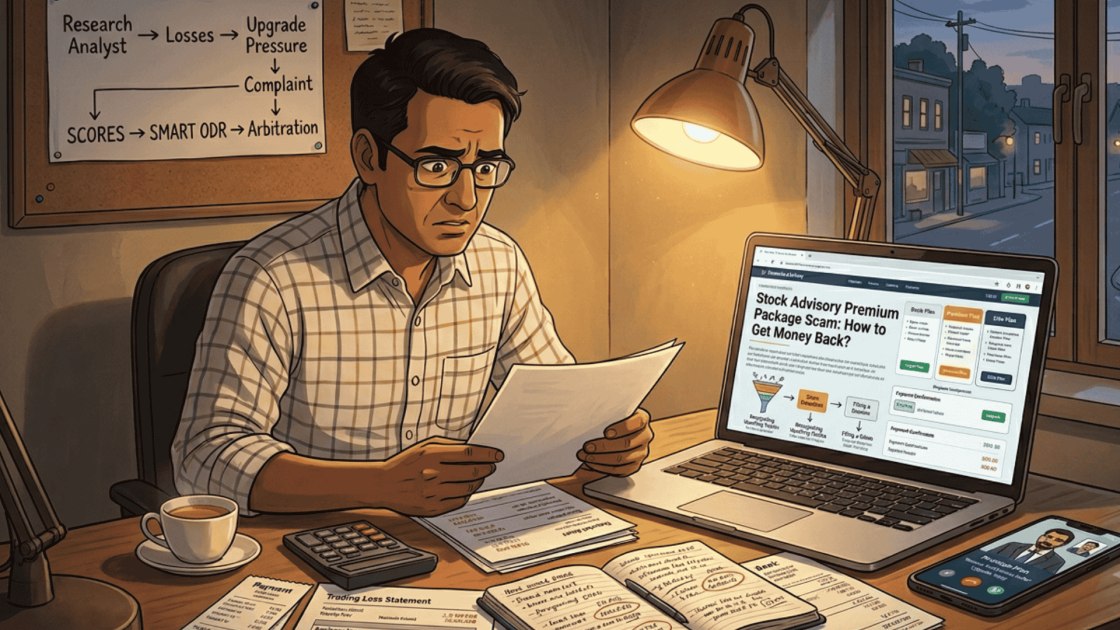
Mehul (name changed), who runs a small business in Morbi, Gujarat, was careful with money. He did not gamble on tips from strangers.
He went looking for a SEBI registered research analyst, a real, registered advisory, and paid ₹34,000 for their service, because that felt like the responsible way to do it.
The trade calls came by phone and video call. He followed them. The losses came too.
But here is the part that should have warned him, and seldom does: when he raised the losses, the answer was not a refund or a rethink. It was an upsell.
“Sir, basic plan mein utni accuracy nahi milti. Premium le lijiye, better calls, jaldi recover ho jayega.”
So he paid again. Another ₹30,000 for the “premium” package, ₹64,000 in fees now, chasing calls that were supposed to be sharper. They were not. The losses continued.
And right on cue, the next conversation was about an even bigger package, an even better tier, the one that would finally turn it around.
That was the moment Mehul stopped. He had video-call recordings, payment receipts, the whole trail. When he came to us, he assumed he had just picked a bad advisory. He had picked a funnel.
We have taken up his case, and there are two separate things wrong with it, not one.
The Upgrade After Loss Loop: How the Funnel Works?
A genuine research service provides research. It does not operate a system where every loss is followed by a suggestion to pay more for supposedly better recommendations.
That structure is essentially a sales funnel disguised as investment advice.
The pattern is simple: the more money you lose, the more you are encouraged to spend, with each additional payment presented as the solution to recovering your losses.
The model is designed to collect increasing fees from investors who are already facing losses and are eager to recover their capital.
The so-called “premium” package is not necessarily a superior service; it is simply the next level in the upselling chain.
At the core of the issue was the original concern: personalised, account-specific trading recommendations.
A SEBI registered Research Analyst is authorised to publish research reports and general buy, sell, or hold opinions, but not to provide customised trade instructions tailored to an individual’s portfolio on an ongoing basis.
Once that activity began, the firm had already moved beyond the scope of its registered role.
How Charging Multiple Premium Fees Breaks SEBI Rules?
Here is the part the upselling relies on you not knowing.
SEBI places limits on what a Research Analyst can charge. The fee model is not meant to be an open-ended ladder of ever-bigger “premium” packages.
So when a registered advisory keeps stacking fees: ₹34,000, then ₹30,000, then the pitch for more, the fee structure itself can breach the rules, entirely separate from the bad calls.
That gives a case like Mehul’s two independent footholds:
- The scope breach: personalised trade-running an RA was never licensed to do.
- The fee breach: escalating package fees beyond what the rules permit.
Either one supports a claim. Together, they are hard to wave away as “market risk.”
How to Reclaim Your Funds Back?
If you have been caught in this kind of upselling cycle, do not assume that your options end with accepting the loss.
Indian securities regulations provide a structured grievance mechanism that allows investors to challenge misconduct and secure a stock advisory fee refund.
Here are the steps to raise a complaint against research analyst:
- File a Complaint Directly with the Research Analyst: Submit a detailed written complaint to the firm’s compliance officer. Clearly describe the issues you experienced, the services provided, the advice or recommendations received, any disputed charges, and the losses or concerns that led to the complaint
- File a Complaint with SCORES: If the Research Analyst does not provide a satisfactory resolution within 15 working days, escalate the matter through the SEBI SCORES grievance redressal platform.
- Register a Complaint in SMART ODR: If the dispute remains unresolved after the SCORES process, proceed to the SMART ODR (Online Dispute Resolution) platform for mediation and conciliation.
- Stock Market Arbitration: If mediation fails to resolve the matter, take the dispute to exchange arbitration, where an independent arbitration panel will review the evidence and issue a binding decision.
Expect the first response to be a lowball settlement, fifty percent, or a part-refund of the fee. That is a starting offer, not the ceiling. The case is built to push for the fees and the losses, and how far it goes depends on how cleanly it is presented.
Save everything: both fee receipts, the video-call recordings, and any message where they pushed the next package. The upgrade pitch is not just embarrassing in hindsight. It is evidence of the funnel.
The lesson Mehul took away: when your “advisor” responds to every loss by selling you a bigger plan, you are not the client. You are the product.
Need Help?
Register with us, and we will help you file the complaint the right way, the right platform, the right detail, the right pressure.
Our team will review your documents, identify the violations, and guide you through every step of the process, from the initial complaint to SCORES, SMART ODR, and arbitration if needed.
Reach out to us today. The sooner you start, the stronger your case.
Frequently Asked Questions
1. Is there actually a limit on what a SEBI registered advisory can charge?
Yes. SEBI places limits on Research Analyst fees. A model that keeps stacking ever-larger “premium” packages can breach those limits on its own, separate from the quality of the calls.
2. They keep telling me to upgrade to recover my losses. Should I?
No. The upgrade-after-loss pitch is the funnel, not the fix. Stop, and save every message where they pushed the next package; it is part of your case.
3. I paid for two packages and still lost. Can I claim all of it?
Both the fees and the losses can be pursued, on the strength of the scope breach and the fee breach. Outcomes are negotiated through SCORES and SMART ODR, and a clean evidence trail is what decides how much comes back.




 Add us as a preferred source on Google »

