

Stockholding Services complaints have been increasing in recent years, and investors researching this broker deserve a clear, factual picture.
SSL is a SEBI-registered stockbroker with a long operational history; however, registration alone does not guarantee a complaint-free experience.
Moreover, exchange data and regulatory orders reveal patterns that prospective and existing clients should understand before making decisions.
Consequently, this detailed breakdown covers complaint data, SEBI penalties, real user reviews, and a step-by-step redressal guide.
If you are evaluating SSL or already facing an issue, the information below will help you take the right steps.
Stockholding Services Complaints Overview
Stockholding Services Limited (SSL), formerly known as SHCIL Services Limited, is a SEBI-registered stockbroker holding registration number INZ000199936.
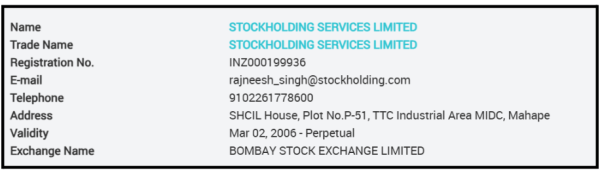
The company is a subsidiary of Stock Holding Corporation of India Limited, a government-backed custodial institution.
SSL is registered as a trading member on both NSE and BSE, and offers equity, derivatives, and depository services to retail and institutional investors across India.
However, despite its regulatory standing and institutional backing, SSL has faced a growing volume of Stockholding Services complaints from retail clients, spanning app failures, KYC issues, fund discrepancies, and poor grievance redressal.
Types of Complaints Clients File Against Stockholding Services
Exchange complaint mechanisms cover the following categories for broker-related grievances.
NSE and BSE handle these complaints through their Investor Grievance Redressal Committees.
| Type | Description of Complaint Type | Count |
| Type I | Non-receipt/delay in payment | 5 |
| Type III | Non-receipt of documents | 1 |
| Type IV | Unauthorized trades/misappropriation | 7 |
| Type V | Service related | 34 |
| Type VIII | IPO related | 1 |
| Type IX | Others | 21 |
Service-related complaints dominate, indicating frequent issues with execution, charges, platform performance, or customer support. This suggests that day-to-day user experience with the broker is a major concern for clients.
A high number of complaints fall under “Others,” which indicates issues that do not fit standard categories but are still significant.
This lack of clear classification may also point to gaps in reporting or varied unresolved concerns.
Stockholding Services Exchange Complaint Data
The following data reflects SSL’s complaint record across financial years, as reported to the exchanges:
| Financial Year | Active Clients | Complaints Filed | Complaint % | Resolved | Unresolved | Arbitration Cases |
| 2025-26 | 76,207 | 55 | 0.072% | 55 | 0 | 0 |
| 2024-25 | 74,593 | 18 | 0.020% | 18 | 0 | 0 |
| 2023-24 | 70,485 | 25 | 0.030% | 21 | 4 | 0 |
| 2022-23 | 70,485 | 25 | 0.030% | 25 | 0 | 0 |
Complaint Volume Has Spiked Sharply in 2025-26
The number of complaints filed jumped from 18 in FY 2024-25 to 55 in FY 2025-26, a more than 200% increase in a single year. Meanwhile, the active client base grew by only around 2%.
Therefore, the complaint rate is rising far faster than the client base, which is a clear warning signal for prospective investors.
Unresolved Complaints Have Appeared
FY 2023-24 recorded 4 unresolved complaints out of 25 filed, a resolution rate of only 92%.
However small the absolute number may appear, unresolved complaints at a SEBI-registered broker indicate a failure in internal grievance handling that every investor should note.
Zero Arbitration Cases May Not Mean Zero Disputes
The absence of arbitration filings across all four years does not necessarily mean investors had no serious disputes.
Consequently, it is possible that many investors were unaware of their right to file for arbitration, or abandoned their claims before reaching that stage.
Also Read: Samco Securities review, the complete review, every category, every real number checked.
Stockholding Services SEBI Order
According to SEBI Adjudication Order No. Order/AN/SM/2024-25/31113 dated January 07, 2025, SEBI carried out a thematic inspection of Stockholding Services Limited for the period April 01, 2022, to June 20, 2023.
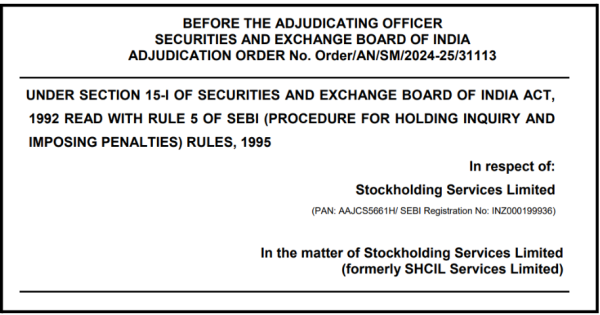
The inspection theme was ‘Multiple UCCs mapped to a common email ID or a common mobile number.’
Violations By Stockholding Services
According to the adjudication order, SEBI established the following violations against SSL:
- KYC Relationship Mismatches: In 13 client accounts, the relationship recorded in SSL’s back office did not match the KYC form and consent letter.
- Missing Consent Letters for 452 Clients: SSL allegedly failed to obtain consent letters for mapping the same email ID or mobile number to multiple client accounts.
- Data Mismatches on Exchange Portal: In 393 client cases, email IDs uploaded to exchange databases did not match KYC records.
- Invalid Contact Details Uploaded: SEBI found that SSL uploaded invalid email IDs for 116 clients and invalid mobile numbers for 18 clients into the Exchange UCC databases.
- Authorized Person Contact Details Used for Clients: In 25 cases, the email ID of an authorized person was mapped to client accounts.
- Blank and Incorrect Bank Details: In 38 client accounts, blank bank details were uploaded to the BSE exchange database.
- Violations Were Repetitive in Nature: According to the adjudication order, SEBI specifically noted that many of these observations had already been communicated to SSL during a previous inspection for the period April 01, 2021 to October 31, 2022.
Despite this, the same violations persisted in the next inspection cycle, a factor SEBI weighed heavily in determining the penalty.
Penalty Imposed
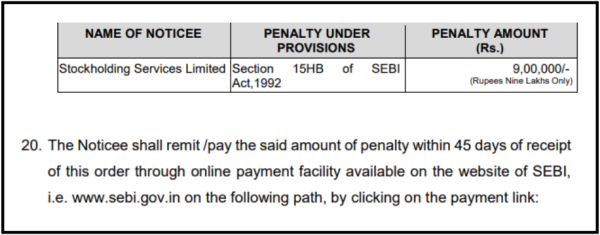
According to the said adjudication order, SSL was directed to pay a penalty of ₹9,00,000 (Rupees Nine Lakhs Only) under Section 15HB of the SEBI Act, 1992, for violations of SEBI’s Master Circular dated May 17, 2023.
What to Learn from This Case?
- SEBI penalising SSL under Section 15HB confirms that the violations were not technical oversights but established regulatory breaches.
- The repetitive nature of the findings, flagged across two consecutive inspection cycles, suggests that compliance was not treated as a priority by SSL’s internal systems.
- KYC failures directly impact investors: incorrect contact details mean exchange alerts, margin calls, and trade confirmations may never reach the actual client.
- Invalid or mismatched bank details in 135 client accounts represent a systemic risk to fund withdrawals and settlements.
- Investors should verify their own KYC details, email, mobile, and bank account with SSL’s back office before placing large trades or making withdrawals.
The SEBI penalty of ₹9 lakh, combined with the breadth and repetition of these violations, reflects a pattern of inadequate compliance infrastructure at SSL, not isolated incidents.
Stockholding Services User Reviews
User reviews highlight recurring issues related to functionality, reliability, and overall user experience of the platform.
1. Limited Features & Lack of Analysis
D S Bamji highlights that the app only shows basic portfolio and valuation data during trading days. There is a clear absence of charts, comparisons, and both technical and fundamental analysis tools.
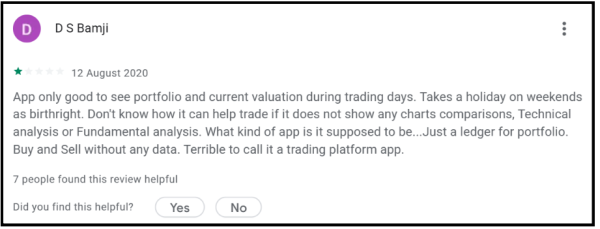
He describes it as more of a simple ledger rather than a functional trading platform.
2. Login Failures & Poor Support
Adarsh Kumar reports severe login issues where the app fails to function even after entering credentials. The system shows inconsistent login behavior, causing confusion and frustration.
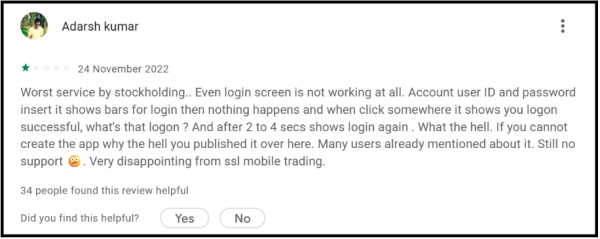
He also points out the lack of customer support despite multiple users facing similar problems.
3. Trading Limitations & Frequent Glitches
A user, Vijayakumar K, criticizes the app for restricting order placement and not supporting margin trading properly.
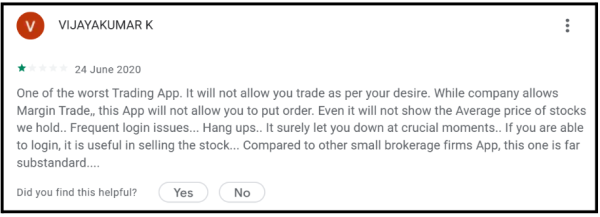
He notes frequent login failures and app hangs during crucial trading moments. Compared to other brokerage apps, he finds it significantly substandard and unreliable.
4. Delayed Transactions & Poor Responsiveness
A user, Karunanithi M, mentions delays in fund transfers, unlike other apps offering real-time credit.
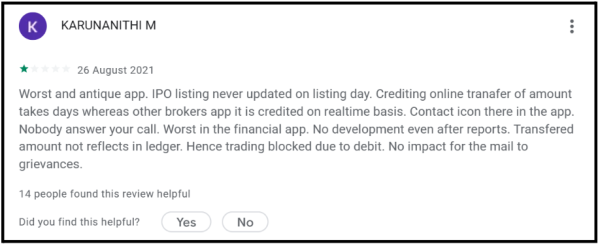
He also highlights issues like unresponsive customer support and outdated IPO information. These problems lead to trading disruptions and unresolved grievances, making the app inefficient.
When to Take Action Against a Broker?
Every day of delay can reduce your chances of recovery.
Here is when you must act immediately:
- Unauthorised Trades: If you notice trades in your account that you did not place, or your stockbroker has done a few unauthorised transactions, raise a formal complaint the same day. Delay can be interpreted as implied acceptance.
- Order Execution Failures: If the app or platform fails to execute your order during market hours and you suffer a loss as a result, document the failure with screenshots and timestamps immediately.
- Unexplained or Excessive Charges: If charges appear in your account without a clear contract note or explanation, dispute them in writing within the same settlement cycle.
- Forced Square-Offs Without Notice: If your positions are squared off without your consent or without proper margin call notice, this is a reportable violation and must be escalated to the exchange.
- Capital Decreasing Without Corresponding Trades: If your ledger balance is falling without matching trade activity or charges, this warrants an immediate written inquiry to the broker, followed by formal escalation.
- No Response to Support Queries: If the broker does not respond to your complaint within 30 days, you have the right to escalate to NSE, BSE, or SEBI SCORES. Waiting longer weakens your case.
Acting early preserves evidence, keeps timelines within regulatory limits, and gives you the strongest possible case at every escalation level.
How To Lodge a Complaint Against Stock Broker Online?
Users facing unresolved issues should report them through official grievance channels for timely action.
Proper documentation and escalation can help ensure accountability and faster resolution.
Step 1: Contact Stockholding Services Directly
Begin by raising your complaint through SSL’s official grievance channel. Write to their investor grievance email or submit a written complaint to your branch.
Retain all written communication, reference numbers, and timestamps. The broker is required to resolve your complaint within 30 days under SEBI regulations.
Step 2: NSE Complaint Against Broker
NSE provides a portal, NICE Plus, where a retail trader can file a complaint against a stockbroker for any kind of violation.
Make sure you have all the proofs and draft your complaint properly to reduce the chance of rejection of the complaint.
Step 3: File Complaint in SCORES
If your issue is not resolved by the broker within the stipulated time (usually 30 days), you can file a SEBI complaint on the SEBI SCORES (Securities and Exchange Board of India Complaints Redress System) portal.
This is the official regulator-backed platform where SEBI tracks and monitors complaint resolution timelines. Registered intermediaries are required to respond within defined deadlines.
You can also check SEBI online complaint status through the portal dashboard.
Step 4: File a Complaint with SMART ODR
If you are not satisfied with the resolution provided through SCORES, you can escalate the matter to the SMART ODR (Online Dispute Resolution) platform.
This system enables structured online resolution of investor grievances through mediation and dispute handling between investors and intermediaries.
Step 5: Arbitration in Stock Market
If the dispute is still unresolved, you can proceed to formal arbitration under the stock exchange mechanism (NSE/BSE).
Arbitration is a legally binding process where an independent arbitrator reviews the case and passes an enforceable award. It is designed to provide a final resolution to investor-broker disputes.
Need Help?
Dealing with an unresolved broker complaint is exhausting, especially when the broker does not respond, and the escalation process feels overwhelming.
Many investors either miss key steps in the redressal chain or delay filing until deadlines have passed. Both mistakes can cost you your rightful recovery.
Register with us if you are facing issues with Stockholding Services or any other broker. We will help you take the right steps at the right time.
Conclusion
Stockholding Services Limited is a SEBI-registered broker with decades of institutional history, backed by a government-owned parent company.
However, legitimacy and reliability are two very different things.
The data examined in this blog reveals four significant findings: a 200%-plus spike in exchange complaints in FY 2025-26, a SEBI penalty of ₹9 lakh for repeated KYC and data violations.
For existing clients, the priority is to verify your KYC details immediately and document any ongoing issues in writing.
For prospective clients, this data warrants serious due diligence before opening an account.
Your money deserves a broker whose compliance record is as strong as its registration certificate.




 Add us as a preferred source on Google »

