

Quick Summary
Only one publicly available investor review exists for SV Stock Research at the time of writing, and it appears on the firm’s own Instagram page. The reviewer describes three specific concerns, losses after paying fees, advice they describe as improper, and a support team that stopped responding when they needed answers. Each of those concerns maps directly to an obligation SEBI places on every registered research analyst, and the firm’s own complaint filings jumped 13-fold in FY 2025-26. This page covers each concern, what SEBI’s regulations say about it, and what the combination means before you pay.
You came here because you want to know what other investors have experienced with SV Stock Research, either before you pay or after something already went wrong.
There is only one publicly verifiable investor review available for this firm at the time of writing. It appears on SV Stock Research’s own Instagram page, left by a named user with a visible profile.
One review is a small data set. But the three specific concerns this reviewer raised, losses after paying, advice they describe as improper, and a support team that went silent, map directly to the obligations SEBI places on every registered research analyst.
That mapping is what this page covers.
We are reporting what this reviewer said on a public platform.
We are not independently verifying the account or the specific transactions described, and no SEBI order confirming this specific conduct has been issued as of July 2026.
What Did the Reviewer Actually Say?
Before examining the concerns, here is the full account as the reviewer gave it so that you can judge the source yourself.
The review appears on SV Stock Research’s official Instagram page, left by a named user with a visible profile and a public account.
The reviewer describes subscribing to the firm’s research services and paying the subscription fee. After subscribing, they say the trades went against them, and they incurred losses.
The reviewer does not attribute this to general market conditions. They specifically state that the advice provided by the firm was the reason behind their losses, and they use the phrase improper advice to describe what they received.
When the losses appeared, and the reviewer tried to get clarity, they say they received no callback. They describe reaching out to the support team and getting no response.
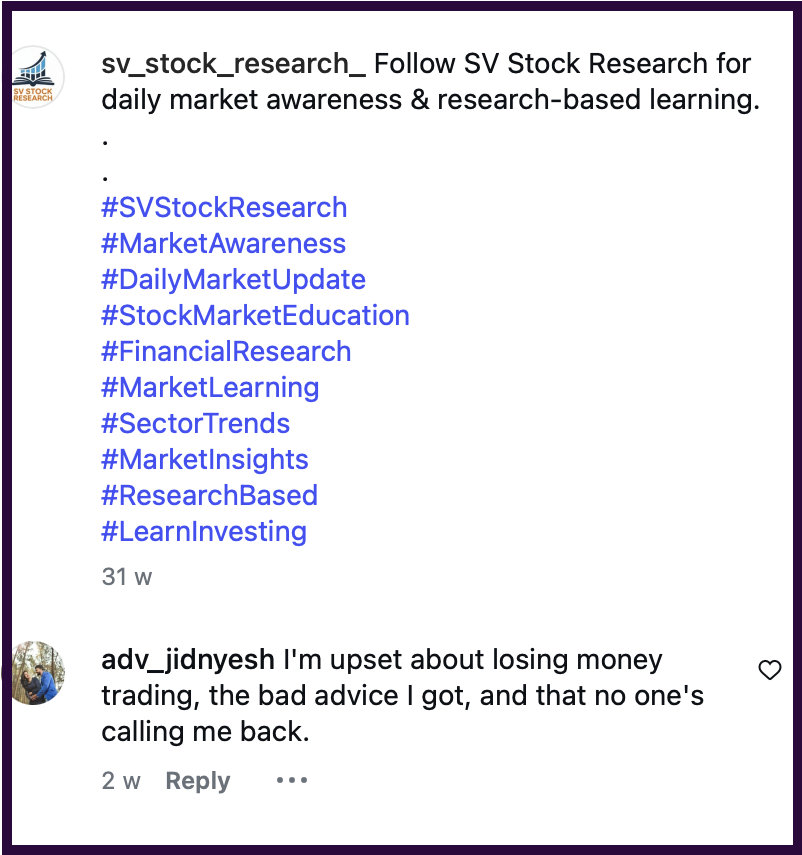
Three concerns, then, and each one deserves its own examination against SEBI’s rulebook, because that is where a personal account becomes a regulatory question.
Concern 1: Losses After Paying Fees
Paying for research and losing money is not automatically a complaint ground.
The stock market carries inherent risk, and every SEBI-registered research analyst’s mandatory disclaimer states that past performance does not guarantee future results.
But the reviewer does not say the market moved against them. They say the advice itself was the problem.
This distinction matters.
If an investor lost money due to normal market conditions and the research analyst provided recommendations based on proper analysis and appropriately disclosed the risks, that situation does not necessarily give rise to a regulatory complaint.
If an investor lost money because the research analyst issued recommendations without adequate analysis, without disclosing material risks, or based on undisclosed conflicts of interest, that is a different situation.
SEBI’s Research Analyst Regulations require that every recommendation be backed by documented research methodology and that risks be disclosed before a client relies on the recommendation.
The reviewer’s claim sits in the second category.
The specific allegation is not “the market went down” but “the advice was improper.” That framing is what makes it a question worth examining against SEBI’s standards rather than a general investment complaint.
Concern 2: Improper Advice
The phrase “improper advice” used by the reviewer is not defined. The review does not specify which recommendations were made, what the research basis was, or whether risks were disclosed before the trades.
What SEBI’s Code of Conduct for Research Analysts does specify is that every research report or recommendation must be based on properly documented analysis.
Conflicts of interest must be disclosed for each specific recommendation. Material risks must be communicated before an investor relies on the advice.
SV Stock Research’s website claims 9,500 active traders and promises consistent success in the stock market.
SEBI’s Schedule III prohibits research analysts from using language that implies assured returns or guaranteed outcomes in marketing material.
Whether the advice the reviewer received was actually improper in a regulatory sense is not possible to determine from a single public review.
What the review does is identify a specific concern that the investor experienced and decided to make public.
Concern 3: No Support Callback
SV Stock Research’s website advertises “live market customer support” and “24/7 support and assistance” as specific features across its subscription plans.
These are not vague marketing phrases.
They are concrete service commitments that investors rely on when choosing between plans.
The reviewer says they reached out to the support team after their losses appeared and received no callback.
The firm’s own website promises that support will be available, specifically 24 hours a day and 7 days a week.
SEBI’s Code of Conduct for Research Analysts requires registered entities to deal with investor queries and complaints in a fair and timely manner. Ignoring investor communications when things go wrong is not a grey area. I
t is directly addressed in SEBI’s conduct requirements.
Whether this reviewer’s experience reflects the firm’s standard approach or a specific situation is not possible to determine from a single account.
What the review creates is a visible gap between what the website commits to and what at least one investor says they received.
Paid the fee, lost the money, and now nobody picks up your call?
We will assess whether your case crosses from bad outcome into regulatory violation, prepare the documentation SEBI’s process demands, and represent you through SCORES, SMART ODR, and arbitration.
Also read: Aakanksha Gupta complaints, the analyst under constant pressure-to-join accusations.
Do the Complaint Numbers Back the Review Up?
One review on its own could be one unlucky client, so it is fair to ask whether anything larger sits behind it.
Something does.
The firm’s own disclosure shows complaints rising from 1 to 13 in a single year, all resolved, and while the disclosure never explains the reasons, 13 investors formalising a grievance in twelve months is not the picture of an isolated bad experience.
The full table, the year-by-year figures, and what the spike does and does not prove sit on our analysis of SV Stock Research fake or real.
What Should You Ask Before Subscribing to SV Stock Research?
Each of the three concerns above converts into one question every prospective subscriber should get answered before paying, so here are all three with how to ask them.
- Does the research come with documented methodology?
Ask to see a sample research report before subscribing. A firm that backs its recommendations with proper analysis will be able to show you what that looks like. - What happens when a recommended trade goes against you?
Ask the support team directly, in writing, how they handle situations where recommendations result in losses. The response, or the absence of one, is itself information. - Is the support genuinely available or just advertised?
Try the support channels before you subscribe. If you cannot get a response before paying, that is a signal about what you might experience after.
Beyond these three questions sits the fuller picture, from the registration and ownership to the five red flags on the firm’s own website, all covered on our complete overview of SV Stock Research.
And because this firm runs on an individual registration, accountability has a single name attached.
Who holds it and what individual registration means for you is covered on our page on the SV Stock Research company owner.
Also Read: Eqwires Reviews, where SEBI confirmed a paid marketing agent created a fake client testimonial.
Conclusion
One investor review is not enough to draw firm conclusions about SV Stock Research as an organisation.
It is enough to raise three specific questions about the gap between what the website promises and what at least one investor says they experienced.
The review describes losses following improper advice and a support team that stopped responding. The website promises research-backed recommendations and 24/7 support.
Those two pictures do not match.
Whether your situation matches this reviewer’s is something only your own experience can answer.
If it does, and you want the full details on how to file a complaint, from the portal steps to what happens after, check our guide: SEBI SCORES complaint.
The earlier you document everything, the stronger you stand on it.
Report. Recover. Stay Fraud Free.
The review appears on the firm's own official Instagram page, left by a named user with a visible public profile. We have not independently verified the transactions or the reviewer's identity, and no SEBI order confirming or denying the conduct exists as of July 2026. Poor outcomes alone are not a complaint ground, since market risk is inherent. But advice issued without documented research, risks never disclosed, or return implying claims made before you subscribed are specific complaint grounds under SEBI's Research Analyst Regulations. The firm received 13 complaints in FY 2025-26, a 13-fold increase from the single complaint the previous year, with all reported as resolved. The full complaint data and what the sharp rise means sits on our fake or real analysis. Document every unanswered attempt with screenshots, dates, and times. If a formal written complaint gets no response within 21 days, file on SEBI SCORES under the Research Analyst category using registration number INH000011909. Yes. The firm holds SEBI Research Analyst registration INH000011909 in the name of proprietor Arunima Rai, active and verifiable on SEBI's website under the Research Analyst category.Frequently Asked Questions





 Add us as a preferred source on Google »

