
Quick Summary
Nitilesh Pawaskar holds SEBI Research Analyst registration INH000004547, granted on 19 December 2016 and now perpetual. He operates as Tanisha Share Market Academy from Ratnagiri, Maharashtra. The complaint record is genuinely light. The annual disclosure shows one complaint received and one resolved across seven financial years. The problems sit elsewhere. The pricing page does not open, so no fee can be checked against the ₹1,51,000 ceiling. MITC, privacy policy and terms are missing. Four different experience figures appear across his own material and third party listings. The terms require all disputes to be filed in Kolkata, roughly 1,900 kilometres from the registered office.
Nitilesh Pawaskar has held SEBI Research Analyst registration INH000004547 since 19 December 2016, and across the seven financial years his own disclosure covers, exactly one complaint appears on the record.
That is a genuinely unusual number in this sector, and it deserves saying before anything else.
Which makes what follows more interesting rather than less.
A registration this old with a record this quiet still has a website that will not tell you what anything costs, and terms that would send a Ratnagiri client to a Kolkata court.
This page works through the register entry, the missing documents, the complaint tables and the fine print, and separates the things that would matter to you from the things that are just untidy.
Who Is Nitilesh Pawaskar?
Nitilesh Pawaskar is a technical analyst operating under the business name Tanisha Share Market Academy, based in Ratnagiri, Maharashtra.
He holds an MBA in Finance. His registration is an individual one, meaning it sits with him personally rather than with a company.
His stated method rests on price action, market psychology and trapping signals, supported by tools including Fibonacci levels and sentiment studies.
He states that he understands fundamental analysis but does not use fundamental data to build projections, taking the position that technical analysis can anticipate major fundamental developments before they surface.
That is a coherent and openly stated philosophy.
It is also worth knowing before you subscribe, because it tells you what kind of output to expect and what will never appear in it.
The website claims appearances as a stock market expert on ET Now Swadesh Hindi, Biz Tak, Money9 on TV9, and DD Sahyadri.
Media appearances are a credential of visibility, not of regulatory standing.
A channel booking an analyst is not a regulator vouching for him, and the two get conflated more often than they should.
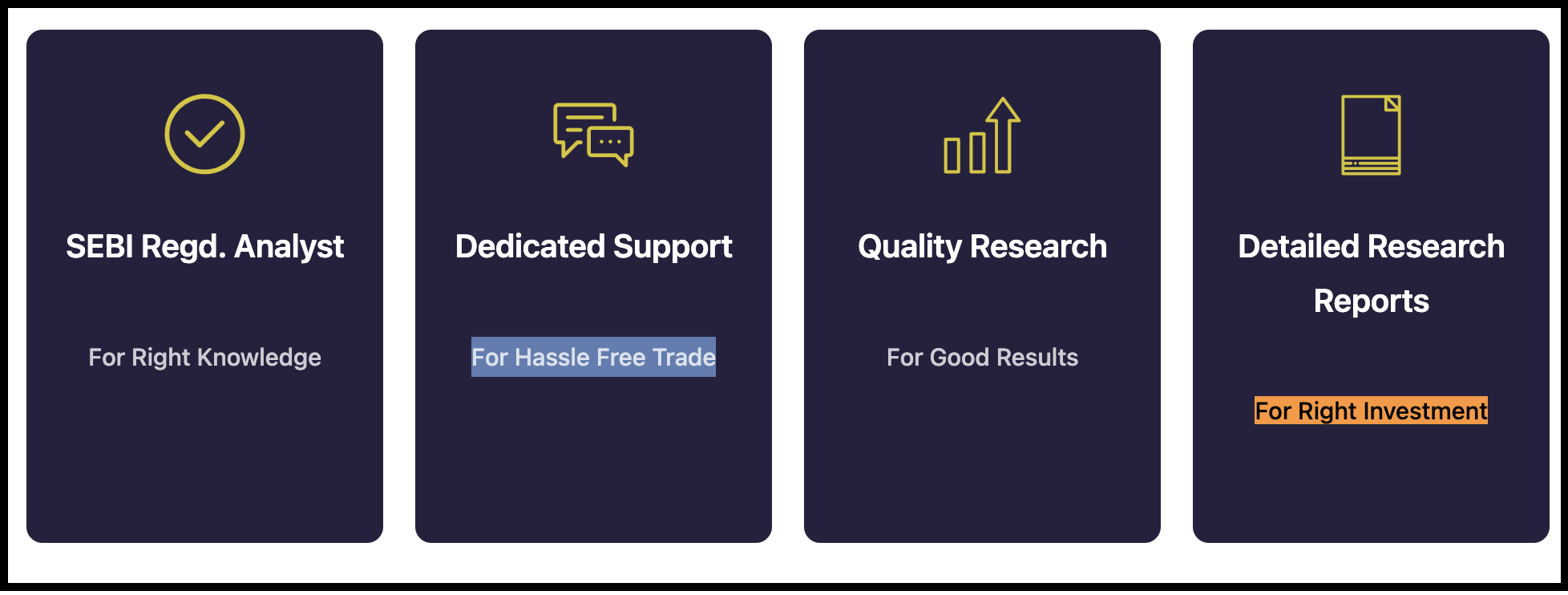
His research offering is described around stock history, company strength, stock trends, charts, market trends and events, alongside promises of SEBI registration, dedicated support, quality research and detailed research reports.
None of that establishes wrongdoing, and nothing on this page does either.
Where a registered analyst’s conduct does cross a line, the formal escalation route is covered in full further down this page.
Is Nitilesh Pawaskar SEBI Registered?
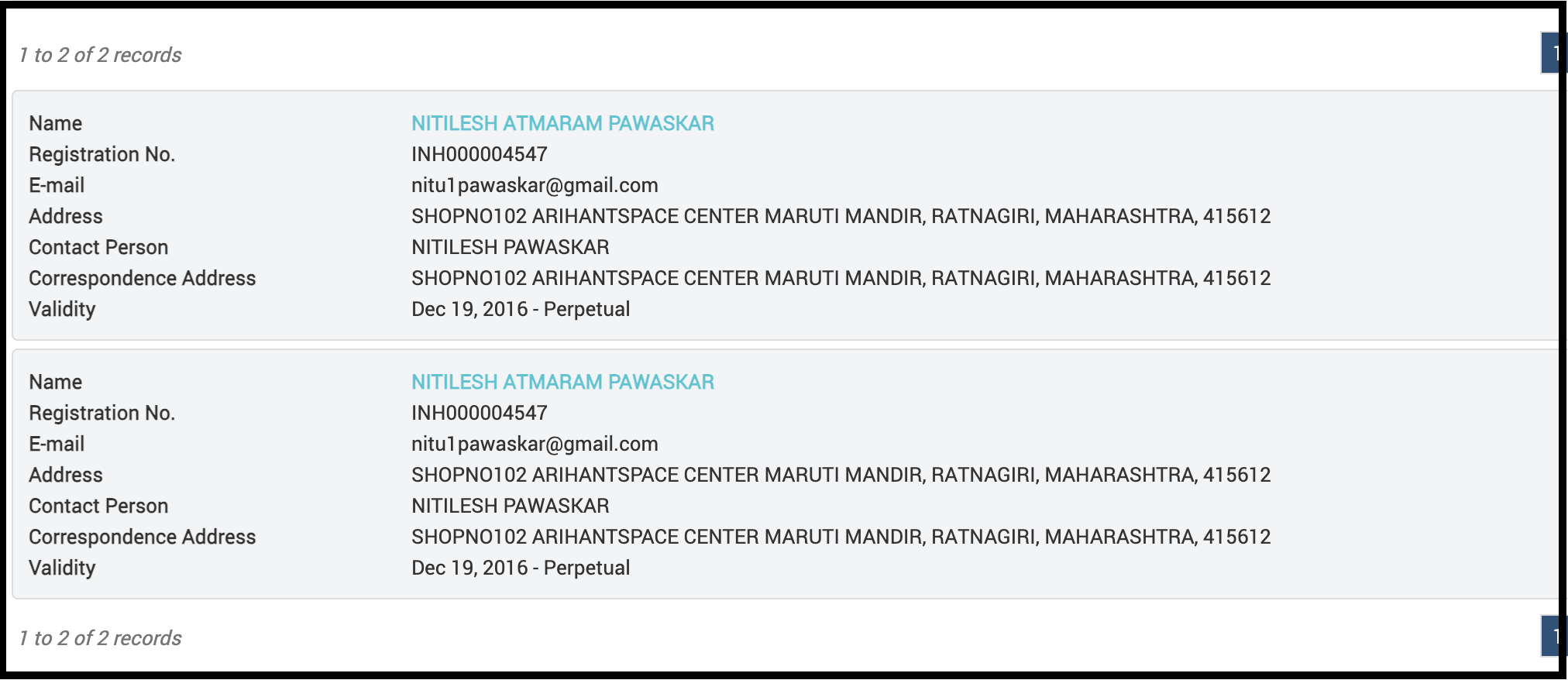
Yes. The registration is real, individual, and has been continuously listed on SEBI’s Research Analyst register since 2016.
His name and number appear on SEBI’s published Research Analyst lists in both April 2024 and March 2025, which confirms the registration has run without interruption rather than lapsing and being restored.
| Detail | Information |
| Registered Person | Nitilesh Atmaram Pawaskar |
| Business Name | Tanisha Share Market Academy |
| SEBI Registration Number | INH000004547 |
| Type of Registration | Individual |
| Registered On | 19 December 2016 |
| Validity | Perpetual |
| Registered Office | Tanisha Share Market Academy, Saraswati Sankul, D Wing, Flat No. 1, Opp. Abhyuday Nagar Bus Stop, Nachane Road, Ratnagiri 415612 |
What an INH Registration Permits and What It Does Not
The INH prefix marks a Research Analyst. An INA prefix would mark an Investment Adviser.
The distinction decides what he may legally sell you.
A Research Analyst may publish research and issue buy, sell, or hold recommendations to a subscriber base.
He may not give you personalised advice built around your income, your goals or your holdings.
He may not execute trades, hold your funds, or manage your portfolio.
That distinction becomes relevant later, because a good deal of third-party material describes this operation using the word advisory.
The Address on the Site Does Not Match the Register
The address recorded against the SEBI registration differs from the address published on his own website.
That is not a violation on its own. Offices move, and website footers go stale for years without anyone noticing.
It matters in one narrow situation.
If you ever need to serve a notice or name a respondent, use the address on the SEBI register, because that is the one the regulator recognises for the entity.
How Many Years of Experience Does Nitilesh Pawaskar Actually Have?
This is a small thing that turns out to be a useful test of how carefully the public material is maintained.
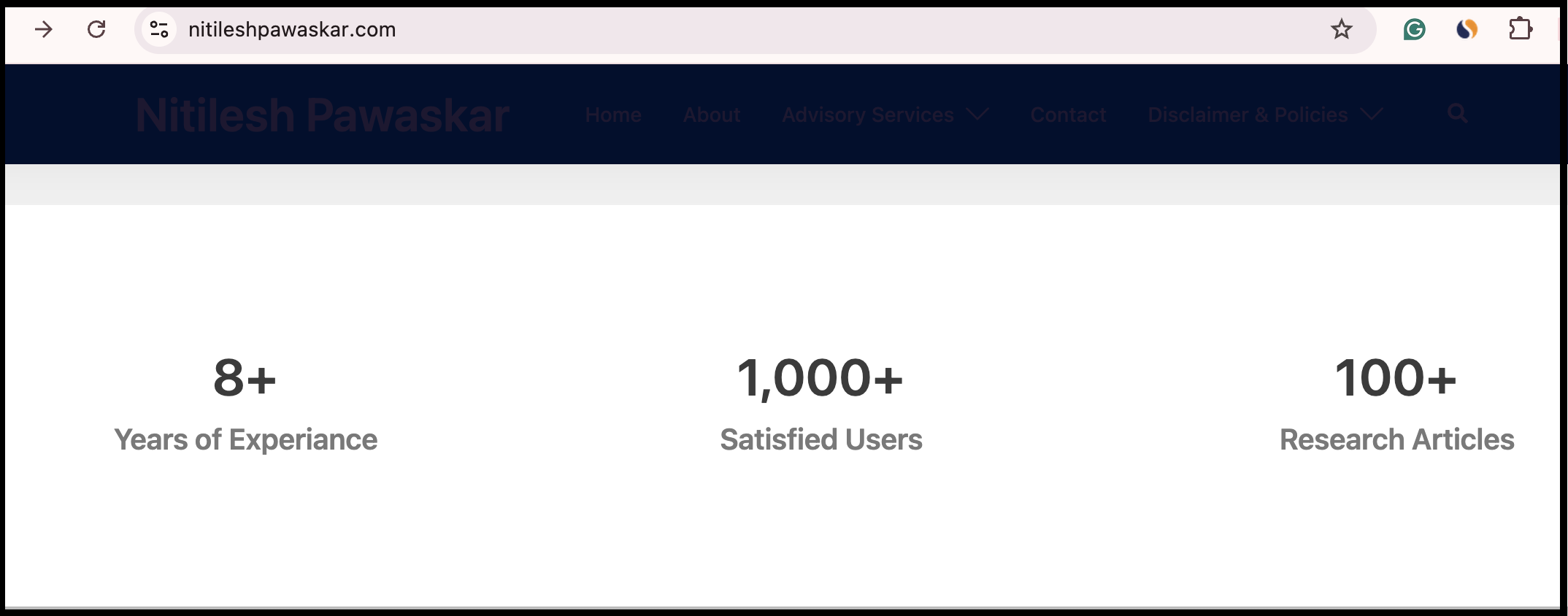
Four different figures are in circulation, and they are not reconcilable with each other.
Experience claims are the one credential a reader cannot verify independently, which is precisely why consistency in stating them matters.
1. The About Page Says Ten Years
The About section of his own website states more than ten years of association with the stock market.
2. The Homepage Says Eight Years
The homepage of the same website indicates eight years. Two pages of one site, two different numbers.
3. A Third-Party Analyst Listing Says Seven-Plus Years
A directory listing describing his services states seven-plus years of market experience, focused on intraday futures and short-term positional calls.
4. The Verifiable Dates Say Something Else Again
Tanisha Share Market Academy was started in 2014, which is twelve years by September 2026.
The SEBI registration date is from December 2016, which is nine years and nine months.
So the honest answer depends entirely on which clock you use. Twelve years in the business, roughly ten as a registered Research Analyst, and none of the published figures match either.
No single one of these is a false statement.
Together they show a public profile nobody has audited in years, which is the same pattern the pricing page and the missing documents will show again.
Why Can You Not See Nitilesh Pawaskar’s Pricing?
Four plans appear on the website, each with an explanation of what it covers.
Click the button to choose one, and it does not open.
The button returns an error. There is no published price anywhere on the site for any of the four plans.
That is a bigger problem than a broken link, for three separate reasons.
1. You Cannot Compare What You Cannot See
The point of publishing plans is so a prospective subscriber can weigh cost against what is offered.
Four plans with no prices give you nothing to weigh.
2. You Cannot Test the Fee Against the SEBI Ceiling
A Research Analyst may charge a maximum of ₹1,51,000 per annum per family across all research services, for individual and HUF clients who are not accredited investors.
Non-individual clients, accredited investors, and institutional clients fall outside that ceiling and negotiate bilaterally.
Nothing in this operation’s public positioning suggests it targets accredited investors, so the retail ceiling is the one that applies.
With no published figure, there is no way for you or for us to check whether any plan sits inside that limit.
We are not suggesting it does not. We are saying it cannot be verified from the outside, which is a different and narrower point.
3. A Price Quoted Only on a Call Is a Price With No Record
When the fee arrives verbally, you have nothing to hold up later if the amount changes, if a second plan is added, or if the annual total drifts past the ceiling.
The practical step is simple.
Ask for the fee in writing before you pay, covering the plan, the duration, the total for a full year, and whether anything else will be sold to you on top.
If the answer only ever comes by phone, that itself tells you something about how the rest of the relationship will be documented.
One protection applies regardless of what you are charged.
On early termination, you are entitled to a proportionate refund for the unexpired period, and unlike Investment Advisers, Research Analysts may not retain a breakage fee.
Also Read: Omkar Thakur has its prices published, but these monthly plans go above the fee cap when annualised.
What Does the Nitilesh Pawaskar Complaint Record Show?
This is the part where the picture genuinely improves, and it would be dishonest to flatten it into the same shape as other reviews on this site.
Every SEBI-registered Research Analyst must publish monthly and annual complaint data.
Here is what the annual table shows.
| Sr No | Year | Carried Forward | Received | Resolved | Pending |
|---|---|---|---|---|---|
| 1 | 2018 to 19 | 0 | 0 | 0 | 0 |
| 2 | 2019 to 20 | 0 | 0 | 0 | 0 |
| 3 | 2020 to 21 | 0 | 0 | 0 | 0 |
| 4 | 2021 to 22 | 0 | 0 | 0 | 0 |
| 5 | 2022 to 23 | 0 | 0 | 0 | 0 |
| 6 | 2023 to 24 | 0 | 1 | 1 | 0 |
| 7 | 2024 to 25 | 0 | 0 | 0 | 0 |
| Up to Sept 2025 | 0 | 0 | 0 | 0 | |
| Grand Total | 0 | 1 | 1 | 0 |
One complaint across seven financial years, received and resolved; nothing pending.
For a Research Analyst who has been registered since 2016, that is a light record by any standard, and it should be read as a point in his favour.
That is the substance. The presentation of it is where the issues sit, and they are real ones.
Do the Nitilesh Pawaskar Complaint Tables Reconcile?
No, and the mismatch is specific enough to pin down rather than wave at.
Reconciliation checks matter because complaint disclosures are one of the few numbers a firm cannot edit for marketing purposes.
When two official tables on the same site disagree, the disclosure stops doing its job.
1. The Annual and Monthly Totals Do Not Agree
The annual table records 1 complaint received and 1 resolved. The monthly table shows 2 received and 2 resolved, falling in July 2023 and November 2024.
The July 2023 entry sits inside financial year 2023 to 24, which the annual table records as 1 received. That one lines up.
The November 2024 entry sits inside financial year 2024 to 25, which the annual table records as 0 received. That one does not.
A complaint recorded in the monthly table has simply not carried into the annual one.
2. The Reporting Periods Do Not Line Up
The annual table runs on financial years. The monthly table runs on calendar months.
The annual table then includes a row labelled up to September 2025, while monthly data is also shown for October 2025.
A reader cannot tell where the reporting period actually ends.
3. The Disclosure Is Close to a Year Out of Date
SEBI requires complaint data to be updated by the 7th of every month. The most recent monthly entry is October 2025.
As of September 2026, that leaves the disclosure roughly eleven months behind. This is not a page that slipped one cycle.
4. There Is a Duplicated Serial Number
Serial number 27 appears twice, against June 2025 and again against July 2025.
On its own, this is trivial.
Alongside the reconciliation gap and the stale data, it points to a table nobody is checking before publication.
5. The Tables Carry No Detail at All
The disclosure records counts received and resolved, and nothing else.
There is no breakdown of complaint nature, source, or how each was disposed of.
SEBI’s format expects the source split, which is the field that tells you whether investors approached the firm directly or went to the regulator first.
Without it, a prospective client learns nothing beyond a number.
There is one structural point worth adding. The first table on a compliant disclosure should carry current month data.
Here it does not, which means the page is not in the format SEBI prescribes, even setting aside how old the figures are.
Also read: One Market Signal, whose complaint table contradicts itself on its own site.
What Does the Nitilesh Pawaskar Investor Charter Leave Out?
The Investor Charter is the document that tells you what to do when something goes wrong.
Two things in this one are worth knowing before you need it.
The stated grievance timeline is 30 days. The charter directs dissatisfied investors to SEBI’s SCORES platform after that.
So far, so ordinary. What the charter does not mention is the stage after SCORES.
There is no reference to the Online Dispute Resolution mechanism anywhere in the escalation framework it describes.
A reader following this charter would believe SCORES is the end of the road.
It is not. Where SCORES does not produce a usable outcome, conciliation is the stage that follows, and that route is set out in full in the complaint section below.
The omission does not remove your right to that stage.
It just means you would not learn about it from the document written to explain your rights.
The second gap is the service description itself.
The details of services provided section covers client onboarding, disclosures, distribution of research reports, and confidentiality.
It does not set out which specific research services or recommendations a subscriber actually receives.
Combined with the missing pricing, a prospective client is being asked to commit without knowing either the cost or the precise deliverable.
Which Documents Are Missing From the Website?
Three documents that a registered Research Analyst’s website would normally carry are not there.
Their absence is not a technicality. Each one is the document you would reach for if a dispute started.
1. Most Important Terms and Conditions
The MITC document is missing. This is the standardised summary SEBI requires an RA to give clients, covering fees, refunds, the advance fee limit, and the fact that no return can be assured.
It exists precisely so that a client does not have to read a long agreement to understand the key terms.
Without it, those terms live only in whatever was said on a call.
2. Privacy Policy
No privacy policy is published, despite the site collecting contact details from prospective clients.
3. Terms and Conditions
The general terms and conditions page is also absent from the site.
The combined effect is that a prospective subscriber has no written basis for the relationship before paying, and no fee schedule either.
That is the single most actionable finding on this page.
What Do the Disclaimers and Terms Actually Say?
Where documents do exist, four clauses in them deserve reading closely, because each one shifts risk onto the subscriber.
1. The Recommendation Disclaimer Contradicts Itself
The document states that its content is not investment advice.
It then tells subscribers they are strictly advised to follow all the recommendations.
Those two statements cannot both be operative. The first is the protective wording; the second is the instruction.
A subscriber acting on the second would be doing exactly what the first says the content is not for.
2. The Liability Exclusion Is Drawn Very Wide
The terms attempt to exclude liability for any losses or damages arising from an investor acting on the reports or recommendations.
Broad exclusion clauses are common.
They also do not override statutory rights, and a clause of this width would be tested rather than simply accepted in a securities dispute.
3. The SMS Clause Overrides Your DND Registration
Subscribers are made to accept unsolicited commercial SMS even where they are registered under DND or NCPR, and are additionally asked to indemnify the entity against any TRAI penalties.
Read that second half again.
The clause asks the subscriber to pay the regulator’s penalty if the sender is fined for messaging them.
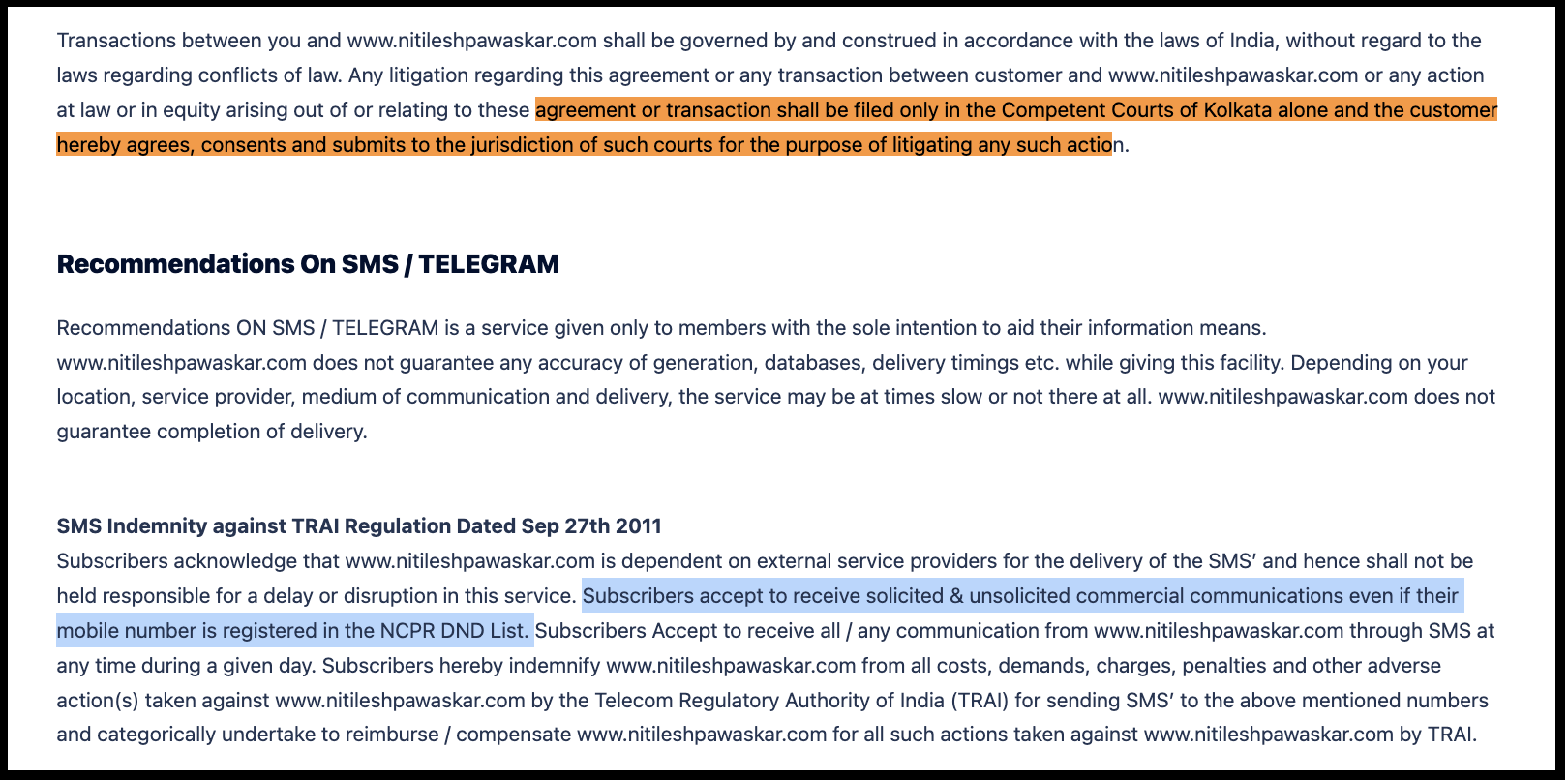
4. All Disputes Are Pushed To Kolkata
The terms require disputes to be filed only in Kolkata courts, with no stated basis for choosing that jurisdiction.
The registered office is in Ratnagiri, Maharashtra. Kolkata is roughly 1,900 kilometres away.
For a retail subscriber in Maharashtra, a clause like this makes litigation practically impossible on cost grounds alone, whatever the merits.
There is a point of real comfort here, and it is worth knowing.
A jurisdiction clause in a subscription agreement does not close off the SEBI framework.
SCORES, conciliation and exchange-level dispute resolution run under securities regulation, not under the contract, and they are conducted online.
Is Advisory the Right Word for What Nitilesh Pawaskar Does?
A significant amount of third-party material describes this operation as advisory, and the wording matters more than it looks.
Published profiles and directory listings refer to it as a SEBI-registered advisory company providing advisory services, alongside intraday, positional, and investment calls, including in Nifty and Bank Nifty.
The registration held is INH, which is a Research Analyst. Advisory in the regulatory sense means an INA registration, which is a different licence with different obligations around suitability, risk profiling, and fee structure.
We are not suggesting he has claimed to be an Investment Adviser.
Most of this wording appears in third-party PR and listings rather than in his own registration disclosures, and loose use of the word advisory is widespread across this whole sector.
The reason to flag it is practical rather than accusatory.
If you believed you were buying personalised advice suited to your situation, and what you actually bought was general research recommendations, that gap is a real one, and it starts with the word.
There is a related point about an award. Published material refers to a Best Analyst and Advisor Award from AdvisoryMandi and Trade and Gain Company.
Both are private commercial entities, not regulators or exchanges. An award from either says nothing about compliance standing.
What Marketing Claims on the Website Need a Closer Look?
The site’s positioning uses three taglines that each edge toward outcome language, which SEBI’s client documentation standards specifically caution against.
Outcome wording is the most common drafting failure in this sector, and it is usually carelessness rather than intent.
It still matters, because it shapes what a subscriber expects.
1. Quality Research for Good Results
The phrase for good results attaches an outcome to the research.
SEBI’s prescribed client documentation states that recommendations must not carry any assurance of returns.
2. Dedicated Support for Hassle-Free Trade
Hassle-free trade can read as a promise about the trading experience or its facilitation.
A Research Analyst does not facilitate trades at all, so the phrase describes something outside his permitted activities.
3. Detailed Research Reports for Right Investment
Describing the reports as leading to the right investment implies the outcome will be correct.
Research can be well reasoned and still be wrong, which is the whole basis on which risk disclosure exists.
None of these amounts to a guarantee of returns in the way SEBI orders have treated explicit profit promises. They are softer than that.
They are still the kind of wording that a compliance review would flag, and their presence alongside the missing MITC suggests no such review has happened recently.
There is a smaller inconsistency worth noting.
The website carries no social media links, yet one of the disclosures refers to a Telegram channel that is not linked anywhere on the site.
A Telegram channel mentioned in a compliance disclosure but not published is a gap in itself, because a subscriber has no way to confirm which channel is the official one.
In a sector where impersonation of registered analysts is common, that ambiguity works against the analyst as much as against the client.
Also Read: Omkara Capital, whose marketing banner includes success assurance and an unverified 50 years of experience claim.
Who Handles Your Complaint if One Person Holds Every Role?
The website names a single individual as CEO, compliance officer, and customer care head.
For an individual Research Analyst operating as a sole proprietor, this is normal and permitted.
There is no requirement to appoint an independent compliance officer at this scale, and it would be unreasonable to expect one.
Knowing it still changes how you approach a grievance. The person who reviews your complaint is the person your complaint is about.
That is not an accusation of bias. It is a structural fact, and it has one practical consequence.
Do not rely on the internal grievance stage to resolve anything on its own.
Use it to create a dated written record, then be ready to move outward if the answer is not usable.
How to File a Complaint Against Nitilesh Pawaskar?
The documentation gaps on this page work in your favour, because a missing MITC or an unpublished fee is a fact the analyst has to answer rather than an argument about whether the research was any good.
Start with what was never put in writing. Reconstruct the fee from your bank or UPI records, then send the grievance by email, describing what you paid, what you were told you were buying, and what you actually received.
Ask directly which plan you were placed on and whether the MITC was ever given to you, and keep the sent record regardless of what comes back.
If that does not resolve things within the charter’s 30 day window, escalation runs through a specific set of channels, and each one exists for a different stage of the dispute rather than as alternatives to pick from.
1. SEBI SCORES for the Formal Regulatory Complaint
Once the 30 days have passed without a usable answer, the matter goes onto the regulator’s own platform.
The SEBI SCORES portal is where that complaint gets filed, and it is worth framing the claim around the fee and the missing MITC rather than around the research itself.
2. SMART ODR for Conciliation if SCORES Does Not Resolve it
Where SCORES closes without a satisfactory outcome, the next stage is structured conciliation rather than a repeat complaint.
The SMART ODR login page covers how a conciliator gets assigned and what documents to bring into that session.
3. Stock Market Arbitration if Conciliation Does Not Settle it
When conciliation still does not produce a settlement, arbitration is the stage that ends in a binding outcome.
Stock market arbitration results in an award that gets enforced through the exchange rather than negotiated with the analyst directly.
That covers each channel on its own, but none of them explain how to actually build and sequence a case from the first email onward.
If you want to know the full process in detail, check our guide complaint against SEBI registered research analyst.
The Kolkata jurisdiction clause in his terms has no bearing on any of the three channels above.
All of them run under securities regulation rather than the subscription contract, and all are conducted online.
Were you quoted a fee that never appeared anywhere in writing?
We rebuild the payment trail from your statements, test the annual total against the ₹1,51,000 ceiling, and put the figure on record in a form the analyst has to respond to. Register with us for a free read on whether you have a documented claim.
Disclaimer
This page is based on Nitilesh Pawaskar’s own published material, the SEBI register and public listings, current as of September 2026, and alleges no wrongdoing since no SEBI order stands against him.
Registration, pricing, and website details can change, so verify everything at source before acting. Treat this page as research, not legal or investment advice.
Conclusion
Nitilesh Pawaskar is a properly registered Research Analyst carrying INH000004547, continuously listed since December 2016, with one complaint across seven financial years and none pending.
On the measure that usually matters most, the record is clean, and saying otherwise would misrepresent it.
What lets the operation down is documentation.
Four different experience figures, a pricing page that does not open, no MITC, no privacy policy, no terms, a complaint disclosure eleven months stale that does not reconcile with itself, and a jurisdiction clause pointing 1,900 kilometres from the registered office.
None of that establishes harm to anyone. All of it means a subscriber signs up without a written fee, without written terms, and without an accurate picture of what they are buying.
Before paying, get the plan, the annual total, and the MITC by email.
If you have already paid and something has not matched what you were told, the fee trail and the missing documents are the strongest parts of your case, so gather them now.
Report. Recover. Stay Fraud Free.
Frequently Asked Questions
Yes. It is registered to Nitilesh Atmaram Pawaskar as an individual Research Analyst from 19 December 2016 and is perpetual. His name appears on SEBI's published Research Analyst lists in both April 2024 and March 2025.
There is no rule forcing prices onto a public page, but the fee must be documented in your agreement and the MITC, and it must respect the ₹1,51,000 annual ceiling. Get the figure by email before paying.
MITC is the standardised summary of key terms SEBI requires a research analyst to give clients, covering fees, refunds and the fact that no return is assured. Without it you have no short written record of what was promised.
No. SCORES, conciliation and exchange level dispute resolution run under securities regulation rather than the subscription contract, and all of them are conducted online regardless of where you or the analyst are located.
It means very few people have formally complained, which is a positive signal but not a guarantee. The disclosure is also nearly a year out of date, so the current position cannot be confirmed from it.





 Add us as a preferred source on Google »

