
Quick Summary
One Market Signal is a SEBI registered Research Analyst carrying INH000019044, operated by Rohit Yadav from Moradabad, Uttar Pradesh, and active since December 2024. Its published refund policy states that no refunds, replacements or cancellations are allowed under any circumstances. SEBI’s own regulations entitle a client to a proportionate refund on early termination, and this policy does not reflect that. Of eight package types sold across three billing cycles, three breach the ₹1,51,000 annual fee ceiling if renewed monthly for a full year, and two yearly plans sit within a few hundred rupees of the limit itself.
One Market Signal holds SEBI Research Analyst registration INH000019044, active since 12 December 2024, and operates under Rohit Yadav from Moradabad, Uttar Pradesh.
The registration checks out cleanly against the firm’s own repeated statements across its site.
What does not check out as cleanly is a specific line in its refund policy, one that directly contradicts a right SEBI’s own regulations give every client.
This page works through the registration, the eight package types and their pricing against the fee cap, the refund policy, the complaint disclosure, and a handful of scope and structure questions worth asking before subscribing.
One Market Signal Review
One Market Signal is a SEBI-registered Research Analyst offering Buy, Sell and Hold recommendations across a wide span of markets, wider than most single-analyst operations reviewed on this site.
Its coverage spans Indian and global equities, commodities including gold, silver, crude oil, natural gas, copper and zinc, indices, futures and options, and what the site describes as Comex and Forex signals.
The firm states its research team conducts company and financial analysis before selecting instruments for its recommendations, and that its research and services are developed in-house by a dedicated team.
Its own FAQ page states plainly, in response to the direct question of whether it provides stock tips or investment advice, “No. We are a Research Analyst, not an Investment Adviser.”
That is the correct answer for an INH registration, and it is worth crediting as a clearly and correctly stated scope rather than assumed and left unstated the way some firms leave it.
The FAQ also promises 5 to 6 high-quality intraday or positional signals daily, delivered through WhatsApp support, calls and online chat, with a one-day free trial before a prospective client selects a paid package.

Social media presence is limited to WhatsApp, Instagram and Facebook. None of this establishes wrongdoing, and nothing further on this page does either.
Where a registered analyst’s conduct does cross a line, the formal escalation route is covered in full further down this page.
Is One Market Signal SEBI Registered?
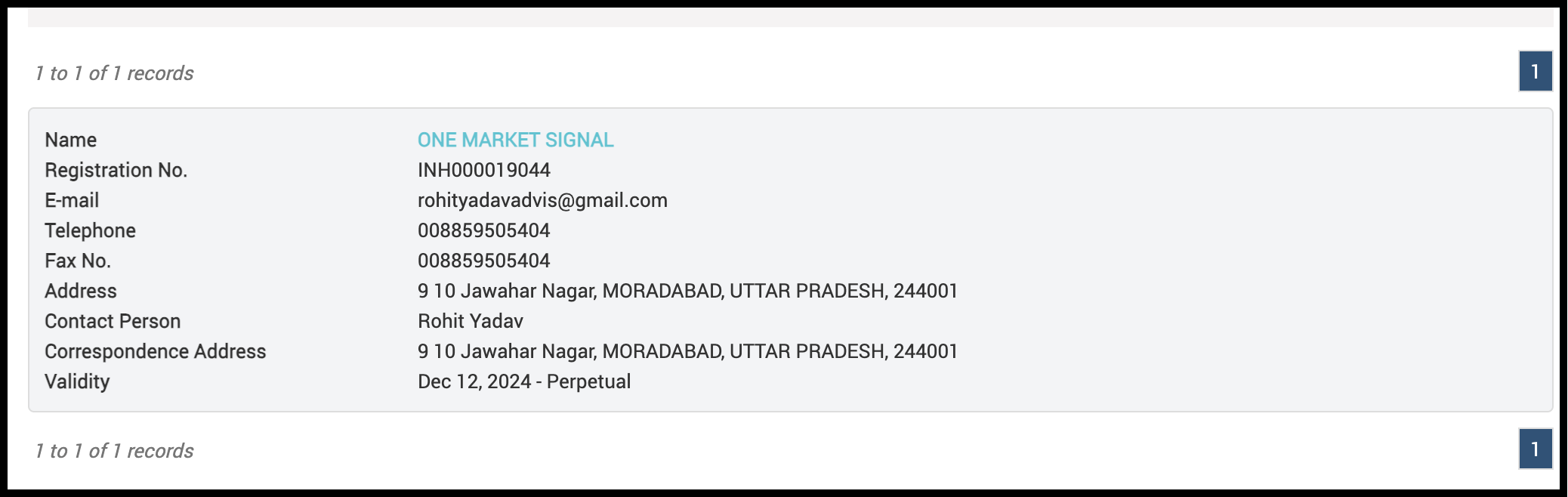
Yes, and the registration is confirmed consistently across multiple pages of the firm’s own site, its home page, its FAQ, its refund policy, and its investor charter, all citing the same number.
| Detail | Information |
| Organisation Name | One Market Signal |
| SEBI Registration Number | INH000019044 |
| BSE RA Enlistment No. | 6446 |
| Validity | 12 December 2024, Perpetual |
| Registered Address | 9/10 Jawahar Nagar, Moradabad, Uttar Pradesh 244001 |
| Correspondence Address | 9/10 Jawahar Nagar, Moradabad, Uttar Pradesh 244001 |
| Contact Person | Rohit Yadav |
What the INH Prefix Permits
The INH prefix marks a Research Analyst. An INA prefix would mark an Investment Adviser, and the firm’s own FAQ correctly draws that distinction rather than blurring it.
A Research Analyst may publish research and issue recommendations to a subscriber base.
It may not give personalised advice built around an individual client’s income, goals or holdings, may not execute trades, and may not manage a portfolio.
Does the Comex and Forex Coverage Fit Inside the Registration?
This is worth asking rather than answering with certainty, because the site’s own description spans more territory than a securities market Research Analyst registration typically covers.
Currency derivatives traded on recognised Indian exchanges fall within SEBI’s regulatory perimeter and are permitted subject matter for research.
Retail forex trading outside that framework, on overseas platforms or through channels not routed via a recognised exchange, sits under RBI’s foreign exchange regulations rather than SEBI’s, and Indian residents face restrictions on that kind of trading regardless of who is providing signals.
Nothing on this page establishes which of the two the Comex and Forex package actually covers.
Before subscribing to this package specifically, ask directly which exchange or platform the underlying instruments trade on, and confirm that is a route your own account is legally able to use.
What Packages Does One Market Signal Offer, and What Do They Cost?
The firm sells eight distinct package types, each available on Monthly, Quarterly, and Yearly cycles, covering different segments of commodities, indices, and currency markets.
The Published Price List
| Package | Monthly | Quarterly | Yearly |
|---|---|---|---|
| MCX Package | ₹20,100 | ₹45,100 | ₹1,51,000 |
| Bullion Package | ₹15,500 | ₹28,500 | ₹1,25,100 |
| Base Metal Package | ₹8,100 | ₹19,500 | ₹80,100 |
| Crude Oil NG Combo Package | ₹12,500 | ₹25,500 | ₹1,10,000 |
| Crude Oil Signal Package | ₹9,500 | ₹20,500 | ₹80,000 |
| Comex / Forex Signal Package | ₹20,500 | ₹30,500 | ₹1,50,000 |
| Crude Oil Option Package | ₹9,500 | ₹20,500 | ₹80,000 |
| Bank Nifty Nifty-50 Package | ₹9,500 | ₹21,500 | ₹1,05,000 |
The ₹1,51,000 SEBI Fee Cap
A Research Analyst may charge a maximum of ₹1,51,000 per annum per family for individual and HUF clients who are not accredited investors.
Non-individual and accredited clients fall outside the ceiling.
Nothing on the pricing page identifies which packages, if any, are intended for accredited investors specifically.
The retail ceiling is the one that applies unless the firm states otherwise.
Where One Market Signal’s Pricing Stands Against the Cap
This is a graduated picture, not a uniform pass or fail, and it deserves to be shown that way rather than flattened into a single verdict.
1. Three Packages Breach the Ceiling if Renewed Monthly Across a Year
The MCX Package, monthly at ₹20,100, annualises to ₹2,41,200 if renewed every month for a year, over the ceiling by ₹90,200.
The Bullion Package, monthly at ₹15,500, annualises to ₹1,86,000, over by ₹35,000.
The Comex/Forex Signal Package, monthly at ₹20,500, annualises to ₹2,46,000, over by ₹95,000.
2. One Quarterly Cycle Also Breaches the Ceiling
Renewed four times across a year, the MCX Package Quarterly, at ₹45,100, annualises to ₹1,80,400, over the ceiling by ₹29,400.
Every other quarterly price stays under the limit; the next highest, Comex/Forex Quarterly at ₹30,500, annualises to ₹1,22,000, comfortably inside it.
3. Two Yearly Plans Sit at the Edge of the Ceiling Rather Than Comfortably Under It
MCX Yearly is priced at exactly ₹1,51,000, the precise figure of the ceiling itself. Comex/Forex Yearly is priced at ₹1,50,000, one thousand rupees under. Both are technically compliant as published, and both leave essentially no room for any additional research service to be added before the client would be charged over the limit.
The remaining six yearly prices, Bullion, Base Metal, Crude Oil NG Combo, Crude Oil Signal, Crude Oil Option and Bank Nifty Nifty-50, all sit meaningfully under the ceiling.
If you hold more than one package from this firm at the same time, add the totals together before assuming you are within the limit.
Two packages purchased together, even both nominally compliant on their own, can combine past ₹1,51,000 the same way it happens elsewhere in this sector.
Also read: Omkar Thakur, whose StockVista pricing breaches the SEBI ceiling on 4 of 7 published plans, one of them by nearly 6x.
Does One Market Signal’s Refund Policy Match What SEBI Requires?
No, and this is the clearest and most checkable issue on this page.
The firm’s published Refund Policy states plainly that once a payment has been made for any service, including single signal advisories, no refunds, replacements, or cancellations will be allowed under any circumstances.
SEBI’s regulations entitle a Research Analyst’s client to a proportionate refund of fees for the unexpired period on early termination of a subscription, and a Research Analyst may not retain a breakage fee.
That right exists regardless of what a firm’s own terms say, because it is set by regulation rather than by contract.
A policy stating no refunds under any circumstances does not carve out an exception for that regulatory entitlement.
Read literally, it denies a right SEBI’s framework gives every client.
This does not mean no refund would actually be issued if requested.
Firms sometimes publish stricter language than they apply in practice, and it is possible One Market Signal would honour a proportionate refund request despite what the policy states.
What it does mean is that a client relying on the published policy alone would reasonably believe they have no refund right at all, which is not the position SEBI’s regulations actually put them in.
If you cancel a subscription with this firm and are told no refund applies, cite the proportionate refund entitlement directly and in writing, rather than accepting the published policy as the final word.
What Does the One Market Signal Complaint Data Show?
The firm’s complaint disclosure is worth reading carefully, because parts of it reconcile correctly while other parts leave a real gap.
The Headline Complaint Table
| Received From | Pending at End of Previous Month | Received | Resolved | Total Pending | Pending Over 3 Months | Average Resolution Time |
|---|---|---|---|---|---|---|
| Directly from Investors | 0 | 1 | 1 | 0 | 0 | 21 days |
| SEBI (SCORES) | 0 | 0 | 0 | 0 | 0 | N/A |
| Other Sources | 0 | 0 | 0 | 0 | 0 | N/A |
| Grand Total | 0 | 1 | 1 | 0 | 0 | N/A |
This table is labelled as covering the month ending January 2025.
As of September 2026, that label is roughly twenty months out of date, and it sits at the top of the disclosure as though it were the current figure.
Monthly Disposal Trend
| Month | Carried Forward | Received | Resolved | Pending |
|---|---|---|---|---|
| Aug-25 | 0 | 0 | 0 | 0 |
| Sep-25 | 0 | 0 | 0 | 0 |
| Oct-25 | 0 | 0 | 0 | 0 |
| Nov-25 | 0 | 0 | 0 | 0 |
| Dec-25 | 0 | 0 | 0 | 0 |
| Jan-26 | 0 | 0 | 0 | 0 |
| Feb-26 | 0 | 0 | 0 | 0 |
| Mar-26 | 0 | 0 | 0 | 0 |
| Apr-26 | 0 | 0 | 0 | 0 |
| May-26 | 0 | 0 | 0 | 0 |
| Jun-26 | 0 | 0 | 0 | 0 |
| Jul-26 | 0 | 1 | 1 | 0 |
Annual Disposal Trend
| Year | Carried Forward | Received | Resolved | Pending |
|---|---|---|---|---|
| 2025-26 | 0 | 0 | 0 | 0 |
| 2026-27 | 0 | 1 | 1 | 0 |
What Checks Out and What Does Not
Three tables, three different stories. One reconciles cleanly, one is simply outdated, and one exposes a gap the firm’s own disclosure never fills.
1. The Monthly and Annual Tables for the Recent Period Reconcile Correctly
The single complaint recorded in July 2026 falls inside financial year 2026-27, and the annual table correctly shows one complaint received and resolved for 2026-27, with 2025-26 correctly showing zero.
That is a genuinely clean reconciliation, and it is worth stating plainly rather than searching for a problem where the numbers actually agree.
2. The Headline Table Is Stale and Disconnected From the Tables Below It
The January 2025 complaint shown in the headline table does not appear anywhere in the monthly trend, which only begins in August 2025, or in the annual table, which has no row at all for FY2024-25, the year in which that January 2025 complaint was received and resolved.
That is likely explained by the complaint having been fully closed within January 2025 itself, so there was nothing pending to carry forward.
It still leaves the firm’s own disclosure for an entire financial year, the one in which it began operating, missing from the annual record.
3. Eight Months of the Firm’s Operating History Have No Monthly Figures Published at All
The firm states it began operations in December 2024.
The monthly disposal trend does not begin until August 2025, leaving December 2024 through July 2025, eight months, without any published monthly complaint figures.
Combined with the missing FY2024-25 row in the annual table, a prospective client cannot establish from this disclosure whether any complaints arose during the firm’s first eight months of operation, only that one arose in January 2025, sitting inside that same unaccounted-for window.
The practical takeaway is narrower than it might sound.
The most recent thirteen months of data reconcile cleanly and show a light complaint history: one complaint, resolved.
The gap sits entirely in the firm’s earliest period, and it is a disclosure completeness issue rather than evidence of anything having gone wrong during that time.
Also read: Nitilesh Pawaskar, whose complaint disclosure has not been updated in 11 months and contains a duplicated serial number.
What Other Details on the Website Are Worth a Closer Look?
A handful of smaller items, none serious on their own, add up to a picture worth knowing before subscribing.
1. Outcome-Oriented Language Across Service Descriptions
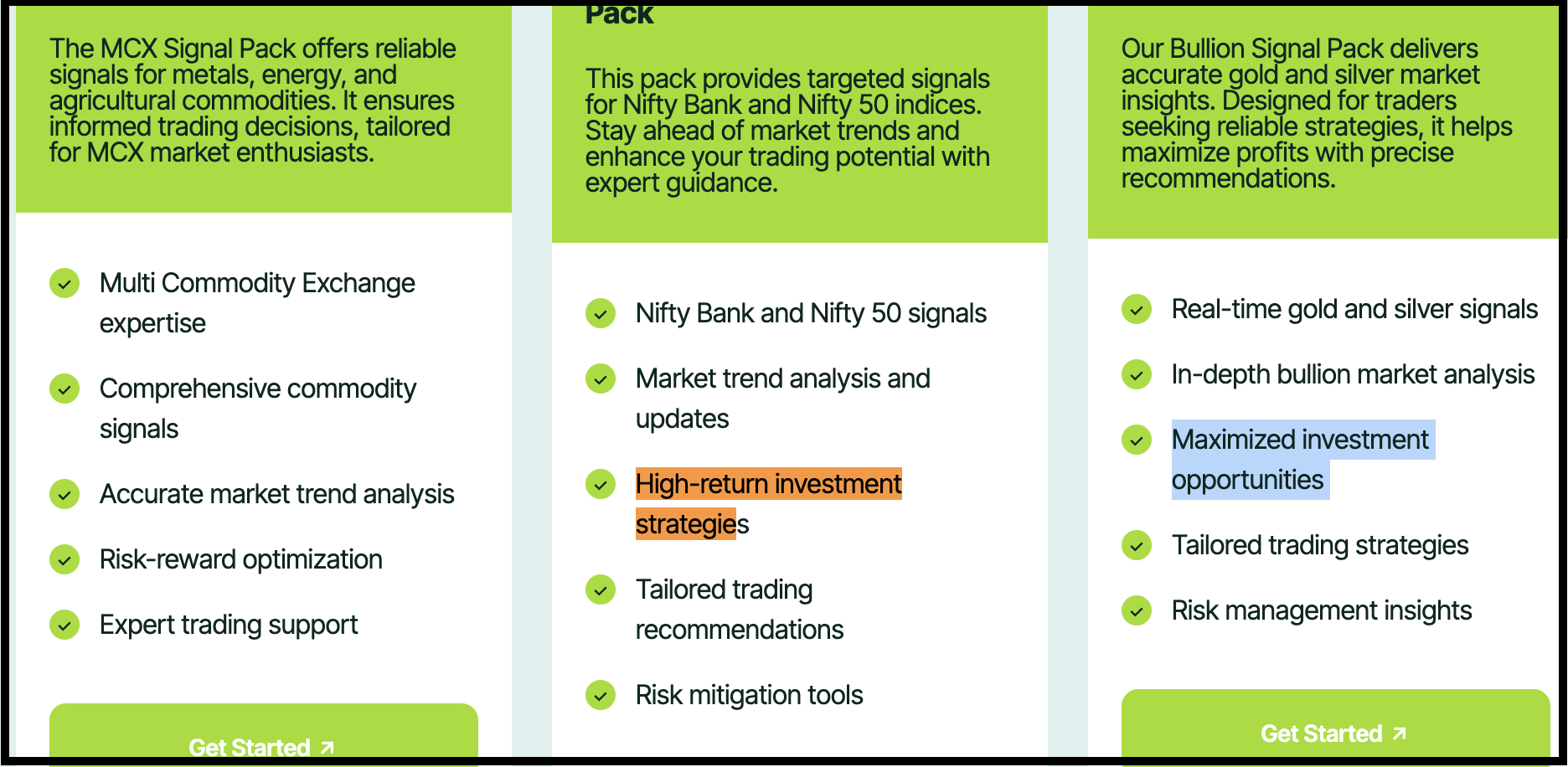
Some package descriptions use phrases including high-return investment strategies, maximized investment opportunities, and high profitability focus.
Language of this kind can create an expectation of returns that no research recommendation is in a position to guarantee, and it sits against the risk disclosures a Research Analyst is required to carry.
2. Repeated Claims of Accuracy and Reliability
The site repeatedly describes its signals as accurate, reliable, or precise.
Recommendations of any kind cannot guarantee an outcome, and claims of consistent accuracy are worth treating as marketing language rather than a performance figure, since no supporting track record accompanies them.

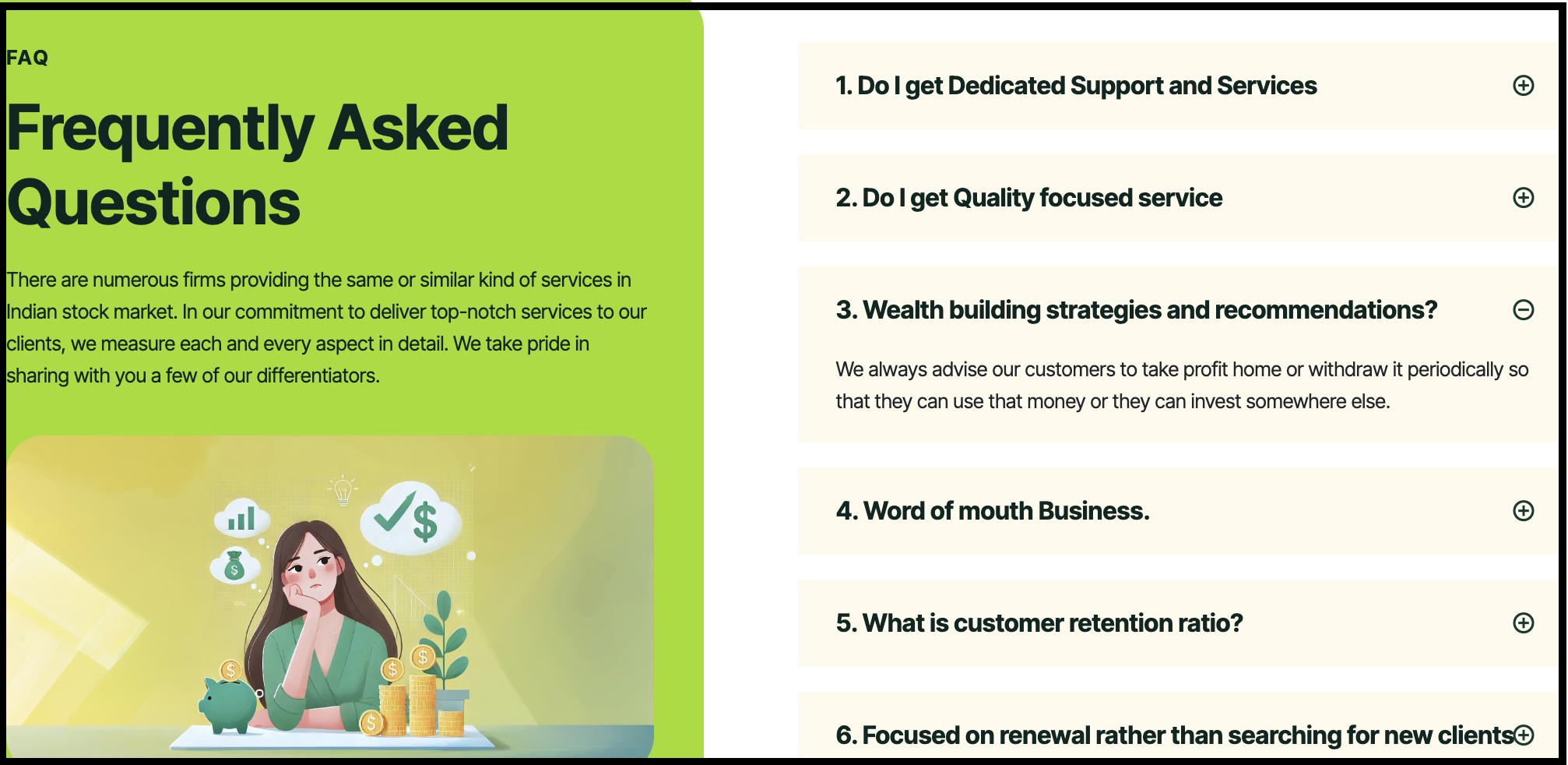
3. The FAQ Contains Assurances Rather Than Only Questions and Answers
Several FAQ entries function as service claims, covering dedicated customer support, quality-focused service, wealth-building strategies, periodic profit withdrawal advice, and an emphasis on customer retention and renewals.
An FAQ built partly around retention messaging reads differently from one built purely to answer a prospective client’s genuine questions.
4. One Person Holds Every Key Function
The website lists Rohit Yadav as Customer Care Head, CEO, and Compliance Officer.
For a single-person operation, this is common and not itself irregular, but it means the person handling your complaint is also the person the complaint concerns, and there is no independent internal check on how that complaint gets recorded or resolved.
That single point is the reason a written, dated record of any grievance matters more with a structure like this than it would at a larger firm.
Also Read: Omkara Capital, whose banner pairs a success guarantee with an unverified claim of 50 years of experience.
How to File a Complaint Against One Market Signal?
The refund policy and the fee cap edge cases give a complaint here firmer ground than an argument about signal accuracy would, since both turn on documented terms rather than performance.
Start by working out your actual annual spend if you hold more than one package, and compare it to ₹1,51,000.
If you were denied a refund citing the no-refunds policy, write to the RA email, citing the proportionate refund entitlement directly, and ask for it to be honoured in writing.
Describe the plan, the amount paid, the date of cancellation, and the exact response you received when you requested a refund.
Keep the sent record regardless of what comes back.
If the response is not satisfactory, escalation runs through a specific set of channels, and each one exists for a different stage of the dispute rather than as alternatives to pick from.
1. SEBI SCORES for the Formal Regulatory Complaint
Once a direct grievance goes unresolved, the complaint moves onto the regulator’s own platform.
The SEBI SCORES portal is where that filing happens, and a refund denial citing regulation by name gives the platform something concrete to act on.
2. SMART ODR for Conciliation if SCORES Does Not Resolve it
Where SCORES closes without a satisfactory outcome, the next stage is structured conciliation rather than a repeat complaint.
The SMART ODR login page covers how a conciliator gets assigned and what documents to bring into that session.
3. Stock Market Arbitration if Conciliation Does Not Settle it
When conciliation still does not produce a settlement, arbitration is the stage that ends in a binding outcome.
Stock market arbitration results in an award enforced through the exchange rather than negotiated with the analyst directly.
That covers each channel on its own, but none of them explain how to actually build and sequence a case from the first email onward.
If you want to know the full process in detail, check our guide complaint against SEBI registered research analyst.
Told you cannot get a refund under any circumstances?
We cite the exact proportionate refund entitlement your subscription is covered by, calculate what you are owed, and put the figure on record in a form the analyst has to respond to. Register with us for a free read on whether you have a documented claim.
Disclaimer
This page is based on One Market Signal’s own published material and the SEBI intermediary register, current as of September 2026, and alleges no wrongdoing since no SEBI order stands against the firm.
Registration details, pricing, and website content can change, so verify everything at source before acting. Treat this page as research, not legal or investment advice.
Conclusion
One Market Signal is a registered Research Analyst carrying INH000019044, active since December 2024, with a correctly stated scope on its own FAQ and a complaint record that reconciles cleanly for its most recent thirteen months.
Two things need a closer look before subscribing.
The refund policy states no refunds are given under any circumstances, which does not reflect the proportionate refund entitlement SEBI’s regulations actually provide.
And several packages breach the annual fee ceiling depending on the billing cycle, with two of the yearly plans priced right at the edge of the limit rather than comfortably inside it.
Before paying, decide which billing cycle keeps your annual total under ₹1,51,000, and if you ever need a refund, cite the regulatory entitlement directly rather than accepting the published policy as final.
Report. Recover. Stay Fraud Free.
Frequently Asked Questions
Yes. It is registered to One Market Signal, operated by Rohit Yadav, from 12 December 2024 and is perpetual. Confirm it directly on the SEBI register rather than relying on the website alone.
No. SEBI's regulations entitle you to a proportionate refund for the unexpired period on early termination regardless of what a firm's own terms state. Cite that entitlement directly if a refund is refused.
The MCX, Bullion and Comex/Forex packages breach ₹1,51,000 if renewed monthly for a full year, and MCX also breaches it on the quarterly cycle. All other quarterly and yearly cycles stay under the ceiling, though the MCX and Comex/Forex yearly plans sit within a few hundred rupees of it.
Ask directly which exchange or platform the underlying trades occur on. Currency derivatives on recognised Indian exchanges fall within SEBI's framework, while retail forex trading outside that route sits under separate RBI restrictions that apply to your own account regardless of who provides the signals.
The headline table is labelled January 2025 and has not been updated, while a separate monthly and annual trend table below it runs current through July 2026. The recent tables reconcile correctly with each other; the older headline table is simply stale.





 Add us as a preferred source on Google »

