

You opened an account with a bank-backed broker for safety. You picked YES Securities because YES Bank stood behind it.
Then the app stopped working precisely when a volatile session opened. Your stop-loss could not be placed.
Your portfolio screen went blank, and the customer care query got no answer. Sounds like something that happened to you?
Moreover, the SEBI adjudication record and the exchange complaint data confirm this is not just your experience.
This blog covers every complaint category, every penalty, and every step you can legally take, starting right now.
Yes Securities Complaints Overview
YES Securities (India) Limited (YSL) is a wholly owned subsidiary of YES BANK Limited, incorporated in 2013 and headquartered in Mumbai.
The broker holds SEBI Stock Broker registration INZ000185632.
This is the primary registration under which retail investors open trading and demat accounts.
YES Stock Trader is the broker’s primary mobile trading application, available on both Android (Google Play) and iOS (App Store).
It offers equity, F&O, currency, commodity, mutual fund, and IPO trading in a single interface.
However, Yes Securities app not working has become a persistent search term among traders due to issues reported since its earliest versions.
According to Google Play reviews spanning 2021 through 2024, users report the app failing during market hours, missing basic portfolio features, and producing statements that are not usable for tax filing.
Types of YES Securities Complaints Clients File
The exchanges formally handle the following categories of investor complaints against registered brokers.
This data is from the financial years from 2022–23 to 2025–26.
| Type | Description of Complaint Type | Count |
| Type I | Non-receipt / delay in payment | 10 |
| Type II | Non-receipt / delay in securities | 7 |
| Type IV | Unauthorised trades/misappropriation | 34 |
| Type V | Service related | 86 |
| Type VI | Closing out / squaring up | 2 |
| Type VIII | IPO related | 4 |
| Type IX | Others | 28 |
The IGRC can issue directions to the broker and, critically, can seek recovery from the broker’s exchange-deposited funds.
Therefore, the IGRC remains accessible to investors even when the broker is unresponsive, and no legal representation is required to appear before it.
YES Securities Exchange Complaint Data
The following data is sourced from NSE’s publicly available complaint monitoring records for YES Securities (India) Limited.
| Financial Year | Active Clients | Complaints Filed | Complaint % | Resolved | Unresolved | Arbitration Cases |
| 2025–26 | 91,401 | 79 | 0.086% | 65 | 14 | 0 |
| 2024–25 | 75,282 | 55 | 0.070% | 55 | 0 | 0 |
| 2023–24 | 71,124 | 36 | 0.050% | 35 | 1 | 0 |
| 2022–23 | 71,124 | 21 | 0.020% | 21 | 0 | 0 |
The numbers look modest in absolute terms. However, the direction they are moving in, especially in 2025–26, demands a much closer reading.
What exactly is happening here?
Complaints Have Almost Quadrupled in Three Years
From 21 complaints in 2022–23 to 79 in 2025–26, the volume has grown by 276% in three years.
Meanwhile, the active client base has grown by only about 28% in the same period.
Therefore, complaints are increasing at more than ten times the rate of client growth, a pattern that signals service deterioration, not scale effects.
Unresolved Complaints Have Suddenly Appeared in Force
In 2025–26, 14 out of 79 complaints remain unresolved, a resolution rate of only 82.28%. This is a dramatic drop from 100% resolution in 2024–25 and 2022–23.
Consequently, the 14 investors with unresolved cases are caught between a broker that has not resolved their grievance and an exchange process they may not yet have initiated.
Moreover, SEBI’s own adjudication order was based on findings from a joint inspection, not from individual investor complaints, which confirms that systemic problems can exist even when complaint resolution statistics look clean.
YES Securities SEBI Order
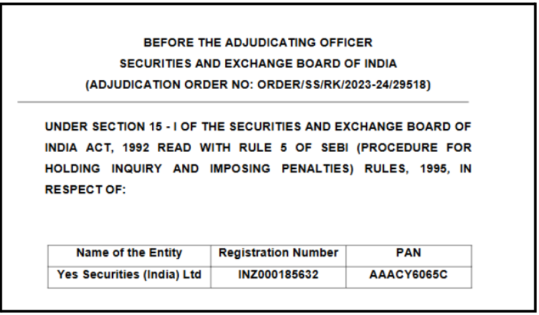
According to SEBI Adjudication Order No. ORDER/SS/RK/2023-24/29518, dated September 27, 2023, SEBI imposed a penalty of ₹5,00,000 on YES Securities (India) Limited under Section 15HB of the SEBI Act, 1992.
Key Violations by YES Securities
The proceedings were initiated based on a joint inspection of YES Securities conducted by SEBI along with NSE, BSE, and MCX.
Five specific violations were established:
Violation 1: Late and Incorrect Settlement Statements
According to the adjudication order, YES Securities sent quarterly account retention statements to 30 clients beyond the 5-day deadline mandated by SEBI circular.
Furthermore, in 4 additional instances, the statements were sent to completely wrong email addresses, meaning those investors never received documentation of their own account settlements.
Violation 2: Wrong Margin Reporting and Short Collection
SEBI found incorrect reporting of client margin of ₹2,083 and confirmed a shortfall in margin collected from clients in MTF positions.
In one case involving PAN No. ACVPM6312N, YES Securities acknowledged a margin shortfall of ₹24,48,305.86 on April 7, 2022.
Violation 3: MTF Leverage Limits Exceeded Across 14 Instances
According to the order, YES Securities exceeded the maximum allowable exposure under the Margin Trading Facility.
The average over-exposure per instance was ₹39.15 crore.
The broker had been counting client cash collateral as part of its exposure calculation, a method the SEBI circular does not permit, as only borrowed funds and 50% of net worth are allowable.
Violation 4: Net Worth Overstated to the Exchange
According to the order, YES Securities reported its net worth to the exchange as ₹96,86,62,991 as of September 30, 2022.
The inspection team’s calculation arrived at ₹94,97,17,920, a difference of ₹1,89,45,070.
Violation 5: Incorrect Enhanced Supervision Data Reporting
YES Securities submitted incorrect weekly enhanced supervision data to the exchange on 3 out of 5 sample dates, with discrepancies in margin figures for credit balance clients.
These five violations, taken together, establish a pattern of compliance failures across fund settlement, margin management, leverage controls, net worth reporting, and data submission, all confirmed in a formal order by SEBI’s Adjudicating Officer.
Penalty
SEBI imposed a monetary penalty of ₹5,00,000 on Yes Securities (India) Ltd under Section 15HB of the SEBI Act for regulatory violations.
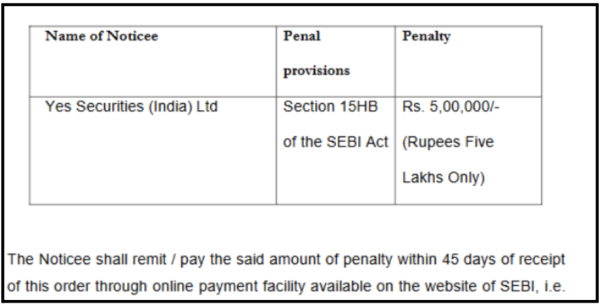
The company was directed to pay the penalty within 45 days through SEBI’s official payment mechanism.
What to Learn from This Case?
- A broker exceeding leverage limits by ₹39.15 crore on average across 14 dates is not a minor reporting error, it is a structural compliance failure
- Clients availing MTF from YES Securities during this period may have been at greater risk than the broker’s disclosed figures suggested
- Sending settlement statements to the wrong email IDs is not just a clerical inconvenience; it deprives clients of their right to know the status of their own funds
- SEBI’s inspection was joint, involving NSE, BSE, and MCX, meaning the violations were validated across multiple regulatory bodies
- A ₹5 lakh penalty is the minimum penalty under Section 15HB; it does not represent the ceiling of regulatory concern
YES Securities User Reviews
These user reviews highlight recurring issues with app performance, transparency, and overall trading experience.
1. App Failure, Missing Features, and Poor Performance
The user reports that the app frequently fails during crucial trading hours and runs very slowly throughout the day.
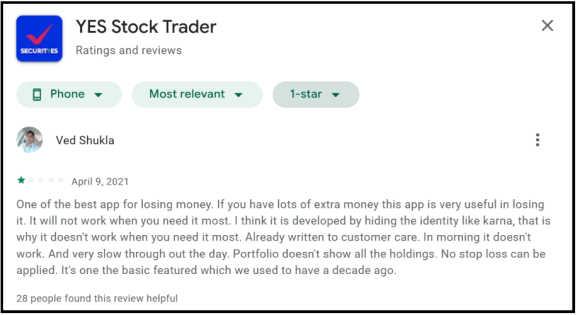
Basic features like stop-loss and complete portfolio visibility are missing, making trading unreliable.
This creates a high-risk situation where users cannot manage positions when it matters most.
2. Incomplete Statements and Non-Functional Features
The user highlights that downloaded statements lack key details like transaction dates and capital gains, making tax reporting difficult.
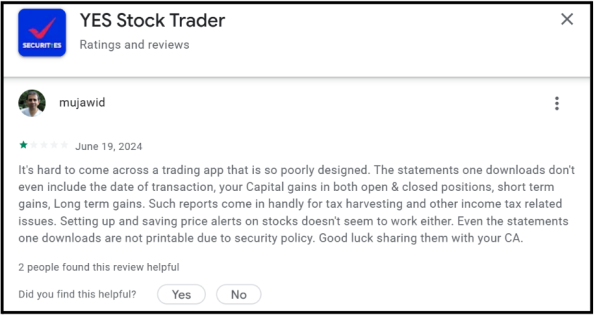
Additionally, features like price alerts do not work, and statements are not printable. This limits both usability and compliance for investors managing their finances.
3. Hidden Charges and Misleading Brokerage Commitments
The user claims that brokerage charges were increased significantly after account opening without clear communication. They also allege that the firm relies on fine print to justify changes, creating a trust gap.
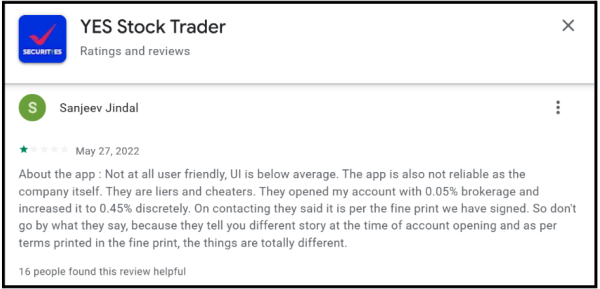
This raises concerns about transparency and fair disclosure practices.
4. Limited Data Visibility
The user finds the app difficult to use, with limited ability to track holdings and key metrics like P/L and total value.
They compare it unfavourably to other platforms, stating they must rely on external apps to make decisions.
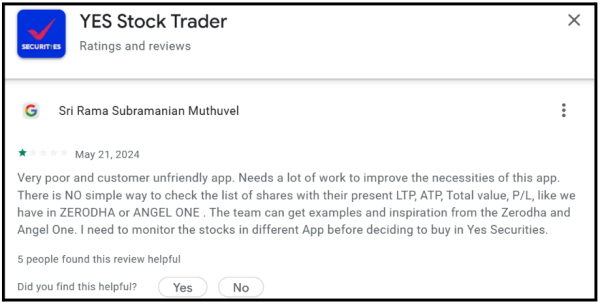
This reduces user confidence and overall platform reliability.
When to Take Action Against a Broker?
Waiting for a problem to resolve itself is how investors lose money and miss legal deadlines.
Here is when you must act immediately:
- Brokerage Changed Without Written Prior Notice: If your brokerage rate changed after account opening and you received no formal written communication before the change, raise a formal written complaint immediately.
- App Failure During Market Hours Causing Financial Loss: If a platform outage or crash prevented you from placing, modifying, or closing an order and that inaction caused a measurable loss, document the exact time, error, and loss amount before the trading day ends.
- Statements That Are Incomplete, Delayed, or Wrong: If your quarterly account statement arrived late, went to a different email, or omits legally required data like capital gains breakdowns, file a written complaint with the broker and retain the evidence.
- Net Worth or Financial Reporting Discrepancies: If information disclosed to you as a client about the broker’s financial standing, capabilities, or capacity appears inconsistent with what the broker reports to the exchange.
- No Response to Written Complaint After 30 Days: Thirty days is the standard deadline for a broker to respond to a formally filed written grievance. After that, every additional day you wait is a day closer to losing a procedural right to escalate.
The guiding principle is this: the market gives you limited time to recover money. Deadlines are real, and silence from a broker is never a resolution.
How To Lodge a Complaint Against Stock Broker Online?
When issues with a broker start affecting your funds or trades, taking timely and structured action becomes critical.
Following the correct escalation process ensures your complaint is formally recorded and increases your chances of a resolution.
Here are the steps to file complaint against stock broker:
Step 1: File a Written Complaint Directly with YES Securities
Send your complaint by email to the Compliance Officer. Always use email, not calls, to create a documented trail.
Include your client ID, the nature of the grievance, the specific dates, and the exact amount in dispute.
The broker is required to respond within 30 days under SEBI’s investor grievance framework.
Step 2: File Complaint in SCORES
If the issue is still unresolved, investors can raise a SEBI complaint through SEBI’s SCORES platform. This official portal allows you to register grievances against market intermediaries.
Once submitted, the complaint is forwarded to the broker, and you can monitor its progress directly on the platform.
Step 3: Escalate Through the Exchange
If there is no satisfactory resolution, you can escalate the matter to the stock exchange by using its investor grievance mechanism, such as filing a complaint with NSE.
Keeping proper records and reporting the issue on time can strengthen your case, especially in technical trading disputes.
Step 4: Lodge a Complaint with SMART ODR
If the matter develops into a formal dispute, for instance, when compensation is claimed and denied, it can be taken to the SMART ODR system.
This platform enables mediation and conciliation between investors and brokers. If the dispute is still not resolved, it may proceed further to arbitration in the stock market.
Need Help?
Raising a complaint against a broker, especially one backed by a large financial institution, can feel like shouting into a void.
You may have already emailed, called, and filed, only to watch your money stay stuck. Many investors lose their right to recover not because their case was weak, but because they escalated in the wrong sequence or missed a regulatory window.
Register with us if you are facing issues with YES Securities or any other broker. We will help you take the right steps at the right time.
Conclusion
YES Securities (India) Limited is a SEBI-registered broker (INZ000185632), Research Analyst (INH000002376), and Investment Adviser (INA000007331), operating under the YES BANK umbrella since 2013.
The picture this data draws is specific: YES Securities complaints have grown by 276% in three years while the client base grew only 28%; 14 complaints remain unresolved in 2025–26 alone after two consecutive years of full resolution.
Real investor reviews add platform failures, including repeated instances of app glitches, along with concerns like YES Securities unauthorised trading, brokerage hikes without notice, and statement quality issues that affect actual tax compliance.
For existing clients, document every grievance in writing and know your escalation path before it becomes urgent.
For investors evaluating YES Securities, this regulatory and complaint record deserves the same scrutiny as the brand’s credentials.





 Add us as a preferred source on Google »

