

Quick Summary
Ayushi Chauksey runs Ayushi Chauksey Adviser Private Limited from Mumbai, currently holding SEBI Investment Adviser registration INA000019707 and Research Analyst registration INH000021687. Her earlier individual registration, INA000008075, was the subject of a SEBI Adjudication Order in October 2022 imposing a ₹7 lakh penalty, followed by a Final Order in September 2023 restricting her from onboarding new clients for one month. The inspection uncovered violations across eight categories, from undisclosed branch offices to incomplete records for 283 clients. This blog covers her background, both registrations, and every violation SEBI documented in full.
SEBI registration is supposed to be a safety net for investors, a seal of credibility telling you an adviser is verified and regulated.
But what happens when a SEBI-registered adviser herself comes under regulatory scrutiny? That’s exactly where Ayushi Chauksey adviser becomes worth understanding in detail.
This page covers who she is, what her current registrations actually confirm, and the full SEBI enforcement record tied to her earlier individual licence.
Ayushi Chauksey
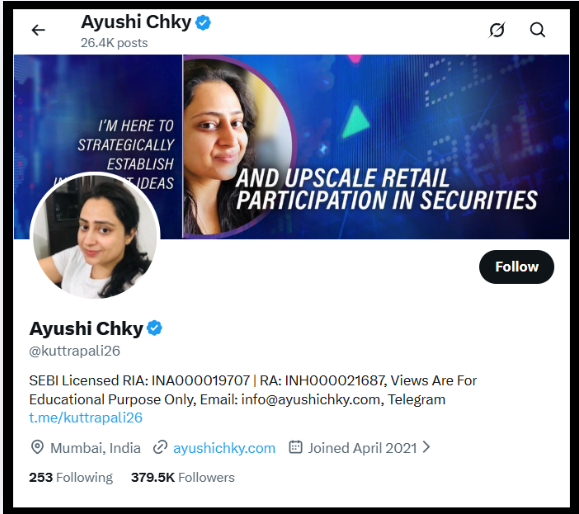
Ayushi Chauksey runs a financial advisory firm out of Mumbai, operating as Ayushi Chauksey Adviser Private Limited and going by the handle “ayushichky” across social media.
She built her investor-facing brand across Telegram, Twitter, and YouTube, and on X specifically posts under the handle @kuttrapali26, sharing stock recommendations and market insights with both free and paid followers.
The firm offers subscription-based advisory products: Quant Matrix, Wealth Matrix, Portfolio Review Services, and a non-advisory Learning Matrix for education-focused subscribers.
Before the company existed, she operated as an individual practitioner, running the business earlier under the name investmentbulls.com as a sole proprietorship.
She also currently serves as COO at Investment Bulls, alongside running her own firm.
Is Ayushi Chauksey SEBI Registered?
Yes, and there’s an important distinction worth understanding clearly before anything else on this page.
Ayushi Chauksey Adviser Private Limited currently holds two active registrations: Investment Adviser registration INA000019707 (non-individual, perpetual validity) and Research Analyst registration INH000021687.

The firm also holds BSE enlistment number 2224.
Neither of those is what SEBI actually took enforcement action against. The orders covered in detail below relate to her earlier individual registration, INA000008075, the licence she held before the company was formed.
That registration, and the period of operations under it, is entirely separate from what she currently operates under today.
This distinction matters because it means the enforcement record below describes her conduct as an individual adviser in an earlier period, not her current corporate entity’s conduct.
Both facts are true and worth holding in mind at the same time: current registration is genuine, and past enforcement is documented; neither cancels out the other.
Also Read: Arthya Wealth has genuine SEBI licences, but its own PMS page gets the registration number wrong.
SEBI Action Against Ayushi Chauksey Investment Advisor
SEBI conducted a formal, physical inspection of her advisory operations on September 18-20, 2019, covering the period April 1, 2018 to March 31, 2019.
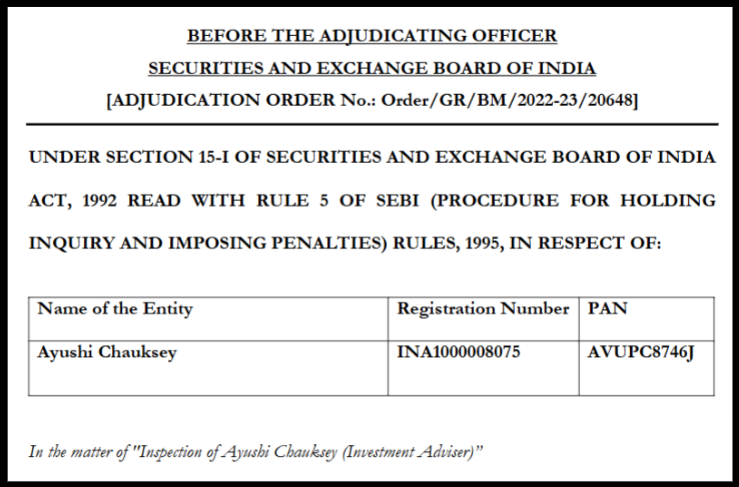
The inspection found violations across eight distinct categories, each drawn directly from the published Adjudication Order dated October 21, 2022.
1. Undisclosed Branch Offices
Ayushi Chauksey operated a branch in Indore with an employee, Mr. Ved Sharma, listed a “Dalal Street, Fort, Mumbai” address on her website, and mentioned a Goa address for a proposed training institute, none of which were disclosed to SEBI.
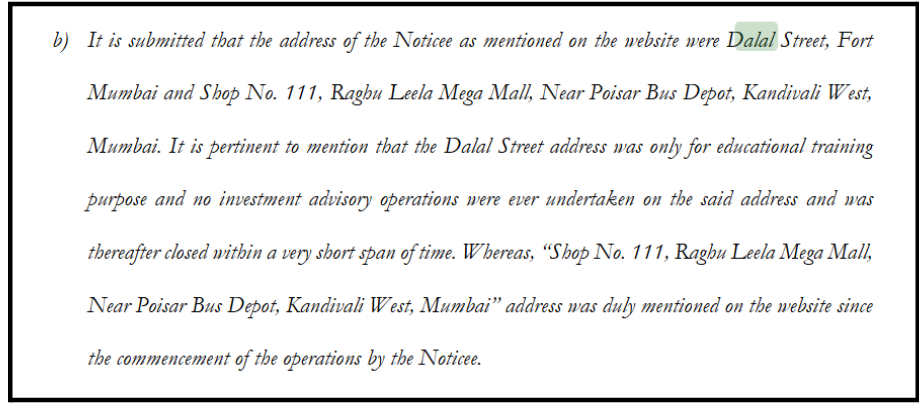
Under Regulation 13(b) of the IA Regulations, an adviser must inform SEBI in writing of any material change in information.
Maintaining undisclosed offices across three separate locations, not just one overlooked address, is a direct and repeated violation of that requirement, not an administrative oversight.
2. Failure to Maintain Valid NISM Certification
Her NISM Level 1 (X-A) certification expired in July 2018, and her NISM Level 2 (X-B) certification expired in October 2018.
She continued providing advisory services without valid certifications for over three years, renewing Level 1 only in August 2021 and Level 2 in September 2021.
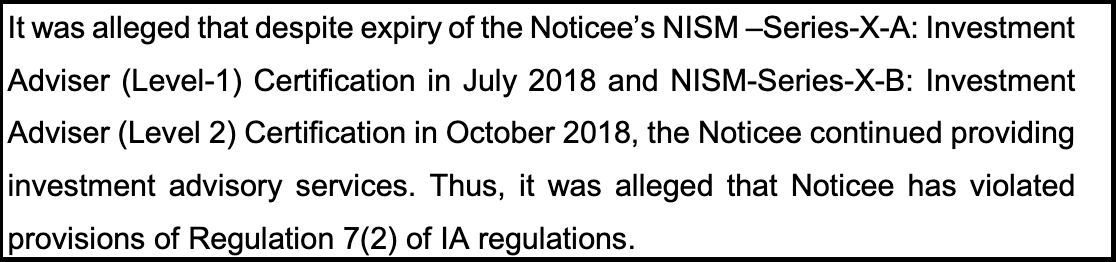
Under Regulation 7(2) of the IA Regulations, every individual adviser must maintain valid certification continuously, at all times, not intermittently.
A three-year gap between expiry and renewal means the person advising clients throughout that entire period was not legally qualified to do so under the regulator’s own standard; this was treated by SEBI as a sustained compliance failure, not a technical lapse someone simply forgot to renew.
3. Not Using “Investment Adviser” Consistently in Communications
Under Regulation 13(d), the exact term “Investment Adviser” must appear in every client communication, not just introductory messages sent at the start of a relationship.
This applies uniformly across emails, SMS, and instant messaging platforms.
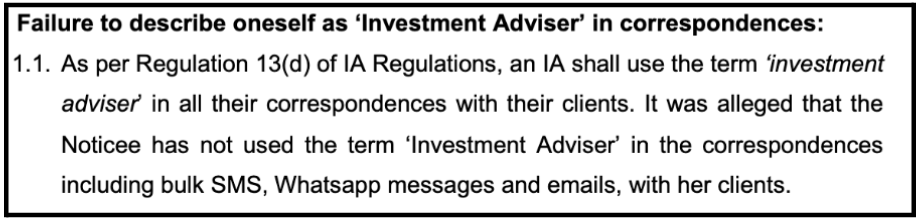
SEBI found she did not use the term consistently in bulk SMS and WhatsApp broadcasts sent to clients.
She claimed to have mentioned her status in introductory WhatsApp messages and in the opening paragraph of emails, but couldn’t provide documentary evidence supporting that claim across every channel she used.
SEBI confirmed the regulation requires the term in every correspondence, and upheld the violation, while noting it was technical in nature compared to some of the other findings.
4. Unreasonable and Excessive Fees
This was the most significant violation in the entire order.
Her stated fee structure was ₹30,000 per product per individual per month, with discounts offered depending on the subscription tenure a client chose.
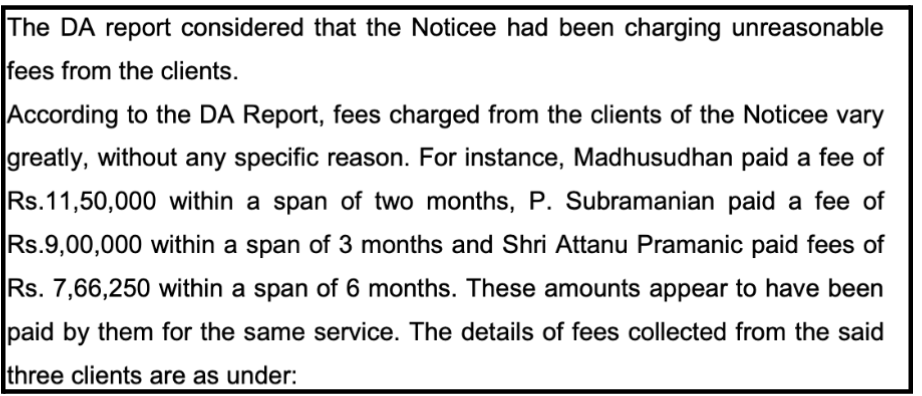
But the actual fees paid by different clients during the same period were not uniform.
SEBI’s inspection found variations across clients, including Madhusudhan, P. Subramanian, and Attanu Pramanic, with annualised charges reaching nearly 28-42% of invested capital, far above what any reasonable fee structure should approach, let alone what regulation permits.
She claimed refunds had been issued to some affected clients, but SEBI found these claims unverifiable, no supporting bank statements existed, and no client confirmations backed up the assertion.
The disparity in fees charged, combined with the inability to document claimed refunds, raised direct concerns about whether the fee structure was genuinely “fair and reasonable” as IA Regulations require, or simply applied inconsistently at the firm’s discretion.
5. Inadequate KYC and CKYC Compliance
During the entire inspection period, she held no registration with any KYC Registration Agency (KRA), the mandated system for authenticating client identity documents.
She registered with a KRA only in February 2021, roughly two years after the inspection period had ended.
Her CKYC registration request was submitted in June 2019, itself after the inspection period had already closed in March 2019. Instead of using the mandated system, she conducted KYC manually by collecting documents via email.
When she attributed this gap to technical difficulty, SEBI rejected the explanation as unsupported by any actual evidence.
6. Inadequate Risk Profiling and Suitability Failures
The risk profiling process had multiple, separately documented failures. Under Regulation 16 of the IA Regulations, risk questionnaires lacked client signatures entirely.
No supporting documents existed to verify client income, existing investments, or outstanding liabilities, the basic financial picture any adviser needs before recommending anything.
The forms themselves carried a “Submit” button, suggesting they were designed for electronic filing, but were instead physically filed on paper, raising a genuine question about who actually completed them and when.
Risk profiles, once created, were never communicated back to the clients they described.
Most seriously, SEBI found she advised high-risk Level 3 Stock Futures to moderate-risk clients Mr. Abdul Gaffar and Mr. Hemant Pataskar, despite clear suitability concerns that should have ruled out that recommendation entirely.
This wasn’t a documentation gap alone; it directly connects to the next violation.
7. Failure to Comply With Suitability Norms
Closely tied to the risk profiling failures above, Regulation 17 requires every recommendation to be appropriate to that specific client’s individual risk profile.
Advice suitable for an experienced, high-risk trader should look completely different from advice given to a conservative investor saving for retirement.
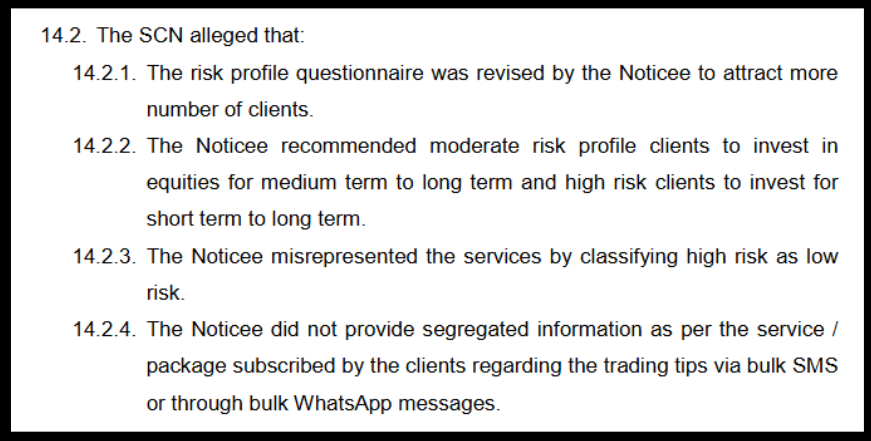
Because the underlying risk profiling process itself was compromised, unsigned, undocumented, and never communicated back, the suitability framework built on top of it was consequently deficient too.
The Level 3 Stock Futures recommendations made to Gaffar and Pataskar are the clearest documented example of this failure playing out in practice, not a hypothetical risk.
8. Record Maintenance Failures and Non-Cooperation With Inspection
Across all 283 clients she onboarded during the relevant period, record-keeping was found severely deficient: incomplete KYC data, missing risk profiles, absent suitability assessments, no signed and dated rationale explaining why any specific advice was given, and no proper client register maintained at all.
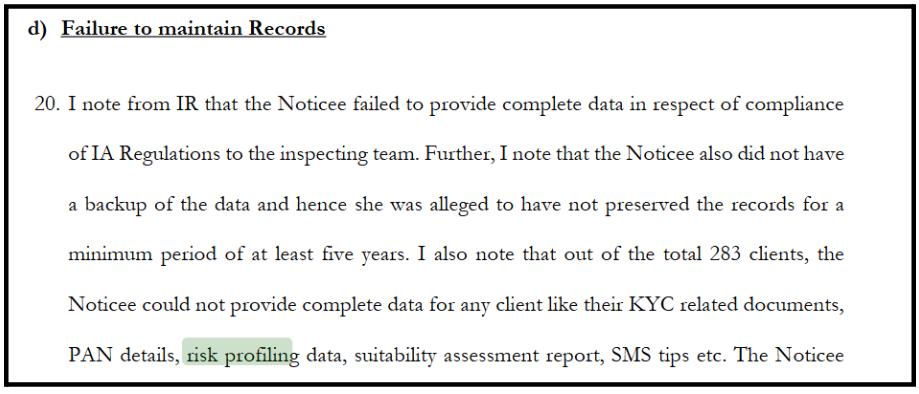
Her explanation that a server crash had caused the missing records was unsupported by any evidence SEBI could verify. Inspectors also noted missing compliance audits and records that weren’t digitally signed as required.
Separately, SEBI’s inspection team reported real difficulty obtaining requested documents and information within expected timelines during the September 2019 inspection itself.
She did later submit a detailed response to the formal Show Cause Notice, but the inspection period itself showed genuine lapses in timely cooperation, a pattern that compounds every other finding above rather than standing apart from them.
Also Read: SEBI action against Wealthmax Solution, where no call recordings, no emails, and no SMS records were preserved anywhere either.
Penalty and Final Order on Ayushi Chauksey
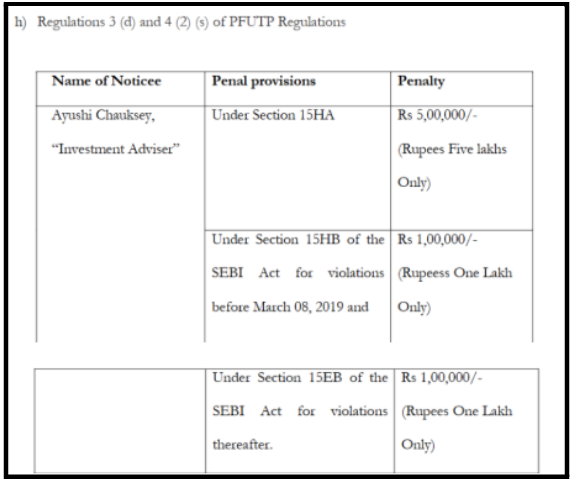
The Adjudication Order, dated October 21, 2022, imposed a total monetary penalty of ₹7,00,000, split as ₹5,00,000 under Section 15HA, ₹1,00,000 under Section 15HB, and ₹1,00,000 under Section 15EB of the SEBI Act, 1992, three separate statutory provisions applied together to reflect the range of violations found.
A separate Final Order followed in September 2023, issued by SEBI’s Whole Time Member under Section 12(3) of the SEBI Act and Regulation 27 of the Intermediaries Regulations.
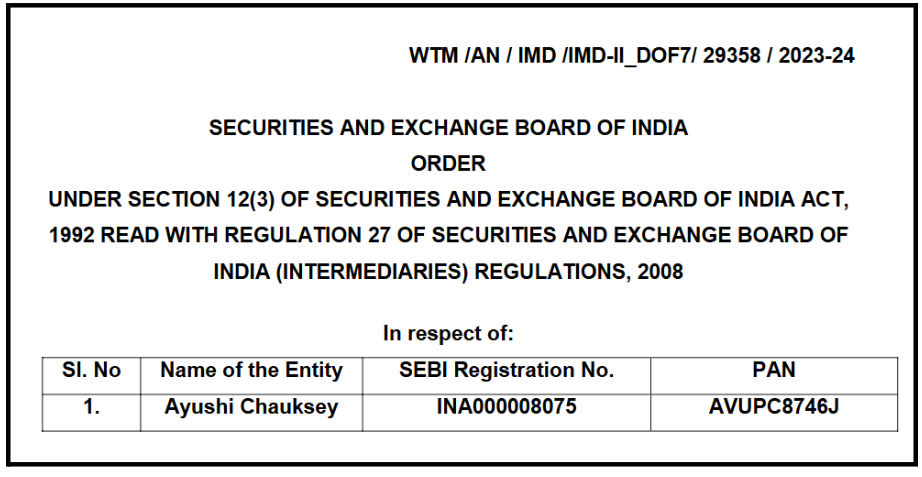
This order arose from a distinct enquiry proceeding, specifically examining whether her registration itself should face further consequences beyond the monetary penalty already imposed.
Despite being given three separate hearing opportunities, on May 26, June 13, and July 3, 2023, she failed to appear on any of them.
The Whole Time Member confirmed every violation identified in the 2022 order, the certification gap, the fee irregularities, and the risk profiling failures among them, and held that regulatory action on the registration itself was warranted.
Rather than cancelling the registration outright, which SEBI does have the power to do, the regulator chose a more measured, corrective step: restraining her from onboarding new clients or accepting new assignments for one month from the date of the order.
Facing something similar with your own adviser?
We review your specific documentation and communications to identify exactly which SEBI provisions apply to your case.
What Investors Must Keep in Mind?
This case highlights principles worth applying to any SEBI-registered adviser you’re evaluating, not just this one specifically.
- A valid NISM certification is required at all times. An adviser operating without one isn’t legally authorised to advise, regardless of how active or professional their registration number and website look.
- Fees are capped at ₹1.25 lakh per annum per family, or 2.5% of AUA, whichever framework applies. Document every payment before subscribing, and treat overlapping subscriptions paid on consecutive days as a specific red flag for fee manipulation.
- Your risk profile must carry your signature and be delivered to you in writing. An unsigned or undelivered profile isn’t a minor gap; it’s itself an independently reportable violation.
- Demand a suitability assessment in writing before acting on any recommendation, one that clearly shows how the specific advice matches your actual, documented risk level.
- Check SEBI’s enforcement orders database independently before engaging any adviser. Past regulatory action, when it exists, often reveals far more than marketing material or a polished website ever will.
Beyond the regulatory record, it’s also worth checking what limited public sentiment exists, current complaint disclosures, review counts, and any social media commentary, before deciding how much weight to give this adviser’s marketing.
That ground is covered separately on our Ayushi Chauksey reviews page.
Also Read: ResearchInn Investment Advisor has ₹1,78,180 yearly plans that raise a direct SEBI fee-cap concern.
Where to Report Ayushi Chauksey If You’ve Faced an Issue?
If your own experience matches any of the violations documented above, excessive fees, an unsigned risk profile, or advice given without valid certification, there’s a formal path to escalate it.
Start with a SEBI SCORES portal complaint once you’ve raised the issue directly with the firm and given them time to respond.
If that doesn’t resolve things, SMART ODR login provides a structured, regulator-supervised mediation route.
If mediation doesn’t end in a resolution, formal arbitration in share market remains available as the final, binding step.
For the complete step-by-step process specific to an Investment Adviser, our guide on complaint against sebi registered investment advisor covers every stage in full
Conclusion
Ayushi Chauksey currently holds genuine, active SEBI registrations as both an Investment Adviser and Research Analyst. That fact is real and independently verifiable; nothing here disputes it.
What’s equally real is the documented enforcement history tied to her earlier individual registration: a ₹7 lakh penalty, a one-month client restriction, and violations touching nearly every foundational requirement of the Investment Adviser Regulations, from certification and KYC to fees, risk profiling, suitability, record-keeping, and cooperation with regulators.
Registration confirms existence within the regulatory framework. It doesn’t confirm conduct within it.
Verify certification status independently, demand documentation in writing before you pay anything, and never let professional branding substitute for actually checking the enforcement record.
Report. Recover. Stay Fraud Free.
Yes. Her firm holds active Investment Adviser registration INA000019707 and Research Analyst registration INH000021687, plus BSE enlistment 2224. No. SEBI's enforcement orders relate to her earlier individual registration, INA000008075, which she held before incorporating her current private limited company. A ₹7,00,000 monetary penalty in October 2022, split across three sections of the SEBI Act, followed by a one-month restriction from onboarding new clients or accepting new assignments in September 2023. Eight, spanning undisclosed branch offices, lapsed NISM certification, inconsistent client communication, excessive fees, inadequate KYC, risk profiling and suitability failures, incomplete records for 283 clients, and non-cooperation during inspection.Frequently Asked Questions





 Add us as a preferred source on Google »

