

Quick Summary
An investor paid roughly Rs. 3,35,000 to DG Share Market Research across four stages, to three representatives, into both corporate and personal accounts. He had no written agreement and incomplete payment records. The firm’s first offer was Rs. 83,000, covering only what its corporate account had received. The settlement closed at Rs. 1,35,000. Three things moved it: a UPI transaction reference in a notification, a WhatsApp contact label carrying the firm’s name, and a four-contact pattern too coordinated to disclaim. This page shows you how each piece was built and why the first offer was not the last.
The investor who came to us had already accepted that most of the money was gone.
He had paid across multiple stages, to multiple representatives, into multiple accounts, and by the time he reached out, the total had grown to a number he did not want to say out loud.
What he did not know was that the evidence he had preserved, almost by accident, was more useful than he realised.
The firm’s first offer was Rs. 83,000. That is not where this ended.
What the Investor Had When He First Contacted Us
He had paid across four stages.
The initial subscription. A top-up after the first trades did not perform. A recovery package was offered by a second representative after the first one became less responsive.
A final payment to a third representative who promised an exit strategy.
The total paid across all four stages was approximately Rs. 3,35,000 when trading losses were included alongside the fees themselves.
Of that, he had documentation for some payments and not others.
He had WhatsApp screenshots from two of the three representatives. He had bank transfer records for two of the four payments.
For one payment, made through a UPI transfer to a personal ID, he had the transaction notification but had not taken a full screenshot of the payment confirmation at the time.
He had no written subscription agreement. No service document. No email confirmation of what was promised before any payment was made.
When investors come to us in this situation, the first instinct is often to focus on what is missing. The missing agreement. The missing call recording. The missing receipt.
What we did here was the opposite. We started with what existed and built the chain from there.
How Was the Evidence Organised?
The first step was a complete inventory.
Every WhatsApp screenshot, every bank statement page, every UPI notification, every trade confirmation, every email. We did not decide what was useful yet. We collected everything first.
From that inventory, three categories emerged.
Each answers a different question, and a case needs all three: where the money went, what was said to get it, and what happened afterwards.
1. Payment Proof
Two bank transfers were fully documented with payee names, amounts, and dates.
One of those transfers went to a corporate account in the firm’s name. The other went to a personal account in an individual’s name.
The UPI payment had a transaction reference number in the notification, which was enough to trace the transfer through the investor’s bank statement even without the full payment screenshot.
2. Conduct Proof
The WhatsApp conversations from two representatives contained specific trade instructions with quantities and lot sizes.
One conversation contained a message promising that losses from the previous recommendations would be recovered through the next set of trades.
A second message in the same conversation described a time-limited opportunity requiring immediate additional payment to access.
Both of these messages were from accounts identified with the firm’s name in the contact label.
3. Outcome Proof
The investor’s trading account statement showed every trade executed during the subscription period, the dates, the instruments, and the net result.
We mapped the trade instructions in the WhatsApp messages against the actual trades in the account to show the direct connection between what the representatives instructed and what happened in the account.
The payment to the personal UPI account was the most important piece to trace correctly.
The representative who received that payment had identified himself on WhatsApp as a senior analyst at DG Share Market Research. His contact label in the investor’s phone carried the firm’s name alongside his personal name.
The UPI ID that the payment went to was different from the firm’s corporate account.
We used the combination of the WhatsApp identification, the transaction reference from the notification, and the bank statement entry to link the personal account payment back to a named individual who had held himself out as a firm representative.
What We Filed and What the DG Share Market Said?
The SMART ODR filing covered all three categories of evidence.
The complaint description laid out a chronological sequence from first contact through each of the four payment stages, referencing each piece of evidence by document name and date.
DG Share Market’s initial response acknowledged the corporate account payments.
The firm admitted receiving Rs. 83,000 through the corporate account and offered to settle for that amount.
The personal account payments and the trading loss aspect of the dispute were characterised in their response as outside the firm’s liability.
The firm’s position was that it could not be held responsible for payments made to individuals acting outside their authorised scope.
This is the point where most investors accept the first number.
The firm has admitted something, offered something, and the investor is tired. Rs. 83,000 felt like something after months of trying to get any response at all.
We did not accept it.
Why Was the Rs. 83,000 Offer Not the End?
The firm’s argument that it bore no liability for the personal account payments rested on characterising those payments as the actions of individuals acting outside their scope.
That argument had a problem.
The individuals who received those payments had used the firm’s name, the firm’s WhatsApp contact identity, and the firm’s service structure to solicit them.
The principle of vicarious liability in the context of SEBI-registered intermediaries is not ambiguous. A registered entity is accountable for its registered operations.
When its representatives, operating under the firm’s identity and brand, collect payments from investors in the course of providing the firm’s services, those payments do not become the personal liability of the individuals simply because they went to a personal account.
We presented this position to the conciliator through a formal written submission during the renegotiation stage.
The submission included the WhatsApp contact labels showing the firm’s name associated with each representative, the transaction references showing the payments, the bank statement entries confirming receipt, and the trade instructions showing these individuals were actively providing the firm’s service at the time of each payment.
The submission also referenced the pattern across all four contacts.
The initial representative. The top-up contact. The recovery contact. The exit contact.
Each one came in sequence as the investment deteriorated. Each one was identified as part of the same operation.
The pattern itself was part of the argument.
Which of those representatives can be tied back to the registered entity is a question the ownership record answers, and our page on the DG Share Market Research owner name sets out who is confirmed and who is not.
How did the Settlement Reach Rs. 1,35,000?
The conciliator reviewed both submissions.
The firm’s position was that Rs. 83,000 was the limit of its confirmed liability.
Our position was that the personal account payments, traced to the named representative through the UPI reference and the WhatsApp identification, were also the firm’s liability.
The conciliator did not issue a formal ruling on the liability question at the conciliation stage.
What the conciliator did was reflect the strength of the evidence back to both parties and facilitate a renewed negotiation.
The firm moved from Rs. 83,000 to Rs. 1,35,000.
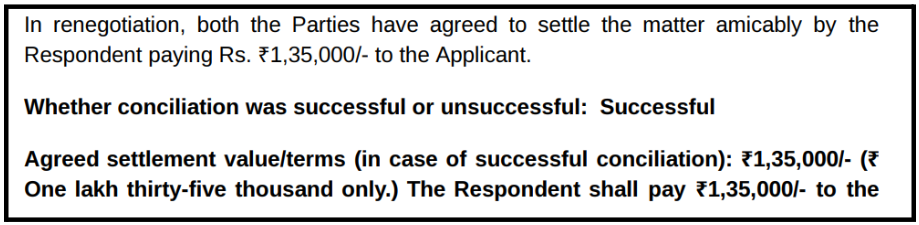
The settlement was documented in the conciliation record with a 7-day payment window. Payment was received within that window.
The gap between Rs. 1,35,000 and the total amount paid across all stages reflects the limit of what the documentation could prove at conciliation.
The trading losses, which formed the larger part of the total, require a different and more complex evidentiary chain to recover.
The fee recovery, which is what SEBI’s complaint framework is most effective for, was the basis for the Rs. 1,35,000.
What Does This Case Show About Evidence?
Three specific things made the difference between Rs. 83,000 and Rs. 1,35,000 in this case.
None of them was an agreement or a receipt.
All three were things the investor had kept without meaning to, which is why they are worth naming individually.
1. The UPI Transaction Reference
The investor had not taken a full screenshot, but the reference number was there.
That reference, matched against the bank statement, created a traceable payment record for a transfer the firm wanted to disclaim entirely.
2. The WhatsApp Contact Label
The investor had saved the representative’s number under a label that included the firm’s name.
That label, visible in every screenshot, was not something the firm could easily distance itself from.
It showed how the representative was identified in the investor’s own records at the time of the interaction.
3. The Sequential Pattern
A single representative acting individually is easier to disclaim.
Four contacts in sequence, each presenting as part of the same operation, each arriving at the exact moment of maximum investor vulnerability after a loss, each requesting payment, are harder to characterise as the independent actions of unrelated individuals.
The Takeaway for Investors Who Have Already Paid
If your situation with DG Share Market Research involved multiple payment stages, personal account transfers, or promises made by representatives who identified with the firm but whose accounts were in their own names, do not accept the firm’s characterisation of which payments it is responsible for as the final word.
The boundary of a registered entity’s liability is not determined by which account the money went to.
It is determined by who collected the money, in whose name, and while providing whose services.
Preserve every piece of communication evidence you have.
The contact label in your phone, the transaction reference in the notification, the WhatsApp identity of the person who asked for payment, and the sequence of events are all part of the evidentiary record that determines what can be recovered.
What the conciliator found and which violations went on the formal record are set out in our DG Share Market Research reviews.
The filing route itself, with the correct SCORES category and what to prepare beforehand, is covered in our guide on how to file a complaint against DG Share Market Research.
Knowing what to keep is the easy half. Knowing which pieces the firm will try to disclaim, and how to close that door before it opens, is the half that moves the number.
Not sure what your evidence can actually reach?
We audit what your evidence can reach, challenge the liability line the firm draws, and take the renegotiation for you.
Conclusion
DG Share Market’s first offer of Rs. 83,000 reflected what the firm was willing to admit directly.
The settlement of Rs. 1,35,000 reflected what the evidence showed about the broader liability, including the personal account payments made to named representatives who operated under the firm’s identity.
The difference was not luck or pressure. It was documentation.
The UPI reference that traced the personal account payment. The WhatsApp contact label identifies the representative with the firm’s name.
The four-contact sequential pattern shows a coordinated operation rather than individual freelancing.
Each piece of evidence added to the argument that pushed the settlement beyond the first number.
Evidence collected before the process starts changes what is recoverable. Evidence gathered after the process has already started fills gaps rather than building on strengths.
Frequently Asked Questions
That was the amount its corporate account had received and the firm was willing to admit. It treated the personal account payments as individuals acting outside their scope, a position the renegotiation submission challenged directly.
Three things in combination. The UPI reference in the notification matched the bank statement entry. The recipient's WhatsApp contact label carried the firm's name. And he was giving trade instructions under the firm's service at the time.
A registered entity answers for its representatives when they act under the firm's identity while delivering the firm's service. The recipients here did all three, so the account the money landed in did not decide the liability.
Yes, though it takes more work than a corporate account payment. You have to show the recipient was acting as a firm representative. Contact labels, service messages, UPI references, and the contact sequence all build that chain.
The reviews page covers what the conciliator found and what went on record. This one covers how the evidence was assembled and how the offer moved from Rs. 83,000 to Rs. 1,35,000. Same case, different question.





 Add us as a preferred source on Google »