

Quick Summary
A misleading stock advisory service uses false claims, fabricated performance, or unregistered status to pull in investors, and it isn’t always obvious until the losses start. Nine real cases below show the range: a ₹1.83 crore refund ordered against one firm, a ₹92.98 lakh order against another, and a Sonipat cyber-fraud case where police recovered ₹8.81 lakh in frozen funds. SEBI’s rules under the IA and RA Regulations make registration mandatory for anyone giving personalised advice or recommendations for a fee, and reporting a violation follows a clear, structured path through SCORES and SMART ODR.
Have you ever received a message promising “100% guaranteed profit,” and wondered if it was too good to be true?
If you’ve traded for even a short while, you’ve probably seen the Telegram group with “zero-risk calls,” the YouTube channel flashing profit screenshots, the WhatsApp tip promising you’ll double your money in a month.
But here’s the reality: in a market where returns are never guaranteed, and risk is always present, any advisory service that promises otherwise is not just misleading; it may be breaking the law.
What Makes a Stock Advisory Service Misleading?
Not every bad tip is illegal; markets are unpredictable and even good analysts get calls wrong.
A service becomes misleading when it uses false or deceptive claims to attract investors, promising guaranteed profits, fabricating past performance, or operating without SEBI registration while pretending to be legitimate.
Under the SEBI (Investment Advisers) Regulations, 2013, and the (Research Analyst) Regulations, 2014, anyone giving personalised advice or stock recommendations for a fee must be registered.
This isn’t optional, and it doesn’t matter how large the Telegram channel or YouTube subscriber count is.
Watch for these patterns together:
- Promises of “guaranteed returns,” “100% profit,” or “zero risk” in any form.
- No SEBI registration number displayed (or one that doesn’t check out), paired with names like “SEBI-certified team” that carry no actual credentials.
- Screenshots of other clients’ supposed profits used to attract subscribers, backed by pressure tactics like “only 5 seats left.”
- Demat login credentials requested under “account handling,” with fees collected through personal UPI IDs, cash, or crypto instead of traceable banking channels.
- No client agreement or risk profiling before onboarding.
- Profit-sharing arrangements where the advisor takes a cut of your gains instead of charging a fixed fee.
Every legitimate IA carries a registration number starting with INA, every RA with INH. If you can’t find the entity on the SEBI website, step back.
Nine Real Cases SEBI and Police Have Acted On
Nine cases, drawn from actual SEBI orders and police records, show how these violations play out in practice.
The penalties, refunds, and outcomes below are exactly what happened, not projections.
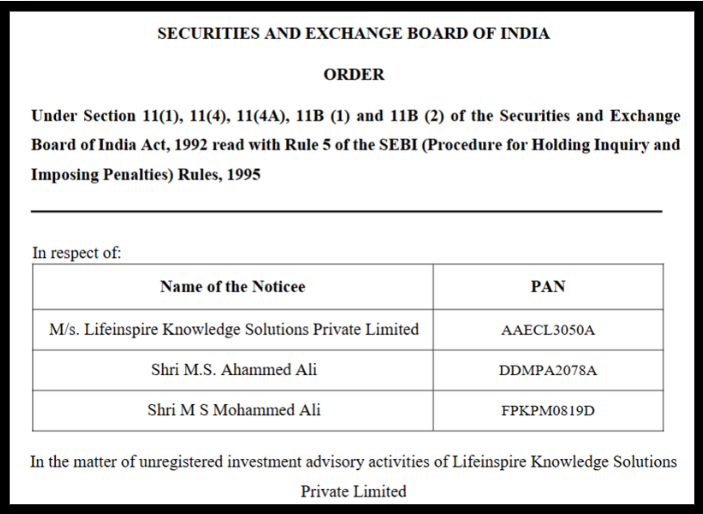
1. Lifeinspire Knowledge Solutions Private Limited (LKSPL)
It was run by directors MS Ahammed Ali and MS Mohammed Ali through the website bankniftyoption.in, which advertised investment advisory packages promising “₹30 lakh to ₹1 crore per month” and “200% profit calls.”
SEBI’s investigation, which began while looking into a related entity, found suspicious credits flowing into LKSPL’s account over a period from September 2020 to 2024.
Total penalty: ₹35 lakh across the company and both directors. Refund ordered: ₹1.83 crore, jointly and severally.
Market ban: 2 years for the company and both directors.
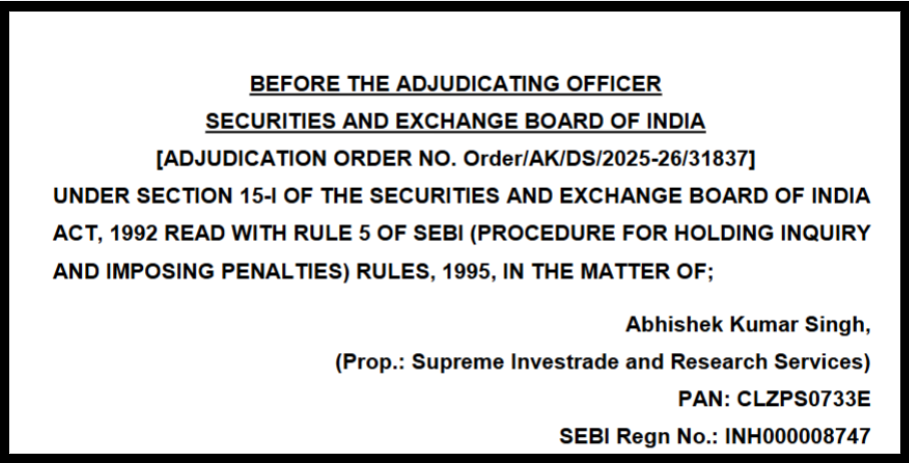
2. Abhishek Kumar Singh, proprietor of Supreme Investrade and Research Services
They held a valid SEBI Research Analyst registration(INH000008747), which made the violation notable precisely because registration alone didn’t stop it.
SEBI’s December 2025 adjudication order found the firm circulating screenshots of other clients’ profits through its communication channels to attract new subscribers, a practice SEBI drew a clear line around.
A legitimate research recommendation must include a defined buy or sell call with a target and stop-loss, not selective, unverifiable profit claims used as marketing.
Penalty on Supreme Investrade: ₹2,00,000.
A parallel case worth knowing runs through Yash Garg’s “Yash Trading Academy,” who charged for account handling and profit-sharing through Telegram channels while falsely claiming SEBI registration, resulting in a ₹92.98 lakh refund order and ₹16 lakh penalty.
That case is covered in full, including how the account-handling and profit-sharing violations were mapped, in our guide on broker traded without my permission.
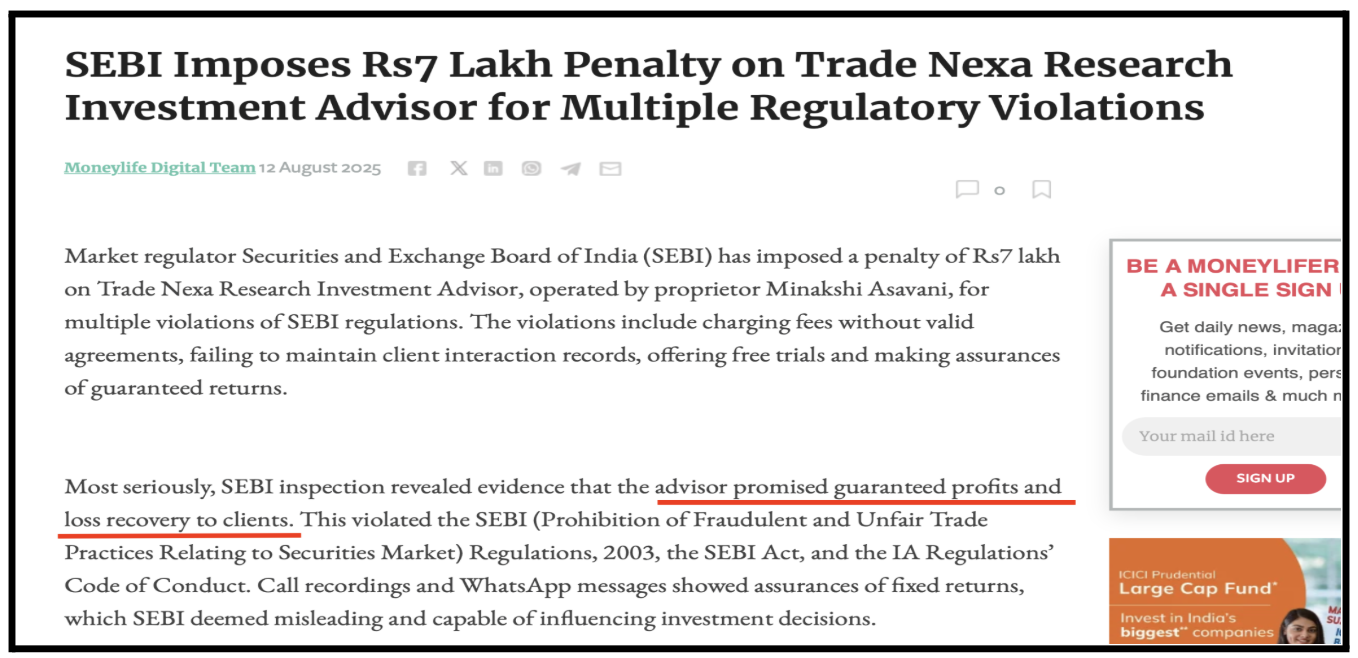
3. Trade Nexa Research Investment Advisor
The advisor made claims of guaranteed returns and loss-recovery assurances to attract investors, telling them previous losses could be recovered through “special trading strategies.”
SEBI found the communication violated investment advisory regulations outright.
Penalty: ₹7 lakh.
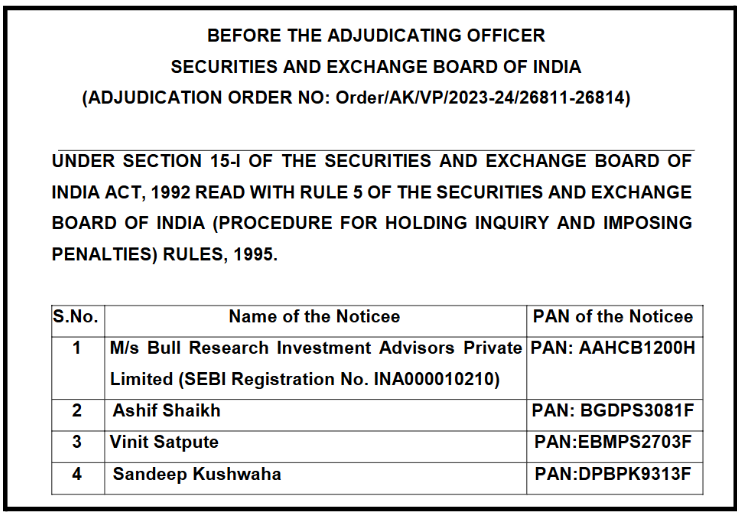
4. Bull Research Investment Advisors
A SEBI-registered IA explicitly assured clients of fixed returns and loss recovery, and raised invoices in family members’ names to bypass the fee ceiling.
This highlights how even credentialed entities can get involved in a SEBI registered advisor scam by exploiting their status to build false trust.
It also sold overlapping subscription packages without disclosure and collected fees before completing mandatory KYC and risk profiling.
Penalty: ₹10 lakh.
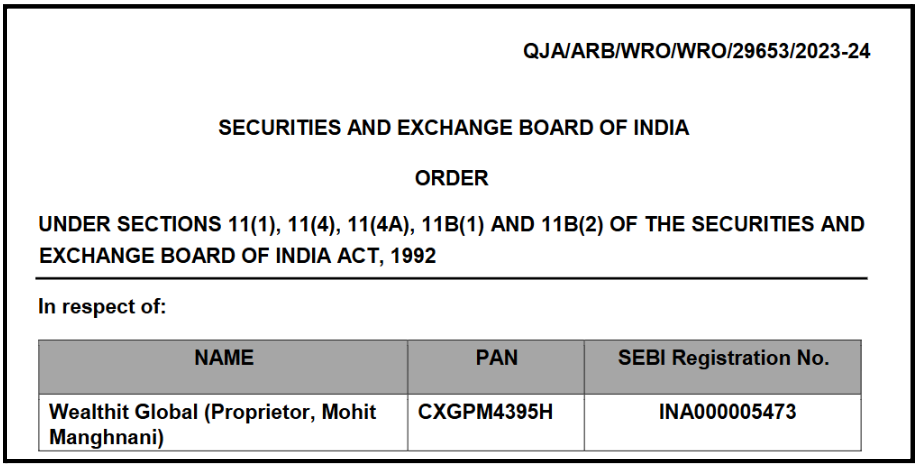
5. Wealthit Global, proprietor Mohit Manghnani
They were allegedly promised one client ₹8 lakh profit in exchange for a ₹2.5 lakh payment with no analytical basis, with call recordings allegedly showing pressure for further payments backed by return assurances.
SEBI also found compliance failures including operating from an unregistered address, with fit-and-proper concerns surfacing after an FIR.
Total penalty: ₹30 lakh.
A related case worth cross-referencing rather than repeating here is 3M Team Research, which promised 200 to 400 percent annual returns and ran an unregistered PMS, covered in full detail in our guide on SEBI registered investment advisor.
6. Options King Research Analyst
The RA continued providing investment advice without a valid NISM certification for an extended period, despite being registered as an intermediary.
SEBI’s adjudication order treated this as a straightforward certification-compliance breach.
Penalty: ₹1,00,000.
7. Money World Research
The firm offered paid investment advisory services, collected client fees, and solicited investors through bulk SMS campaigns, all without holding the mandatory SEBI Investment Adviser registration.
SEBI issued a formal Interim Order in December 2014 directing the company to immediately cease advisory operations, stop acquiring new clients, withdraw all promotional material, and not divert or dispose of investor funds without prior SEBI permission, a reminder that unregistered advisory activity is never treated as a grey area.
8. Kundli Fake Trading App Cybercrime Case
A Kundli resident was contacted through WhatsApp and offered trading guidance with assured returns of nearly 15 to 20 percent daily.
Scammers added him to a fake investment setup and convinced him to download a fraudulent trading app showing fabricated profits and institutional stock opportunities.
He invested repeatedly, transferring around ₹18.59 lakh in multiple transactions, and communication stopped the moment he tried to withdraw.
Sonipat Police traced the digital trail, arrested two accused from Madhya Pradesh, recovered ₹3,300 in cash and two mobile phones, and froze ₹8.81 lakh pending investigation.
Unlike the other cases here, this was a police cybercrime matter, not a SEBI order, since the operation was never registered at all.
9. Kiran’s Case: Impersonated SEBI Registration
Kiran, a woman based in Pune, lost ₹7 lakh following tips from someone she believed was a registered Research Analyst, who later claimed someone else had used his ID and registration number to provide the advisory services.
Multiple signals could have flagged the fraud earlier: she was asked to open a demat account through his link, later asked to transfer money to a third-party bank account, and continued receiving tips over WhatsApp despite his claimed SEBI registration, none of which a genuine registered entity would ask for.
How to File a Complaint Against Misleading Stock Advisory Services?
Collect all evidence first. Screenshots of Telegram or WhatsApp messages, advertisements making profit claims, payment receipts, transaction records showing fees paid, any signed agreements, and records of trades executed based on the tips.
If your complaint involves someone who actually took over your account rather than just misleading you with claims, that’s a distinct violation covered in our guide on registered advisor managed my account.
Verify the entity’s registration status on the SEBI website under the Intermediaries section. If they claim registration but don’t appear there, that absence itself is a violation worth naming in your complaint.
Approach the entity directly first, in writing, and give 30 days for a response before escalating.
Then file through SEBI SCORES, selecting the correct category, Investment Adviser, Research Analyst, or Unregistered Entity, and attaching your evidence.
If SCORES doesn’t resolve it, SMART ODR provides structured conciliation and arbitration, and many investors recover advisory fees at this stage without needing full arbitration.
If the dispute remains unresolved, exchange arbitration delivers a binding award.
Been shown fabricated profit screenshots, guaranteed-return promises, or pressured into a “recovery” package?
We verify the entity’s actual registration status, document the misleading claims made, and build your complaint around the specific SEBI or PFUTP violation involved.
Register with us for a free consultation.
Conclusion
India’s market regulator has been sending a consistent message through its enforcement actions: there is no place for guaranteed profit claims, unregistered advice, or misleading marketing in the securities market.
SEBI cannot be everywhere at once. When traders report suspicious services, investigations begin. When investors file complaints on SCORES, data gets built.
So if something doesn’t feel right about an advisory service you’ve used or seen, trust that feeling. Verify the registration. Save your evidence. And report it. You have the tools. Use them.
Report. Recover. Stay Fraud Free.
Frequently Asked Questions
No, the violation sits with the advisory service, not with you for following their advice. If you paid for access to a service that misled you through fabricated claims or unregistered advice, that is the basis for your own complaint against them.
Treat the absence as confirmation of a violation. A firm claiming SEBI registration that doesn't appear in the official intermediary database, searchable by name or registration number, is either unregistered or misrepresenting a different entity's registration entirely.
Yes. SEBI accepts complaints against entities operating through any communication channel. Screenshots of the chat, payment records, and any promotional material sent through these channels serve as your evidence, and SEBI has previously investigated and penalised operators running purely through social media and messaging platforms.
A registered entity's violation goes through SEBI SCORES and can lead to a monetary penalty, refund order, or registration cancellation. An unregistered entity operating as an advisory service is itself the violation, and depending on the scale, may also warrant a police cybercrime report alongside a SEBI complaint, as the Sonipat case shows.





 Add us as a preferred source on Google »

