

The SEBI action against Ayushi Chauksey Investment Advisor stands as one of the most instructive enforcement cases in recent years. The violations were not extreme, but they were systematic.
A SEBI-registered adviser, active on social media, with a structured website and professional branding, received two separate SEBI orders for compliance failures.
The violations reportedly touched nearly every foundational requirement of the Investment Adviser (IA) Regulations. Here is the complete picture.
Ayushi Chauksey Adviser
Ayushi Chauksey is a Mumbai-based SEBI registered investment adviser and the founder of Ayushi Chauksey Adviser Private Limited.
She operates under the trade name “ayushichky.” Before the regulatory action, she built a visible presence across Telegram, Twitter, and YouTube.
Her firm offers subscription-based advisory products, including Quant Matrix, Wealth Matrix, Portfolio Review Services, and a non-advisory Learning Matrix.
The services were marketed to retail investors through a structured, professional-looking platform.
Before incorporating the private limited entity, Ayushi Chauksey operated as an individual investment adviser. She is also associated with Investment Bulls in a COO capacity.
Is Ayushi Chauksey SEBI Registered?
Yes, Ayushi Chauksey Adviser Private Limited currently holds two active SEBI registrations: Investment Adviser registration number INA000019707 and Research Analyst registration number INH000021687.
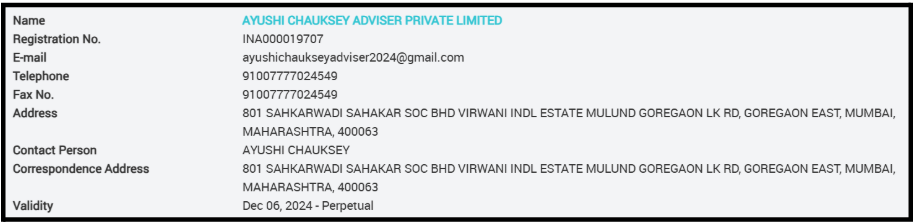
The firm is also BSE-enlisted under enlistment number 2224. However, her original individual IA registration under which SEBI took enforcement action was INA000008075.
The enforcement orders discussed in this blog relate to the earlier registration and the period of operations under it.
SEBI Order Against Ayushi Chauksey Investment Advisor
SEBI conducted a physical inspection of Ayushi Chauksey’s advisory operations for the period April 1, 2018, to March 31, 2019.
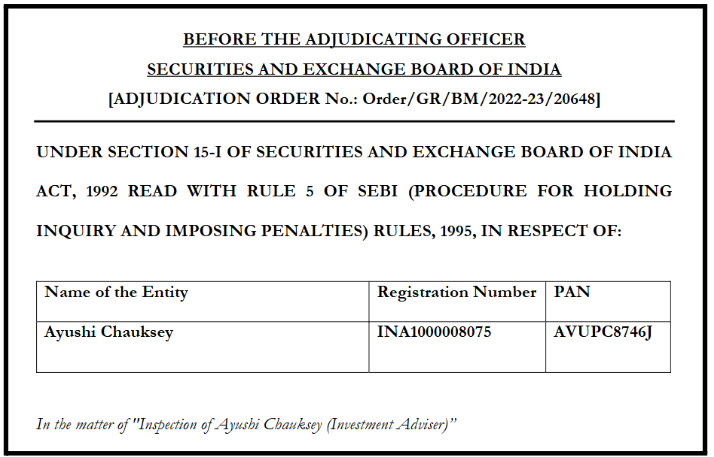
The inspection took place on September 18–20, 2019. What inspectors found resulted in two separate orders: an Adjudication Order in October 2022 imposing a monetary penalty, and a Final Order in September 2023 suspending her business activity for one month.
Violations by Ayushi Chauksey Investment Advisor
SEBI established violations across seven distinct categories during the inspection period.
Each violation is drawn directly from the published adjudication order dated October 21, 2022.
1. Undisclosed Branch Offices
Ayushi Chauksey operated a branch in Indore with Mr Ved Sharma as an employee, listed a “Dalal Street, Fort, Mumbai” address on her website, and mentioned a Goa address for a proposed training institute, all without informing SEBI.
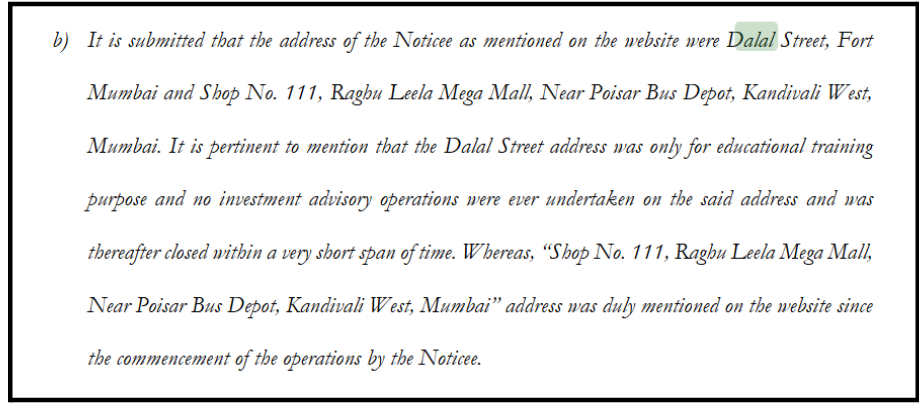
SEBI held that an IA must inform SEBI in writing of any material change in information, and maintaining undisclosed offices is a direct violation of Regulation 13(b).
2. Failure to Maintain NISM Certification
Ayushi Chauksey’s NISM Level 1 certification expired in July 2018, and her NISM Level 2 certification expired in October 2018.
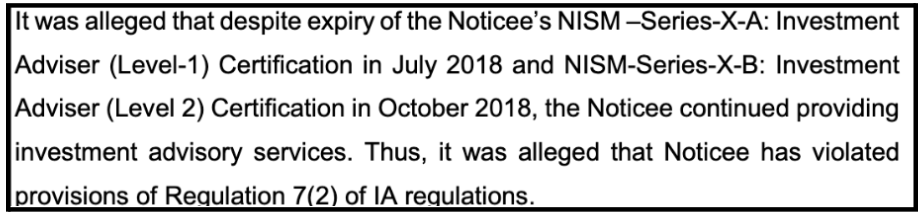
She continued providing investment advisory services without valid certifications until September 2021, a gap of over three years.
She renewed Level 1 in August 2021 and Level 2 in September 2021, both well after the inspection.
The IA Regulations require every individual investment adviser to maintain a valid NISM certification at all times. Operating without certification for three years was not a technical lapse.
It was a sustained compliance failure.
3. Failure to Use “Investment Adviser” in All Correspondence
SEBI found that Ayushi Chauksey did not use the term “Investment Adviser” consistently across all client communications, including bulk SMS messages and WhatsApp broadcasts.
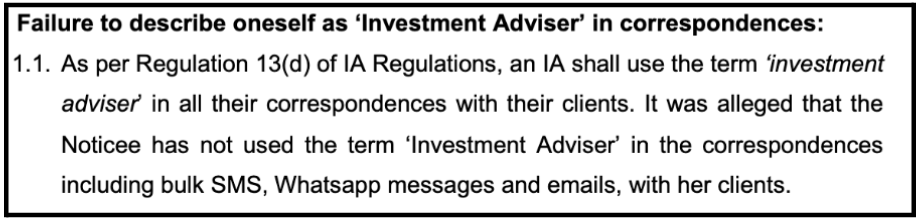
The regulation requires the term to appear in every correspondence, not just introductory messages.
4. Unreasonable and Excessive Fees
This was the most significant violation in the order.
Ayushi Chauksey allegedly collected fees far above SEBI’s permitted limits from clients, including Madhusudhan, P. Subramanian, and Attanu Pramanic.
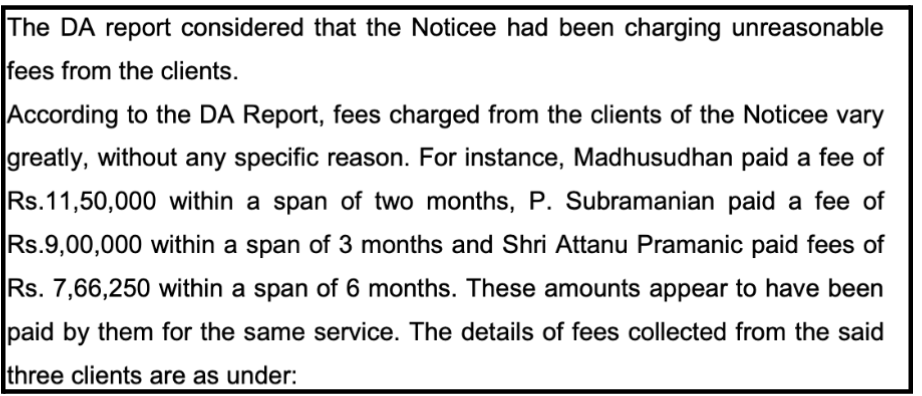
SEBI noted that the annualised charges reached nearly 28-42% of invested capital, significantly exceeding the regulatory cap.
Although Ayushi Chauksey claimed refunds were made to some clients, SEBI reportedly found the claims unverifiable due to the absence of supporting bank statements and client confirmations.
5. Inadequate KYC and CKYC Compliance
During the inspection period, Ayushi Chauksey did not hold registration with any KYC Registration Agency (KRA).
She registered with KRA only in February 2021, well after the inspection. Her CKYC registration request was submitted in June 2019 after the inspection period ended in March 2019.
She conducted KYC manually via email collection, without authenticating documents through the mandated KRA system. SEBI rejected her claim of technical difficulty as unsupported by evidence.
6. Inadequate Risk Profiling and Suitability Failures
Ayushi Chauksey’s risk profiling process had multiple documented failures. Risk questionnaires lacked client signatures.
No supporting documents verified client income, existing investments, or liabilities.
The questionnaire contained a “Submit” button, suggesting electronic filing. However, the forms were physically filed, raising doubts about who actually completed them.
Risk profiles were not communicated to clients. SEBI found that Ayushi Chauksey advised high-risk Level 3 Stock Futures to moderate-risk clients Mr. Abdul Gaffar and Mr. Hemant Pataskar, despite suitability concerns.
7. Record Maintenance Failures
Ayushi Chauksey failed to maintain complete records for her 283 clients, including KYC data, risk profiles, suitability assessments, signed and dated rationale for advice, and a register of clients.
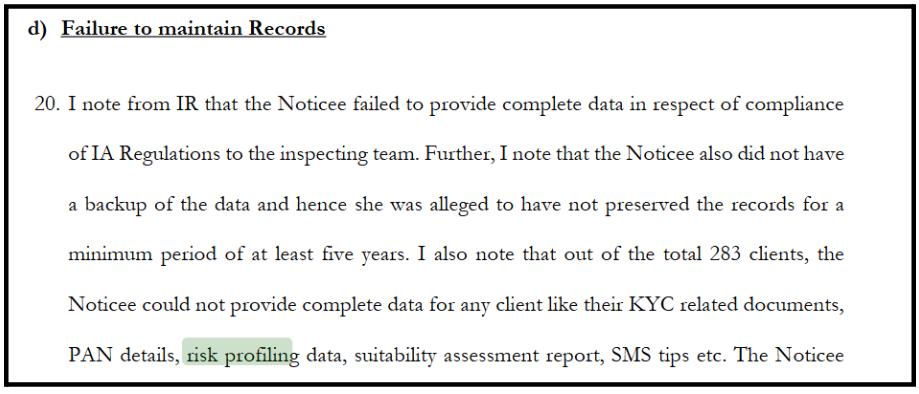
SEBI found Ayushi Chauksey’s server crash claim unsupported. It also noted missing compliance audits, unsigned advice rationale, and non-digitally signed records, leading to SEBI action against Ayushi Chauksey Investment Advisor.
Penalty
The Adjudication Order (Order 1) imposed a total monetary penalty of ₹7,00,000 (Rupees Seven Lakhs only).
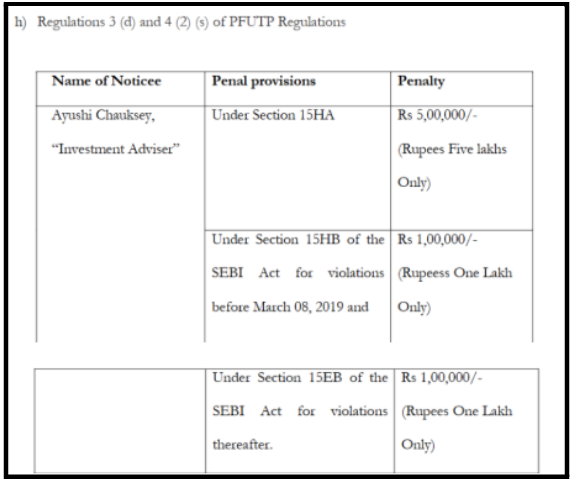
This consists of ₹5,00,000 under Section 15HA, ₹1,00,000 under Section 15HB, and ₹1,00,000 under Section 15EB of the SEBI Act, 1992.
Final Order on Ayushi Chauksey
In September 2023, nearly a year after the monetary penalty, SEBI’s Whole Time Member passed a separate Final Order under Section 12(3) of the SEBI Act and Regulation 27 of the Intermediaries Regulations.
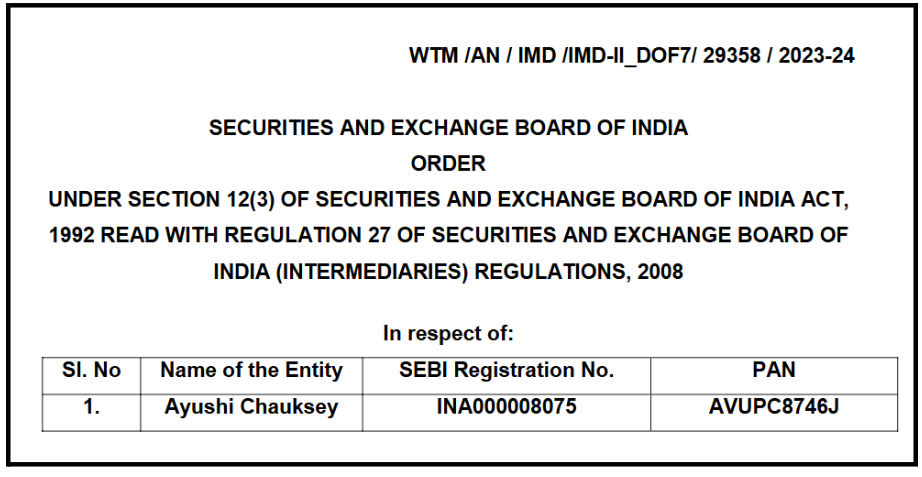
This order arose from an enquiry proceeding specifically examining whether Ayushi Chauksey’s registration should face further action.
Despite being given three hearing opportunities (May 26, June 13, and July 3, 2023), Ayushi Chauksey failed to appear on any occasion.
The WTM confirmed the violations identified in the 2022 order, including the certification gap, fee irregularities, and risk profiling failures, and held that regulatory action on the registration was warranted.
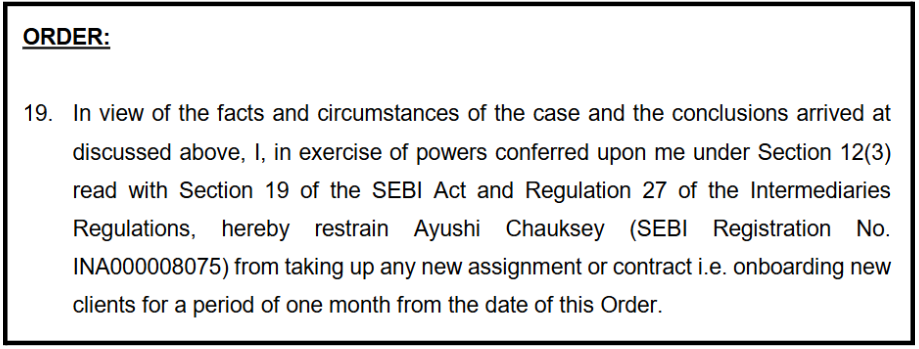
SEBI restrained Ayushi Chauksey from onboarding new clients or accepting new assignments for one month, instead of cancelling the registration outright.
Lessons for Investors
The SEBI action against Ayushi Chauksey Investment Advisor offers an important lesson for retail investors. Registration confirms existence within the regulatory framework, not conduct within it.
- An adviser operating without a valid NISM certification is not legally authorised to provide advice, regardless of the registration number displayed
- Fees exceeding ₹1.25 lakh per annum per client or 2.5% of AUA are prohibited. Document every payment before subscribing
- Risk profiling without your signature and without a copy delivered to you is non-compliant. Always ask for your risk profile in writing
- Overlapping subscriptions taken on consecutive days are a red flag for fee manipulation. Never pay for a new subscription before the current one begins
Before evaluating the regulatory action, investors should also understand the distinction between a SEBI registered Research Analyst vs Investment Advisor.
Although both operate under SEBI regulations, their roles, responsibilities, and the services they are legally permitted to offer differ significantly.
Systematic compliance failures, inadequate records, missing certifications, and excessive fees are sufficient grounds for both monetary penalties and registration-level consequences.
Investors who spot these patterns in their own adviser’s conduct have every right to file a complaint.
How To File a Complaint Against Ayushi Chauksey?
If you engaged Ayushi Chauksey’s advisory services during the inspection period or with any comparable adviser and experienced fee irregularities, unsuitable recommendations, or inadequate risk profiling, these steps apply.
Here is how to complaint against RIA:
Step 1: Document All Payments and Subscriptions
Save every payment receipt, bank transfer record, invoice, and subscription confirmation.
Note the dates, amounts, and subscription periods, particularly if you paid for overlapping subscriptions or amounts that exceed the SEBI fee cap.
Step 2: Request Your Risk Profile in Writing
Write formally to the adviser asking for a copy of your risk profiling document, the suitability assessment made before any recommendation, and the rationale behind each investment recommendation.
Non-response or inability to produce these documents is independently reportable to SEBI.
Step 3: Send a Formal Complaint to the Adviser
Write a structured complaint to the adviser’s grievance officer by email and registered post.
State the specific issues: excessive fees, unsuitable advice, and missing documentation and give the firm 21 days to respond before escalating.
Step 4: File a Complaint in SCORES
Since both Ayushi Chauksey’s individual and corporate entities hold SEBI registrations, SEBI has direct regulatory jurisdiction.
File a detailed complaint on SEBI SCORES, citing the specific violations: fee cap breach, inadequate risk profiling, unsuitable recommendations and attach all supporting documentation.
Step 5: Escalate to Smart ODR
If SEBI SCORES does not resolve the matter, escalate to Smart ODR, SEBI’s Online Dispute Resolution platform.
Register your case, upload your evidence, and request a conciliation session for a structured, regulator-supervised resolution.
Step 6: Arbitration in Stock Market
If unsuitable investment recommendations caused measurable financial losses, pursue arbitration through BSE, where Ayushi Chauksey Adviser Private Limited holds an enlistment number 2224.
Arbitration produces a binding decision and covers compensation for losses caused by advice that violated SEBI’s suitability requirements.
Need Help?
If you subscribed to Ayushi Chauksey’s advisory services, paid fees above the SEBI cap, or received unsuitable recommendations, you may have grounds to raise a formal complaint, and we can help you.
Register with us.
Our services include:
- Case assessment: We review your payment records, subscription history, and advisory communications to identify the specific violations applicable to your situation
- Complaint drafting: We prepare a precise complaint citing the exact regulatory provisions applicable to your case
- SCORES and Smart ODR guidance: We walk you through every step of the filing and escalation process and ensure the right evidence is submitted in the right format
- Arbitration support: we help you build your case for trading loss recovery through BSE arbitration, where applicable
- Conciliation representation: we represent your interests during formal dispute resolution sessions
Professional investor protection support can significantly strengthen cases involving missing risk profile documentation or regulatory non-compliance.
Conclusion
SEBI action against Ayushi Chauksey investment advisor produced two enforcement orders: a ₹7 lakh monetary penalty in October 2022 and a one-month new client restriction in September 2023.
The violations covered certification, KYC, record maintenance, risk profiling, suitability, fee structure, and disclosure.
Together, they touched nearly every foundational requirement of the IA Regulations.
The case confirms that a professional website, active social media, and a SEBI registration number do not substitute for actual regulatory compliance.
For every investor, the lesson is the same: verify the adviser’s certification status, demand your risk profile in writing, and ensure fees stay within SEBI’s mandated limits before you pay, not after.





 Add us as a preferred source on Google »

