

Have you seen Love Sharma profit claims on Instagram or Telegram? Maybe you noticed screenshots showing massive trading profits within hours.
Some posts claimed traders turned ₹3 lakh into ₹6 crore. Others showed daily profits with little discussion about risks.
That kind of marketing attracts thousands of retail traders every year. And when the person is SEBI-registered, the claims can feel more believable.
Love Sharma, through Amaradarsh Research and Analytics and Trade With Love (TWL), operated as a SEBI-registered Research Analyst.
But arbitration records and social media evidence tell a more complicated story.
This blog explains the Love Sharma guaranteed profit claims, the violations discussed during arbitration, and what traders should carefully check before joining any advisory platform.
Love Sharma Guaranteed Profit Claims & Violations
Love Sharma is SEBI registered entity as a Research Analyst under registration number INH000011893.
He is based in Delhi and positions himself as a Chartered Accountant and full-time trader.
Being SEBI-registered means Love Sharma must follow the SEBI guidelines for RA.
These rules are clear: no guaranteed returns, no misleading advertising, full transparency in fees, and no promotion of unauthorized financial products.
Here is where the evidence paints a different picture.
1. Guaranteeing Returns on Telegram Channel
The most direct and documented violation is the use of assured return language across platforms.
One of the most cited examples is a message circulated on Love Sharma’s Telegram channel stating “900 mein 9000 kamao with 2 lots”, a direct claim that a small investment would generate a specific, guaranteed return using a specific number of lots.
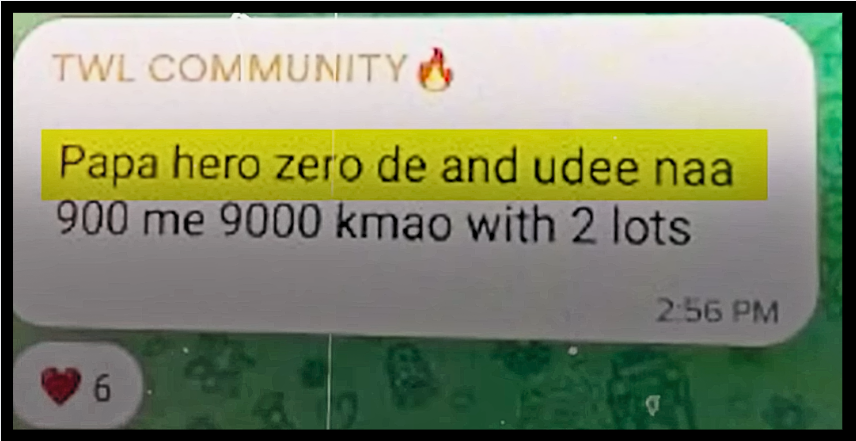
This is a dual violation. First, it promises a fixed return from a market-linked trade, which no SEBI-registered entity can legally do.
Second, specifying lot quantities (“2 lots”) crosses into personalized trading advice, which requires a separate SEBI Investment Adviser (IA) registration that Love Sharma does not hold.
SEBI regulations are explicit on this. Regulation 24(1) prohibits Research Analysts from making any assurance of return or profit.
Markets are uncertain by nature, and any communication implying otherwise is not just aggressive marketing; it is a regulatory violation.
2. Misleading Profit Claims on Instagram
Love Sharma Trader Instagram bio prominently states: “Turned 3L to 6Cr.” His Twitter/X bio carries the claim: “Made 3L to 7Cr in a Month.”
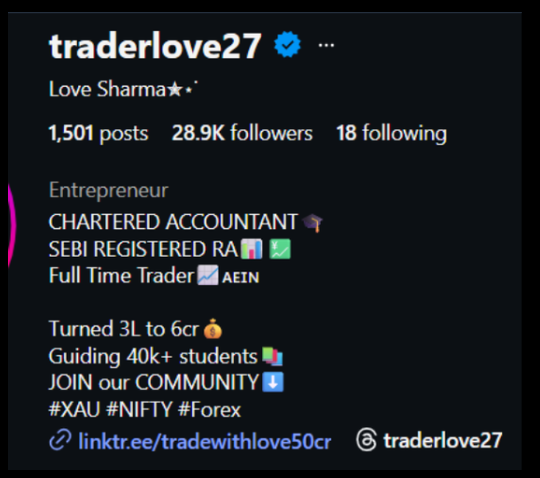
These are not disclaimers or educational content.
They are placed in bios, the first thing a potential subscriber sees, and they function as marketing claims suggesting extraordinary, repeatable returns.
SEBI’s Master Circular requires that performance claims be backed by audited, verifiable records and be accompanied by balanced risk communication.
Cherry-picked profit screenshots, with no mention of losses or risk, do not meet this standard.
They mislead retail traders into thinking consistent, extraordinary returns are normal, and they are not.
3. The Locked Trades and Pay Later Promotions
The TWL Community app featured a product called “Locked Trades”, a paid access model where subscribers could pay a fee to receive specific trade setups with predefined entry points, stop-loss levels, and lot sizes.

The settlement documents specifically note that the complainant raised concerns about the “Pay Later” trade option being promoted on the platform while disregarding SEBI rules.
Offering trade-specific, lot-specific instructions through a subscription tier, framed as a product, blurs the line between general research recommendations (permitted for RAs) and personalized investment advice (which requires IA registration).
This structural ambiguity in service delivery was identified as a concern in the arbitration proceedings.
4. Selling Subscriptions Through the TWL App
The arbitration settlement documents specifically cite that using the Love Sharma TWL app to sell subscription plans allegedly breached Section 24.1 of the SEBI RA Regulations Act 2014.
Section 24.1 of SEBI’s Research Analyst regulations governs the permissible methods by which Research Analysts can distribute their services and collect fees.
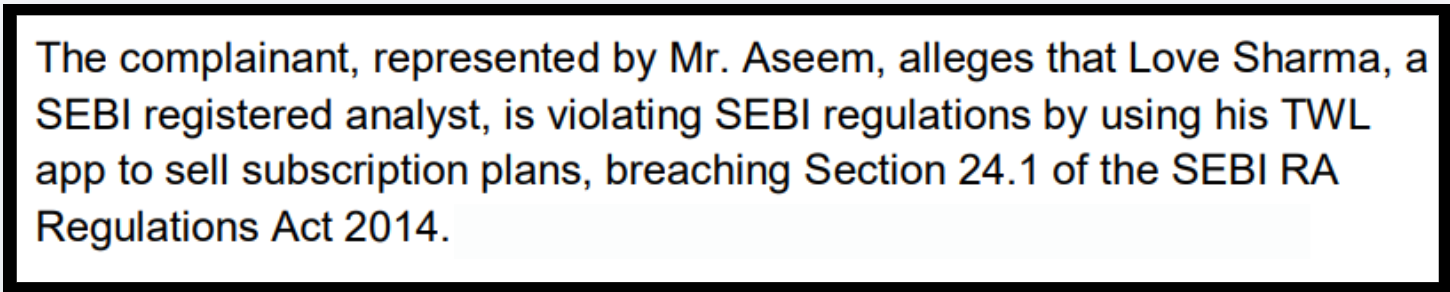
Operating a dedicated commercial subscription app with bundled products, tiers, and gamified elements raises questions about whether the distribution model stays within the bounds of what is permitted.
The complainant documented this concern, and it was formally recorded in the arbitration settlement.
5. Selectively Displaying Student Profit Screenshots
The TWL app and Instagram encouraged subscribers to post profit screenshots, and these were publicly amplified.
Only winning trades and successful outcomes were showcased, with no corresponding data on losses, failed calls, or overall performance rates.
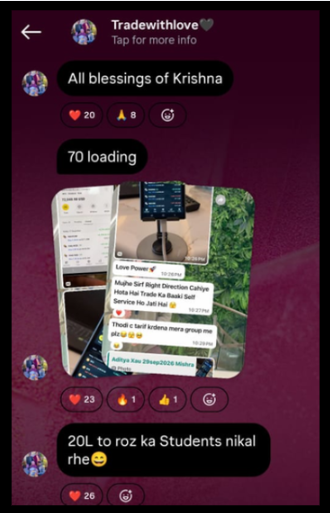
SEBI Regulation 20(4) requires that research recommendations be backed by proper data and analysis, not selective feel-good testimonials.
Presenting only successful outcomes creates a distorted performance image that misleads new subscribers into expecting consistent profitability.
This pattern, showing only wins and never losses, is specifically prohibited under the Master Circular’s advertising standards.
This also raises a larger investor protection question: can a SEBI-registered analyst give profit guarantee?
Under SEBI regulations, registered analysts are not permitted to offer assured returns or present stock market outcomes as guaranteed profits.
Love Sharma Arbitration Case
The concerns documented above were formally taken through arbitration under Case No. MSE-RA-2024-12-494386.
The complainant, represented by Aseem, enrolled in the TWL membership on 29 August 2024 by paying ₹7,200 (including GST), specifically to document violations as a whistleblower, with evidence gathered through screenshots, audio recordings, and video documentation.
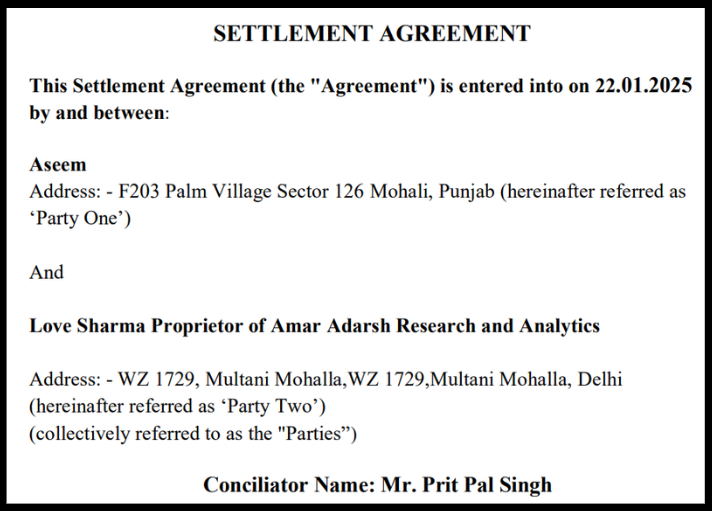
The arbitration was conducted with Mr. Prit Pal Singh as Conciliator, and the settlement was executed on 22 January 2025.
Key Findings from the Settlement Agreement:
- The complainant alleged violations of SEBI Master Circular SEBI/HO/MIRSD-PoD-2/P/CIR/2023/90, covering Sections 7.1.a.ii, 7.b.i, 7.b.vi, 7.b.vii, 7.c.iii, 7.c.iv, 7.1.c.xii, and 7.c.x, including assured return promises, missing disclaimers, misleading profit displays, and improper advertising.
- The complainant documented the Dhan conflict of interest, the incorrect registration number on the TWL app, the promotion of Exness, and the Section 24.1 subscription model concern.
- The respondent, in his defence, denied some allegations, but could not provide evidence to support his claim of SEBI approval for the Dhan commission arrangement.
- Love Sharma admitted his faults and acknowledged the violations.
- The settlement required Love Sharma to provide an undertaking to comply with the SEBI Master Circular going forward and upload this undertaking on the ODR portal.
Arbitral Outcome: The matter was resolved through conciliation. Love Sharma accepted fault and committed to correcting his practices in line with SEBI regulations.
However, and this is important, subsequent documentation suggests that similar practices continued through his Instagram groups and new Telegram channels after the settlement was recorded.
The question of ongoing compliance remains open.
What Retail Traders Can Learn From This?
The Love Sharma case is not unique. It reflects a wider pattern in India’s social media trading advisory space.
Here is what every retail trader should hold onto before engaging any paid advisory service:
- SEBI registration is a starting point, not a guarantee: It confirms a person operates under regulatory oversight. It does not confirm that the regulations are being followed.
- No SEBI-registered entity can guarantee profits: Ever. Full stop. If someone is promising you fixed returns from market trading, regardless of their credentials, walk away.
- Extraordinary profit claims need audited proof: Screenshots of one-day or one-month wins are not performance records. Ask for audited, complete P&L data before subscribing.
- Check for conflict of interest disclosures: If an advisor recommends a broker, ask whether they earn a commission. This disclosure is mandatory under SEBI rules’ its absence is a red flag.
- Lot-specific instructions are investment advice, not research: If someone tells you to “take 2 lots,” they are crossing into IA territory without the registration to support it.
- Offshore forex platforms promoted by Indian advisors are a red flag: RBI has issued clear cautions on unauthorized overseas forex brokers. Platforms like Exness are not approved for Indian retail traders.
- Save all evidence from day one: Screenshots, call recordings, payment receipts, promotional messages. If things go wrong, this documentation is your entire case.
- Check SEBI’s SCORES portal: Before engaging any advisor, search their name or registration number for existing complaints.
How To File A Complaint Against Research Analyst?
If you have faced issues with Love Sharma, Amaradarsh Research and Analytics, or any similar trading advisory service, here is how to take formal action.
Step 1: Document Everything First
Before doing anything else, gather all your evidence. Keep payment receipts and subscription confirmations safely stored.
Save WhatsApp and Telegram screenshots related to the service. Collect promotional material shared before enrollment.
Keep records of all calls, chats, emails, and messages. Document any claims or promises made before payment.
Strong documentation is the foundation of every successful complaint.
Step 2: Write to the Firm Directly
Send a formal written complaint by email to the advisor or their support team. Clearly state your grievance, the resolution you expect, and attach all supporting documents.
Keep a dated record of this communication and any response received.
Step 3: File a Complaint in SCORES
Visit SCORES, SEBI’s Complaints Redress System, and file a formal complaint.
You will need your PAN, Love Sharma’s SEBI registration number, a clear description of your grievance, and supporting documents.
Once filed, the entity is required to respond within a prescribed timeframe.
Step 4: Register Complaint in SMART ODR
SEBI’s Smart ODR (Online Dispute Resolution) platform offers a structured, faster route for eligible investor disputes. If direct communication and SCORES do not produce results, Smart ODR is the next step.
Step 5: Stock Market Arbitration
As the Love Sharma case itself demonstrates, formal arbitration is available when SCORES and direct resolution do not reach a satisfactory outcome.
The arbitration process creates a legally reviewed settlement and can result in directed compliance and compensation.
Need Help?
Navigating the complaint process against a SEBI-registered entity can feel daunting, especially if you have never done it before.
If you are unsure how to structure your complaint, gather evidence, or approach SEBI SCORES, you do not have to figure it out alone.
Register with us. Our team has experience supporting investors through exactly these kinds of cases, from documentation to filing to escalation.
Your experience matters. Every formal complaint adds to the regulatory picture and helps protect future traders.
Conclusion
Love Sharma’s case matters because there is a documented regulatory record.
An arbitration settlement was signed on 22 January 2025.
The matter involved alleged guaranteed profit claims, Telegram promotions, selective profit screenshots, and Exness-related marketing.
These are not just marketing issues. They relate to investor protection and SEBI compliance standards.
A SEBI registration is not a guarantee of credibility or performance. What matters is whether regulations are actually being followed after registration.
Before joining any trading advisory service, verify every claim carefully. Ask for audited performance records.
Read fee terms properly. Question return promises.
If something sounds unrealistic, stay cautious.
Formal complaint mechanisms exist to protect investors. Use them when necessary.




 Add us as a preferred source on Google »

