

Choosing a financial research service requires careful evaluation, not just of the services promised, but of the regulatory standing, transparency, and operational clarity of the entity behind them.
Investors today have every right to ask hard questions before they commit time, trust, or money.
Nifty Research operates as a market research and analysis platform, catering to traders interested in indices like Nifty, Bank Nifty, FinNifty, and Sensex.
The firm is based in Mumbai, Maharashtra, with a listed office address in the Lower Parel area.
In this blog, we take a structured look at what Nifty Research offers, what its own documentation says about its regulatory status, and what investors must understand before subscribing to any such service, based on publicly available information and Nifty Research reviews.
Nifty Research Review
Nifty Research describes itself as a research-driven market guidance platform focused on clarity, discipline, and risk-aware decision-making.
According to its About page, the firm aims to help traders navigate the markets with confidence by combining technical analysis, structured research methodologies, and educational content.
The platform covers index segments, primarily Nifty, Bank Nifty, FinNifty, Midcap Nifty, Sensex, and Bankex, and offers paid subscription packages ranging from a basic “Nifty Lite” plan to “Index Options Premium” and add-on tiers.
The firm operates out of Mumbai and lists a secondary address in Bengaluru, Karnataka.
On the surface, the platform appears structured; it has an Investor Charter page, a Terms & Conditions document, a User Consent page, and a Privacy Policy.
The website also displays a standard SEBI disclaimer at the top of every page, which is common among firms in the financial research space.
However, here is the detail that every prospective subscriber must pause at: the question of whether Nifty Research SEBI registered status exists has a clear answer; its own website footer states, “We are not SEBI registered.”
This is explicitly mentioned across all pages.
No registration number appears anywhere on the platform. If a firm charges fees for market analysis or trading guidance, SEBI registration as a Research Analyst (RA) is typically required under Indian securities law.
Investors should factor this in carefully before subscribing.
It may appear reassuring that the firm references an Investor Charter and uses standard market disclaimers. But the presence of compliance-sounding pages alone does not substitute for actual regulatory registration.
Understanding what the Research Analyst SEBI guidelines require and what its absence implies is essential for any investor evaluating this platform.
What SEBI Registered Research Analysts Can Do?
Under SEBI (Research Analysts) Regulations, 2014, any individual or entity that provides research reports, investment recommendations, or analysis-based guidance on securities and charges a fee for doing so is generally required to obtain a SEBI Research Analyst (RA) registration.
SEBI registration is not merely a formality. It creates a formal accountability structure around how a firm operates, communicates, and handles investor interests.
Registered Research Analysts are required to:
- Disclose their registration prominently: A SEBI RA registration number must appear on all research reports, communications, and marketing material. Its absence is itself a regulatory signal.
- Follow strict content standards: All recommendations must be supported by documented research. Claims of accuracy rates or performance must be backed by verifiable, auditable data, not testimonials on a website.
- Avoid conflicts of interest: Registered analysts must disclose any positions they or their associates hold in the securities they recommend, to prevent self-serving advice.
- Maintain a structured fee framework: Fees must be transparent, fixed in advance, and not linked to trading profits or capital deployed by the client.
What SEBI Registered Research Analysts Cannot Do?
Before subscribing to any market research service that operates without a SEBI registration, it is important to understand the risks that come with operating outside the regulated framework.
Can we trust SEBI registered research analyst services blindly?
While registration doesn’t guarantee profit, it provides a legal framework for grievances that unregistered platforms lack.
- No Guaranteed Return Claims: Any platform, registered or not, that implies assured profits, fixed monthly income, or high-probability “sure calls” is making claims that are neither legally permitted nor financially realistic. Market outcomes cannot be guaranteed.
- Terms That Limit All Liability: Nifty Research’s Terms & Conditions explicitly state that the firm “shall not be liable for any direct, indirect, incidental, consequential, or punitive damages” arising from use of its services. Users bear all risk entirely on their own. This is worth reading carefully before paying for a subscription.
- Content Described as “Educational Only”: The platform’s FAQ and footer consistently describe all content as being for “educational and informational purposes only.” If the firm’s own documentation classifies its outputs as educational, subscribers should calibrate their expectations of the service accordingly.
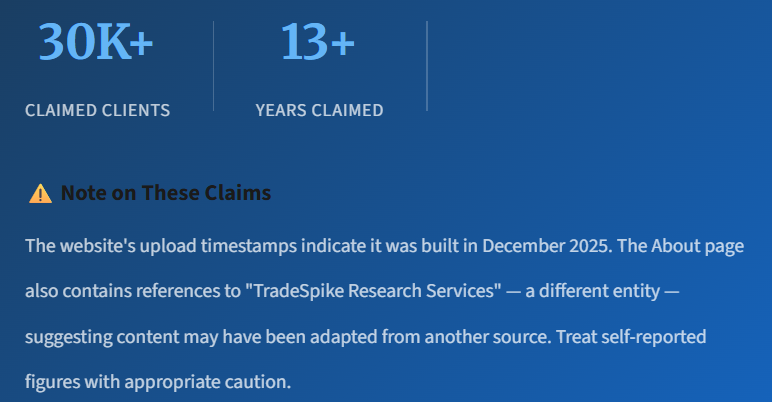
- Self-Reported Metrics Without Verification: Claims of high option trading accuracy rates, large client bases, and over a decade of experience are difficult to independently verify. There is no publicly available audit, SEBI performance disclosure, or exchange-registered track record that subscribers can cross-check.
- Scammer Impersonation Risk: Nifty Research has itself issued an alert on its website warning that fraudsters impersonate the firm on WhatsApp, Instagram, and Telegram to divert payments. This underscores the importance of verifying payment details directly before transferring any funds.
How to Raise a Complaint Against a Research Analyst?
If you feel that a market research provider, registered or otherwise, has acted in a misleading or harmful way, staying composed and following the right process matters more than acting hastily.
India’s investor grievance ecosystem has multiple tiers, and using them in the correct order strengthens your case significantly.
Here are the steps to follow:
- Gather and organise all evidence: Collect payment receipts, bank transaction records, WhatsApp or Telegram chat logs, emails, and screenshots of any calls or recommendations received. Arrange them by date to build a clear, verifiable timeline.
- Contact the Research Analyst Directly: Reach out to the research analyst or firm through their official communication channels. Clearly explain your issue, include supporting evidence, and state the resolution you expect. Keeping a written record of this communication is important for future reference.
- Register a complaint in SCORES: If your research analyst has not responded to your complaint, you can escalate the matter by filing a complaint on the SEBI SCORES portal. Even if the firm is unregistered, you are still allowed to report it. Operating without proper registration is itself a regulatory violation, and SEBI may take action based on the details you provide.
- File a Complaint in SMART ODR: If your issue is not resolved through initial channels, you can escalate it to the SMART ODR (Online Dispute Resolution platform). This system allows investors and intermediaries to resolve disputes digitally through mediation and conciliation, making the process faster and more accessible.
- Approach the Stock Exchange Grievance Cell: You can also file a complaint with the relevant stock exchange, such as the National Stock Exchange or the Bombay Stock Exchange. They have dedicated investor grievance mechanisms to handle issues related to brokers and trading disputes.
- Arbitration in Share Market: If the complaint remains unresolved, you can proceed with arbitration through the stock exchange. In this stage, an independent arbitrator reviews all submitted evidence and passes a binding decision on the dispute. Arbitration is a formal legal process and is often the final step for resolving share market disputes.
Remember: The presence of an Investor Charter, disclaimers, or Terms & Conditions on a website does not substitute for SEBI registration.
Always verify the regulatory standing of any financial platform independently at sebi.gov.in before making a payment.
Need Help?
Many investors find themselves in grey-area situations when dealing with unregistered platforms, especially when services were framed as “educational” but felt indistinguishable from paid investment advice.
When you register with us, we help you with:
- How to verify whether a platform is genuinely SEBI registered
- How to identify when “educational content” crosses into unregistered advisory activity
- How to draft strong complaints to SEBI, cybercrime authorities, or consumer courts
- How to assess whether you have a valid case and what steps to take next
Our approach focuses on evidence, proper procedure, and holding the right parties accountable.
Conclusion
Nifty Research presents itself as a market research platform focused on index-based analysis, educational guidance, and risk-aware trading support.
It has a structured website with paid packages, a listed Terms & Conditions document, and an Investor Charter page.
However, the firm’s own website explicitly states that it is not SEBI registered, and no registration number appears anywhere across the platform.
For investors considering a paid subscription, this is a material fact that warrants careful consideration.
Before subscribing to any research service, particularly one that provides entry levels, exit targets, and stop-loss guidance, verify the firm’s regulatory status independently, read the Terms & Conditions thoroughly, and ensure you understand exactly what protections you do and do not have as a paying user.
Informed decisions are always the first line of defence.





 Add us as a preferred source on Google »

