

Stock market advisory services often look structured and credible on the surface, especially when they come with regulatory tags and consistent trading calls.
But for investors, the real question is not how polished a platform appears; it is how transparent, accountable, and independently verifiable it actually is.
CA Abhay Kumar, also known as CA Abhay Varn, is one such market research and advisory provider offering trading calls and index-based analysis for retail traders in India.
At first glance, the presence of a SEBI Research Analyst registration does add a layer of regulatory credibility. However, experience in financial markets shows that registration alone is not enough to judge the quality or transparency of any advisory service.
In this blog, we’ll break down Abhay Kumar’s services, regulatory standing, disclosures, and the key factors investors should carefully evaluate before subscribing.
Abhay Kumar Details
CA Abhay Kumar operates under the brand “CA Abhay Varn”, offering stock market research and trading recommendations through online platforms and social media channels.
His service is primarily targeted at retail traders looking for intraday, swing, and options trading calls.
The platform provides:
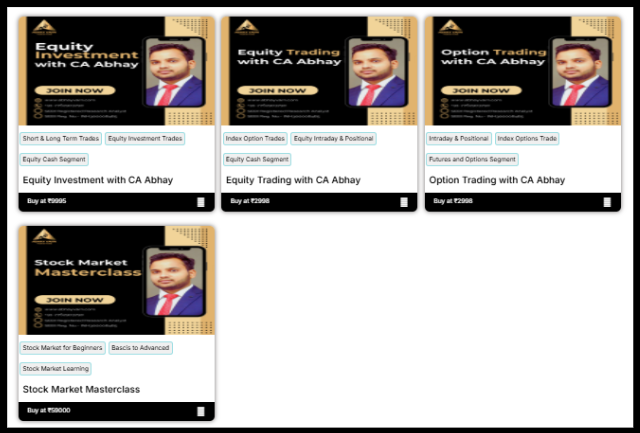
He also claims experience in technical analysis and market research, and positions his service as a structured, risk-aware advisory model.
CA Abhay Kumar is listed as a SEBI Registered Research Analyst (Reg. No. INH300008465), which means he is authorized to provide research-based recommendations under SEBI guidelines. 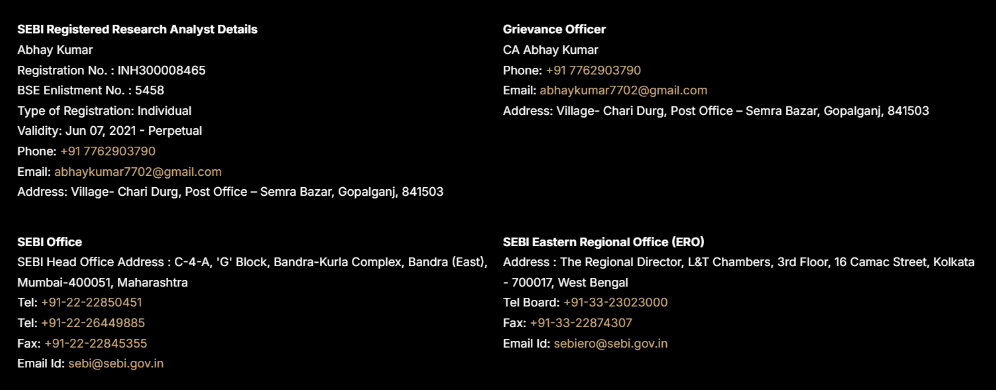
This registration indicates compliance with baseline regulatory requirements such as disclosures, fee structure transparency, and research-based reporting standards.
However, registration alone does not guarantee performance quality, client satisfaction, or transparency in grievance handling.
Since CA Abhay Kumar is a registered Research Analyst, he falls under SEBI (Research Analysts) Regulations, 2014.
Under this framework, SEBI allows registered analysts to:
- Provide research-based stock and index analysis.
- Share buy/sell recommendations based on documented research.
- Charge transparent, upfront fees.
- Publish reports with risk disclosures.
However, SEBI also expects strict compliance in terms of transparency and investor protection.
Also Read: Investowryght shows a blank page when proceeding for payment.
Abhay Kumar: Red Flags to Watch For
Even though the platform is SEBI registered, there are important structural points that investors should carefully observe before forming expectations or subscribing.
1. Complaint Disclosure Gap
While SEBI-registered analysts are expected to maintain grievance transparency, no detailed investor complaint data is publicly displayed on Abhay Kumar’s website, which limits external visibility on how issues are actually handled in practice.
This includes:
- No visible complaint history.
- No detailed grievance resolution statistics.
- Limited transparency on past dispute handling.
This becomes important because complaint disclosure is a key part of investor confidence under regulatory expectations. It also helps users understand how responsive and accountable a service is when real issues arise.
2. Educational vs Advisory Positioning
The platform frequently uses terms like “educational content,” “research-based insights,” and “informational guidance,” which creates a blurred line between learning material and paid trading advice, making it important for users to clearly understand what they are actually subscribing to.
This positioning can influence expectations, especially for newer traders who may interpret structured calls as guaranteed guidance.
3. Self-Reported Claims
Like many advisory platforms, experience and performance-related claims are largely self-reported, without independent validation or third-party audit backing the stated results or accuracy levels.
There is no independently verified audit of:
- Accuracy claims
- Long-term performance track record
- Client success outcomes
This means investors have to rely primarily on internal representations rather than externally verified data when evaluating credibility.
4. Risk Responsibility
The service clearly states that trading involves risk, no guaranteed returns are offered, and users are fully responsible for their own trading decisions, which aligns with SEBI guidelines but also clearly limits the liability of the service provider.
This structure reinforces that the platform functions as a guidance provider rather than a risk-bearing entity in trading outcomes.
Investors need to understand that losses, if any, remain entirely their responsibility.
Also Read: Complaint transparency isn’t just about disclosure; it’s about disclosure that holds up as made aware in Finest Capital Research.
SEBI Guidelines For Research Analyst
Before relying on any market advisory service, it is important to clearly understand the regulatory boundaries set by SEBI.
These rules define what a registered research analyst is permitted to do and what practices are strictly prohibited.
| What SEBI Allows an RA to Do | What is Not Allowed By SEBI for RA |
|---|---|
| Publish structured research reports based on analysis | Guarantee profits or fixed returns |
| Provide trading recommendations (buy/sell/hold views) | Offer loss recovery or “risk-free” claims |
| Charge transparent subscription or advisory fees | Link fees to trading performance or profits |
| Share technical and fundamental market analysis | Use misleading, exaggerated, or aggressive marketing tactics |
How to File a Complaint Against Your RA?
If a user feels dissatisfied or misled by a research analyst service, there are formal steps available:
- Collect Evidence: Maintain all relevant proof such as payment receipts, chat conversations, call records, and trade recommendations. Make sure everything is saved in chronological order, as a clear timeline helps in proving the sequence of events and strengthens your complaint.
- Contact the Analyst: Raise the issue directly with the official contact channels provided. Clearly explain the concern in writing so there is a documented record of your grievance before escalation.
- File a complaint in SCORES: If unresolved, file a complaint on SEBI’s SCORES portal with full documentation. Ensure all supporting documents are uploaded properly so SEBI can review the case without delays or missing information.
- Lodge a Complaint in SMART ODR: If SCORES does not resolve the issue, escalate to SEBI’s Smart ODR portal for structured online dispute resolution. This mechanism allows you to seek conciliation or arbitration without requiring legal representation, making it accessible for individual investors.
- Approach the Exchange Ombudsman: If Smart ODR does not yield a satisfactory outcome, file a complaint with the Exchange Ombudsman appointed by NSE or BSE. Provide the complete complaint history, including SCORES and ODR references, so the Ombudsman can review the full sequence of escalation attempts.
- Initiate Stock Market Arbitration: If all prior steps remain unresolved, proceed with arbitration through the stock exchange mechanism as the final legal remedy. Submit all evidence, payment records, trade details, and prior complaint references so the arbitrator can evaluate the case and deliver a binding resolution.
Your money matters, and so does your voice when something goes wrong.
By raising a concern, you are not only addressing your own situation but also contributing to a more transparent and accountable financial ecosystem.
Don’t let the process feel overwhelming or complicated.
Register with us today to file your case, and allow our team to guide you through the first important step toward resolution and clarity.
Conclusion
CA Abhay Kumar (CA Abhay Varn) operates as a SEBI-registered Research Analyst and provides index-based trading calls, options strategies, and broader market research insights for retail traders.
On paper, the service appears structured and aligned with regulatory registration requirements, which adds a layer of legitimacy to its operations.
While no large-scale Abhay Kumar complaints have been publicly documented at this time, the absence of disclosed grievance data makes it difficult to independently verify investor satisfaction.
For traders exploring subscription-based advisory services, SEBI registration alone should not be the deciding factor.
It is equally important to assess how transparent the platform is in handling complaints, how clearly it communicates performance claims, whether risk disclosures are properly defined, and whether expectations around returns are realistic.
Remember: Past registration doesn’t guarantee future performance. Due diligence protects your capital.





 Add us as a preferred source on Google »

