

If you’ve been looking for stock tips and stumbled across ‘Vikash Sharma Research Analyst,’ you’re definitely not alone.
With so many trading advisory services popping up, it’s easy to get overwhelmed.
But before paying any analyst, traders should always ask a few important questions. Is the entity SEBI registered? What services are actually being offered? And what are other traders saying online?
That is why in this blog, we will examine Vikash Sharma Research Analyst, his SEBI registration details, services offered, online complaints, and key red flags traders should watch for.
Vikash Sharma Research Analyst Overview
Vikash Sharma Research Analyst is a SEBI-registered research analyst operating an advisory firm named Stock Market Research and Services.
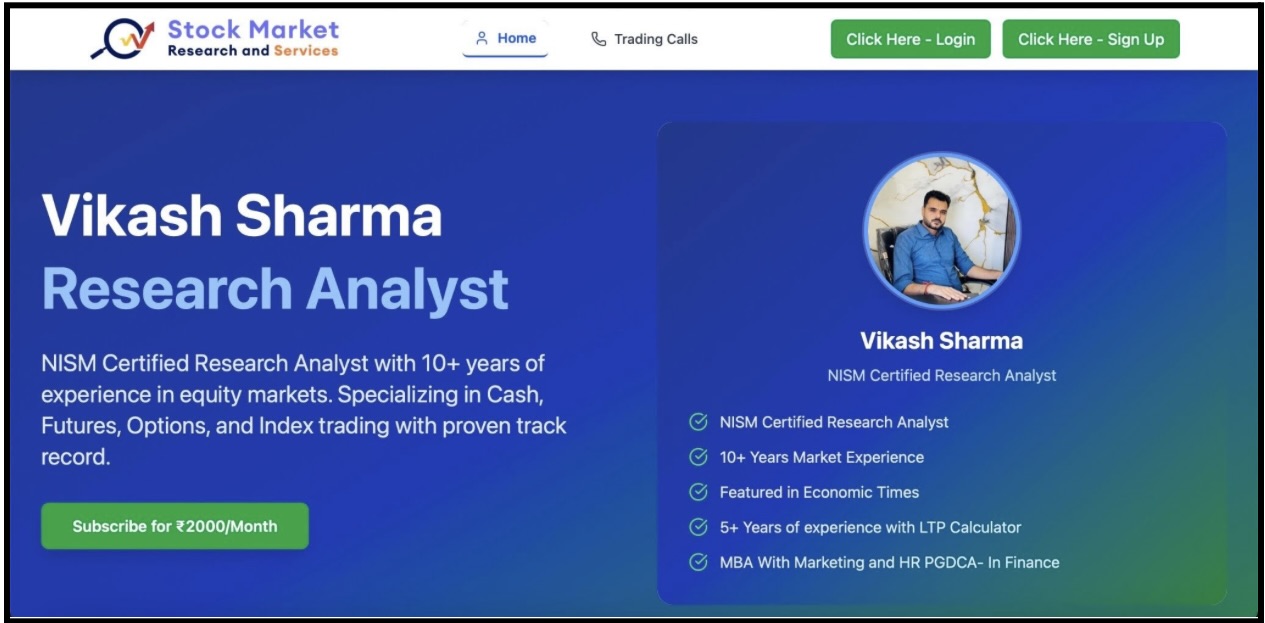
The entity is operated by Vikash Sharma as a sole proprietorship firm based in Guna, Madhya Pradesh.
The firm mainly appears to provide stock market research, intraday trading recommendations, options trading calls, and market-related advisory services for retail traders.
The firm’s grievance section also lists Vikash Sharma as the compliance officer, CEO, and principal officer.
The company appears to provide market recommendations through subscription-based services, alerts, and trading updates focused mainly on active traders.
Also Read: Moneyplant Research, the header form shows a different registration than the footer.
What Services Does Vikash Sharma Research Analyst Provide?
The platform of Vikash Sharma mainly appears to focus on short-term trading and derivatives-based recommendations.
The services seem targeted toward traders looking for ready-made trading opportunities instead of doing independent market research.
The firm appears to provide:
- Intraday trading calls
- Nifty and Bank Nifty recommendations
- options trading calls
- entry and exit signals
- short-term market analysis
- premium subscription plans
Like many advisory firms in India, the platform seems heavily focused on high-activity trading segments where traders are constantly entering and exiting positions during market hours.
This type of trading naturally carries very high risk, especially for beginners or traders operating with limited capital.
Vikash Sharma Research Analyst SEBI Registered or Not?
Yes. Vikash Sharma, Proprietor of Stock Market Research and Services, is SEBI registered as a Research Analyst under registration number: INH000016153.
The registration details are publicly available in SEBI’s intermediary records.

Checking SEBI registration should always be the first step before paying for any advisory or research service.
At the same time, traders should understand something clearly. SEBI registration does not guarantee profits.
A registered entity can still receive complaints related to service quality, delayed communication, trading losses, or unrealistic expectations created during sales discussions.
That is why traders should evaluate the full picture before subscribing to any service.
Vikash Sharma Research Analyst Reviews
There are several online complaints and negative reviews related to Vikash Sharma Research Analyst and Stock Market Research and Services.
Most complaints revolve around delayed trade alerts, repeated stop-loss hits, poor customer support, and a mismatch between promises and actual service quality.
1. Delayed Trade Messages
One user strongly warned others not to subscribe to the service and described it as “very poor.”
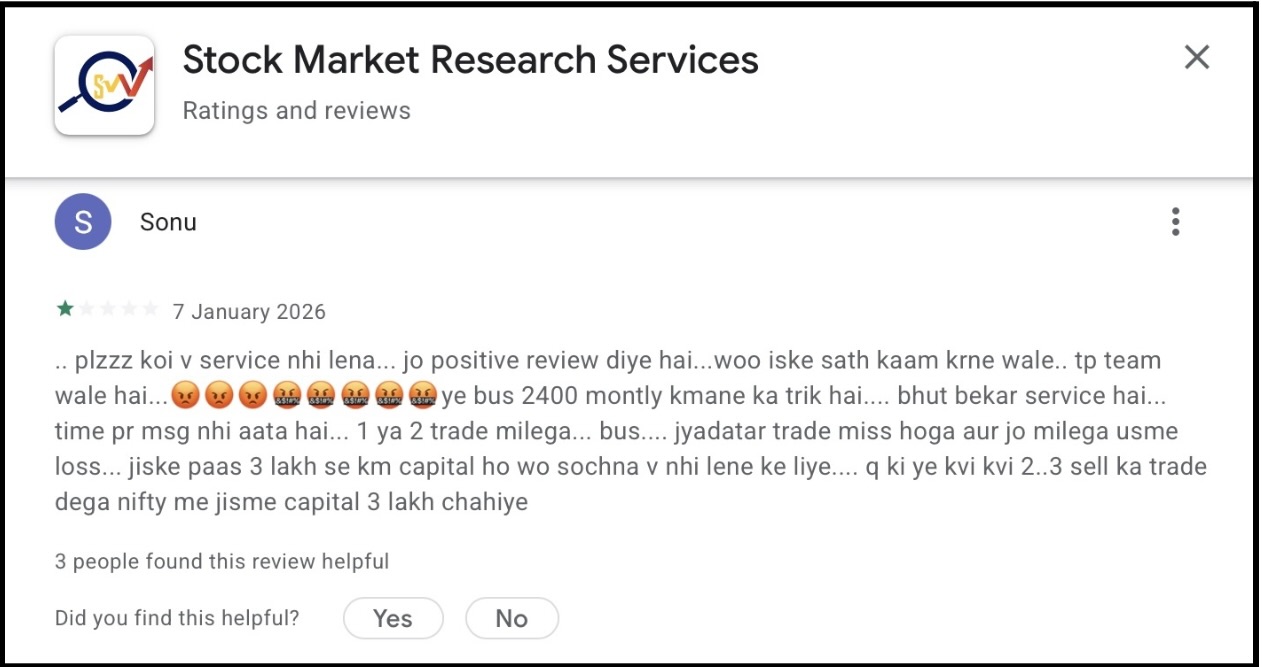
According to the review, trading messages often arrived late, because of which traders missed proper entry points.
The user claimed that only one or two trades were received during the day, and many trades were already running by the time alerts came.
The reviewer also mentioned that several trades ended in losses after delayed execution.
This is a serious issue in intraday and options trading because even small delays can completely change the risk-reward of a trade.
2. Small-Capital Traders Cannot Follow Trades
Another reviewer specifically warned low-capital traders not to join because many trades reportedly involved sell-side strategies that required much larger margins.
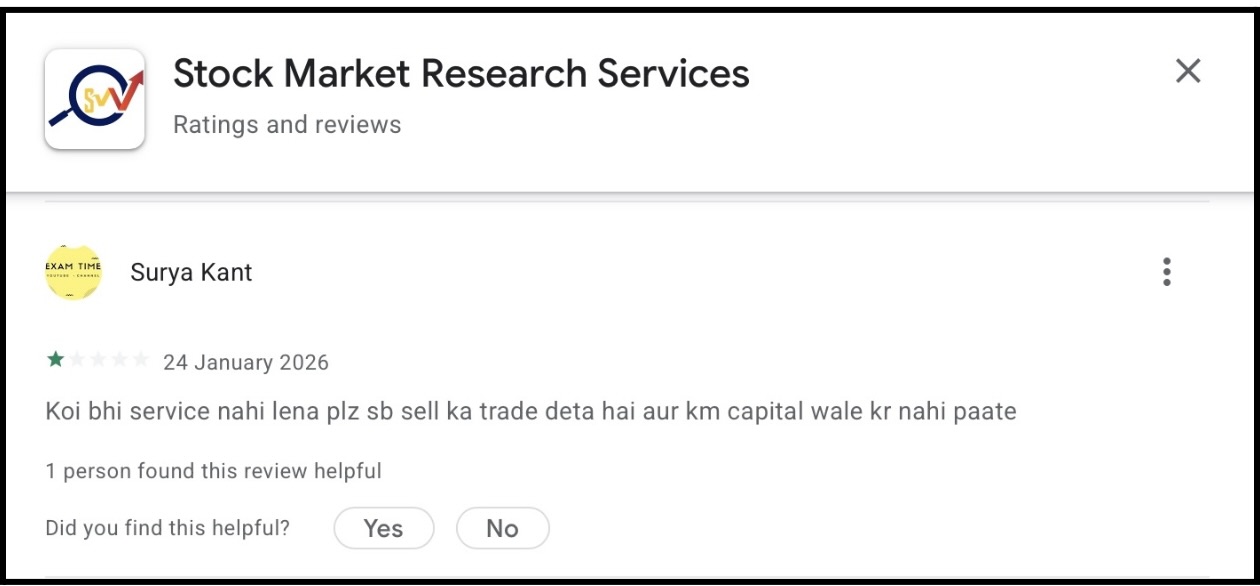
This is an important point.
Many beginners enter advisory services expecting simple trading opportunities. But certain derivative strategies can require significant capital and carry very high risk exposure.
If the trader’s account size itself is too small, even one bad trade can create major losses.
3. Frequent Stop-Loss Hits
One reviewer described the service as extremely poor and claimed stop losses were getting hit very frequently.
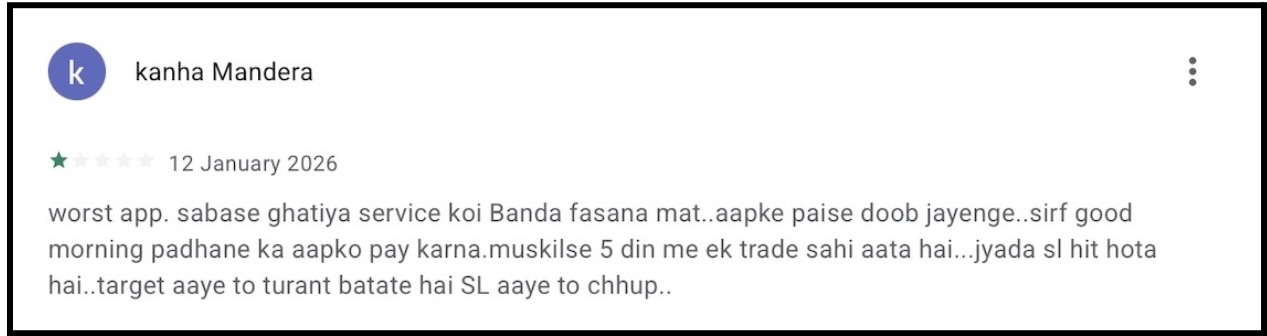
The complaint further alleged that whenever targets were achieved, updates were shared immediately. But when stop-losses got triggered, communication became silent.
This type of selective communication is one of the biggest frustrations retail traders often discuss in advisory-related complaints.
Many traders feel emotionally pressured when only profitable trades are highlighted publicly, while losses receive very little transparency.
4. Complaints About Promised Calls Not Being Delivered
Another user claimed that before payment, the platform promised around 5–6 trading calls daily.
However, according to the complaint, the promised calls were never actually provided after the subscription.
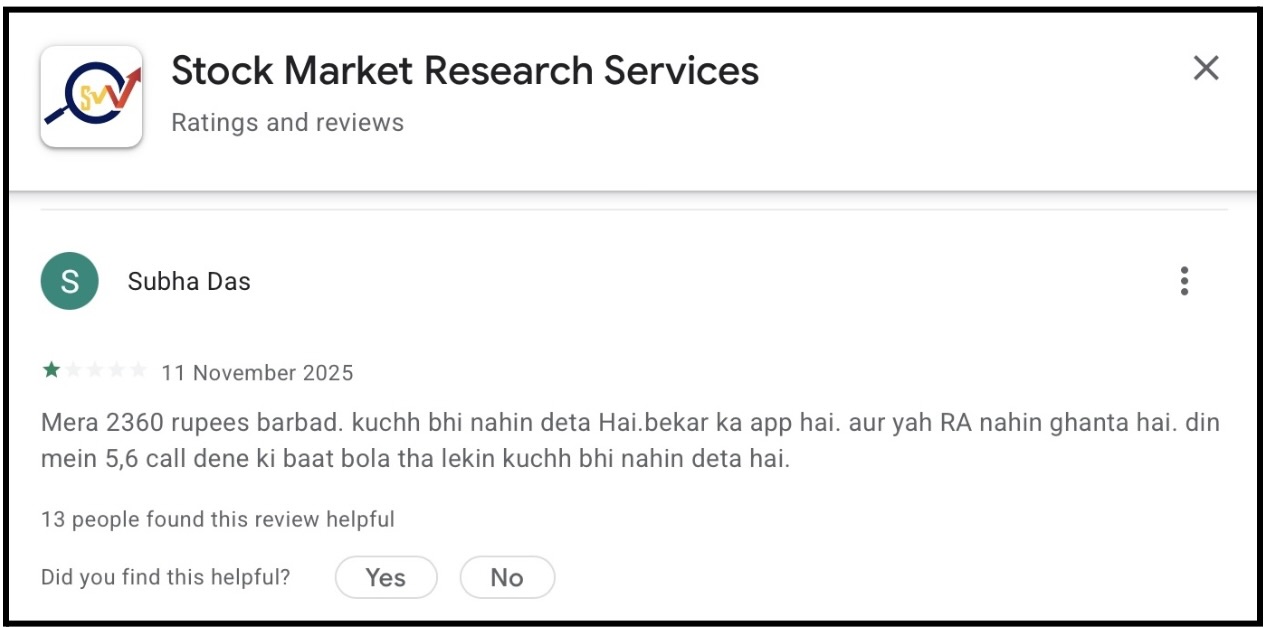
The user also expressed frustration over paying subscription fees despite receiving very limited trading support afterward.
Complaints like these are commonly seen in the advisory industry, where expectations created during onboarding sometimes differ from the experience after payment.
Also Read: Fund Track Research company, no separate entity, just one name behind everything.
What Are the Red Flags of a Research Analyst?
Retail traders should understand that not every advisory platform operates transparently.
Some industry practices may look attractive initially, but become extremely dangerous for inexperienced traders.
-
Demo Trades and Profit Screenshots
One common tactic across the industry is showcasing demo profits or selective winning trades to create an illusion of very high accuracy.
Sometimes traders only see the successful calls while losing trades remain invisible.
This creates unrealistic expectations for beginners entering the market.
-
Loss Recovery Promises
No research analyst can legally guarantee recovery of trading losses.
Under SEBI regulations, promising fixed returns, assured profits, or guaranteed recovery is prohibited.
Still, many retail traders emotionally get influenced when sales teams indirectly suggest that earlier losses can easily be recovered through premium packages or upgraded plans.
-
Profit Assurance
Stock markets do not provide guaranteed outcomes.
Any platform creating expectations of “consistent monthly income,” “fixed daily profit,” or “high accuracy without risk” should immediately raise caution for retail traders.
Even experienced traders face losses regularly.
-
Selective Sharing of Past Performance
Another major concern in the advisory industry is the selective display of past performance.
Sometimes, only profitable trades, targets achieved, or successful screenshots are highlighted publicly.
But trading performance should always be viewed holistically, including risk, drawdowns, and stop-loss frequency.
-
Pushing Clients Toward High-Risk Trading
A very common issue in the advisory space is excessive focus on derivatives trading, like:
- Bank Nifty options
- Nifty options
- option selling
- leveraged intraday trades
These segments are highly volatile and can wipe out small trading accounts very quickly.
Retail traders with low capital and low risk tolerance should never be aggressively pushed into high-risk derivative strategies.
How to File a Complaint Against A Research Analyst?
If you believe you suffered losses because of misleading communication, unethical conduct, or advisory malpractice, there are formal ways to escalate the matter.
Step 1: Organise Evidence
First, collect and organise all evidence properly.
This includes:
- Payment receipts
- Bank transaction records
- WhatsApp chats
- Telegram messages
- Emails
- Call recordings
- Screenshots of recommendations
A structured evidence file becomes extremely important later.
Step 2: File a Complaint with the Firm
Before escalating externally, first send a formal written complaint directly to the research analyst or firm.
Clearly mention:
- The service purchased
- amount paid
- issue faced
- losses suffered
- expected resolution
Always keep proof of complaint submission.
Step 3: File Complaint with SEBI SCORES
If the issue remains unresolved, investors can file a complaint through: SEBI Complaints Redress System (SCORES)
Attach all evidence properly while filing the complaint.
Detailed and documented complaints generally carry much more weight.
Step 4: Raise a Complaint with SMART ODR
Investors can also use: SMART ODR (Securities Market Approach for Resolution Through ODR) for online dispute resolution, mediation, and conciliation.
This process is designed specifically for disputes involving securities market intermediaries.
Step 5: Stock Market Arbitration
In cases involving large financial losses or serious disputes, investors may also explore arbitration proceedings where applicable.
Arbitration can become important when:
- Substantial losses are involved.
- The evidence is strong.
- Disputes remain unresolved after earlier complaint stages.
Before entering arbitration, traders should organise all documentation carefully.
Need Help?
If you’ve subscribed to services from Vikas Sharma Research Analyst and are facing issues or unexpected losses, you don’t have to handle the situation alone.
We understand how frustrating it is when things don’t go as promised, and our team is here to guide you through the complaint process every step of the way.
Our team helps you by organizing your evidence, drafting your formal complaint, and ensuring your case is presented clearly.
So, don’t let your concerns go unaddressed. Register with us today, and let our team guide you through the process, step by step.
Conclusion
If you’ve been through the frustration of paying for services that didn’t deliver, or if you’ve faced losses because of misleading advice, don’t just sit in silence.
You have rights as an investor, and there are formal ways to speak up.
If you’ve encountered similar problems, take the next step: gather your records and file a formal complaint.
It’s the best way to hold services accountable and try to set things right. Don’t let poor service go unchallenged; take action today.
Disclaimer: The reviews mentioned in this document have been collected from publicly available online sources and represent the personal experiences and opinions of individual users. They have not been independently verified, endorsed, or approved by SEBI or any other regulatory authority.
Frequently Asked Questions
1. Does SEBI registration guarantee profits?
No, SEBI registration does not guarantee profits. It only means the entity is compliant with regulatory standards.
A registered entity can still provide poor service or lead to trading losses.
2. What should I do if trading alerts are regularly delayed?
Delayed alerts significantly impact the risk-reward ratio in intraday trading.
You should document these delays with screenshots or timestamps as evidence and consider escalating the issue formally to the firm or SEBI.
3. Why are some advisory services risky for small-capital traders?
Many derivative strategies require large margins and carry high risk. If your capital is limited, high-risk strategies can deplete your account very quickly.
Always evaluate if the suggested strategy aligns with your capital and risk tolerance.
4. How can I address discrepancies in promised versus delivered services?
If you were promised a specific number of daily calls that are not being met, keep a record of the initial sales communication.
This discrepancy should be a key part of any formal complaint regarding misleading service quality.
5. What does it mean when an advisory service only highlights profits but stays silent on losses?
This is a major red flag. Professional advisory services should provide transparent reporting, including stop-loss hits and overall performance, rather than just highlighting successful trades.





 Add us as a preferred source on Google »

