

Nilesh (Name Changed) had done everything right.
He held a hedged position. His margin was above the requirement at the start of the day. He was watching his account.
Then, late at night, without a single warning, Zerodha’s system squared off his positions. The wrong quantity. At the wrong time. With no prior intimation.
His loss: ₹10.39 lakh.
The arbitrator heard the case. Examined the evidence. And awarded Nilesh the full ₹10,39,000.
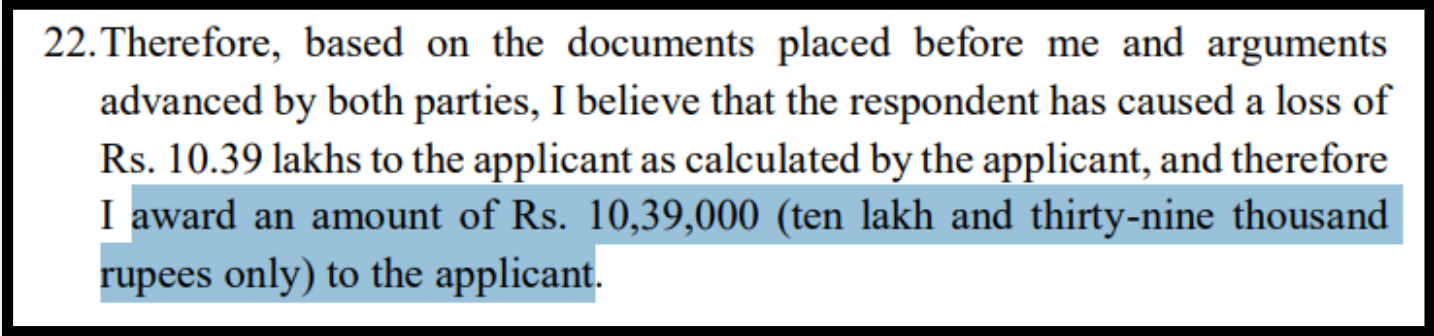
This blog tells that story completely, and explains what it means for you if Zerodha has done something similar to your account.
How a Routine Trading Day Turned Into a ₹10.39 Lakh Dispute?
Nilesh was a commodity futures trader from Bikaner, Rajasthan. He actively traded Silver futures through his Zerodha Commodities account.
On 2nd April 2024, his account held 6 lots of Silver May Futures. His opening balance was ₹37.96 lakh, well above his margin requirement of ₹30.30 lakh.
That morning, he cancelled a potentially problematic order before it created any issue. When a margin alert came in, he acted on it within hours. Everything was under control.
Then, at 7:49 PM, Nilesh exited some positions.
This broke his hedge. His margin requirement climbed to ₹51.57 lakh. His available balance was ₹37.96 lakh. A shortfall of ₹13.60 lakh opened up.
At 10:33 PM, less than three hours later, Zerodha’s Risk Management System (RMS) squared off 180 quantities of his Silver May position.
The broker failed to send any SMS or email notification.
Nilesh found out after the damage was done. But it did not stop there.
Within one minute, Zerodha’s own team identified an error. They had squared off 60 extra quantities unnecessarily. Those 60 quantities were reinstated at 10:34 PM.
Think about that. Zerodha’s own system admitted it had squared off 60 lots too many. It corrected the error quietly, one minute later, after the financial damage had already landed on Nilesh.
Nilesh immediately raised a support ticket.
The response never came.
From Support Ticket to Arbitration: Why Nilesh Refused to Let It Go?
Like most investors, Nilesh initially expected the issue to be resolved through customer support.
After all, if the broker had made a mistake, surely it would be corrected.
Days passed. Then weeks. The support ticket remained unresolved. The financial loss remained.
And the explanations never arrived.
At that point, Nilesh made a decision many investors never make. He escalated.
The matter eventually reached formal arbitration under MCX through the JustAct Online Dispute Resolution platform.
Now the dispute was no longer about customer support.
It was about evidence.
And evidence would ultimately decide the outcome.
What the Arbitrator Discovered During the Hearing?
The arbitrator carefully reviewed the entire sequence of events.
Several issues immediately stood out.
Failure 1: No Prior Intimation Before the Square-Off
In the morning, when a similar margin issue had appeared, Zerodha gave Nilesh nearly 7 hours before taking any action. That patience was the standard the broker had set for itself.
That evening, Zerodha squared off his positions in under 2.5 hours, with no fresh warning, no SMS, and no email before acting.
The arbitrator specifically noted this inconsistency. The same broker. The same account. Two very different approaches to the same problem.
Failure 2: Excessive Square-Off
Zerodha’s own reinstatement of 60 lots at 10:34 PM confirmed that only 120 quantities were needed to cover the shortfall. The system had liquidated 60 extra lots with no basis.
The arbitrator called this “callous.” That word matters. It describes a system that acted without precision, without care, and without accountability, on a client’s live trading account, late at night.
Failure 3: Upfront Margin Norms Not Followed
SEBI’s circular dated 19 November 2019 requires brokers to collect upfront margin before orders are placed. Zerodha’s own RMS system only sent alerts at every 5% increment once the shortfall crossed 100%.
The first alert came at 123%. The next was scheduled for 130%. Zerodha squared off the position at 127%, before triggering the next alert. The system acted before it had even completed its own warning sequence.
The arbitrator found no satisfactory explanation for this from Zerodha’s side.
Failure 4: No Reasonable Time Given to Add Funds
Nilesh discovered the margin shortfall late at night. The arbitrator asked a pointed question: could Zerodha not have waited until the next trading session to give him a chance to add funds?
Zerodha’s account opening documents stated that positions could be squared off without notice due to margin shortage.
The arbitrator rejected that as a complete defence. A contractual clause does not override the obligation to treat clients fairly and communicate properly.
Failure 5: Unresolved Support Ticket
Nilesh’s formal support ticket about the square-off was still open at the time of the hearing. An unresolved ticket on a matter of this financial significance was not a minor administrative lapse.
The arbitrator treated it as additional evidence of Zerodha’s failure to respond properly to its own client. The final award was clear and complete.
₹10,39,000, awarded in full to Nilesh.
Could Your Zerodha Square-Off Complaint Be Similar?
Nilesh case was specific to commodity futures and a late-night RMS action. However, the underlying pattern appears in many Zerodha accounts.
Read through these carefully. If even a few of these reflect your experience, you have grounds to file a formal complaint.
1. Your Positions Were Squared Off Without Any Prior Warning
SEBI requires brokers to communicate margin shortfalls to clients before taking action. If Zerodha squared off your positions without sending you an SMS, email, or app notification first, that is a procedural failure you can formally challenge.
2. The Square-Off Happened in the Middle of the Night or Outside Market Hours
Squaring off positions late at night gives a trader no realistic opportunity to respond. If your positions were liquidated at a time when you could not reasonably have been expected to add funds or reduce positions yourself, that timing is relevant to your complaint.
3. More Lots Were Squared Off Than Was Necessary to Cover the Shortfall
Zerodha’s own system admitted this in Nilesh’s case. If your account was squared off for more than the minimum required to resolve the margin deficit, the extra liquidation was not justified.
Check your contract notes against your margin shortfall at the time.
4. Your Margin Alert System Did Not Follow the Correct Sequence
If Zerodha acted before completing its own alert cycle, squaring off positions before sending you the next scheduled warning, that violates the standard RMS policy of stock broker communication protocols they are supposed to follow.
5. Your Support Ticket Went Unresolved After a Square-Off
A support ticket raised about an unauthorised or excessive square-off must receive a formal resolution. If yours was closed without resolution, or simply never answered, that becomes part of your formal complaint.
6. The Square-Off Caused You to Miss a Recovery in the Market
If your positions were liquidated at a loss and the price recovered shortly after, the timing of Zerodha’s action is directly relevant to the financial harm you suffered.
Can You Recover Money Lost in a Zerodha Square-Off?
Yes. Nilesh’s case proves that recovery is possible even against a large, established broker.
However, recovery does not happen automatically. It depends on two things: your evidence and your escalation path.
Your position is strongest when you have:
- A timestamped record of when the margin shortfall occurred and when you were notified
- Contract notes showing the exact quantities squared off and at what price
- A comparison between the quantities squared off and the minimum needed to cover the shortfall
- Any screenshots or app records showing your available balance at the time of the square-off
- Records of the support ticket you raised and how it was handled
- A record of the alert sequence, when Zerodha sent warnings and when the square-off actually happened
You do not need all of these. Even a few well-preserved documents can build a case. The contract notes alone often tell the most important part of the story.
The time limit for exchange arbitration is generally three years from the date of the disputed transaction. Do not wait.
How to Formally Complain Against Zerodha?
Most traders who try to resolve this informally never get past the first deflection.
The right approach is documented, structured, and escalated through the correct channels in the correct sequence.
Follow these steps to file stock broker complaint:
Step 1: Preserve All Evidence Right Now
Download your complete trade history, margin statements, contract notes, and account ledger. Screenshot your current account view. Save every app notification, SMS, and email from Zerodha around the date of the incident.
If you have a support ticket number, save that with its full history. Evidence gathered today is significantly more powerful than evidence gathered after a complaint is filed.
Step 2: Raise a Formal Support Ticket with Zerodha
Create a support ticket with a clear, factual description of the issue. State the date, the positions involved, the quantities squared off, and why you believe the action was disproportionate or without proper notice.
Keep the ticket number. Screenshot the acknowledgement. If Zerodha does not resolve it satisfactorily within 30 days, that non-resolution becomes your next piece of evidence.
Step 3: File Complaint with SCORES
If you are unsure how to lodge complaint in SCORES, the process is straightforward: escalate to SEBI’s official portal and select “Stock Broker” or “Commodity Broker” depending on the exchange involved.
Upload your full documentation, your complaint, Zerodha’s response, and all supporting records.
Once Zerodha complaint to SEBI filed, the complaint carries official regulatory weight.
Zerodha must respond formally. Unresolved SCORES complaints attract direct SEBI scrutiny.
Step 4: File a Complaint in SMART ODR
If SCORES does not produce resolution, take your case to SEBI’s SMART ODR platform. A neutral expert reviews your case through a structured, digital process.
This is the same pathway used in the Nilesh case, through JustAct, an ODR platform empanelled by MCX. Most disputes receive attention within 30 days.
Step 5: Stock Market Arbitration
This is exactly where Saurabh’s journey ultimately led.
When informal discussions failed and the complaint process did not produce a satisfactory outcome, the dispute was placed before an independent arbitrator.
The arbitrator reviewed the records, examined the broker’s actions, and issued a legally binding award.
Need Help?
Zerodha Acted Without Warning But You Should Not Have to Navigate What Comes Next Alone.
Nilesh did not expect to spend months in a formal dispute with his broker. He expected a support ticket resolution. He got silence instead.
What changed his outcome was moving from informal follow-ups to a structured, evidence-backed complaint filed through the right regulatory channels.
That shift, from frustrated client to formal complainant, is the difference between getting nothing and getting everything back.
If Zerodha’s RMS system squared off your positions without proper notice, took more than necessary, or left your complaint unresolved, you are in exactly the same starting position Nilesh was in.
If you believe your shares were sold without adequate notice, your account was handled improperly, or you suffered losses due to actions you did not fully understand or authorise, acting quickly is critical for a quick Zerodha loss recovery.
Register with us now. We can help you with:
- Free Case Assessment: We go through your margin timeline, contract notes, and alert records. We tell you honestly whether your square-off was procedurally wrong and what recovery is realistic. No upfront cost. No commitment.
- Evidence Organisation That Stands Up: We map every procedural failure against SEBI’s margin guidelines and the broker’s own documented protocols. A complaint built on this does not get dismissed on technicalities.
- Full Representation Through Every Stage: From Zerodha’s support team to SEBI SCORES, SMART ODR, and exchange arbitration, we handle every step. You do not need to figure out the next move alone.
Nilesh’s case was won on the evidence and the argument. The same is possible for yours.
If Zerodha’s actions cost you money and their support team gave you nothing useful in return, reach out to us today. We will assess your case at no cost and tell you exactly where you stand.
What Every Zerodha Trader Should Learn From This ₹10.39 Lakh Award?
Nilesh held a hedged position. He had adequate margin. He was watching his account.
None of that protected him from a late-night RMS action that squared off the wrong number of lots, without a single prior warning.
However, the matter did not end there. Instead, the investor documented the entire timeline, raised a formal complaint, and ultimately pursued arbitration.
And the arbitrator found exactly what the evidence showed, Zerodha’s system had been callous, imprecise, and procedurally wrong.
The full ₹10,39,000 recovered.
If your positions were squared off without proper notice, if more was liquidated than the shortfall required, or if your support ticket was never answered, the same process that worked for Nilesh is available to you right now.
Do not let the clause in your account opening form be the final word. It was not the final word for Nilesh.
Document what happened. File through the right channels. Take it all the way if you have to.
Your money does not disappear just because a broker’s system made an error. You have the right to fight for it. Start today.
Frequently Asked Questions
1. Zerodha squared off my positions without sending me a warning. Is that a valid complaint?
Yes. SEBI guidelines require brokers to communicate margin shortfalls to clients before taking action.
If Zerodha acted without sending you a proper notification, SMS, email, or app alert, before the square-off, that is a procedural failure you can formally challenge through SEBI SCORES and arbitration.
2. Zerodha squared off more lots than my margin shortfall required. Can I claim the difference?
Yes. Zerodha’s own reinstatement of 60 extra lots in Nilesh’s case confirmed that only the minimum necessary quantity should be squared off to cover a shortfall. If your contract notes show that more was liquidated than needed, the excess liquidation was not justified and forms the basis of a valid claim.
3. My square-off happened late at night. Does the timing matter?
It matters significantly. The arbitrator in Nilesh’s case specifically questioned whether Zerodha could not have waited until the next trading session.
A square-off at a time when you cannot reasonably respond is relevant to both the fairness of the action and the financial harm it caused.
4. I raised a support ticket with Zerodha but it was never resolved. What should I do?
Escalate to SEBI SCORES immediately. Document the ticket number, the date you raised it, and the absence of resolution.
An unresolved ticket on a matter involving financial loss is itself additional evidence in your formal complaint. Zerodha is required to respond to regulatory complaints formally.



 Add us as a preferred source on Google »